
How can I tell when I need new tires on my road bike?

QUESTION: How can I tell when I need new tires on my road bike? High end tires like the Continentals or Michelins that I prefer have gotten expensive, so I don’t want to waste money by changing them out too soon. I don’t want to end up in a dangerous situation either though. When should I change them? —Jon H.
RBR’S STAN PURDUM REPLIES: If you are looking for a rule of thumb, some cyclists routinely install new tires every 2,000 to 3,000 miles, changing the rear tire nearer the 2,000-mile mark, since rear tires are the “drive” tires and bear more of the rider’s weight than the front tires, and thus wear out more quickly than the front ones.
Some riders, looking to get more mileage out of their tires, will, at the 2,000-mile point, move the existing front tire to the rear wheel and put the new tire on the front wheel. That way, they have a new tire on the steering end of the bike and may squeeze another 1,000 miles or so out the tire they moved to the rear.
That plan is fine if you want to put all that effort into remounting tires, but it also means that the more worn tire is on the rear wheel, which, if it flats, is more of hassle to fix while on the side of the road, with the rest of the ride group disappearing into the distance.
Personally, I’ve never adopted either the mileage rule of thumb or the move-the-front-tire-to-the-rear practice, but I have learned to inspect my tires often and install new ones when my inspection finds problems.
Actually, I learned to do that the hard way. In my first years as a cyclist, when I didn’t have much money, I purchased new but cheap tires, and found them to wear out quickly. So I started buying better grade tires, but, foolishly, assuming they would last longer, I didn’t bother with inspections. Then came the day when a friend invited me to a group ride that started 40 miles from my home. So I took the day off of work, loaded up my bike and drove the 40 miles to the starting point. The group set out, and after about three miles, my rear tire flatted. My friend and a couple of the other riders stopped with me.
When I removed the rear wheel, I found that my tire was worn down to and through the threads in one spot, which was where the inner tube now had a hole. And though I had a spare tube with me, I realized the wheel was likely to flat again if I continued the ride. So, it was over for me. At the advice of one of the other riders, I put a folded dollar bill in the tire where the hole was, and installed and inflated my new tube. Then, bidding my fellow riders goodbye, I gingerly pedaled back to my car and drove home, bummed out that I missed the ride.
I had kept records of when I put that tire on new, so I checked them when I got home. The tire had more than 8,000 miles on it, but by keeping it that long, it short-circuited what would have been a fun day.
So now I purchase good tires and inspect often.
The late, great cycling guru Sheldon Brown says there are only two reasons for replacing your tires:
- When the tread is worn so thin that you start getting a lot of flats from small pieces of glass and the like, or the fabric shows through the rubber. [By “tread,” Brown does not mean the “tread pattern,” but rather the area of the tire surface that rolls on the road. He also maintains that tread patterns are not needed on road bike tires.]
- When the tire’s fabric has been damaged, so that the tire has a lumpy, irregular appearance somewhere, or the tube bulges through the tire.
The problem, though, is that, until the fabric is showing through, how do you know when the rubber in the tread area has gotten too thin? Thin unbroken rubber looks about the same as thick unbroken rubber. Fortunately, several of the better tires come with “tread wear indicators,” such as grooves, dimples or different color rubber. The sidewall adjacent to grooves or dimples may even be marked “TWI” with an arrow pointing toward the indicator (PHOTOS). When the indicator is flush with the tread, or when a different color rubber is showing, it’s time to replace the tire.
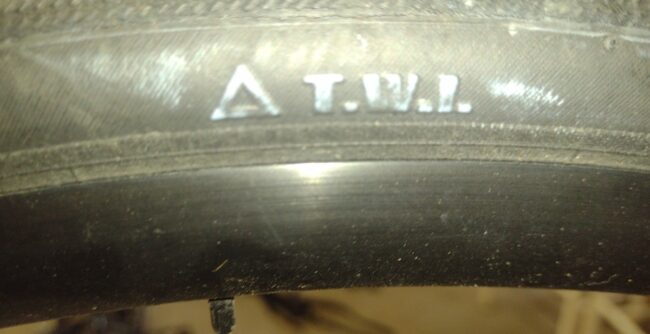
If your tire has no indicators, look for the whole tread area becoming flat (it’s rounded when the tire is new, and the tire still has remaining life if the flat area is narrower than the tread area).
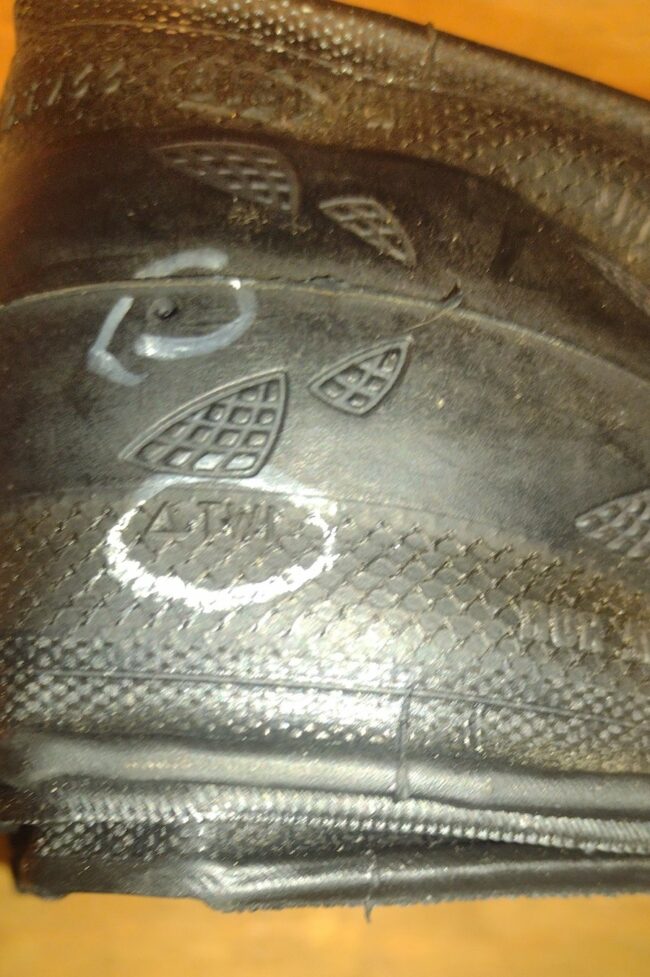
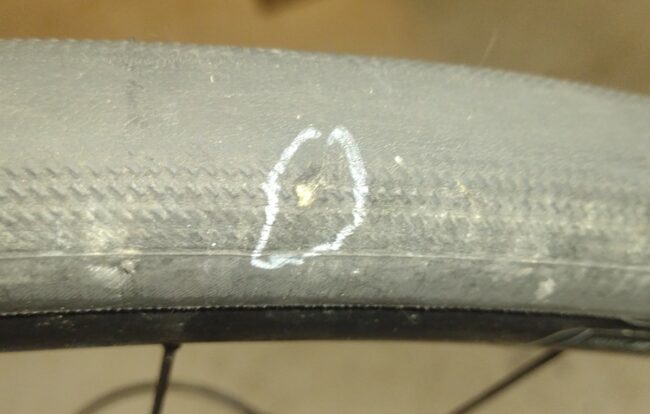
The other things I look for are cuts in the tread or sidewall, chunks of rubber missing, large cracks or other irregularities — the lumps and bulges Brown refers to. During my most recent inspection, I found a small chunk about half the size of a pencil eraser missing from the rear tire. The hole gets smaller as it goes deeper into the tire, and at the bottom of the hole, I can see a tiny area of the casing. (PHOTO) For the time being, I’ve decided to leave the tire, which has 2300 miles on it, on the bike. It’s a calculated risk: The rubber around the hole is substantial, and a foreign sharp object would have to penetrate at that exact spot, which is more on the sidewall than the tread area, to cause a puncture. But I’m aware that I’ve chosen the risk and will keep an eye on that spot.
One other way to know it’s time to replace a tire is if you are getting frequent flats. It’s possible that’s because you have a sharp object — a piece of metal, glass or stone — embedded in the tire. If you can locate and remove the foreign object, and the tire looks good otherwise, you can probably keep using it. But otherwise, frequent flats are a signal that the tire is done for.
Stan Purdum has ridden several long-distance bike trips, including an across-America ride recounted in his book Roll Around Heaven All Day, and a trek on U.S. 62, from Niagara Falls, New York, to El Paso, Texas, the subject of his book Playing in Traffic. Stan, a freelance writer and editor, lives in Ohio. See more at www.StanPurdum.com.

Rear tires wear out faster because that is where the power of the rider is transferred to the road, and the scrubbing action removes rubber. I’ve done extensive record keeping and measurements, and front tires do not wear hardly at all. I put over 6,000 miles on a front tire and it had lost essentially zero weight. That means no wear. If you live in an area where you are doing a LOT of downhill braking, that might give you some wear on the front, but for most of us, it is only the rear tire that wears out due to rubber loss. All tires can get cut from debris and crazed and cracked from environmental exposure, but front tires are not wearing out by losing rubber. I replace my rear tire when the wear indicators are gone, which also corresponds to the casing just starting to be visible through the rubber of the tread. Then I move the front to the rear and put a new tire on the front.
Thanks. This is good information. It’s hard to argue with good record keeping.
What about simply the age of the tire (when it still looks ok)? How old is too old? Had a friend bring me a bike to work on whose tires are 9 years old, but they still look pretty decent! Thanks!
Generally, if the rubber is not deteriorated (cracked, crazed, cut up) then the tire is good to go. Traction might be reduced somewhat because the rubber has hardened but unless you’re leaning hard in criterium races, this is rarely an issue. An “aged” tire will generally get more mileage because the rubber is slightly harder.
I don’t know a specific number of years, but when working in a charity bike shop, where we refurbished old bikes, I noticed that the donated bikes that had rotting tires usually had been stored in a garage or basement and had not been ridden in years. Bikes that came in that had been regularly ridden usually had tires that weren’t rotted, but needed to be replaced because of worn spots, chunks missing or other use damage. Of course that could be because those using their bikes changed their tires more often. Significant sidewall cracks are usually indicators that the tire is getting too old.
2000 miles? Must be a misprint. Even my tandem,, which eats up tires, is good for 3000 miles. My road bike tires typically get 5000 miles. And when I use Continental or Specialized tires that have the tread wear indicators it’s possible to push 6000..
Tire mileage depends on a number of factors, including rider power output, tread thickness, rubber compounds, tire pressures, and road conditions. Unless you are running the same tires as somebody else, then you really can’t compare like you’re doing.
Rider weight contributes to how fast a tire will wear, and if you’re on a camping/touring bike, then you have a lot of gear weight along with rider weight on top of that.
The road surface has a lot to do with wear on tires, if you live where there are a lot of chip and seal roads, or some place like Hawaii, the crushed lava they use to make their roads, wear out tires fast.
Then there are also mountain roads, all that twisting and turning puts a lot of wear on tires.
Pedaling style also matters. Years ago, when I started riding with Kerry Irons and friends, I had excessive wear on my rear tire that only had about 1500 miles on it. Kerry asked about the mileage on the tire and gave it a brief examination. After watching me ride some more, he informed me that I was a “pedal stomper” and I would continue to wear through tires quickly if I didn’t change my form. I’ve improved over the years, but to this day I only get about 3,000-4,000 miles on good Continental tires.
I don’t replace my tires at 2000 miles. I almost always get more than that out of them, and some times a good bit more. What I was saying is that some people do replace them that often, I just check my tires regularly and replace as needed, regardless of mileage.
Stan, that small hole in the tire can easily be repaired with Shoe Goo. I make sure the hole is dry & free of debris, then just press a tiny ball of the stuff in. It serms to subsequently wear evenly with the tire.
Thanks Ken2.. That’s a useful tip.
Stan
I was just looking to reply with the Shoegoo hack and spotted one of us already noted it. One failed hack I’d tried was super glue in fine fresh cuts. Seems that the hard set cyanoacrylate can be it’s own “blade” that in some cases will work through and cause tube fraying, so that’s a hit and miss fix.
Tire wear is HIGHLY variable, even for the exact same brand/model of tire. My wife rides easy and gets 5-6,000 miles (rear wheel) from the same Vittoria training tire I wear out by 3,000-3500 (mostly ‘spirited’ club rides). And there’s a younger rider in my club that is lucky to see 1,000-1,500 mi on most any rear tire- because he’s regularly locking his rear wheel skidding to a stop (thinks he’s the ‘cool guy’?).
Other random tire thoughts-
1) NEVER trust a tire with a sidewall defect/damage or signs of dry rot. These can fail at any time…..which Murphy’s Law clearly states will happen many miles from home or on a fast downhill curve.
2) ALWAYS put your best tire on the front. A sudden front flat at speed is much more likely to cause a crash.
3) Tire price does NOT directly correlate with durability or wear. Expensive light race tires are often MUCH faster-wearing and more puncture-prone than cheaper training (or commuting) tires.
4) Consider stopping to check your tires after riding over a road hazard. That bit of glass or metal you find and flick out may prevent the tire flatting down the road (as the hazard keeps penetrating deeper).
5) Practice changing a tire at home periodically using the gear you carry on rides. It is never easier to fix a flat out on the road.
Every tire is different, every rider is different, every environment is different. Usually on medium-grade road tires that are 25c size I’ll get 3,000 to 4,000 miles on the rear tire. But to say that front tires never wear out is simply incorrect, the front will last about twice as long as the rear, and maybe 1 1/2 times longer. There is a lot of load being put on front tires, and they provide most of the grip when riding, which is why it is important to put the newest tires on the front.
With that in mind, I usually move my front tire to the rear when the rear wears out, and put a new tire on the front. There is a way to almost equal the wear of both tires. That is you put a 28 tire on the rear and a 25 on the front, by the time the rear wears out you’ll only have maybe 20% tread life left on the front, thus if you feel more comfortable replacing both tires at the same time, this method means you won’t be wasting 50% to 66% of a perfectly fine tire.
A lot of the better tires have wear indicators, little round indentations, when those indentations disappear then it’s getting close to time to replace the tires. Some tires have a tread design, once that tread design is gone it’s time to consider getting new tires. Another thing that happens is when the tire is new it has a rounded shape to it, when it wears it begins to square off, flats will increase, and then shortly after that the threads will start to show.
Another incorrect assumption is that expensive tires last longer, well they do to a point, once you get into the top end of tires those are racing tires, and most of those will wear out around 800 miles! Pros will usually average about 6 to 8 races on a set of tires.
I’m a BIG fan of ShoeGoo for my running shows and always keep a tube on hand. Unfortunately it has never worked well for me on bike tires. Even cleaning the area well (inc. wiping with rubbing alcohol) it wears away falls out of the tire within 20-50 miles so I stopped using it on my tires. And ShoeGoo has NO structural integrity. Being very flexible it will not reinforce the casing to hold a bulging tube in place. I will immediately trash a tire with a cut (or wear) down to the casing, but long ago stopped sweating over small surface cuts in the tread (very, very common in my area).
A slice in the sidewall, particularly with a slight bulge, is definitely a major warning sign – swap it out immediately….I use Continental Gatorskins, and sometimes these slices just mysteriously appear….
The comments are full of great insight and thanks to all.
Anyone have any re-use ideas for used tires that would otherwise end up in landfills?
Marc-
My local recycling center will not take bike tires 🙁
I reuse smooth old tires in landscaping to secure branches of bushes and saplings without digging into the bark like cable can.
And old tubes are a source of scrap rubber strips to use for a variety of uses- like light mounts, flexible shims, even wrapping a soft grip on tool handles (similar to a road handlebar wrap- you can start with a glued double-turn and finish using a wrap of electrical tape- I wrapped my plain steel lawn mower handle like that).
Nobody mentioned this. I put my old tires on my indoor bike -on a rear wheel trainer- and use them till they are literally shedding rubber and showing tons a casing. Does lead to some startling blowouts but no crashes or danger. I definitely get my money’s worth out of tires.