Do You “Need” Disc Brakes Now?

Jim’s Tech Talk
By Jim Langley
This being RoadBikeRider, I hope it’s understood that it’s disc brakes on ROAD bikes that’s on my mind today.
Because if it was mountain bikes, with the death defying feats even average MTBers routinely attempt today, I think it’s pretty undeniable that disc brakes are needed.
I learned that lesson at the Mt. Bike Cross Country Masters Nationals on Big Bear Mountain in the late 1990s. It snowed that day and halfway through the race with all of us on direct-pull and V- rim brakes, we all wore out our rim brake pads and spent the rest of the race crashing because of it.
Luckily snow makes for softer landings. Also lucky for me, so many racers dropped out that I got a third, my highest nationally ranked event finish ever. All because of a little snow and a lot of practice riding off road on snowy cross country ski trails in Vermont in 1980.
But, as soon as disc brakes became standard equipment – just like every other mountain biker I knew, I bought an MTB with disc brakes. I’ve had discs on every MTB since too. And I have them on my Trek gravel bike.
Not on my road bike yet
But I do not have discs on any of my road bikes yet. I bought two “new” vintage steel road bikes in the last two years but those too have rim brakes of course.
Which brings me to what happened on my last group road ride. I was aboard my circa 2010 full Shimano Dura-Ace Cervelo S5 aero road bike with rim brakes. Nine others were on the ride, most with disc brake road bikes, one guy with a brand new Specialized Athos (discs). George, Nils and I were the only riders with rim brakes. Nils rides a Giant, George has a Look.
I’ve ridden thousands of miles on the road with this crew, sometimes it’s a bigger group. For a while I planned and led the ride. Now I can’t make it as often so others do that.
A Comment Gets Me Thinking
Riding in Santa Cruz where we live is mostly climbing and descending. As we were cresting one of these hills and starting to drop down the other side, one of the gals on the ride rolled up alongside and remarked, “Jim, you’re still riding rim brakes.”
A lot went through my head when I heard what she said. But, what I said was “I’ve been looking at a new road bike with disc brakes.” That’s true, I have been looking. And she mentioned a few of the bikes she had looked at in choosing her bike.
That was the end of the conversation on the ride. But since, I’ve been thinking of what was said and it has raised a lot of questions for me. I’ll list a few of the main ones below.
Have a look and please comment with your opinion whether you still ride rim brakes or discs:
- If you ride a rim brake bike do you think that riders with disc brakes see you as a dangerous rider or will see you that way as discs take over?
- And disc are already taking over since the bike industry seems determined to force them on us rather than allow us to choose what we think is best.
- Will group road rides (races, events) soon require or recommend disc brakes?
- Have crashes in pro road racing been reduced with disc brake use or have they increased? (There’ve sure been some awful crashes this season.)
- If the number of crashes is about the same, has the severity of crashes lessened in pro road racing since disc brakes? (Again, this year’s crashes haven’t seemed any less severe, but maybe some official body is keeping track?)
- Just because someone has disc brakes doesn’t mean they’re a skilled and safe road rider. For example, hitting the brakes in a group is one of the main causes of crashes. More powerful brakes is not going to help that rider.
- Road bikes have always been exercises in minimalism and simplicity. One of the difficulties in pulling the trigger on a disc brake road bike for this roadie is that they break both these tenets with over complication and added weight. There are light disc brake road bikes but take away everything required for the disc brakes, add rim brakes instead and the bike gets a lot lighter. And rim brakes are simple to fix.
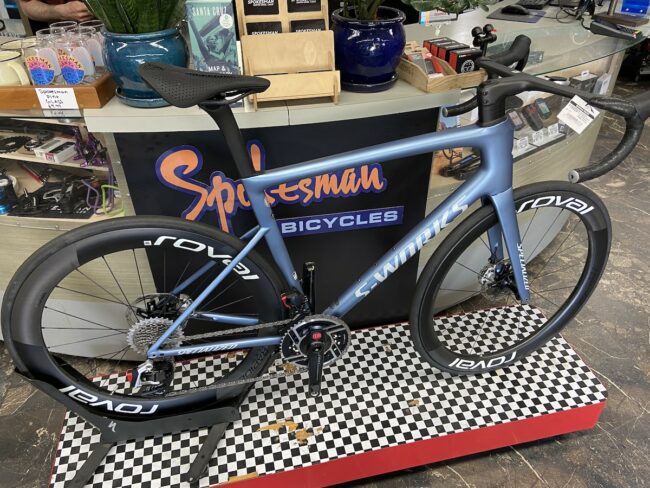
One last point: it took a ton of changes to road bikes to make them disc brake compatible and none if it came cheaply. You can argue that the crazy prices we’re seeing today for premium road rigs such as the $14,000 Specialized in the photo is in large part because it has disc brakes on it. Rim brakes could be had for far far less.
I look forward to reading your thoughts on my points and any others you think of.
Jim Langley is RBR’s Technical Editor. A pro mechanic & cycling writer for more than 40 years, he’s the author of Your Home Bicycle Workshop in the RBR eBookstore. Tune in to Jim’s popular YouTube channel for wheel building & bike repair how-to’s. Jim’s also known for his cycling streak that ended in February 2022 with a total of 10,269 consecutive daily rides (28 years, 1 month and 11 days of never missing a ride). Click to read Jim’s full bio.

I’m reminded of the title of Richard Feynman’s book, “Why do you care what other people think?”
Personally, I’d worry a lot more about whether disc brakes provide and advantage, or rim brakes put me at a disadvantage, for the riding I do. So far the answer is overwhelmingly, “No.”
I have two road bikes that I mainly ride. They both have rim brakes on carbon rims. It is board-flat where I live and see no advantage to disks in my area. I have dialed the fit on the two bikes that I have and one is custom fit titanium. I have no desire to add weight and complexity and restart with new expensive frames to add disks with no advantage and then all of the wheelsets that i own are then deemed useless. I do have disks on my mountain bike and wouldn’t have it any other way, but on my road bike, it would just add problems and an unnecessary expense.
I have disc brakes on my gravel bike and on my mtn bike, but rim brakes on my road bike. I find disc brakes necessary while gravel/mtn biking, but they are a pain. Maintaining the rotors and pads is a lot more work than for rim brakes. They wear out fast and they love to start rubbing any moment. And if they aren’t rubbing they are making horrible squealing noises. And of course you need to make sure you bleed them at regular intervals. My conclusion is that rim brakes are superior to disc brakes in every way except braking. If you absolutely must have that stopping power, get discs. My rim brakes on my road bike (Ultegra) work really well and on the road are way more than adequate.
Amma gonna stick with rim brakes. It’s a lot easier to lock up disc brakes than rim brakes. Lock up and you loose control and skid and crash.
Moreover, in a pileup, I do not want to crash into any discs on other peoples bicycles. They are like blades.
Accolades to the thought of the bicycle staying simple. Disc brakes would probably turn the bicycle into a dealer service only machine. I want to keep doing things myself.
When I look at my wheels turning through my rim brake pads, I can see if my wheel is staying true. Disk brakes don’t do that.
Descending,I am faster than everyone in my group (more aerodynamic). My rim brakes don’t seem to matter.
I ride hilly terrain in North Georgia
I completely agree with Pat. I do just fine in all conditions with rim brakes on my road bike.
It would be difficult for me to go back to rim brakes on my road bike. I live in a hilly area and I feel more confident descending with discs. The braking is more predictable with no loss of braking when wet. With hydro discs my hands do not get tired on long descents.
I agree completely. You also can still ride the bike if your wheel goes badly out of true with, for example, a busted spoke. That happened to me one time on a MTB ride and I was able to limp back home. That happened another time on a road ride when I was still riding with rim brakes. I had to call my wife to come rescue me…
I agree, being able to brake effectively when a wheel goes out of true is a great advantage for disc brakes. I still ride with rim brakes and I have had this happen, and it sucks when it does. Otherwise, I have no problem braking on my road bike with my rim brakes. I can brake effectively, even with just one finger on the brake lever. Besides, I can’t get disc brakes without getting a whole new bike and that isn’t going to happen.
I should add that I’d like to get a cheap bike for running errands around town. For me, the ideal errand bike would have rim brakes. In this case I would prefer the lower maintenance of rim brakes and I have not found TAs on any lower priced bike. IMO disc brakes should always have TAs due to the forces that want to pull the wheel out of the drop-outs. Even though this price range it’s difficult to find a non-disc bike.
I only have disc brakes on my Trek Speed Concept Tine Trial bike and only because that is the only option. Had a Giant Defy with disc brakes and tubeless tires. Didn’t like either. I live in Ohio, but spend a lot of time in Tennessee in North Carolina so I get in 400,000 feet of climbing per year. Bleeding the brakes, replacing the brake pads, having to replace one of the Ultegra brake levers after a year, etc., all convinced me that rim brakes are just fine. I have successfully navigated a lot of steep and very long descent without an issue with rim brakes.
I own two rim brake road bikes and had, but sold, a disc brake gravel bike. I lived and biked in Colorado for ten years and now live in SC and occasionally get to the upstate to bike in the Blue Ridge Mountains so I have extensive biking experience in the mountains where supposedly disc is superior. Other than wet conditions in the mountains I see no advantage to disc. In flat or rolling terrain there is zero reason for the added complexity of disc even in wet conditions. The sad part is the bike industry went full on disc right about the time direct mount rim brakes were coming out. Of my two rim brake bikes one is direct mount. My direct mount rim brake bike stops just as quick and with better “feel” than my gravel disc did.
I’ve come to the conclusion that it really just depends on the kind of riding and other equipment you have. For 90% of my group riding on rolling terrain with some punchy hills, my rim brakes with carbon wheels are fine and I never have any braking power issues. However, on that other 10% where there are prolonged technical descents of >8% where you really need good braking power at 30-45mph, my rim brakes are lacking. I find I have to stay much more on top of the braking earlier in order to get enough braking power and as I get older (63) my grip strength is not what is used to be so these conditions are exhausting. Alloy rims would certainly change that equation with rim brakes, but I don’t have any more of those. This alone has flipped my bit on whether I would stay with rim brakes on the next bike. All in all, I think the positives of disc brakes when you really need them (descending and wet) outweigh any negatives (more complicated, not really needed in most cases) of disc brakes. On the 7 things in your article, they really don’t matter to me and have had zero impact on our local group riding and racing.
Agree completely with old and strength points. Would add water to the mix. No question wet rims aren’t as good as wet disks
I have 7 bikes. Only one has disc brakes.
Personally I see no difference when I ride. That said I will be able to make a decision after I go to Colorado where there are real descents.
Unfortunately we no longer have a choice. All bikes are now disc brakes.
The industry has decided for us!
Yes, I feel safer with disc brakes. Especially in wet and or muddy conditions. Only have 2 bikes but both have disc brakes.
I agree and feel safer with disc brakes. I am fairly new to road bike riding and last year during a cycle challenge, it was drizzling rain and I had a car back out of a driveway causing me to break heavily. My brakes stopped me rapidly to avoid a collision and save me from injury. I am certain that my town bike without disc brakes would have caused a collision due to wet and slick rims.
I am a believer!
I am a retiree in my 70s. As disk brakes are not an upgrade but rather a major replacement for one’s current ride, this question says to replace millions of great bikes. NO! I have ridden the “Hilly Hundred” in southern Indiana (some long downhills with many 15% or so) in the rain. With my decades of experience, I’ve never questioned the ability of my rim brakes. Again, with my age (and that I have “ended” the past two seasons in medical rehab), spending thousands on a new bike to replace my beloved machines makes no sense at all!
Interesting that you mentioned the Hilly. I have been riding the Hilly for over 15 years and the last 12 were on my Trek Madone. I only had a handful of times when I ‘missed a turn’ because I could not break enough (in the rain) to make it safely. Last year my wife gave me a new bike, of course it has disc breaks. I live in central Indiana and for the 8 months I have the new rig I feel only one difference and it is given by the wider tires! I could only put 25s in the Madone and the new rig came with 28s. It says I can put up to 35s! So maybe I like my disc breaks because of the wider tires (and lower pressure that they allow me to use)…
I was on the fence about the need for stop in a dime braking until last week when a garbage truck cut me off while I was going at a good clip. My hydraulic disc brakes saved me from a lot of hurt. I’m now sold on disc brakes.
1. If you ride a rim brake bike do you think that riders with disc brakes see you as a dangerous rider or will see you that way as discs take over?
JRD: I don’t ride rim brakes, but I don’t automatically think that riders who do are dangerous.
2. And disc are already taking over since the bike industry seems determined to force them on us rather than allow us to choose what we think is best.
JRD: I suspect that the industry is following demand as much as they are leading.
3. Will group road rides (races, events) soon require or recommend disc brakes?
JRD: I don’t expect this to happen. MAYBE for events with big, long descents. But even then, I don’t see requirements coming.
4. Have crashes in pro road racing been reduced with disc brake use or have they increased? (There’ve sure been some awful crashes this season.)
JRD: This would be really hard to analyze given that crash data haven’t been collected.
5. If the number of crashes is about the same, has the severity of crashes lessened in pro road racing since disc brakes? (Again, this year’s crashes haven’t seemed any less severe, but maybe some official body is keeping track?)
JRD: Same answer.
6. Just because someone has disc brakes doesn’t mean they’re a skilled and safe road rider. For example, hitting the brakes in a group is one of the main causes of crashes. More powerful brakes is not going to help that rider.
JRD: Do we really know that hitting the brakes in a group is a main cause of crashes? A cause, sure, but a main cause? And I can see an argument that more powerful brakes can keep a rider from touching the wheel of a rider in front.
7. Road bikes have always been exercises in minimalism and simplicity. One of the difficulties in pulling the trigger on a disc brake road bike for this roadie is that they break both these tenets with over complication and added weight. There are light disc brake road bikes but take away everything required for the disc brakes, add rim brakes instead and the bike gets a lot lighter. And rim brakes are simple to fix.
JRD: Rim brakes are certainly simpler and lighter. If the terrain doesn’t require disc brakes, rim brakes can be fine, although care needs to be taken (including with pad choice) with carbon rims in wet weather.
RBR: You can argue that the crazy prices we’re seeing today for premium road rigs such as the $14,000 Specialized in the photo is in large part because it has disc brakes on it. Rim brakes could be had for far far less.
JRD: I find this assertion a bit extreme. I can’t imagine that expensive bike prices are “in large part” because of disc brakes. The high prices are much more likely due to exotic materials, electronic drive trains, and the willingness of riders to pay. There are countless affordable bikes with disc brakes.
Very interesting insights. I feel much safer on long-distance self-assisted road rides with rim brakes, as they are more serviceable. Fast descents, in the rain or snow are the only situation where disks win hands down, but there will always be a niche for rim brakes IMHO. It is a pity they are rarely an option on new bikes now and the prices are soaring!
Jim: I agree 100% about the industry pressuring us to go disc. I still love my rim—braked bikes for 90% of my rides but can only defend the weight of discs in two situations …when bombing down a long descent in ninety-degree weather and worrying about overheating my carbon rims, and in wet descents trying to apply rim brakes to wet carbon rims. Except for that, I would always stick with rim brakes, as I have for 50+ years of road riding.
Walter C.
I now have a bike with disc brakes because, as Jim says, the industry gave me no choice. They are nice on steep descents but where I live in the mostly flat midwest there is absolutely no advantage to them. The goal of riding is moving forward, not slowing down!
Jim,
As I found on my Giant TCR, a big benefit to disc brakes is the through axle on the front. The through axle gives much better feel and control, especially on tighter turns at higher speeds. The braking power before those turns feels smoother and more control. Who cares about anyone else, I think I’m a better, safer rider with disc brakes.
I agree with the comment above. I get the opportunity several times a year to ride in the Adirondack mountains. Having disc breaks on a long descent is great. The amount of pressure you need to apply to moderate speed is so much less and therefore far safer. A lot of riders in my club have older bikes with rim breaks that don’t cause any problem; I rode with them forever. I just feel safer with disc brakes, a huge advance in technology.
I’ve found the Shimano Dual Pivot rim brakes to be a nice compromise.
I ride rim brakes on my 17 year old Cannondale. No one has ever questioned my bike handling skills because of that. One downside of rim brakes is the amount of effort required when descending steep roads. I’m not a daredevil at 67 years old
My thought is disc brakes require much less pressure from the rider and if someone in front of you brakes hard, that’s a problem.
I agree that you cannot judge a rider’s skill by the bike they are riding, just how much money they can spend.
Use it up, wear it out, make it do, or do without. With a lite speed ultimate 30 yrs? a masi xc 10 yrs and a sachs 40 yrs? to what purpose to add to the landfills with a disc brake frame?
Meh. I don’t think disc brakes are better on a road bike than rim brakes, except in wet weather, which I almost never do. They don’t stop better and require more maintenance like periodic bleeds, replacement of pads that last way shorted than rim brake pads, rubbing, and noise. The only time I’ve ever experienced brake fade is with disc brakes on my mountain bike and total loss of the rear brake when there was an undetectable leak at the caliper and the lever went to the bar. When I do a steep, long, and twisty descent on my discs, I worry about overheating the brakes. I never worried about my rim brakes doing that, even on my mountain bike.
I live in mostly flat northwestern Indiana. The only hills are going in and out of the Wabash River valley. My regular rides have a steep downhill into the valley with a 90 degree turn at the bottom. For thirty years I rode that almost daily with rim brakes on a DeRosa Protos with Campagnolo aluminum wheels with no problems. But one day on the 2016 RAINSTORM tour on a steep downhill in a blinding thunderstorms I flew about a hundred yards past the convenience store I planned to stop at. Fortunately the road was straight with nothing in front of me and I just made a U turn.
Last fall I bought a Specilized Turbo Creo that came with through axles and disc brakes. For the most part I don’t need the disc brakes, but I do feel more confident with them. Plus like one earlier comment, I’m getting older (68) and appreciate not having to put so much force into the levers. On the other hand, if the Specilized hadn’t come with disc brakes I would happily have bought a rim brake version.
I ride a newer lightweight steel bike (Gunnar) with mechanical disc. I’ve toured it with camping gear and never had a complication or failure. I am 70. I ride a lot of hills in the Driftless Region of Southern WIsconsin and the braking is never grabby or problematic. But, I also tour with my rim-braked 80’s Fuji. Got to admit I feel more confident descending with the disc.
Like Jim, I positively want disc brakes on my mountain bike, as they are more effective in those elements. I live in South Jersey, which is relatively flat. Since I don’t ride in the rain or descend big climbs, I never wanted disc brakes on my road bike. But I bought a Domane SL7 last year, which is only available with disc brakes. I have to say that I do love them. I definitely feel like I have more control with less effort at the lever. Do I need them? Probably not, as I still road my older bikes with rim brakes. But do I want and enjoy them? Absolutely. It’s definitely a personal choice. But I would recommend riding discs before dismissing them.
I own two Trek Emonda SLRs one with disc the other rim brakes. They are two years apart in design (same drivetrain and wheel set). They are about 1 pound different in weight with the rim brake Emonda lighter, it is equipped with Bontrager Speed Stop Pro Direct Mount Integrated Road Brakes. The direct mount brakes are one of the best rim brakes I’ve ever owned and they are powerful ( I’m 75 and ride 10-13 thousand miles a year). I’ve delaminated two sets of carbon rims over the past 10 years, that’s a negative. I live in western NC near the Blue Ridge Parkway so high speed down hilling is a way of life here. There’s no question that the disc brakes are superior in wet braking but the Bontragers are a close second in dry conditions. The brake hoods on the Sram disc are more comfortable than the Sram rim brakes hoods but I like both. My recommendation is that if you live in the flats and aren’t climbing/descending at high speeds and don’t ride in the rain then rim brakes are just fine.
Trek still sales the non disc frame.
P.S. I’ve never had anyone on a group ride say to anyone about not trusting a rider because of their rim brakes.
I have two vintage road bikes and one older cyclocross bike with rim brakes. I ride the cyclocross bike more often now because I can fit a 700×35 with fenders. I love how the bigger tires feel. Looking for a new bike but will have to go with discs to get the tire clearance I like. Or go custom with cantilevers, love my Paul Mini Motos.
I’ve still got. Rim bike road bike. But vastly prefer my disk brake road bike.
I will Never go back to rim brakes. I live with Lots of big hills. “Try it, you will not go back to rim brakes. “ easier to pull , better if it rains on you. And you CAN stop quicker. Yeeees a tad heavier but I’m not a pro rider
Dry, no issues with rim brakes ever. Wet, not contest, disc for sure every time. That said, my Look and Serotta road bikes are rim and I’m not going to buy a new one to change brakes. The gravel and MTB are disc. Wish the old Miyita touring bike was disc.
If I were buying a tandem today, I would most certainly buy Disc brakes.
I’m assuming disc brakes have come a long, long way since my one and only experience with them on a tandem, was with an early Phil Wood design (on the rear). The disc, made of some composite material, disintegrated rather early in its life, but the thing that really got to me was how hot the hub would get on a long descent. At the time we lived on top of a mountain in Sonoma County, and it was a 5 mile 2200’ descent and climb for every bike ride. That rear Phil Wood 48 spoke hub would get so hot, long before we reached the bottom, that when I poured water on it, the liquid would sizzle and boil away instantly. I can’t imagine that the bearings and grease in that hub were designed for 100-150C temperature. I still do wonder though – would that still be an issue with modern discs on long steep descents on a tandem?
Not sure if I saw this comment above (I’ve read all of them, I swear!), but the ability to run a 30-32mm road tire is dramatically improved with the use of disc brakes.
Also, disc brakes don’t have to be hydraulic. I have Yokazuna mechanical disc brakes on a gravel bike–they perform great, never have to be bled, do have to have the cables/housings replaced (but I haven’t done that yet, and the bike is from Apr 2022.
My gravel and ebike have disc brakes, road bike has rim brakes. The extra weight of the ebike argues the case for discs. That said, I can’t recall ever seeing an ebike with rim brakes. My gravel bike initially had mechanical disc brakes but my hands were getting fatigued on long, steep, bumpy descents so they were swapped out for hydraulic brakes and that problem was solved. On the road bike with rim brakes I need fewer watts climbing hills with lighter, disc-less wheels. I brake 70-30 front-rear and the stopping power with rim brakes on carbon wheels is fine–however in wet conditions braking well in advance is required. One of the constraints with my older road bike with rim brakes is that tire size is constrained to 700×25 but low pressure tubeless tires help on that point.
I have rim brakes on my 2016 Motobecane Le Champ and hydos on my new 2023 Giant Revolt. When I moved from the flats of the Carolina Lowcountry to the mountains of Western NC (before I got the Giant). I discovered that the steep, tight switchback descents down local climbs like Skyuka, Hogback, and Green River Cove Rd. could be harrowing. More than once I thought I was going to fly off the side of a mountain. Those descents left my hands throbbing.. I now ride the Giant almost exclusively, and the Moto sits on the trainer.
I’m sure you’ll get a lot of comments on this one. I’m a recent road disc convert but only by lack of options, as top end rim brake frames are becoming scarce. The notion that rim brakes are more dangerous than disc is preposterous. Riders simply don’t know how or are too lazy to safely brake with rim brakes. I will remind disc brake advocates (who seem to be very defensive about their braking choice – I know, weird), that what determines stopping distance is the friction between road and tire, and that if I can lock up my rim brakes, then I can brake as quickly and with more modulation than their disc brakes. So aside from being heavy, ugly and overly complicated, I can attest the true advantage of road disc is found in the thru axle, which to confer a definite stiffness and solidity to the bike that can actually be felt.
So in the relatively rare instances of descending steep passes in the rain, road disc is more “dummy-proof”, whereas a rim brake requires a more thoughtful , judicious approach of planning ahead and remaining aware of the moisture on your rim and road surface. This is road cycling 101, is it not?
To conclude, neither system is superior, they both stop your bike. Rim brakes work with simplicity, beauty, and mechanical elegance. Disc works with ham fisted brute force, weight, and ugliness. Pick your poison, either way, you squeeze the lever, your bike slows, squeeze harder, your bike stops.
Hmm, this post is the only one thus far that I’d call defensive. Also a bit offensive, I’ll argue: “dummy-proof?” “ham fisted [sic] brute force?”
The article asks for responses, not insults.
“Neither system is superior” is an odd assertion. If that’s the case, why submit a comment at all. As the author and many commentators share, there are trade offs all over the place, meaning that for different circumstances, one system will almost always be superior.
Not even an hour for a defensive response. Thanks for proving my point. No insults given, simply an opinion. One can feel free to agree or disagree, that’s what a discussion is, is it not? As for odd assertions, again, it’s my opinion, based on 25 years of riding road and dirt, on both rim and disc brakes. Take it for what it’s worth, it’s certainly not fodder for getting a nose out of joint; it’s just cycling, right?
@Big Bob, you seem to have already forgotten what you originally posted.
“I will remind disc brake advocates (who seem to be very defensive about their braking choice – I know, weird)”
My response to your post may have been defensive with respect to your tone (and let’s face it, there’s nothing wrong with being defensive when the occasion calls for it), but it certainly was not defensive with respect to braking choice.
I’ll say it again–my read of the growing list of posts detects approximately no one being defensive about the use of disc brakes. That’s most likely because no one has been suggesting there’s anything wrong with using disc brakes when the situation warrants. That is, there’s been nothing to get defensive about (brake choice-wise).
We’re of course free to express our opinions and respond to them, sometimes with opposing opinions. I wasn’t taking objection to any of that, I was merely suggesting that the “ham fisted” manner (your phrase, not mine) in which you were expressing them wasn’t constructive in moving the conversation forward.
I have to disagree with “that if I can lock up my rim brakes, then I can brake as quickly and with more modulation than their disc brakes”. You never want to lock up your brakes; that can throw the bike into a skid and a loss of control. As someone who has taught bike safety for several years, you want to be able to better modulate your braking. Disc brakes offer far better modulation with much less pressure required at the levers. In general terms, they are superior to rim brakes. But that superiority only matters if it fits your needs. I recently had to ride a rim brake bike while my disc brake bike was in the shop. Did I have any issues riding or stopping? Absolutely not…I’ve ridden that bike thousands of miles over many years with no issues. Did I have to get used to rim brakes again? Absolutely…the feel at the lever is completely different and requires much more effort and finesse to modulate compared to discs. So while it is a matter of preference and need, discs are definitely superior to rim brakes.
Never asserted that one should “lock em up”. When and if you do, you’ve lost control – never a good thing. I merely made the statement to indicate that both systems are equally capable of enough power to do so. And I disagree that modulation is easier with disc, at least with shimano hydraulic disc (can’t speak for SRAM). Campy super record disc much more closely equates with the modulation possible from a good rim brake system. Again, JMO.
I couldn’t have said it better. I have both disc and rim road bikes. I’ve ridden rim brakes for many years and disc for last 5 yrs. Yes they both will stop the bike but the disc brakes have far better modulation with much less pressure required at the levers. My rim brake bike with Enve carbon wheels and Enve specific brake pads require much more effort than my disc brakes. Maybe that’s because I’m a stupid lazy bike rider huh. As far as weight problems I can say I can’t really tell any difference and as for disc brake problems I can say I’ve never had any issues with them. Maybe I’ve been luckier than most others that say they’ve had problems. I say to each his own. It’s a free country. You have choices. If you want rim brakes, ride them. If you prefer disc then ride that.
Main advantage of disk brakes on road bikes is ability to use wider tires at lower pressures for better performance and lower puncture risk.
However when descending high altitude mountain passes in afternoon thunder storms hydraulic disk brakes are easier and safer to use.
If you mostly ride flats and rollers, rim brakes are fine. For long descents in the mountains, disc brakes all the way. For long descents in the mountains in the rain, a must! Now you can stop thinking about your brakes and pay attention to riding the curves. If you suffer from numb fingers at all, disc brakes help tremendously.
I have only ridden bikes with alloy wheels and rim brakes. From the flat lands of The Netherlands to the mountains outside Denver to home now tropical Malaysia.
I have never had a crash because I couldn’t stop in time to avoid one.
Riding in the rain does require occasionally gently squeezing the brakes to clear water from the rims and leaving more braking room ahead. Riding with extra care because of the conditions. Not much different from driving on wet or icy roads.
My disc brake-using friends do not think I am a dangerous rider.
The riding I do is light-years removed from pro racing. I can see why the pro peloton is on discs. For the same reason that F1 cars have huge carbon fibre brake discs. Their braking needs far exceed mine.
It is hard to draw conclusions about the pro peloton crashes. There are no rim brake users to compare against.
I see far fewer rim brake wheelsets for sale than just a few years ago. Thank goodness for Boyd Cycling, among a few others! Like you, I will stick with my rim brakes for as long as possible. I am happy with their stopping power, even on long descents. I ride a custom metal bike. I cannot make the financial case for buying a new frame and groupset to accommodate disc brakes.
I also do not want to be stuck miles from home with hydraulic brake pistons jammed tight against the discs. This happened to a friend who left his bicycle in the sun during a coffee stop. He must have had some air in his hydraulic brake lines. Heat = expansion = an Uber ride home.
It’s like 4 wheel drive. In 28 years in Montreal I never had it, and only wished I had it once or twice. It depends on the quality of your tires, as well as your skill. I am over 200 lbs. and was just riding in the Dolomites. Disc brakes for descending were very welcome! But they need constant maintenance, which is a pain in the you know what. A friend who knows told me Campy makes the best ones, Shimano is OK, and SRAM is the worst.
Another thing, an equivalent rim brake bike will be about a pound lighter than a disc one. The rim brake one will have a better ride because the fork doesn’t have to be stiffer. Also, quick releases on rim braked bikes are faster to remove your wheels if you have a flat than a through axle. But, if you do mountain descents, rim brakes and carbon wheels are not a good combination. Excessive heat can cause carbon rims to fail.
Of course, nothing would prohibit a rim brake bike from using through-axles.
As for removal time, the axles on one of my disc brake bikes have levers that make them only fractionally slower to remove than a QR axle.
I don’t think you understand why thru axles are used on disc brakes and why it would be dumb to use them with rim brakes. Also, thru axles with those small handles don’t provide enough leverage to adequately tighten a thru axle. Hence most thru axles come with an hex socket that you need a longish Allen wrench to provide enough tightening torque, as specified.
While I’m by no means an expert on the subject, my understanding is that with rim brakes, the applied forces are well away from the axle, whereas with disc brakes, they are essentially at the axle (requiring more fork strength there). The fact that there’s no need to use through-axles with rim brakes doesn’t mean that it couldn’t be done.
I’ve been riding through-axles on my gravel bike since 2018. That riding includes a fair amount of rugged, underbiking terrain. I’ve yet to encounter a situation where sufficiently hand-tightened through-axles have let me down. That said, I would be curious to know what torque I’m applying relative to what’s recommended.
Been riding rim brake bikes for 25+ years and have both rim and disc now. Prefer the discs on gravel and MTB, but for a while rim worked there too. Disc is just better. But on road, rim brakes have always been safe, and are still safe for the riding I do in New England area. IMO for all disciplines it’s a preference thing, not a safety issue.
Finally, someone has mentioned the biggest advantage of disc brakes for people in our area where the roads are terrible: the ability to run wider tires which are a game changer. Comfort is greatly increased of course, but so you also feel much safer and therefore more relaxed as the tires roll over the many cracks instead of going into them. A friend broke a few ribs and his pelvis after getting his front wheel stuck in a crack riding his old bike with 25mm tires. He now rides a disc brake bike with 32s. Once you do get a modern bike to run the wide tires realize the brakes are so much better. Combined with the wider tires at lower pressure which offer more grip and through axles you can have a lot of fun in corners and on descents without taking any risks. I design bikes for a living and I am currently riding a prototype of a $2900 Canadian disc brake bike. I have no desire to pull out the $8000-$9000 rim brake bikes sitting in my basement. I would never go back to rim brake for riding in our area. If you live in an area with great roads YMMV. Many of my friends are still on older top of the line rim brake bikes I set up for them. I tell them if you enjoy your bike on your rides, don’t feel pressured to change it. But if you do change it, don’t buy the same bike (rim brake/QR) again. A new rim brake bike will only be marginally better than an old TOTL model. But a new disc brake/through axle/wide tire bike will be a game changer. I would not go shopping for a new car and demand a solid rea axle and carburetors because those “have worked fine for me in the past”.
I am an IRONMAN Triathlon competitor. I presently ride a rim P4 Cervelo. The P5 (which I am looking at) is as light as my P4 AND more aero AND has disc brakes…..for me there is not a choice here AND downhill speeds in some races can reach 50mph which IMO requires the safety of disc brakes. Just some thoughts, yours may differ
It’s a simple answer for me, as I avoid riding in the rain, unless caught out, and am a cautious descender. My 20 year old S-Works Roubaix with side pull Dura-Ace and aluminum rims does all I need, with far less maintenance, lower cost, and less weight. Yup, I would have liked discs when I lived in CA, and rode a far bit in the Sierra – If only for the lighter grip pressure and lessened hand fatigue on long descents. My one experience with discs was when visiting my son-in-law and borrowing his (unused) mid range mountain bike for hill repeats on a local two block long 15% paved street – for that, they were exquisite! For a new road bike, with our endless series of short climbs where I live now, ideally I would like cantilevers and aluminum rims, and a carbon frame – not so easy to find that combination. In “Ride Bike” about Jobst Brandt (a great read!!) he writes about touring and descending mountains in Europe in the 60’s-70’s, and having to turn the front wheel around as the glue softened on his tubulars due to the heat, stressing the valve stem toward failure. He definitely could have used discs – all 6’5” of him.
Like Jim. I’ve had discs on my MTB for decades. Most of my riding these days is on relatively flat Midwest road (though with some short steep grades to 15+%) and I have never felt WELL-MAINTAINED rim vs disc brakes were a notable disadvantage. Even in the wet with good AL rims & PROPER pads (love Kool-Stop salmons). Roadies too often forget the limiting traction factor is generally those ‘skinny’ road tires (not all disc brake roadies take 32mm tires). And rim brakes are FAR easier to maintain, including when things get amiss when traveling (MUCH easier to slide in a new cable than a replace/rebleed a damaged hydraulic line). I’m sad to see that top-tier rim brakes have basically faded away in today’s road bike market.
IMHO- Too many riders forget the most important issue with both brake types is proper maintenance. A poor set-up can mean poor stopping power with either rims or discs.
” a lot of practice riding off road on snowy cross country ski trails in Vermont in 1980.”
I feel obliged to comment that cyclists should NEVER ride on snowy cross-country ski trails.
As for disc vs rim, My disc-brake bike presently needs a trip to the shop to have the brakes bleeded because right now I pull the brake levers to the handlebars and no braking occurs. This *never* happens on my rim brake bikes.
Jim gives a lot of good use-cases for needing disc brakes, but if you see a for sale somewhere a handbuilt vintage-steel rim-brake bike that can fit 25 tires inside the forks/brakes, you should buy it right now. it isn’t obsolete! Speaking of obsolete, there are many different disk brake models, with different sizes and mounting bracket designs, and imo this will cause many bikes to become unrepairable one day because parts will not be available. This basically will never happen with rim brakes.
Because my disc brake bike hasn’t made that trip to the shop yet, I’ve been riding my vintage steel hand built bike this summer and I have been going just as fast, having just as much fun, as on the disc brake bike. That’s kind of the point, for me, of riding a bike in the first place, to have fun and enjoy the pure freedom that a bike provides..
I think disc brakes were a consequence of carbon rims/rain issues.
Disc brakes are much more difficult to service and, for me, require a trip to the shop to let them do it.
Like so many changes to road bikes, there is no actual improvement.
Yes, and this author failed to make that point.
Depends on the type of riding. On my ‘good’ bike (Dogma F12) I ride it only on the road in good weather. I elected rim brakes for this bike because they are simpler with fewer troubles, lighter, more aesthetic, and brake as well as I need under dry conditions. I have disc brakes on my gravel bike, which is better for the riding I do on it. However, I have had more problems with these in the five years I’ve had this bike than I have had with numerous rim brakes in over fifty years on all my other bikes. Problems included frozen caliper pistons, rotor/caliper alignment drifting, hydraulic lines need occasional bleeding, and brake pads need frequent replacement. None of these are issues with rim brakes. On a bike as beautiful as the Dogma, disc brakes only detract aesthetically. Disc brakes on a fine road bike is like putting a roof rack and ball hitch on a Ferrari.
Properly set up and maintained, both rim and disc brakes will safely stop a road bike in any weather or terrain.
Comparing the two, each has unique advantages and disadvantages. Most are mentioned in the previous comments.
What’s annoying is that bike component manufacturers have decided not to leave the consumer (or the pro’s; just ask Chris Froome) a choice.
One plus on this rim vs disc article. Jim will surely break the record for number of comments on RBR!
Three bikes, one with rim brakes, one with mechanical disc brakes, one with hydraulic disc brakes. As long as it’s not raining, the rim brakes are fine. Even if it’s raining, I just have to slow down & keep then dry by using them more than I would need to otherwise. I live in a very hilly area. I happen to ride that bike more than the others, and have no wish to change. Hydraulic discs are nice, easier on the hands on big descents. I really don’t like the mechanical disc brakes. They don’t stop as quickly as either of the others. (They are there only because the bike has S&S couplers, so hydraulic is not an option.) I hope the industry ends up continuing to offer both options. Can’t hurt to hope.
It always surprised me that they allowed these in the pro peloton. Imagine one of those discs slicing your calf in a big pileup!
My
My newest bikes are from 2005, both tandems with v-brakes. The only disc brake I have is one I retrofitted to the front of my 90’s era Klein Mantra mtb after my v-brake became useless in the snow (with the disc brake, just the tire became useless sliding through the snow – oh well)
Anyway, we live in lots of steep hills and somehow my rim brakes always seem to stop the bike, even the tandems. (I do have an additional drum drag brake for long tandem descending. It won’t stop the bike but reduces the risk of overheating the rims) I do appreciate the simplicity and low maintenance of rim brakes. I can deal with any problems on the road. The fork can be more compliant and the front wheel can be stronger without any dishing required. Discs have an advantage in wet conditions due to the higher pressure involved between the pads and disc, but I rarely ride in the wet, and I’ve found that certain rim brake pads can be quite good even when wet (I like Swisstop) Through axles are necessary for disc wheels, but QRs are nice for rim brake wheels. Discs allow the reliable use of carbon fiber for rims, which moves the weight from rim to brake I guess. But I find aluminum rims and rim brakes to give a quieter ride overall, and I can fit 38mm tires on the tandem using linear pull brakes. Bottom line, I’m not highly motivated to “modernize” my stable of bikes.
I remember reading an article from one of the tandem makers I think about 10 years ago. They did testing with disk brakes and managed to smoke/fail them all and said there are no tandem rated disc brakes. They came out with a mechanical large rotor diameter disc drag brake though. I don’t have a tandem, but heat related blow offs can be an issue with rim brakes on a tandem without a drag brake. We had just done a gnarly steep decent and a couple in a tandem had a tire blow off just after they finished that descent (luckily for them).
Rim heating and tire blow off are real problems with tandems, hence the wide use of drum drag brakes before the advent of widely available disc brakes. But I’ve descended on tandems with large disc brakes as well, and at some point brake fade can be an issue as the disc gets to very high temperatures. One tactic I’ve adopted is to use Schwalbe Aerothan tubes, which supposedly handle higher temperatures than butyl tubes and are more resistant to pinch flats, allowing somewhat lower inflation pressures. And wider tires present more air volume and rubber for lower temperatures at a given amount of energy input. I try to pay attention to the possibility and fortunately have never had a problem although I’ve ridden with tandem teams that did. I did get the rims hot enough once to make my brake pads become softer, which I could feel as they passed the rim wear indicators. I then stopped for a while so the rims could cool.
My first though is just a little snarky… Isn’t a “rim brake” a disc brake with a large diameter rotor?
Anyhow, I appreciate disc brakes mostly for the variey of wheel and tire sizes they support, especially on my gravel bike, but it is true to some degree on the road bike as well. That said, as a wheel builder, I don’t appreciate all the extra work the spokes have to do. Spokes fatigue much faster as a result of the added torsional loads the disc brakes introduce to the wheels. I believe it warrants a few extra spoke to get similar longevity to what we can yield with a rim brake wheel.
I’m still excited though to see brands that still include rim brake bikes among their offerings. ‘Hoping this will be the case for many years to come.
I have both rim and disc brake road bikes. I have ridden each well over 25,000 miles. I’ve crashed on both bikes, had close calls, and so on. The brakes were not a factor in any of them. My rim brake is a 2006 model Shimano mechanical with carbon wheels. The brake pads have worn tracks in both front and back wheels, which may be near the failure depth that all rim-brake wheels will face given enough braking miles, even with proper pads. I do very frequent maintenance on my bikes and learned how to do the essential tasks on both systems. My disc brake bike is an electric shift 2018 model with a Shimano drive train. Other than a very occasional bleed, I found that cleaning or changing disc pads is very simple and straight forward: remove the wheel, remove the pad axle, pull the pads, clean or replace the pads, reverse the procedure. The through axle solidly aligns the wheel when replacing it. On my rim-braked bike I’ve had several times when the skewer wasn’t fully seated and caused the wheel to wobble and sometimes drag on one of the pads. It’s a quick fix if the caliper is centered. The field fix is to twist and center it by hand, but the proper way is to loosen the hex bolt with an Allen wrench if you carry one or at home or in your shop. If you add gapping the disc brake pads and bleeding brakes to maintenance, I’d agree it’s more complicated than rim brakes and requires some extra tools, knowledge, and dedication to maintenance. But if you routinely change the chain on your bike, you can master hydraulic disc brakes. And now you can learn it on YouTube. I agree that when a new design or tech comes out, it gives manufacturers and vendors new opportunities for marketing and revenue. We need them to stay in the game. We shouldn’t expect them to provide both rim and disc brake options for every size and model across their entire product line. Just like automobile manufacturing, they have to consolidate products to make a profit and stay competitive. Enjoy what you ride, enjoy, can afford, and maintain, or have someone else maintain. Perhaps in 30 years, we’ll see a resurgence of new rim bikes like we are seeing a resurgence of vinyl records. The next debate question Jim should ask is “Do you prefer electric or mechanical shifting?” Perhaps it’s not as controversial since most manufacturers still seem to offer mechanical shifting for most of their complete builds. But that’s also starting to change on some high-end models. Stat.
I disagree that bike manufacturers can’t offer road disc and rim braked models profitably. There’s a market for both (albeit a smaller one for rim braked models). They offer gravel bikes, endurance bikes and all sorts of niche models and custom builders do both disc and rim braked models, so why not the big manufacturers?
If the UCI lowered the minimum weight standard like it was rumored some years ago that they were going to do that, all the pros would switch back to rim brakes because the resultant bike would be at least a pound lighter than the disc one. Then, you’d see a resurgence of rim brake bikes in the bike shops. But, since the UCI is in bed with the bike manufacturers…
I bought a semi-custom bike last year. The builder said disc brakes would add 2.5 pounds. It is not only the brakes’ weight, but the fork and rear triangle would have to be built to be more sturdy and thus heavier. I decided to save the 2.5 pounds but got larger rim brakes to handle larger tire size up to 32. (I ride on 28s; my old bike would take only 23s).
My touring bike – canti’s. My Recumbent tandem – disc. Someone once commented to me that a rim brake is just a really large disc brake. People have mentioned that in wet weather discs are better. I would argue that with the right pad weather is not an issue. My tandem uses disc because of heat. Back when it had canti’s it melted the glue holding the carbon inset to the rim on a ride. But the best option that never fails is the Fred Flinstone approach. Did that on a Burley Duet – rim brakes going down an 18% grade, heading into a reverse Y intersection, traffic, preceded by a 90 degree curve in the middle of a hill. Brakes fully applied and the bike is picking up speed. Tell the stoker hold on, unclipped and planted the feet on the pavement and leaned into them hard. The soles of the shoes started heating up (and got pretty hot) but it did stop the bike and we walked the rest of the way down after resting with the shoes off to cool down.
Related to the comment that bike makers can choose mechanical or e-shifting for high end bikes, the answer is ‘not so much’. Shimano made the decision 2 years ago to stop making mechanical Dura Ace and Ultegra shifters, their top two models. I built up my Gunnar Fastlane 10 years ago (lightweight steel, disc) with Ultegra mechanical shifters. I love them! They are smooth and quick. I can run a 40 tooth cassette with pretty smooth shifting still. BTW, I run 35mm tubeless tires, and can scream down the several hundred foot twisty drops on roads here in the Driftless area of Southern Wisconsin (means the glacier did not ‘drift’ into this area, so not ground flat like so much of the state). So if you like mechanical shifting buy up old stuff now!
I’ve upgraded my Colnago C50 after 12 years of riding it with rim brakes. They’re great in dry conditions. Where they fall short is in the rain and on very steep descents where you’re braking to maintain control. I have carbon wheels and they heat up a lot with rim brakes. I saw a friend’s explode due to overheating.
I can’t say enough god about my new bike with disc brakes. Consistent stopping power in all conditions. Yes, more complex but I feel safer with them after riding rim brakes my whole life.
Tech changes and advances. Some tech I feel is for tech sake. Tubeless tires are an example of that with the messy sealant vs clinchers. Just my opinion even though I love the wide tires for comfort and handling over my 700×25
WOW! What a wonderful response to my Tech Talk everyone! Thank you SO much for the excellent points, tips, riding stories and for sharing your super thoughtful & helpful opinions and experiences with disc and rim brakes.
You are the best,
Jim
I’ve got two new road bikes with disc brakes. I don’t find that either of them is particularly impressive in the braking department. Neither brakes any better than my older road bike with its rim brakes. The disc brakes on my hybrid bikes work better than the disc brakes on either of my disc-brake road bikes, but not any better than the cantilever rim brakes on my previous hybrid.
What I don’t like about rim brakes is that their “disc” is my expensive wheelset, which will eventually wear down and have to be replaced, rather than inexpensive brake discs. Also, the newer bikes with wider tires seem to require disc brakes, and I accept that. The wider tires do have advantages of their own, which is a topic for another discussion.
Lots of good discussion here. The only reason I might get disc brakes would be on a new bike because lightweight wheels for rim brakes are getting hard to find.
My 10-year ole Caletti (made by John Caletti in Santa Cruz) has rim brakes and is a very capable bike.
BTW, John Caletti was recently in a very serious bike crash after hitting a patch of gravel on a high-speed descent in the Santa Cruz mountains. If you would like to support his recovery and help him get back to building beautiful bikes, you can donate to his GoFundMe campaign here: https://www.gofundme.com/f/teamcaletti
Wow Jim! Writing an article about rim and disc brakes . . . are you purposely trying to brake (pun intended!) the internet!
My summer bike is rim brake, my winter/gravel bike is disk. They both work great.
I want to buy a new bike soon, but I’m horrible at making decisions, so I will probably be looking at bikes and fretting over the decision of which bike to buy for years to come. So, I am actually thankful the bike industry has gone full-in on disc brakes as this removes the rim vs disc brake question that would have certainly added at least another year to my decision making process!!
Though I suspect in a few years time when I have almost decided on which bike to buy the bike industry will do what it always does and reintroduce an old technology to the market as a new, better technology . . . rim brakes! And so, I will never be getting a new bike.
-Brandon
I have below average hand strength due to a nuero-muscular disorder (Charcot-Marie-Tooth disorder). I haven’t been on my beloved 1981 Peugeot PFN-10 for several years. It currently has old school “normal reach” Campy Record brakes. One of the reasons I have shied away from riding is my concerns about hand strength.
I don’t mind, so much, if I don’t have the legs to pedal but I “feel differently” if I don’t have strength to work the brakes! lol! I live in the rolling hills of south-central Pennsylvania. There are some Rail/Trails nearby but I don’t necessarily want to restrict my rides to those.
I realize it’s not possible to refit the 43 year old forks/frame with disc brakes but if there’s a noticable advantage in reduced effort to work disc brakes, it might be time to (semi-) retire my old ride. Opinions? Thanks in advance.
I am a 66-year-old woman with small hands. I ride in the mountains of Western NC, on long curvy descents full of driveways and side roads, Disc brakes give me confidence when braking in the drops, but the biggest advantage is they allow me to take a ‘rest’ on the descents by sitting up with my hands on the hoods and still have good braking power. When riding with rim brakes I can never come out of the drops on a long descent.
I do have a nice Ultegra rim-brake Pinarello for sale 😀
Have you noticed a significant difference between the effort required between your disc brake bike and your rim brake bike?
I ask because I’m 64 and have a neuromuscular disorder that gives me below average hand strength. My current bike is far too old to refit with disc brakes but I hate that I shy away from riding because I’m concerned about stopping. I live in the rolling hills of south-central Pa. (and I’m a wee bit jealous of where you live! lol!).
I’d really hate to retire my old bike – I bought it new in 1981, put a bunch of money into upgrades and it’s still beautiful in my eyes. However, I don’t want to avoid riding either.
Many thanks,
Joe
Joe – I don’t really notice the difference in effort to pull the levers when I’m in the drops, but the reduction in effort is quite noticeable when I have my hands on the hoods and have much less leverage with which to pull the lever. So, I think the answer is probably yes, there is a significant reduction in effort.
I know it’s really hard to give up your old steed, but I would encourage you to test ride a bike outfitted with hydraulic disc brakes (I don’t think cable-actuated disc brakes are very popular anymore, but they would likely not exhibit the same reduction in effort.)
I hope it works out for you and you can get out there and enjoy those gorgeous rolling hills where you are!
Linda
As others have mentioned, unless one has reduced strength, or is riding in mountainous areas or in wet weather, I believe there is no reason to replace your trusty old rim brake bike.
I agree with those who have suggested it would be nice if manufacturers offered both – choice is good, and there are reasons to choose one vs the other (it reminds me of those who argue in favor of either EV or ICE vehicles; there are pros and cons to each!).
To add to the debate, here is a YouTuber who goes extensively into rim versus disc brake bikes – he describes in detail why in his view, road disc brake bikes are ‘the biggest gimmick on two wheels’.
https://youtu.be/99BS5ju8IiI?si=gpPV-wSL-TVaurfu
This has been a really interesting discussion. I’ll chime in again with a follow up. My new C68 has disc brakes and I love it. The bike weighed in the same as my C50 with rim brakes. Both bikes had DuraAce setups and both bikes have ENVE 4.5 wheels. The C50 is mechanical which you’d think would weigh less than the DI2, nope. Stopping power with disc is amazing and confidence inspiring on descents and wet roads. Working on disc brakes isn’t much more complex than rim brakes unless you’ve gotta bleed em and deal with the hydraulic aspect which I rarely have to do (I have disc on a gravel bike too). Some new tech can be what I call “tech for tech sake” but I don’t consider disc in that category. So, if you’re worried about disc brakes my advice is to learn about the tech and if you do get them go with hydraulic. Mechanical disc brakes are cheaper and the stopping power isn’t there. Just my $.02 worth.
Tom C=
Thanks for sharing that YouTube link!!!!!
Best review I’ve seen on the issue.
My 3 year old Waterford has Paul centerpulls and I like them a lot. My 1978 Raleigh Super Course has Tektro long reach brakes and they are great. The 1985 Trek 720 has Shimano cantilevers and they are great. My 8 year old Gunnar Touring has disc and I hate them. (My fault Richard, not your fault, if you are reading this).