Why Masters Cyclists Need to Train Harder (Not Easier)

By Ric Stern
You’ve hit 40, or older, and conventional wisdom tells you it’s time to start slowing down, cut your ride duration, ease off the intensity, avoid the middle ground. You’ve probably heard it from well-meaning friends, maybe even a doctor. It sounds reasonable, right?
It’s also mostly wrong.
At CycleCoach, one of my primary jobs has always been to bust myths and chase mechanisms to understand not just what works, but the why. And while there’s always more than one way to approach training, here’s my read of the evidence and how it should actually be applied to those of us on the wrong side of 40.
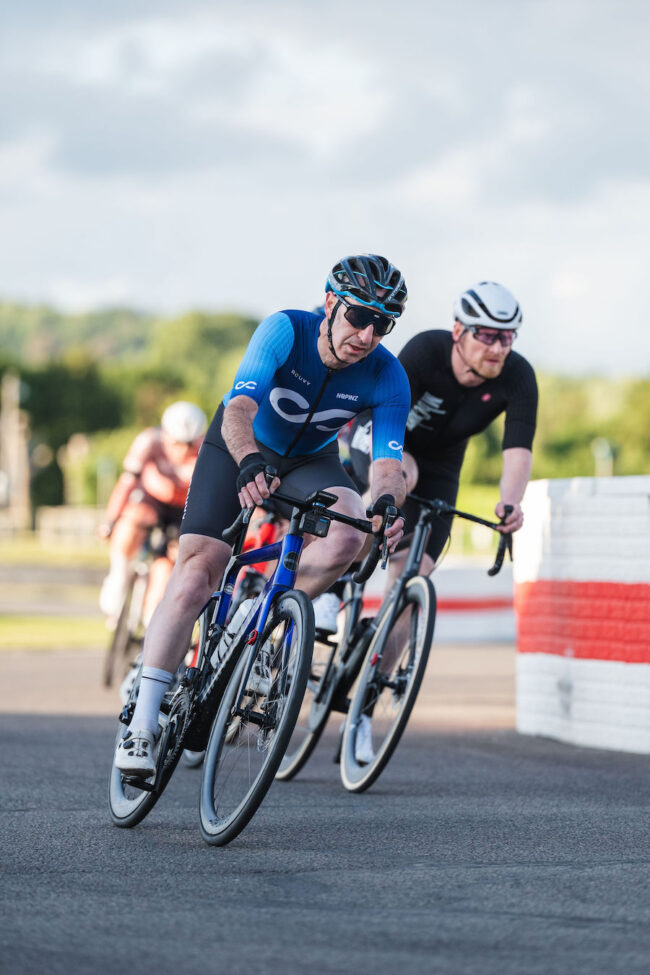
Picture the typical masters rider I see: out every weekend, putting in the miles, heart rate sitting comfortably in the 130s and 140s, week after week. Feels like training. Feels responsible, even. Here’s the uncomfortable truth they’re often losing fitness faster than they need to, and the moderation they think is protecting them is part of the problem.
Counterintuitively, the research is fairly clear on this: older riders don’t inevitably lose fitness at a faster rate than younger athletes. The differences we see are largely explained by what masters cyclists choose to do, specifically, the reductions in volume and intensity that come with the belief that they should be taking it easier. Cut back because you think you should, and the decline accelerates. The age isn’t the primary cause. It’s the behavior.
The obvious conclusion: ride more, ride harder is correct in broad terms, but it needs nuance. Because as we age, recovery genuinely does slow down. Harder sessions take more out of us and take longer to absorb. That’s real, and ignoring it leads to a different kind of problem. The answer isn’t to train like a 25-year-old. It’s to train with the intensity that drives adaptation, and protect that training with smarter recovery.
Recovery: slower, but not for the reasons you think
Recovery slows as we age but the reason matters. If we accept the premise that we should ride easier and cut back, we lose fitness. And as fitness decreases, recovery slows further. It becomes self-reinforcing. I’m not suggesting that training harder will keep your recovery capacity identical to your 30-year-old self because it won’t, but detraining is making the problem considerably worse than it needs to be.
Beyond fitness itself, two factors are worth addressing directly.
Protein.
As we age we become slightly protein-resistant, meaning we need more dietary protein to achieve the same anabolic response. Sarcopenia, the age-related loss of muscle mass also accelerates without adequate protein and training stimulus. For both males and females, the evidence points to around 2.0 grams of protein per kilogram of body mass per day. A 70kg (154lb) rider needs roughly 140g of protein, which, if you were eating only chicken breast, would be around 350g of it. Not that I’d recommend a chicken-only diet! If you’re trying to lose fat mass, or eating a plant-based diet, your requirement is higher still, not lower.
Inflammation.
Exercise-induced inflammation is actually a necessary part of adaptation it triggers the cascade that makes you fitter. The goal isn’t to eliminate it but to support it. Foods rich in flavonoids and polyphenols, found abundantly in plants, help modulate inflammation and support recovery. A diet high in a variety of plants isn’t optional background noise for masters athletes it’s part of the training program, and has been shown to help with cardiac health.
How hard should you actually train?
Different training models produce different adaptations, and there’s been a lot written recently about zone 2 and polarised training. Zone 2 steady aerobic work, sustainable but not trivial — forms the foundation of polarised training, which essentially divides your riding between easy and very hard, with minimal time in the middle. This has been popularised by researchers like Stephen Seiler and adopted by a number of professional cyclists, though notably not all of them.
The alternative is pyramidal training: roughly 65% zone 2, around 30% at medium intensity (just below to at threshold), and about 5% above threshold. In my experience this tends to suit athletes with less available training time, though again, several professional riders train this way too. And frankly, I don’t think rigid adherence to one model is necessary; with athletes I coach we’ll move between pyramidal and polarised depending on what’s happening in their training cycle.
What matters more than the specific model is this: if you are well and healthy, you should be doing some genuinely intense training for most of the year. I include VO2max intervals in my own training almost every week, year-round. Sometimes as a specific block, sometimes just a few efforts scattered through the week, enough that my mind and body don’t forget how to go hard.
There’s also a growing body of work suggesting that zone 2 rides shouldn’t always be pure zone 2. Occasionally including harder efforts within longer rides several minutes of sustained climbing, or a handful of near-maximal 30-second efforts adds a useful intensity stimulus without turning an endurance ride into an interval session. Not every ride. But regularly.
Strength training: not optional
Strength work gets more attention than it used to, and rightly so. For cyclists it has direct performance benefits more power output over both short efforts (seconds) and longer durations (an hour or more). But the health case is at least as compelling as the performance case.
Sarcopenia begins in your mid-30s. Building and maintaining muscle mass slows or reverses it, with significant long-term health implications. Masters cyclists — male and female — are also at elevated risk of osteoporosis, for several compounding reasons: aging itself, the lack of mechanical load in cycling, and for older women, the effect of menopause on bone mineral density. I want to be clear that men are not exempt from this. I know from personal experience.
Although adding muscle may increase body mass slightly, the power gains will almost certainly outweigh any weight penalty on climbs and the improvement in durability (the ability to go hard when fatigued) is arguably more valuable. Useful when there’s a steep climb in the final third of a ride, or someone attacks late in a race or spirited group ride.
To drive meaningful adaptation, strength work needs to involve heavy loads and low repetitions. That doesn’t mean loading a barbell on day one if you haven’t lifted in years. Start light — around 10 reps, several sets — to learn correct movement patterns and avoid injury. Expect significant DOMS initially; it will temporarily affect your riding, and that’s normal. A few years ago I started squatting with a 2kg kettlebell, genuinely concerned my osteoporotic spine wouldn’t tolerate more. Within two months I was squatting 40kg. Five years on, I’m more than double that. Exercises targeting the legs — squats, deadlifts — alongside upper body work cover the bases for performance, general strength, and bone health.
Finally, don’t neglect plyometrics: box jumps, lateral hops, and similar movements train your neuromuscular system to contract rapidly. This matters for cycling explosive efforts, sprints, responding to accelerations, but it also matters for ageing more broadly. The ability to react quickly when you start to lose balance is exactly what prevents falls. And for older adults, a fall resulting in a hip fracture can be genuinely life-altering, or worse.
Where to start
If you’re uncertain where your fitness currently sits, which is more common than you’d think, especially after years of training by feel the most reliable first step is an accurate assessment of your Maximum Aerobic Power (MAP), from which precise training zones can be set. I developed the MAP Ramp Test protocol now used by Zwift, TrainerRoad, Rouvy, and MyWhoosh. For RoadBikeRider readers, I’ve put together a dedicated page at cyclecoach.com/rbr with the free MAP and power profile calculator, a Masters Recovery Resilience calculator, and details on coaching options if you want to go further.
Train with intent. Eat to support it. Lift heavy things. The decline isn’t fixed a lot of it is a choice.
Coach Ric Stern is the founder of CycleCoach. He holds a first-class degree in Sport Science, has published peer-reviewed research in exercise physiology, and has coached riders from track sprint through to ultra-endurance and the Tour de France.
At 57, he’s still racing himself and is fitter now than he was in his 20s.
Your article specifically states to gain the strength, you need to lift heavy weights with low repetitions. However, there is a lot of recent studies that have found that you can increase your strength using the lower weight and higher repetitions:
The following articles and overviews detail the science behind this shift:HSS Sports Medicine Insights: Details how the historical “low rep/heavy weight” standard has evolved, explaining why doing a high number of repetitions with less weight is an efficient path to building muscle.McMaster University Research: Highlights the landmark studies showing that whether you lift heavy or light, muscle growth remains the same as long as the exercises are performed to the point of exhaustion.Built With Science Analysis: Reviews multiple scientific studies to conclude that light and heavy weights lead to similar muscle hypertrophy (muscle growth) when volume is equalized and sets are taken near failure.GQ Fitness Feature: Breaks down the consensus among top strength and protein researchers, explaining that the inverse of heavy/low-rep is perfectly viable for growth as long as you push yourself close to failure
Thanks for the thoughtful comment it’s a great distinction to draw out, because it actually splits into three separate questions: muscle size, strength, and cycling performance. (Oh and bone health making 4).
On muscle size (hypertrophy), you’re right. The research much of it from Stuart Phillips’ group at McMaster is now clear that light and heavy loads produce similar muscle growth provided sets are taken close to failure and total volume is matched. No argument there.
But the column wasn’t really about growing muscle it was about getting stronger and faster on the bike. And here the load matters. Notably, the same McMaster studies that found equal hypertrophy across loads also found the heavy-load groups gained more maximal strength. Strength has a large neuromuscular component recruiting your highest-threshold motor units, improving rate coding and coordination and heavy loads train that more effectively.
More importantly, the body of work looking specifically at strength training for cyclists used heavy loads in the 4–10 rep range, not light-to-failure. A few examples: Rønnestad and colleagues (2010) found that adding heavy strength training reduced heart rate and oxygen cost in the final hour of a 185-minute ride and increased 5-minute sprint power afterwards by 7.8%, with no change in the endurance-only group. Vikmoen et al. (2016) found heavy strength training in female cyclists improved 40-minute all-out power, cycling economy, and fractional utilisation of VO2max. Vikmoen et al. (2017) found it improved both cycling and running performance specifically when tested after prolonged submaximal work i.e. when you’re already tired, which is when races are won and lost. Sunde et al. (2010) found maximal strength training improved cycling economy.
Those cycling-specific benefits economy, durability, late-race power are what heavy, low-rep training delivers, and they’re the reason I recommend it. Light-to-failure will build you similar muscle, but it hasn’t been shown to produce the same improvements in how efficiently and powerfully you ride, especially when fatigued. And for bone a key concern for masters cyclists, given cycling is non-weight-bearing bone responds to high strain magnitude, which lighter loads simply don’t generate.
So both approaches build muscle. But if your goals are strength, cycling performance, and bone density, the heavy, low-rep work still earns its place. Thanks again for raising it it’s a distinction well worth making.
also, it’s worth mentioning, that while the evidence tends to suggest that heavy strength training is beneficial to cycling performance (and bone health), it’s also a benefit to tendon health as well and improves running performance and economy (due to increased tendon stiffness Millet et al). Lastly, it’s also worth remembering that cycling includes high velocity movements so practising some strength work at high speed (when you’ve developed good movement routines) is also of benefit (eg reducing the load of say a back squat but performing the movement faster, or by adding in plyometrics).
(note, that i’m going from memory on the Millet paper — i recall discussing it with him, but it was a while back and i’m old ;-)).
A great book on this topic, Fast After 50 by Joe Friel.
Great article Ric. Thanks.
Thanks Willie
Master Cyclists are not in their 4o’s!!! I did more miles in my 40’s and 50’s than my 30’s. They don’t need help. What about 70 and older cyclists…the true masters who keep plugging along for thousands of miles!
For clarity, the definition of masters as it relates to athletes is actually 35 and above — that’s where you can start racing in age bands. So you’re well covered!
And full respect to the 70+ riders keeping the miles up I’ve raced with some and there are some seriously strong ones out there. If anything, the column’s argument matters more with each decade: the riders who hold onto their fitness best into their 70s and beyond are the ones who keep some genuine intensity and strength work in, rather than backing off to steady miles alone. Plenty of thousands-of-miles riders, but the ones still racing at 75 tend to be the ones still going hard sometimes.
Thanks Ric for this encouraging article. However I just completed my 82nd lap around the sun and still love getting on my bike. You do mention “40 or older” but 40 is a long ways to 82 so just wanted to check your thoughts here.
Cheers,
Marv
Boulder, CO
Congrats, Marv, and brilliant that you’re still out there riding. I’m hoping to be doing the same. 🙂
To your actual question: yes, the principle still applies at 82. The evidence on maintaining some intensity and strength work isn’t restricted to your 40s it holds across the lifespan. There’s even documented work showing athletes improving their fitness in their 80s, and a remarkable case of a centenarian cyclist who raised his VO2max with training between 101 and 103. The body keeps responding to a training stimulus far later than most people assume.
The sensible caveat at 82 as it would be at any age, but more so now — is to check in with your GP or medical team before ramping up intensity. Tell them you’re a regular cyclist and explain what you’d like to do, so they can advise based on your actual health, which of course I can’t see from here. Start there, and go from that.
(And if you get the green light and want a hand structuring it, I’d be happy to help.)
Cheers, and respect for 82 laps and counting.
Hi Ric,
Yes, I would like to chat. I have been seeing a cardiologist for the past 15 years or so. I started that when my GP kept telling me my max heart rate was 220/my age. That got way too boring. After a bunch of tests the cardiologist told me I had NO limits. My main question is about balancing a good workout with the issue of recovery. Maybe that’s where training comes in?
Hi Marv sounds like you’re in good hands, and a cardiologist who knows you well over 15 years is exactly the right person to have in your corner.
You’ve put your finger on the key question. Balancing hard work with recovery is the whole game, and yes that’s precisely where training (and coaching) earns its keep. The short version is that the hard sessions still matter at 82, but the recovery between them becomes the thing that governs how often you can go hard. Get that balance right and you keep the quality work without digging a hole. As it happens, recovery is the subject of one of my upcoming columns here, so you’ll get the fuller picture soon.
I’d genuinely enjoy talking this through with you. The best next step is to reach out via https://www.cyclecoach.com/contact so we can do it properly, I’ll want to understand your current training, what your week looks like, and it’s worth folding in your cardiologist’s view on specific intensities so anything we build fits you and them.
Cheers, and here’s to many more laps