Vehicle Rack Company Küat’s Advice on Racks and Covers when Traveling with Bikes

Jim’s Tech Talk
By Jim Langley
We received a surprising response to our recent articles on traveling with bicycles from the vehicle rack company Küat. We’re sharing it because they’re a rack company and they make some interesting and helpful points to consider if you’re in the market for a rack. Here are links to our 2 articles and a link to Küat too:
Part 1: A Few Beginners Tips for Traveling with Disc Brake Bikes
Part 2: One More Disc Brake Tip for Beginners – and Why We Share These Tips
We’ve reviewed several Küat racks here over the years which you can find by searching on “Kuat.” My review that Valerie from Küat refers to is on their NV rack. The review ran in August of 2013.
Kuat’s response
Hi Jim, my name is Valerie and I head up our marketing at Küat Racks and came across your recent story on Road Bike Rider. While I know it wasn’t about racks, we do appreciate you giving us a shoutout with your NV 2.0 rack.
I read a couple of things that I wanted to make a quick note to help avoid a potential issue in the future. The NV 2.0 bike rack is not RV-approved and we also do not recommend use of bike covers on any hitch rack as they create a lot of wind drag and resistance which could cause damage to your rack or bicycles.
Here is a list of our racks that are RV approved. https://kuat.com/collections/rv-rated-bike-racks
We appreciate all of your education you provide to the bicycling community!
Thank you,
Valerie
One of the racks in Valerie’s list
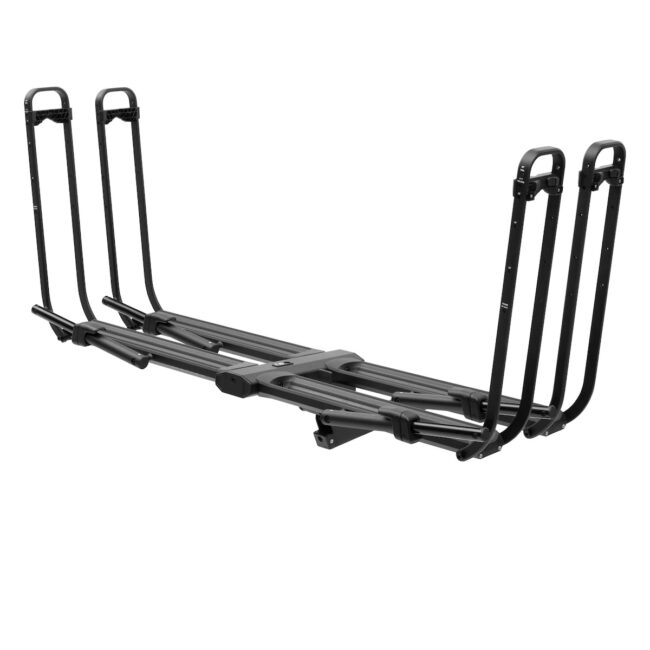
Below is a photo of a Küat Piston Pro rack, which can be set up to handle up to four bicycles, is RV-compatible and can carry ebikes too.
My response to Valerie
It’s nice to hear from you Valerie and thanks for providing the 2 points. Please allow me to explain about the NV rack.
When you provided me the NV rack for testing and review in 2013, I discussed how it would be going on a Sprinter campervan with a member of your product development team and as I recall, they said it would be fine on a van RV like that versus a true RV. Of course only for bikes not ebikes. I remember at first he said no and after we talked he agreed to send the sample rack to us.
I put 33,000 miles on the NV without any issues at all. But I understand about it not being used on an actual trailer/motorhome. Thanks for the information.
Regarding bike covers – I’m really surprised by what you said. Because, in close to 100,000 miles now with 3 different hitch racks and 2 RVs, I have never experienced any bike or rack issues. In fact the damage to bikes and racks occurs when they’re uncovered. Rain is awful when bikes are left out in it uncovered speeding down the highway. It can be worse at the campground if it’s steadily raining for days.
And as I said in the story, even a short dirt road will trash the bikes. Not to mention the fragile electronics on modern bikes and ebikes. For what it’s worth, I use a full zip-up cover by Formosa. The cover takes the beating instead of the bikes. They’re always pristine when you go ride.
Valerie’s follow-up
Hi Jim, thank you for letting me know. Great to know you have a Sprinter and not an RV. Yes, the NV will work just fine for a Sprinter. We do not consider Sprinters an RV.
And totally understand your point and experience with a cover. Our company has seen issues with covers being used so we explicitly state to not use covers in the Warnings section of our User Guides. You are ultimately able to do whatever you want with your rack and bikes, I just wanted to point out our policy.
Thanks again for your support and happy trails,
Valerie
Your turn
It would be interesting to hear from you readers what your experience has been using bike covers on bike racks, whether or not the rack is on an RV. I can appreciate how a cover might create drag behind a sedan or especially anything carried on a roof rack, but it seems SUVs and anything larger would be much less of an issue. And, in my travels, the cover sure seems to save the bikes.
Jim Langley is RBR’s Technical Editor. A pro mechanic & cycling writer for more than 40 years, he’s the author of Your Home Bicycle Workshop in the RBR eBookstore. Tune in to Jim’s popular YouTube channel for wheel building & bike repair how-to’s. Jim’s also known for his cycling streak that ended in February 2022 with a total of 10,269 consecutive daily rides (28 years, 1 month and 11 days of never missing a ride). Click to read Jim’s full bio.

I regards to the bike covers: if the cover is snug on the bike and doesn’t flap in the wind I can see how a well protected ride is appreciated once at your destination. However, having tried a loose fitting cover while driving, Valerie’s point is very valid. I ended up cutting through holes in the cover just to cut down the parachute effect while traveling. Worked like a charm, but a total bodge.
I had a Sprinter type RV for a few years and logged many miles with a Saris rack and two bikes with a full cover. No issues ever. However, on a trip in my car, the wind resistance of the cover put so much strain on the rack that it bent and almost came apart. I had to stop and ship my bike to our destination. I think it is just a matter of how the air flows around your vehicle.
Thanks a lot for letting us know your experience with covers Matt, appreciate it!
Jim
How to Safely Transport Bikes on RV Racks
For years, I’ve used bike racks and covers on both Class C and Class A RVs, logging well over 100,000 miles in diverse weather conditions and on all types of roads without issues. My success stems from a reliable method for securing bikes and protecting them with covers. Below, is my approach to ensure safe and damage-free bike transport.
1. Secure the Bikes Effectively
A high-quality, well-engineered, heavy-duty bike rack is essential for safe transport. However, don’t rely solely on the rack’s built-in attachment points. To ensure maximum stability, I use the following techniques:
• Ratchet Straps for Extra Security: In addition to the rack’s attachment points, I use ratchet straps to firmly secure the bikes to the rack and RV.
• Toe Straps for Wheel Stability: I secure the bottom of each bike wheel to the rack’s wheel tray using toe straps. This prevents vertical movement and keeps the bikes steady, even on bumpy roads.
• Regular Inspections: Before each trip, check all straps and attachment points for wear and ensure they’re tightly fastened.
This combination results in a rock-solid attachment, minimizing movement and reducing the risk of damage to both the bikes and the RV.
2. Protect Your Bikes with Proper Covering
Covering your bikes is critical, especially for high-value models or those with sensitive electronics. Exposure to road debris, rain, and UV rays can cause significant damage.
2.1 Shield Sensitive Components
For bikes with electronics (e.g., e-bikes with displays or battery packs), I use kitchen plastic wrap, such as Press’n Seal, to tightly cover any components that cannot be removed during transport. This creates a water resistant barrier against moisture and dust.
2.2 Use High-Quality Bike Covers
Invest in a high-quality, weather-resistant bike cover that fully encloses each bike. If a single cover isn’t large enough, use two covers: one placed under the wheels facing up and another over the top facing down. Secure the covers together assuring the top cover overlaps the bottom. Use bungee cords or straps to ensure a snug fit that won’t slip down during transit.
2.3 Prevent Billowing with Netting
To eliminate drag, noise, and wear from loose covers, I use cargo netting (commonly used for pickup truck beds) to hold the covers tightly against the bikes and rack. This is key. The netting prevents billowing, reduces wind resistance, and minimizes abrasion that could damage the bike or cover. Ensure the netting is taut and securely fastened to the rack.
Thanks so much for taking the time to write this up and share it Bill. Excellent tips and advice, thank you!
Jim
RV or Recreational Vehicle is a ubiquitous and confusing term. I’m sure Kuat has a specific definition they are working from. Hollywood Racks has a clear take on them and illustrations to go along with it.
https://hollywoodracks.com/collections/e-bike-racks-for-suvs-and-trucks/products/rv-rider
In researching a rack for a Casita 17.5′ tow behind trailer, arguably an RV, I found a lot of conflicting info. Just in the Casita line there are frame mounted/welded 2″ receiver hitches and bumper mounted. I feel comfortable using my Raxter rack to carry a tandem plus one more bike using the my welded hitch. Hollywood Racks has a lot of info on vibration and harmonics in the FAQ’s down in the page above.
What about the issue of hot car exhaust damaging carbon fiber rims?
Per ZIPP; Do not expose Zipp wheels or rims to hot vehicle exhaust or allow the rims to contact any vehicle exhaust components.
Enve and DT Swiss note the same issue:
https://www.bicycling.com/repair/a29002171/your-hitch-rack-might-be-damaging-your-carbon-wheels/
My experience with the fine folks at Kuat leaves me with 100% trust in what they advise. This stems from a mishap in ta Costco Parking lot that left my Kuat 2.0 with a bent hitch insert. I contacted Kuat for the part needed, they graciously reduced the cost, though it was still around $150. When the shipment arrived, I found that it was not just the hitch insert, but also a new articulating mechanism attached to it. Since I only needed the insert, not a new articulating mechanism (the part that allows the rack to be lowered and raised), I cannibalized the hitch insert from the articulating mechanism then wrote a email to Kuat asking if I could ship the mechanism back to them. They responded that I may have reassembled the parts incorrectly that may cause a mishap when carrying bikes. What did Kuat do? Without my requesting it, they shipped me another complete hitch insert with articulating mechanism at no cost to ensure that I and my bikes would be safe. I gotta praise them. There’s good customer service, then there’s outstanding service. Kuat is outstanding.
I use a trailer rack for local transport. Some time ago I looked into bike covers. I decided against them as it looked like they would block the view of the car’s tail and brake lights — not good in daylight and worse in the dark. I know there is a way to add lights onto the rack, but that adds even more cost and complexity. It seems to me that talk of using a bike cover should include talk of extending the tail and brake lights.
. . . and license plates. I know someone who once got a ticket because her cross bike on a rear rack made her license plate unreadable from behind.