Posedla Joyseat Ultra Saddle Review

By Brandon Bilyeu


Hot!
- Saddle shape and padding is tailor fit to your needs
- No need to visit a special store, butt imprint is done at home
- Specific zones of padding created by 3D printing
- After break-in period, the Joyseat is very comfortable
- Your saddle will never be discontinued; you can always order a new one
Not!
- Price, but you can’t expect a custom product at mass-produced prices
Price:
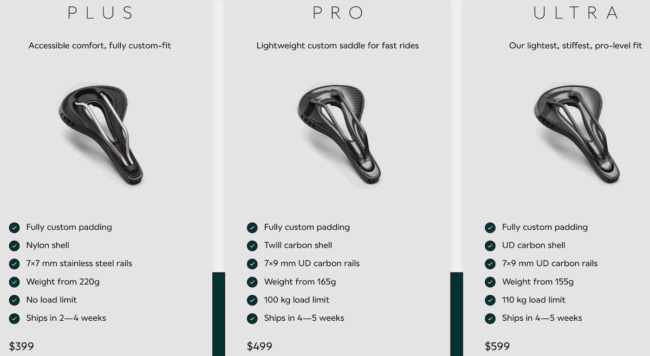
$599 – Joyseat Ultra (UD carbon rails and shell)
$499 Joyseat Pro (UD carbon rails and twill carbon shell)
$399 – Joyseat Plus (stainless steel rails and glass-reinforce nylon shell)
How obtained: review sample
Available: online
Website: Posedla Joyseat
RBR Sponsor: no
Tested: 50+ hours
Saddle Disclaimer
Saddles are a very personal contact point with the bike. Everyone’s body, and thus saddle needs, are different. What is comfortable for me might be the world’s most perfect torture device for you. That said, the Joyseat saddle I tested will not be the same saddle you ride because the Joyseat is fully custom for each customer based on their riding style and undercarriage measurements. Also important to note is that a custom saddle can’t fix problems caused by a poor bike fit.
Posedla – 3D Printing Custom Saddles in the Czech Republic
Posedla is the brainchild of two cyclists with sore butts who wondered why there were no fully custom saddle options and then decided to fill that gap in the market with 3D printing. Most saddle companies tout their 3D printed saddles as the pinnacle of comfort, but the saddles are typically just 3D printed versions of their mass-produced, foam-padded saddles. While the 3D printing does allow perfect control of support and cushioning, the comfort improvements are more marginal gain than miracle. These companies are not taking full advantage of 3D printing’s ability to quickly and easily print any shape and size. This is where Posedla has harnessed the true potential of 3D printing to make custom saddles.
Posedla started off with the original custom Joyseat saddle. Now a few years down the road Posedla has reached iteration 3.0 of the Joyseat and expanded the Joyseat line to include two slightly more affordable options. Custom is never cheap, but with the Joyseat Plus you can now get a custom 3D printed saddle for about the same price as a mass-produced 3D printed saddle. And as you can see below, spending more on the Pro or Ultra Joyseats just gets you more carbon bling and a little less weight.
Customized at Home
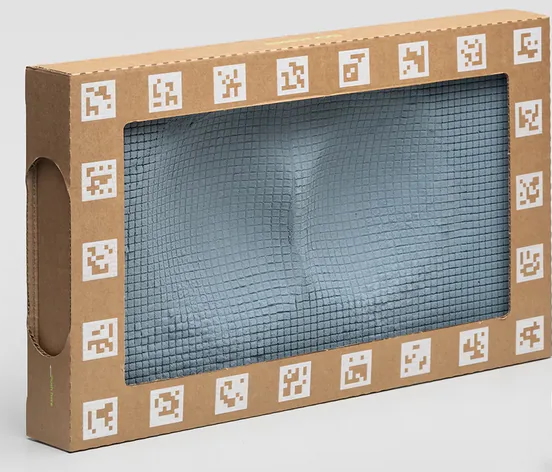
The customization process starts with a butt imprint and questionnaire to help Posedla understand your body and typical riding conditions. Posedla mails you their Smiling Butt Kit that allows you to make an impression of your backside into a soft, collapsible foam. To get a good imprint, Posedla provides detailed written and video instructions. Once the imprint is made you take a series of photos from different angles and then upload these images to the Posedla website where they are analyzed to determine body measurements like sit bone width.
After uploading the pictures, you fill out the questionnaire to help Posedla fine tune the saddle to your particular needs. Important questions like type of bike, annual mileage, average ride length, and flexibility are covered. For subjective questions like flexibility, Posedla provides clear examples, so you are sure to give the right answer. You can also specify a short, personalized text to be printed on the inside of the saddle cutout.
Your butt imprint and answers are used with a Posedla algorithm to determine the size, shape, and padding distribution of your Joyseat. For example, your sit bone width drives the width of your saddle, and Posedla determines your saddle width in 1mm increments over the range 130 to 170 mm. Most saddle manufacturers offer two or three saddle withs, Posedla offers 40 widths. When your saddle finally arrives, it comes with a birth certificate detailing all your inputs and showcasing the details of your saddle.
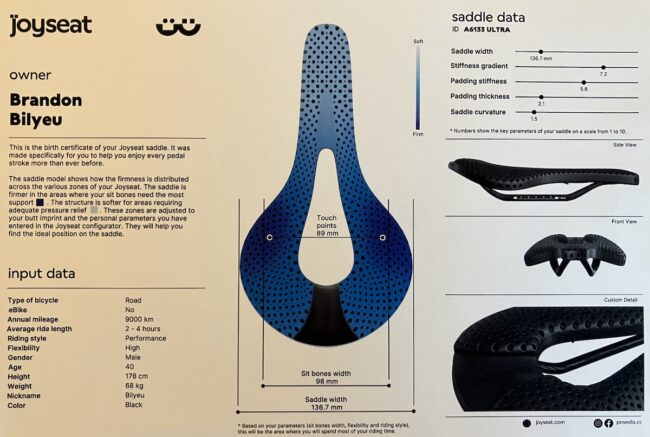
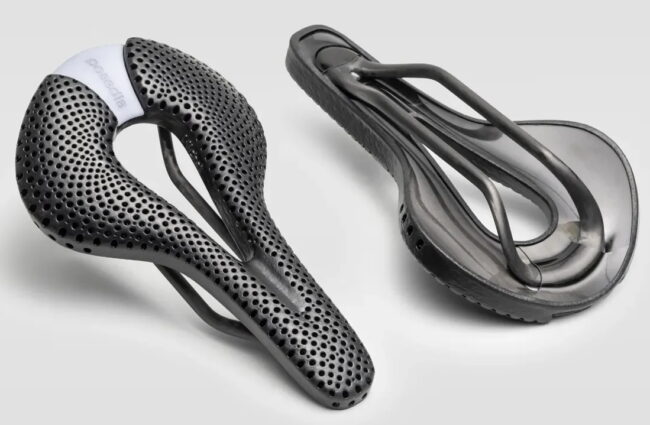
When my saddle arrived, my curiosity forced me to probe the 3D printed padding to see where it was stiff and where it was soft. The sit bone area was very firm and the other areas much softer. The nose was so unexpectedly soft that I fully depressed the lattice and managed to snap one connecting element between holes. This did not impact function in any way, but Posedla assured me this should not happed and made me a new saddle. The second saddle has held up to my prodding finger without any issues.
The saddle itself looks great and super high quality. The Ultra’s UD carbon shell and rails are beautiful and the bonds holding the rails to the shell are neat and clean. There are no maximum clamping range marks on the carbon rails and when I asked Posedla about this they commented that the markings were removed for aesthetic reasons. They showed me a saddle with white rail markings, and I must agree it ruins the sleek look of the all-black Joyseat. Instead, Posedla includes a detailed mounting instruction sheet with the saddle that shows the clamping areas.
On the Bike
My standout impression of the first ride on the Joyseat Ultra was that the padding was very firm and felt hard under my sit bones. Posedla says a 300-500 km (185-310 mile) break-in period is necessary, and soon the saddle did not feel hard anymore. I wasn’t sure if the saddle really changed during the break-in period or if my butt just became accustomed to the firm ride, but the arrival of the replacement saddle solved this debate. As soon as I put on the new saddle it felt very hard, so you need to give the Joyseat time to break-in and avoid hasty judgements on comfort.
Overall, the Joyseat Ultra is a very comfortable saddle. After the break-in period my butt found the 3D printed padding supportive and comfortable in positions from relaxed on the tops to hammering in the drops. The saddle width, padding stiffness distribution, and saddle curvature all feel great under my sit bones and soft tissues areas.
I’ve had some issues with other 3D printed saddles where the material is super grippy and abrasive, making slight position adjustments difficult and eating away at my shorts’ seams. The Joyseat feels more like a traditional saddle cover in terms of grippiness and did not cause me any issues.
Posedla expects a minimum 30,000 km (18,500 mile) before the 3D lattice starts to lose elasticity. For most people that means several years of riding. One problem with mass-produced saddles is that after several years they tend to update their models, so a saddle you love may no longer be available. With Posedla, they will still have your original print file and can make you an exact copy and even reuse your shell and rails if they are still in good condition.
Bottom Line
The Posedla Joyseat is a fully custom, high-quality 3D printed saddle. If you bike fit is good, and you still have problems with saddle discomfort then a custom saddle may be a good option for you.
Brandon Bilyeu is an avid recreational roadie who lives in Regensburg, Germany. He’s a year-round bike commuter and is a mechanical design engineer by trade. Click to read Brandon’s full bio.

This sounds like an updated take on a saddle company I reviewed in 2017 — Meld. https://www.roadbikerider.com/meld-body-customized-road-bike-saddle-d2/
Very similar process. I enjoyed that saddle until I foolishly left it on a bike I sold last year.
I have my second Meld saddle. I ordered it based on your review in 2017. It’s the same idea. I have very happy with them. I had to order the second because I broke the first in a fall.
Looks like a good saddle choice, especially if you get the width correct.