A Few Beginners Tips for Traveling with Disc Brake Bikes

Jim’s Tech Talk
By Jim Langley
As you may already know if you’ve been reading this column for awhile, my wife Deb and I do a fair amount of RVing. As I type this we’re enjoying the lovely rolling hills, lush fields and forests in Missouri.
Every day on our RV adventures I try to get out for a ride. Usually the bikes travel on a hitch rack at the back of the RV protected by a zip-up Formosa 2-Bike cover, which I reviewed back when I bought it. I highly recommend a cover like this that fully zips up because you never know what the weather or route holds for you. Only a short dirt road detour will cover your two wheelers in dust if they’re not fully covered.
I’ve also reviewed the three hitch racks we’ve used over our RVing years. Both with our Lazy Daze Class C RV we have now and with our previous rig a Roadtrek Agile SS Class B built on the Mercedes Sprinter platform. Here are those reviews in case you’re in need of a nice hitch rack:
And the one we use now, the Saris Edge
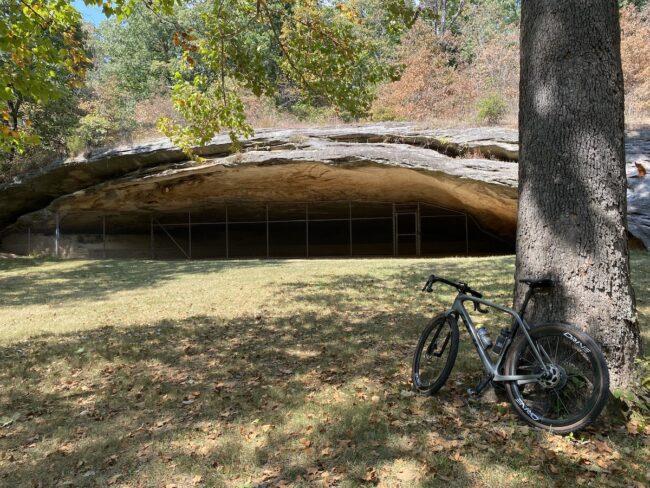
No rack this time
For this trip where we’re driving from our home in Santa Cruz, California, around Missouri and then heading back on Route 66 to California, we decided to leave Deb’s Specialized Levo e-bike at home (because she didn’t think there’d be time to ride it – too many planned activities).
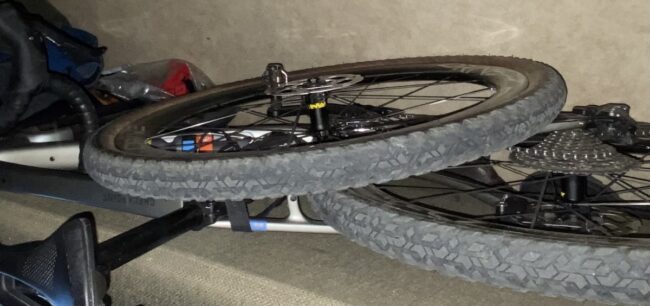
So, with only my Trek Checkpoint gravel bike along, it made a lot of sense to store it inside the motorhome, especially because the second bed on most Class C motorhomes that’s directly above the driver and passenger seats up front is just the right size to accept it.
The only thing is, that in order to get it up there and down from there easily for my daily rides, the front wheel needs to come off. You should be able to make out how nicely the bike fits up there in the photo. Don’t worry it’s strapped in place and can’t fall.
Traveling with disc brake bikes tips for beginners
When you carry a bike with disc brakes on most hitch racks, the wheels stay on the bike. This ensures that nothing changes with the disc brake adjustments, unless you have the misfortune of somehow banging into and bending a rotor. But you’ll probably only make that mistake once.
In contrast, when you have to remove the wheel or wheels of a bike with disc brakes for traveling, several annoying issues can occur. Experienced disc brake users know what can go wrong and how to avoid it, so if that’s you, after reading my tips, please add any you’d like to share with beginners in a comment. They’ll appreciate it.
Here are common mistakes to avoid & tips
Do not push down or weigh the bike when removing thru axles to remove wheels. It makes it more difficult to remove the axle and also to install them. Just hold the bike so it can’t fall over as you loosen and remove wheels and reinstall them. I do not recommend turning bikes upside side down or laying them on the side to remove and install wheels.
Tip: If you run into a thru axle that will not loosen no matter how hard you try, it’s probably frozen due to dry threads or corrosion. Luckily, most thru axles have hex holes in both ends, which lets you use 2 wrenches to break the axle free. Be sure to turn the wrenches together, and both in the same direction.
To do this, stand on the left side of the bike (the non-drivetrain side), turn the wrench on that side counterclockwise to loosen and remove the thru axle. Don’t get confused and turn the wrench on the right side of the bike the other way. Turn it in the same direction as the other wrench. Be sure to put a little lube on the thru axle threads once you get it out so that it won’t freeze again. (But do NOT let any lube get on the rotor.)
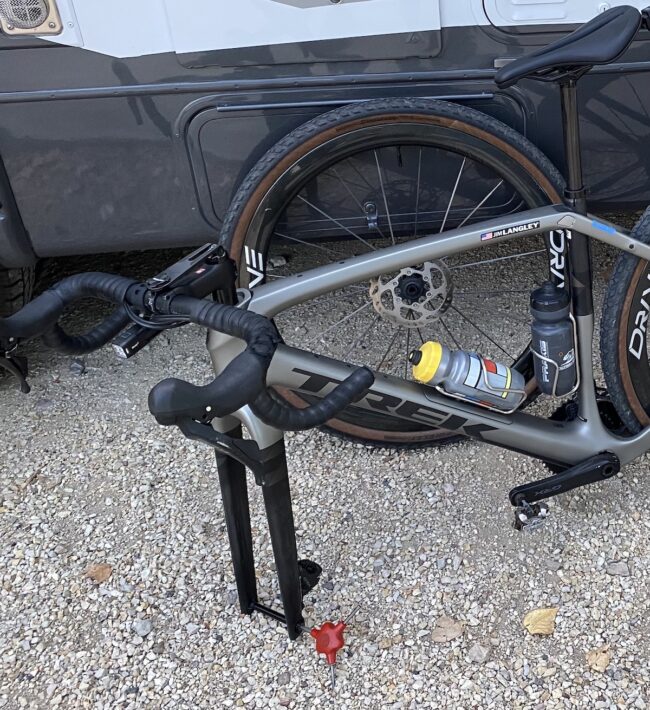
Do not leave the thru axle laying on the ground after removing the wheel and drive away without it. Instead put it back in the frame of the bike. Just thread it in enough so that it can’t come out on its own. If you crank it down, you could flex the fork or rear stays out of position.
Do not leave the removed wheel(s) anywhere it could get damaged. I’ve seen wheels laying on the ground driven over by people not realizing the wheel was under their car. Put it where it’s safe.
Do not pack the disc brake wheel(s) any way it could get damaged. In the photo of my Trek inside our RV, I hope you can see that the front wheel has the rotor facing up, and that one pedal protrudes through the spokes. The wheel can’t bounce out and land on top of us when we’re driving this way.
But, if I left the wheel like this, the rotor would definitely smack into the pedal damaging the rotor and the pedal might damage the rim or spokes even. So I cover the bike and pedal with a blanket and then rest the wheel on top so it’s padded all around and protected.
Do not lay disc wheels down with the disc brake rotor facing the ground. They protrude and can get damaged if they strike something even if it’s the rotor on the other wheel if you’ve removed both.
Do not let the disc brake rotors get near anything that has lubrication on it such as the drivetrain parts.If they make contact with lube, be sure to clean the rotors with a solvent before reinstalling the wheels because any lube on the rotors will be transferred to the brake pads, which could ruin your braking.
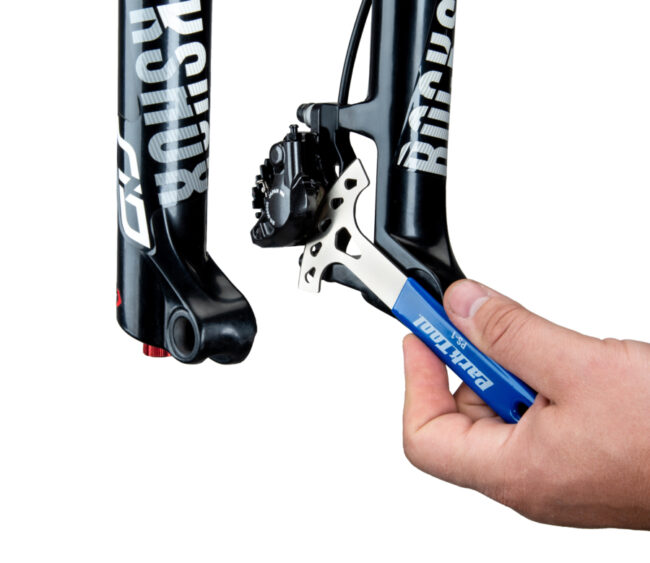
Do not squeeze the brake lever once the wheel(s) is removed. Doing so will put the brake “on” making the brake pads come together and you may not be able to get the wheel back in. If you have a tool like Park’s PS-1 Disc Brake Pad Spreader (or you can make something like it), you can gently wiggle it between the pads to get the needed gap back.
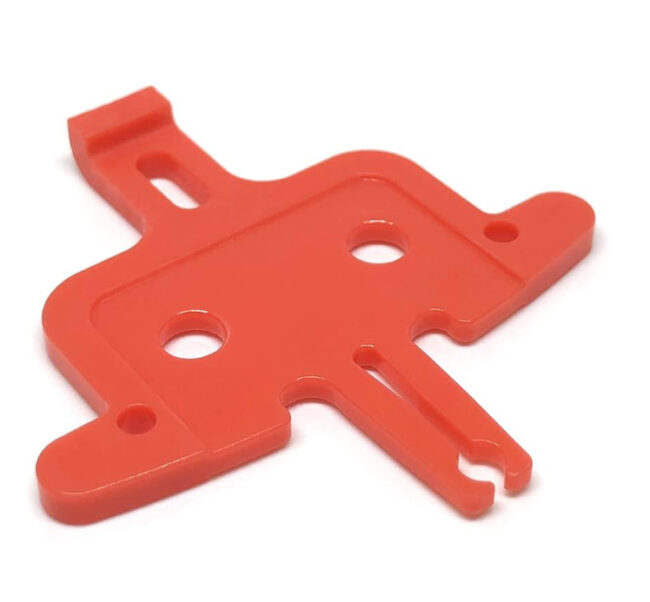
Tip: If there’s a chance that the brake levers might get squeezed by someone or somehow, a nice thing to carry is some disc brake pad spacers. These little plastic shims are put in between the brake pads so that the pads won’t close if/when the levers are squeezed.
Do not force wheels back into the fork or frame. You might have a short window of time to fit in a ride and be in a rush to put the wheel(s) back on. But, if you try to force them into place, you can ram the rotor into the pads knocking them out of position, or even bend a rotor.
Also, the wheel axles need to find “home,” the place where the holes in the axle line up with the holes in the dropouts (frame ends). Everything needs to line up for the thru axle to slide through and thread in.
So take your time and watch carefully as you install wheels. Pay attention that the rotor goes between the brake pads and that the axle slips into its seats on both sides. Then without putting any pressure from above on the bike, you can thread in and tighten the thru axle.
Do not overtighten thru axles. If you overdo it, you can put too much load on the hub bearings which might lead to premature wear. To get it right, you can go by your bike manufacturer’s recommended torque if you can find it. And if you have a torque wrench along to check. A common range is 10-15 Newton meters.
Trek gives 10 Nm for my Trek. I don’t use a torque wrench to tighten thru axles, I go by experience having tightened many. 10 Nm feels like a good firm tightening with a standard 6mm hex key. You can feel that it’ll go further if you really crank it or put your weight into it, which you don’t want to do.
Your turn
As I mentioned earlier, you can make this article even more useful by sharing your traveling with bikes with disc brake tips in a comment. Or just traveling with bikes tips would be helpful too. Thanks in advance.
Jim Langley is RBR’s Technical Editor. A pro mechanic & cycling writer for more than 40 years, he’s the author of Your Home Bicycle Workshop in the RBR eBookstore. Tune in to Jim’s popular YouTube channel for wheel building & bike repair how-to’s. Jim’s also known for his cycling streak that ended in February 2022 with a total of 10,269 consecutive daily rides (28 years, 1 month and 11 days of never missing a ride). Click to read Jim’s full bio.
I’ve never seen a thru axle with hex fittings in both ends. 1 of 4 disc brake bikes in our house has the front axle inserted into the wrong (left) side. I rarely get it right when I go to remove that front wheel. With an axle with hex fittings in both ends of just have to turn the axle backwards to remove it.
That’s a good point Syborg, thanks. I should have written “some” thru axles have hex holes on both ends. All my bikes do but going back to when thru axles first came along and even today there are lots of different designs you might run into. Thanks!
Jim
I use a small square of plastic styrofoam and wedge it between the brake lever and handle bar. Don’t have to worry about using brake block wedge.
That’s a nice tip Kenneth! Thank you!
Jim
More reasons I refuse to even consider buying a bike with disc brakes.
Been traveling for over 20 years with rim brakes, never any issues. None.
Brakes always seem to stop me when I need them.
Being a regular traveler with bikes, I agree with your comment. We traveled for years in our RV with rim brake bikes. We do have hydraulic disc brake bikes at home, but when we wanted to buy new gravel bikes dedicated to stay with our RV which we keep in another state, I was very hesitant to go that route. At the time it was nearly impossible to buy a rim brake bike in the “gravel/all road” category which we were looking for. So I purchased relatively inexpensive fully mechanical bikes to keep on the RV. Simple mechanical shifting and mechanical disc brakes. The mechanical disc brakes work great – I can’t say they perform any differently than the hydraulic for the type of riding we do. Being mechanical, they’re totally on-the-road repairable with parts and tools that I can keep on hand or find anywhere. No bleeding to be concerned about. No exotic electronic shifting parts.
Don’t get me wrong – hydraulic brakes and electronic shifting are great, but not critical and certainly not as simple and easy as mechanical stuff if you’re on the road.
I have traveled overseas with my padded Airline bike bag and I always remove my rotors- they are center lock! Then wrap them securely in padded wrap. May be an extreme solution – but that way they won’t be damaged.
Perhaps the best example I have ever read as to why I continue to ride with rim brakes. Why would I opt for a heavier bicycle (unless possibly if you fork out $15-20K), that is far more vulnerable to damage/maladjustment, and more complicated to travel with or repair. Over the 50+ years I have been cycling, road, mountain bike, tandem, I’ve never had a braking issue of consequence. No, I’m not being paid to negotiate 10%+ mountain passes with lots of switchbacks at 60-70mph, and have to brake hard repeatedly at the turns. Nor do I make a habit of riding in torrential rain. I dare say 95% of the riding public has no need for disc brakes either, and I’ll bet a good percentage of those discs are badly in need of adjustment at any given moment. We have taken a simple, elegant, and cost efficient machine, and made it into a ridiculously expensive (for something moderately high end) and heavier complexity with disc brakes and electronic shifting. Feel very sorry for me on my early 2000’s Gerolsteiner team issue Roubaix, and gasp – only ten mechanically shifted cogs to choose from (how can I possibly manage?). Perhaps I have to spend an hour a year on brake maintenance at almost zero cost, and the only battery I have to think about is in my taillight. The consumer is at the mercy of an industry working overtime to make bicycles as complicated and expensive as possible with virtually zero benefit for 99.5% of that market. What would I change on my road bike were I to redesign it? Perhaps to cantilevers, such as on my 1995 Merlin Ti mountain bike – just so I could run wider tires than 28mm.
My sentiments exactly. I have a few disc brakes on used bikes I bought, still can’t change or service them myself. Disc brakes on road bikes was one of the worst ideas ever. That and electronic shifting. People are much better off with rim brakes. Maybe they will make a comeback.
Great tip about using two allen wrenches. This Spring our club had the experience of having two riding partners flatting on the road. After figuring out that the lever on the thru axle of a Trek can be removed and used on the other axle, we could not release it. Handle on the tool was just too short. After working at it for 20 or so minutes, we finally got it to loosen up by putting an allen wrench in the right side. Never thought about using two allen wrenches in unison. That was Case 1. Second situation about 3 weeks later and we could not remove the axle on the road. Fortunately, this bike had tubeless and we were able to maintain enough pressure in the tire to get to a bike shop. My observation is that you have hit 3 major maintenance points:
1. Lube the threads very carefully making certain none of the lubricant gets near the brakes.
2. Don’t overtighten the axle when installing.
3. Use two wrenches when it is locked in.
In each instance, it was a rear wheel that gave us issues. I suspect that is because they are more subject to the weather and environmental elements.
Once every month, I now remove my thru-axles, lightly lube the threads (I use Phil’s) and I do the same for my pedals (another place things can get sticky).
Regarding traveling with the bike, I have center-lock rotors, and I remove them from the wheels. I place each one in a kraft envelop to prevent contamination and to also label front and rear. This way I keep the rotors matched with the brake pads they have burned in with.
Thanks for sharing your tips Big Ring Bob, great stuff!
Jim
No problems with air in the brake lines with rim brakes either. No special tools needed.
And now the major suppliers have screwed us rim brake users further: Shimano and SRAM no longer offer electric shifters with cable operated brakes—even cable operated disc brakes.
Disc brakes may be the hot ticket for racers but they are a needless and complicated concept that allows manufacturers to raise prices to ridiculous levels. In 1972 a full on Paramount racer with Campy Super Record cost less than $500. Bet you would go 99% as fast as on a $15,000 carbon wonder bike. Nowadays one carbon wheel costs more.
Check out Wheeltop electronic shifting groups. They are unique in that they offer a mechanical brake option for the electronic shifting levers. You could then use them with rim brakes or mechanical discs. Another very interesting feature is that the shifting is programmable to the number of sprockets you have. I believe it’s programmable from 6 to 13 speeds.
I am very intrigued and will probably get a set next year to try out on one of my road bikes. I have three – one 8 speed and two 10 speeds. There is no other electronic option that I could easily use on any of these.
that 1972 Paramount actually about $350 (4x the Varsity I bought then!) (https://schwinnbikeforum.com/SLDB/Adobe/1972%20Consumer%20Catalog.pdf)
would cost about $4000 in today dollars. Which will get you a pretty decent (not WorldTour level) bike today.
My hydraulic disks need much less maintenance than the (many mfg) rim brakes I have had. Obviously different riders but rim brakes almost useless with carbon wheels. especially in the wet.
It’s easy to overtighten thru axles. They don’t need to get honked down. See the tiny wrench Trek provides on theirs.
A friend drove me to a recent ride. We both use disk brakes.
His bike rack inside of his van was amazing.
It would slide out #1.
After removing my front wheel and replacing the through axel, he inserted the plastic piece in the disc brake.
Then the surprising part. The bike rack had small clamps mounted which would clamp on the through axel to hold the bike upright. We slid the rack back in and away we went!
Those are called fork mounts and are available in many different types for thru axle and quick release forks.
You can easily make your own fork mount bike carrier for the back of a large SUV or a pickup truck. Simply get fork mounts and bolt them to a 2×6 board or similar.
To keep the pads from clamping together if the lever is accidentally pressed when the wheel is off, the spacer shown in the article should be standard practice, all the time. Sure you can respread them but it’s a hassle and you really do need the tool.
An easy to find alternative if you don’t have the actual spacers is a toilet shim that you can find in any hardware store. These are the little plastic shims that are used to level a toilet on the floor. They’re the right size, cheap and they work perfectly.
Much easier with bike upside down as long as your on a protected surface.
My mechanical disc TRP Spyre breaks avoid some of the complications. Good stopping power and no hydraulics to mess with
My sentiments exactly. I have a few disc brakes on used bikes I bought, still can’t change or service them myself. Disc brakes on road bikes was one of the worst ideas ever. That and electronic shifting. People are much better off with rim brakes. Maybe they will make a comeback.
Wouldn’t placing a pedal between the spokes potentially bend or break a spoke?
Great article, thanks. Wish I’d discovered your disc brakes articles before spending hours figuring out these solutions on my own. Specialized specs 15 nm for thru axles so I use a Topeak digital torque wrench. Not cheap but super helpful to have. I always have to tighten to about 10 nm, ensure no disc brakes rubbing, then tighten to 15 nm. Keep the articles coming, thanks.
I have both rim and disk brake bikes. Like many, my need for the stopping power of disk brakes is minimal… and I’ve never had a problem stopping using rim brakes. My lightest rim brake bike is about ½ lb lighter than my lightest disk brake bike (comparably equipped and with frames alone within an ounce of each other.). All my disk brakes are somewhat tempermental compared to my rim brakes, and all are high end systems. OTOH, I totally disagree with some who view electronic shifting as an unnecessary addition to bikes. I have a touch of arthritis in my left hand (and know many others with worse wrist problems) and would not be able to do a long ride without electronic shifting. I don’t find the maintenance and upkeep with these shifting systems to be tremendously onerous and often easier than manual shifting systems (I’m looking at you, SRAM “double tap”…)