
Do “1X” (1-by) Drivetrains Speed Chain Wear?

Jim’s Tech Talk
By Jim Langley
This week I’m responding to what I find an interesting comment to last week’s article: Abbey Bike Tools’ L.L. Chain Wear Tool. It’s from a reader with the pen name “Freddy” who stated something as fact, that I believe is open for debate, consideration, maybe skepticism.
A lot of you have tons of experience riding many different types of drivetrains (and I have too). It would be great if you’d read Freddy’s comments and my thoughts on the matter and then share yours based on your finds riding these various drivetrains. Thanks!
Drivetrain lingo explained
Just in case the bike jargon in the title and in what follows doesn’t make sense to you, “1X” or “1x” stands for “1-by” or you could express it “one-by.” And all those terms are another way to say a drivetrain with a single (just one) chainring. So if a bike has just one chainring, people say it’s a “one-by” bike or a “1-by” drivetrain or gearing.
And because somebody coined “1X” (I have no idea who) – we started saying “2X” for bikes with double chainrings (2 chainrings), and “3X” for bikes with triple chainrings (3 chainrings). Got it? Isn’t bikespeak fun?
Freddy wrote
This quote here is actually an excerpt from Freddy’s longer comment. Since he mentions it in this part, I’ll explain that his first tip is to use an engineer’s ruler for measuring chains, which is good advice. Here’s the excerpt related to this article.
“If you [ride] a 1x drivetrain bike, then lateral measurement is very important as the cross chaining happening on those systems is stressing the chains and these chains will likely wear out in the lateral before it wears out in a ruler test [the engineering ruler he recommended].
1x chains do not last as long as 2 and 3x, typically 1x last between only 1,500 miles to the most 3,000 miles; whereas with a 2 or 3x a chain can last 2,500 to 5,000 miles on average, though some people, like myself, average between 8,000 to 10,000 miles.”
My thoughts
Thanks for commenting, Freddy. It would be good to know more about your comment that 1x drivetrains wear chains more quickly, as, to my thinking, it should only wear one thing more rapidly, that thing being the chainring.
On 2x and 3x bikes, as long as people shift, the load is shared across the chainrings. No chainrings see constant wear. On 1xs they do and it’s why 1x chainrings wear more quickly. I think every mountain biker will attest to this – MTBs being the prevalent 1xs by far.
But, there’s no reason the chain should wear faster. It seems it would wear more slowly because it’s not getting a workout in front, just in back. The chain shifting up and down the 2 and 3 chainrings should wear the chain at least a little compared to a chain just riding along on a single chainring, never having to bump into anything on its sides since it never climbs or drops onto different rings.
Also, if a 1x bike is designed and built correctly the chainring should be in the center of the bike’s chainline putting it centered in relation to the cassette cogs in the back. It needs to be there or else the chain might tend to try to come off. This means that there is less cross chain effect on a 1x than on a 2x or 3x drivetrain.
In case “cross chain” or “cross chaining” or sometimes called “crossover” or “cross over” gearing isn’t in your biketionary, it means when the chain is in the extreme widest positions. These include when it’s on the smallest chainring and the smallest cog at the same time. And when it’s on the largest chainring and the largest cog at the same time.
If you were taught how to shift by the bike shop you bought your first derailleur bike from, they might have told you to stay out of these gears to avoid wearing the drivetrain prematurely. That’s a good idea but plenty of riders ignore the warning and just ride in whatever gear they end up on so it’s not something you can expect will automatically happen.
But back to what happens with the different drivetrains, on a 2x chainring, both rings are offset from center. So you’re cross chaining a lot of the time on both. On a 3x the middle ring is just like the 1x so it doesn’t cause cross chaining. But the “granny” ring (smallest chainring) and the largest chainring are even wider apart than on the 2x drivetrain. So on those there is cross chaining happening unless you make a point to avoid it.
Still, the 2x and 3x drivetrains put the chainrings outboard of where the 1x ring is, meaning the 1x should still be the easiest on the chain since the angle to the cogs is less extreme.
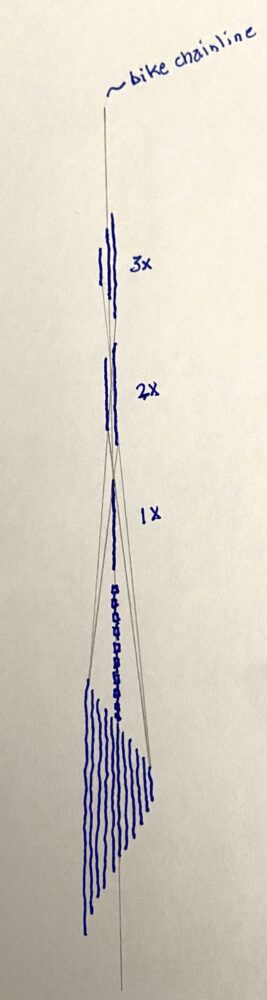
Apologies for the crude sketch but I hope it’ll help in thinking about this. On it I marked the bike chainline. That grey line runs down the center between the chainrings and cassette cogs. The blue lines are the chainrings and cogs and the blue blocks represent the chain.
The other grey lines trace the approximate angle the chain would take to get from the rings to the cogs. The key thing to notice is that the 1x ring sits right on the center of the chainline. So it’s closest to the extreme cog positions (cross chain positions), while the 2x and 3x (2 of the 3 rings) sit further away meaning more cross chain effect on 2x and 3x drivetrains. Which should mean more chain wear even if you avoid the cross chain positions.
Summing up, if it’s true that 1x chains wear out more quickly (I don’t know that they do), I don’t think that wear is the result of cross chaining since it’s less on a 1x than other drivetrains. But I do have a guess what it might be. And that’s that the chain might wear faster because it’s shifted more frequently.
That might be the case with 1x bikes because you can only shift up and down the cassette cogs, you can’t shift between chainrings, you only have one. So every shift is a rear shift, versus a triple or double where you might instead make one front shift in place of multiple rear shifts. That could add up to a lot more shifts over time.
I look forward to your comments!
Jim Langley is RBR’s Technical Editor. A pro mechanic & cycling writer for more than 40 years, he’s the author of Your Home Bicycle Workshop in the RBR eBookstore. Tune in to Jim’s popular YouTube channel for wheel building & bike repair how-to’s. Jim’s also known for his cycling streak that ended in February 2022 with a total of 10,269 consecutive daily rides (28 years, 1 month and 11 days of never missing a ride). Click to read Jim’s full bio.


Engineers don’t use “rulers” they use scales ?
My only 1x bike is an MTB and I do wear out chains a little faster on that bike. This is due to the extra dirt and stress that chain sees during it’s lifetime. That’s not a fair comparison.
It’s been a few years since I had a 2x MTB, but I don’t recall those chains wearing any better than my current 1x set-up.
I agree with Jim that chains in a “1x” drivetrain should wear more slowly. However… these days a lot of drivetrains have a million cogs on the cassette, requiring a narrower chain. My suggested hypothesis is that the narrower the chain is, the less bearing area in each link and, consequently, more wear assuming the same amount of power transfer.
Also, I have a bike with a “1×1” drivetrain (IGH), and I get the same chain life as my road bike with 3×9.
Food for thought. 🙂
Yea, I agree with you Jim that the cross-chaining ought not be an issue if set up correct, thus removing the concerns for wear due to this aspect. As for lifespan whether laterally or linear, I just assume the stretch over 3,000 – 4,000 miles is enough to swap the chain out and preserve the more expensive cluster / chain rings regardless if it’s my 2x-road bike or 1x-gravel bike system. Admittingly, I only purchase basic Shimano / SRAM speed appropriate chains, so nothing fancy. And I wax my chains with plain paraffin wax. But for the couple decades prior to waxing, I still didn’t push the chains to the ultimate end-of-life, but did a chain swap once per 5,500-6,000 mile year either in Spring or Fall. That would allow my cluster to go upwards of 10,000 or so miles.
I have over 5500 miles on my Campagnolo 1X13 drivetrain. The chain is not even close to needing replaced. The cassette and chainring show no discernible wear. I use an immersion wax every 1ooo miles or so, with a drip wax top up every 200 miles. This contrasts with my experience with Shimano 2X10, where I would have gone through at least two chains for the same mileage. With the 2X I used an oil based wet lube. I’d bet the lube choice is the important variable. In any event, I’ve been very pleased with the 1X setup.
I ride a Specialized Creo e bike which is a 1x. With most road e bikes when you’re riding with “assist” you’re in the 11, 12, 13 tooth casette rings often, which looks like cross chaining. I replaced my chain at around 5000 miles, not because it stretched or shifted bably but as a preventive maintenance item.
Along the lines of what syborg says, most 1x drivetrains are on multi surface bikes (MTB, gravel or CX) so see more wear due the dirty conditions. It would be interesting to compare apples-apples chain wear using 3 road setups with the same chain manufacturer.
I have a 1x hybrid bike which is still on its first chain. I’ve got 1,600 miles on it and the chain is at approximately 0.5% wear. What I notice about the 1x setup is that when I’m riding on one of the center cogs, the drivetrain is quietest, and when I use the larger or smaller cogs, pedaling gets noisier. I believe that this noise is a proxy for chain wear, and I do feel that this chain will wear out faster than on my bikes with double front chainrings. I don’t really care for the 1x setup and miss the versatility of the bike that this one replaced, which had a triple front chainring and was a very quiet and durable setup.
I think this is Freddy’s point – a 1x has a bigger range of cog sizes which results in more extreme chain angles.
In theory, if one shifts to minimize lateral chain wear (in the smaller chain ring when in the larger rear cogs and in the larger chain ring when in the smaller rear cogs), one could (in theory) reduce lateral chain wear vs a 1x. However, in my experience, chains wear out faster from normal stretch wear than from lateral chain wear (I have never replaced a chain due to lateral wear – only replaced them due to stretch wear – whether 1x, 2x or 3x).
It may depend upon operator shifting patterns although I have replaced chains on bikes of many other riders -but never because of lateral chain wear. Having said that, I have replaced broken chains……..which may have failed from lateral chain wear although I could not determine the actual cause of failure.
Finally, I would assume that if the one often shifted when at full power (vs reducing pedal pressure slightly when shifting), one could increase lateral (as well as stretch) wear and increase the chance of breaking a chain.
My MTB does not have a 1x, but the gravel bike I just got does. If there is more wear I would suggest two things:
1. Gravel and MTB see more dirt and grit .
2. A 1x for off-road use is hooking up with a lot of gears with a wide range in back. In my case 11-46 tooth. That takes a very narrow chain compared to my older road bike with a 9x in back. I think side flex is easier with a narrow chain – less bearing area.
I don’t think I shift more often on my 1x compared to my 2x and 3x. Most of the time, when shifting the front, you need another shift on the rear – double-shifting – to get to the right cadence. So that actually means more shifting with 2x & 3x, compared to 1x.
I rode 1000’s of miles on my track bike while commuting. No real exposure to dirt like a MTB. I had 1/8″ wide track-width chain and a perfect chain-line all the time. I generally replaced chain every 4000 miles, since chains were relatively cheap. I got over 12,000 miles on a steel 16t rear cog – which, while still usable, was showing signs of wear. The alloy 42t front chainring wasn’t showing as much wear.
Thanks for the great points everyone, appreciate all the comments!
Jim
Jim,
I believe there are way too many variables to accept any ‘anecdotal’ observations as proof of the differences.
Even in your own experience how many different arrangements have you ridden under similar enough conditions to make an objective recommendation???
I suggest that only an authoritative source of testing data (Friction Facts, Ceramic Speed or similar) would be able to produce a theoretical answer…albeit under laboratory conditions.
Time better spent riding, cleaning and waxing…
As someone who has been tracking chain wear (and tire wear, brake pad wear, chainring wear, etc.) for decades, the relevant data is someone who has switched from a 2x to 1x drivetrain with roughly the same range of gear ratios. Once they can report chain life (to the 0.5% elongation point) on a couple of chains, we can start a conversation based on data rather than supposition. Until then, it’s just speculation.
Strength of chain is in side plates. Narrow chains wear out sprocket teeth faster because of higher surface loads.
If you shift properly, you could keep a straight chain line. 1 x or 2x bikes limit a bike’s usefulness for the average rider. A typical ride might have most of the time in a 50×17 0r 19, but another ride time in the 28×30 and you don’t know what it’s going to be until you show up. I have been on rides where the average was 19mph & max was 27mph. Others average of 14mph with max of 37mph. 30 gears are barely enough!
I believe there is more wear on a 1 X chain and cassette for two reasons. 1) cassette always used for gear change rather than sometimes using chainrings and 2) the cross chaining affect is increased in my view. On 2X and even 3X to some extent you can align the chainring to the cassette cogs realtively easily by selecting the better cassette cog for the chainring being used. On a 1X however, you’re quite cross-chained a lot of the time (in the extreme higher and extreme lower gears). I notice the noise of cross-chaining a lot on my EKAR 1X, especially in the granny gears of the casette. Thanks Jim
All of this seems anecdotal opinions. I did not see any reference to cadence which would logically be an additional parameter to consider since the velocity of the chain would also appear to effect wear. Clearly dirt on the chain would have a huge impact on wear. Does anyone have any actual data?
I suggest that 1x drivetrains have more wear due to poor chainline. The HIGH TORQUE and HIGH LOADS of climbing is in LOW GEARS with a poor chainline. Long Live the Front Derailer!!!