
New Product News: Abbey Bike Tools’ L.L. Chain Wear Tool

Jim’s Tech Talk
By Jim Langley
Lots of tech news from the Tour de France is pinging my inbox but the item that piqued my interest so much that I immediately bought one is from Abbey Bike Tools. It’s their L.L. Chain Wear Tool ( $45). (It’s lucky that I bought it because it’s already sold out and backordered until August.)
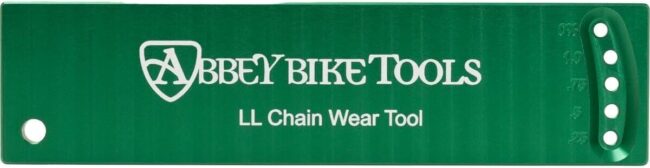
The L.L. in the name stands for the tool’s two chain measurement gauges. One is for length. That’s the measurement that all chain wear tools check. Different tools measure it in different ways. While some are basic go/no-go tools that only show that the chain has life left or is worn out, others measure the amount the chain has lengthened. This lets you put a number on how worn the chain is and by using the tool and keeping track you can learn how long it takes before a chain needs to be replaced instead of guessing.
Length is how we’ve always checked chains for wear. It becomes an issue when you can’t decide if the chain is worn out enough to replace. Chains are getting more expensive. So you probably want to get as many miles out of one as you can. If the length tool shows that the chain has any life left it’s only natural to want to keep running it, especially if the bike pedals and shifts fine. Sometimes that chain might be wearing out and it might be safer to replace it.
That’s where Abbey Tools’ new tool comes in. The second L stands for lateral as in lateral chain deflexion. With this second measurement – the first time I’ve seen a chain tool with it, we have a second way to put a number on how worn a chain is. If a chain is too long and also has too much flex, it’s a no-brainer that it should be replaced. Also, lateral flex has to do with how accurately chains shift so the measurement provides another test for finding what’s causing shifting problems too.
Abbey pulled out all the stops to make the most accurate tool they could. In their own words: “We set out to not only build a tool that handled the variance of roller diameter when measuring chain wear but also measure lateral wear, something nobody bothered to do, until now. Linear wear or “stretch” as it’s commonly called is measured on this tool by locating both sides of the roller in a V shaped notch which allows us to locate the center of the roller accurately regardless of its size. Then you line up the pin with one of 5 holes on the opposite end. This also prevents roller wear from influencing the measurement.
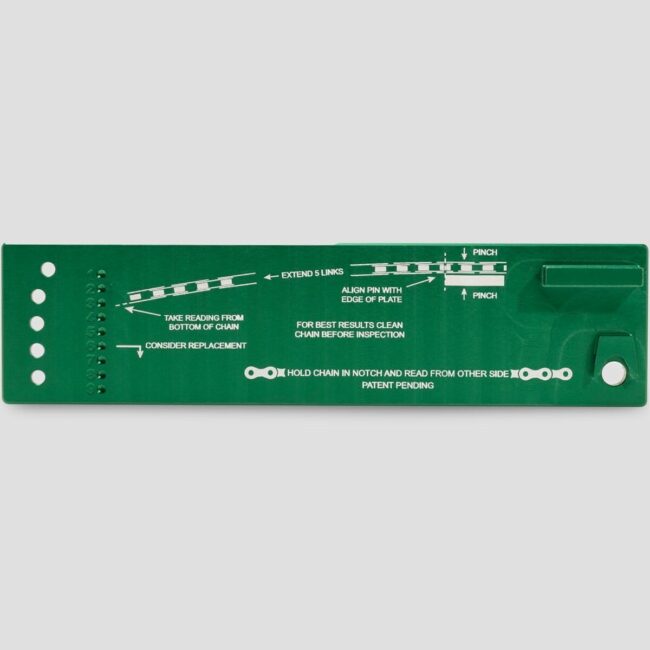
To measure lateral wear, the chain will need to be off the bike. Then simply pinch the chain against the boss and hold it vertical and see how far it sags. Anything below a 6 isn’t shifting well and a new chain will improve shifting quality.
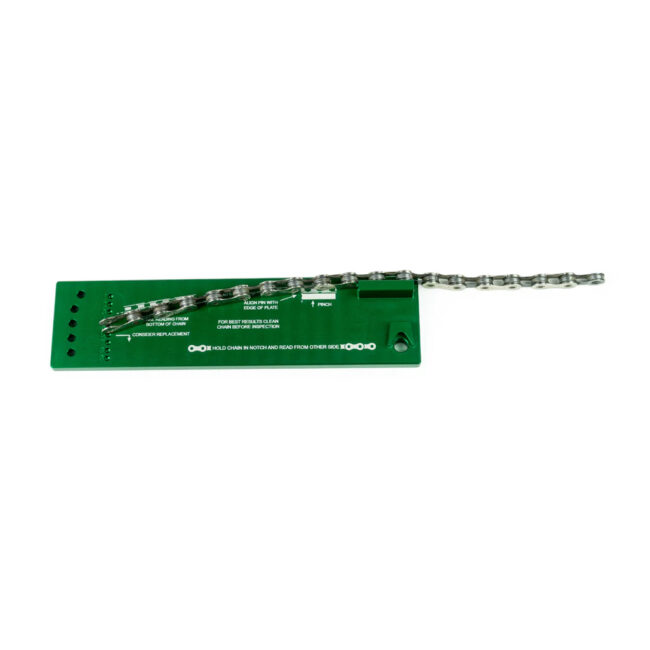
The other big thing we tackled with this tool is the accuracy of the tool itself. Most chain wear tools on the market are cut with a laser, which is a nice process however it’s not all that accurate. We CNC our tool from a billet to give it the durability and accuracy this tool deserves. Since we actually make these in house we also have complete control over the process and are able to hold tolerances as tight as .0002″(.005mm).”
With so many chains coming with quick links now, it’s easier to remove chains so you can take both these measurements. I think Abbey’s got another great tool here that sets a new standard for chain care and that could result in less problems and longer life out of drivetrain components. Here’s a short video of it:
Jim Langley is RBR’s Technical Editor. A pro mechanic & cycling writer for more than 40 years, he’s the author of Your Home Bicycle Workshop in the RBR eBookstore. Tune in to Jim’s popular YouTube channel for wheel building & bike repair how-to’s. Jim’s also known for his cycling streak that ended in February 2022 with a total of 10,269 consecutive daily rides (28 years, 1 month and 11 days of never missing a ride). Click to read Jim’s full bio.
The real question is whether a chain fails lateral chain wear before it fails chain stretch. It would require testing to determine this and thus to determine if measuring lateral wear is actually required. Guess I will need to wait until I can order the tool before determining this and whether the tool will solve a problem or not. Do you know if the manufacturer did this testing?
Thanks for the comment Walt. I couldn’t learn if Abbey did this testing or not, but they do say that the new SRAM “flattop chains” are unique and I believe this tool is in response to that partly, and also to provide 2 ways to evaluate chains – doubling the ways to determine if a chain should be replaced. I can’t see anything wrong with having a second measurement.
Thanks,
Jim
>> To measure lateral wear, the chain will need to be off the bike. <<
And by removing it from the bike, you use up a master link, most of which are single-use. I'm finding that to be a problem with my waxed chain — every time I want to rewax it, I have to remove it, and the cost of those links adds up.
Steve: They do sell reusable master links…should be a lot less expensive that several single use master links.
All master links are reuseable, regardless of what the chain manufacturers say. Josh at Silca, for example, talks about using links multiple times. So long as they are properly installed, and snap into place, they are not going to cause any problems. I am hot waxing my chain, topping up with Silca Super Secret between hot waxings. I expect the master link to last the life of the chain.
Hi Steve,
Walt is correct: there are reusable quick links such as those by Connex and KMC. They say “reusable” right on them. Those are what you should use for rewaxing.
ALSO and very important for safety, if you reuse a link not designed to be reused, you are doing something the manufacturer of the chain doesn’t want you to do because they have tested whether it’s okay or not to do it. I know this because I asked SRAM (chain maker) and Park Tool (independent tester) about this and they both said DON’T DO IT.
But that’s fine because the reusable quick links are readily available and they work fine and can be used over and over. Here’s one of KMC’s – see how it says “RE-USABLE?” https://amzn.to/3y4BTdy
Hope this helps,
Jim
>> Walt is correct: there are reusable quick links such as those by Connex and KMC. They say “reusable” right on them. Those are what you should use for rewaxing. <<
A Wippermann Connex link for a 12-speed chain is $33 on Amazon — and according to Zero Friction Cycling, it's not even compatible with my SRAM AXS 12-speed flat-top chain. The only links that are compatible are the SRAM links, and they're not (officially) reusable; they're about $5 each.
My comment was deleted?!
The old way of checking a chain for wear is still the best way for 2x and 3x drivetrains. A simple steel engineers ruler works just as good and is a lot cheaper, chain checking using the ruler method has been going on for a very long time and it’s been highly reliable at determining chain wear, and you don’t remove the chain from the bike to do it.
Simply place the ruler’s ‘0’ inch mark directly above the center of one of your chain pins. Now count 12 complete links. A complete link equals 1 inner and 1 outer. The rivet on a new chain should line up exactly with the 12 inch mark.
On a used chain If the rivet is less than 1/16″ past the mark, your chain is good. If it’s between 1/16″ and 1/8″ past the mark you’ll need a new chain, but your sprockets should be ok unless the sprocket has already outlasted 3 chains. If it’s more than 1/8″ past the mark, you’ll have to replace both the chain and rear sprockets.
If you have a 2x or a 3x drivetrain lateral measuring is not important, the chain will wear out before the lateral wear would happen. If you a 1x drivetrain bike, then lateral measurement is very important as the cross chaining happening on those systems is stressing the chains and these chains will likely wear out in the lateral before it wears out in a ruler test.
Measuring 2x and 3x chains with a ruler is a tried and true method for over 40 years. Many tools have come onto the market, but the all work the same as a engineers metal (either stainless steel or aluminum) ruler, but why an engineers flat metal ruler? Because they are known to be 100% accurate, won’t break like plastic, and they’re cheap under $16, you can get them in black or stainless, you can get them with or with a hole to peg hang it. Some are triangular shaped, you don’t really need that style. But now with 1x drivetrains it is now crucial to buy a tool such as the Abbey Chain Wear Tool to check your chain with.
1x chains do not last as long as 2 and 3x, typically 1x last between only 1,500 miles to the most 3,000 miles; whereas with a 2 or 3x a chain can last 2,500 to 5,000 miles on average, though some people, like myself, average between 8,000 to 10,000 miles.
I agree completely with Freddy, that the way to measure chain wear is with a steel ruler, this gives results that are easily accurate enough. The big and unresolved question is how worn should you let a chain be before you change it. Certainly chain manufacturers will give you some low number as benefits their sales.
If shifting has been degraded then this could a reason to change the chain. However the only real determining factor is, if you put a new chain on a cassette that is too worn, it will jump. Since a chain will normally wear faster than a cassette, putting successive new chains on a cassette that is gradually wearing out is not the best thing to do and chain #3 could start jumping. To really optimize chain usage one method is to start with chain #1. Switch to chain #2 at the very first signs of wear, similarly then to chain #3. Then go back to chain #1 repeat the sequence and do it again until everything is equally worn out
The question I always have when it comes to chain wear tools is what real value added do they provide beyond a ruler.
Yes and now that Abbey has shown us how they think lateral should be measured you could use a ruler for that too 😉
Thanks Kerry,
Jim