
Your Feedback on Lower Gearing

Jim’s Tech Talk
By Jim Langley
As expected (and greatly appreciated), our article last week about lowering the gearing on a Cervelo Carbon Soloist road bike from 2007, attracted a lot of comments and helpful tips. It will all come in handy should you too want easier gearing for the hills now or in the future. Follow this link to read the original story and all the comments: The Long Story of Lowering the Gearing on My Old Road Racing Bike.
This week I’ll cover some of your recommendations and answer most of the questions you raised about my choices and lower gearing setup.
Why didn’t I go with a compact crankset?
Several of you asked this great question and I don’t have a really good answer, except to say that I really wanted to keep my top-of-the-line Shimano Dura-Ace crankset, mainly because it’s original to the bike and I like how it complements the Cervelo’s aero tubing.
The problem, as you pointed out, is that the “smallest” chainring this crank accepts is a 39-tooth – not very small at all. And because the chainring isn’t small, it means I had to go to a larger cassette. And in turn, that meant a new derailleur that could handle the larger cassette.
Compact crankset: huh?
In case you’re unfamiliar with the terminology, I’ll explain that a standard double-chainring road crankset, which is what my Dura-Ace crank is, usually accepts chainrings in sizes 53 and 39 or larger rings. A compact crankset usually has 50/34 chainrings. And there are also what’s called sub-compact cranksets that go even smaller with 48/32 or 46/30 as a couple of examples. The photo shows a Shimano compact crankset with 50/34 rings.
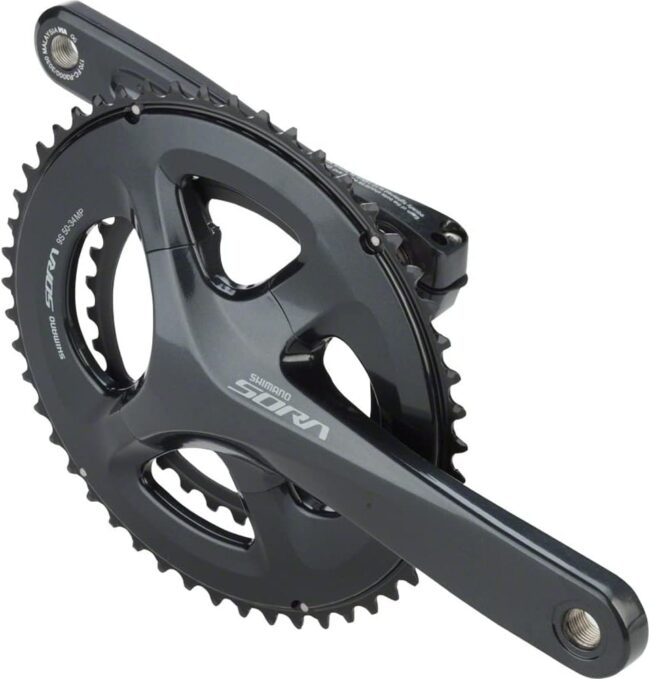
Compact and sub-compacts are a nice way to get easier gearing and without changing the derailleur or shifters. Because the chainrings will be smaller than the previous ones, one thing to check is the front derailleur. It has to be able to be lowered until it’s just about 3mm above the large chainring in order to keep it shifting properly.
If your bike has a built-in front derailleur mount (or one brazed on), it might limit how low the front derailleur can go and that can make a compact or sub-compact crankset incompatible with your bike. If it’s just a little bit off, there may be a workaround to lower it such as filing the hole in the mount a bit, but definitely don’t do anything that compromises the mount’s strength.
If you have a clamp-on (also called a “band-type”) front derailleur, you can usually loosen the clamp bolt, which will loosen the derailleur on the frame and let you lower it as far as it needs to go (provided there’s nothing in the way, such as a bottle cage braze-on as just one example).
Did I consider a triple crankset?
To get even lower gearing – even super low, some of you have gone with triple cranksets and suggested that option. I did not consider it because it would have meant changing the other shift lever since it’s for double chainrings. And, I don’t think I could have lowered the front derailleur enough to shift a triple.
The beauty of triple chainrings is that you always have a bailout gear if the hills get too steep or you plain run out of gas. Some people will say that at that point you might as well get off and walk because you’re moving so slowly in that tiny gear. But I always found it was easier to keep pedaling than walk so I disagree.
Triples were very popular for touring road bikes and then were on every mountain bike before the single chainring “1X” (say “one by”) took over. Triples are still a fine option (though there aren’t as many options as there used to be), but I wanted to stick with a double on my racing bike to keep the shifting simpler and keep the weight low too.
NOTE: Speaking of triple cranks and availability, I noticed recently that my friend Grant Petersen over at Rivendell Bicycle Works carries a couple. Velo Orange also has one and I believe Peter White Cycles still carries TA triple cranksets. Here are links if you’d like to take a look:
https://www.rivbike.com/products/crank-akhdkgn2154sdg
https://velo-orange.com/collections/cranks/products/grand-cru-110-fluted-triple-crankset-24x34x48t
https://www.peterwhitecycles.com/tach.php
Did I consider other Shimano derailleurs?
Yes, I did look at a number of different Shimano derailleurs both road and mountain. I decided I wanted to stick with a road derailleur since that’s what the bike had originally.
I also did not want a newer model of Shimano rear derailleur that uses a B-link such as the Ultegra R8000 (photo). While it’s supposed to only handle up to a 34-tooth cog, you can usually get them to shift to a 36. But, I dislike the looks of these B-link derailleurs and wanted one that is actually designed to shift onto a 36 too, within spec.
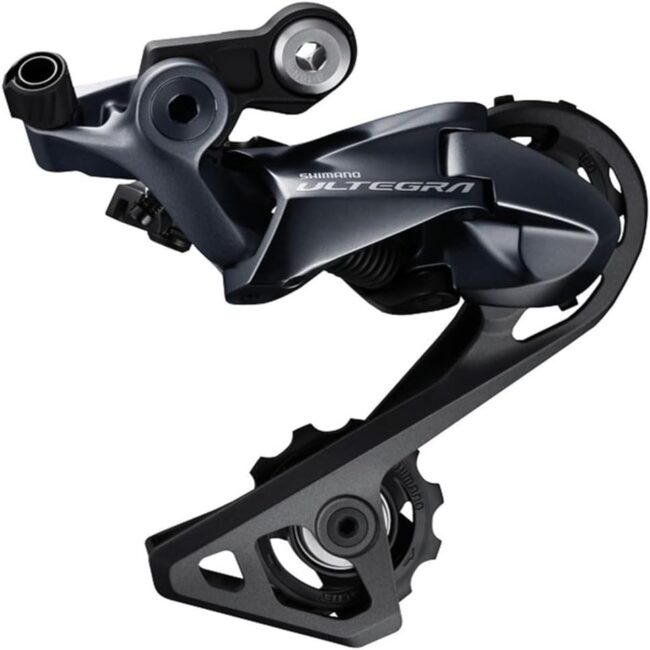
Like my decision to keep the Dura-Ace crank, a road derailleur without a B-link would keep my Cervelo looking the way I want it to. Also, the Shimano Tiagra derailleur I went with is made to handle a 36-tooth cog.
Tips for going lower if you’re okay running mountain bike derailleurs
I explained that I wanted to stick with a road derailleur. But several of you pointed out that had I been open to it, I could have kept my 10-speed shifters because their pull ratio would work with 9-speed Shimano mountain bike derailleurs. That would have saved me some money too since I wouldn’t have had to replace the shifter, so overall, it’s probably a smarter option.
Answering compatibility questions has gotten easier
One of the challenges of lowering the gearing on a bicycle is figuring out what works with what. It’s always been complicated and you used to have to do the research, finding the specs for the components you wanted to use to be sure they are compatible with each other. Or an easier way, by inquiring at your local bicycle shop.
Recently it has become easier to do this online and I believe it’s thanks to artificial intelligence (AI) that’s now built in to the different browsers. I use Google Chrome and Safari on my Mac desktop and iPhone.
For example if you want to determine what the pull ratio is on a certain shifter, you can type the question in the search bar in these browsers and you’ll get a fairly complete answer in seconds. Or, if you want to know the largest cog a derailleur will handle, you’ll find that information too. You do want to use the correct part names and models to get an accurate answer.
I can’t be certain that your online devices and browsers will give the results mine do, because I’m not sure what’s working the magic, but I believe it’s AI and I think most up-to-date devices are running it at some level. With any luck yours will be as helpful as mine for figuring these compatibility questions out. It’s a lot easier than digging out old component catalogs looking for specification charts!
Thanks again for the excellent comments and for sharing all your stories of how you’ve lowered your gearing. Keep conquering those climbs!
Jim Langley is RBR’s Technical Editor. A pro mechanic & cycling writer for more than 40 years, he’s the author of Your Home Bicycle Workshop in the RBR eBookstore. Tune in to Jim’s popular YouTube channel for wheel building & bike repair how-to’s. Jim’s also known for his cycling streak that ended in February 2022 with a total of 10,269 consecutive daily rides (28 years, 1 month and 11 days of never missing a ride). Click to read Jim’s full bio.


Did pretty much the same thing as you. Have 2002 steel Landshark that was Campy Chorus. Wanted a compact crank. was going to be a bit of a hassle with an old Campy tapered BB. Summer 2024, my LBS had a 2023 Shimano 105 group sitting on shelf with a compact crank he gave me for good discount. It’s been great. My main ride is a 2020 Trek Domane SL6 but I take the Landshark out with it’s custom Slawta for giggles and grins.
Nice to hear about your upgrade Chuck. I bet your Landshark rides like a dream!
Thanks,
Jim
With some crankset, one can achieve lower gearing by just replacing the Chainrings.
Jim,
I’ll probably be the odd man out, because in almost all of 420,000 miles I’ve ridden, my setup was a single 45 tooth ring. I did the Mount Mitchell climb in South Carolina ten times and the lowest cog I had was a 28. I wouldn’t consider myself strong but it worked for me.
At 86 my balance is not so good, but I still pedal 10 miles each morning in the garage.
Thanks for sharing and congratulations on being able to stick with that 1960’s gearing for so long Bob! It worked for Jacques Anquetil and it worked for you too😊
Regarding lower gearing, I am a rider without much leg strength — it’s just the way I’m made. As I am now in my 70’s, my poor legs are even weaker. My question has to do with cassettes. Both of my bikes (Ultegra 11-speed and SRAM 12-speed) have cassettes with the smallest rings of 11 and 12 teeth. I can honestly say that I have never used either of those rings, even on the steepest downhills I encounter in hilly Tennessee. Why doesn’t a manufacturer make cassettes that start at 13 teeth? That would give more reasonable steps when going into the lower gears (2 or 3 teeth shifts instead of 3 or 4)?
Here’s a 12-sp cassette with a 13-tooth bottom cg Craig:
https://www.pinkbike.com/news/ethirteen-announces-new-close-range-and-wide-range-cassettes.html
Hope this helps,
Jim Langley
I was excited when I saw this, until I realized that it’s a 13-52 cassette, designed for 1x cranks. It’s really frustrating that nobody is making 12, or 13-speed road cassettes that start with a 13-tooth cog. There are a lot of us who simply have no use or need for higher gearing, but the major manufacturers keep going in the opposite direction, with 9 and 10-tooth cogs. It really makes no sense that they’re ignoring a substantial part of the market.
I did find that Miche is making 10 and 11-speed cassettes for both Campy and Shimano that start with 13t cogs. https://miche.it
You can’t get rid of the 11 tooth, but I combined a 11 – 25 shram with a 11 – 34 to get the gears I wanted in the mid-range. Left out the 13, so I could have a 15, 17, 19, 21.
I’m pretty sure the AI is happening at the search engine server (e.g., Google) and not in your device, so the enhanced information gathering you are seeing should be the same for anyone using the same search engines. I’m a computer scientist but not an AI researcher or web engineer, so I’m pretty sure I understand what’s going on here, but would defer to someone who works more closely with these systems.
I did this to create my first gravel bike. My 2001 Sirrus came with mountain gearing. I changed from flat to drop bars, added 10 speed Ultegra controls and front derailleur from a totaled road bike while keeping the 9 speed Deore rear. I used new 105 50/34 compact cranks with an 11-36 cassette. Pull ratios were the same, though the mini-Vs ended up needing travel agents.
My 2009 Cervelo R3 has a complete Dura Ace 10 gruppo including compact chainrings; so they are/were available.
Your Taigra setup is a great solution. Nice to have closer spacing with the 11 cogs.
While not the most visually pleasing, I’ve taken a Chorus triple, taper BB, and changed the small ring to a 26, via Specialties TA. I then fashioned some spacers, removed the large chainring and created a 26-34 crank, paired with an 11-32 cassette. I used my existing Record front mech (double), and with a bit of fine tuning, got it shifting quite well. Yup, there’s a larger space between the 34 and the mech, but it still works fine. The potential issue is shifting into the 26-11. Chain slack and slight rubbing on the bottom of the front occurs, but it almost never occurs and when it does, it’s simple to fix with on click.
OK, why did I do this? I didn’t want to spend extra money switching to another manufacturer’s drivetrain and I had these used parts available. I’ve had good experience pushing campy products beyond their stated limits. And most importantly, I need lower gearing for hill climb events that last about 70 minutes with an average gradient of 7%.
One thing I can say about using AI to provide options is that the source material is usually the manufacturer’s manual. Thus, AI rarely provides info the suggests how you might push the limits. Might be worth incorporating that into you prompt (i.e., push the limits of what might work).
This is an excellent approach! Most folks have high gears they never use. My top end is a 42 x 13 and it suits me just fine. Going to a 36 x 11 is the same gear and this reduces the need for a super-big cassette to get low enough gears.
My friend Tony Hoar, who was Lanterne Rouge in the 1955 Tour, many years ago gave me his Cinelli Model B “torpedo” training bike. It was constructed around 1954 in Modena by Cinelli’s framebuilder. For early-season training to build leg strength quickly, pros of that era converted race bikes to fixies, with a single enormous gear and no brakes (though Tony installed a rear brake on his).
At my advanced age (75), this bike requires leg strength I no possess to get up and down the Oakland hills. I have had the gearing lowered and the bike converted to a coaster, and added a front brake. Mostly I ride my Lemond, but on days when I feel especially strong I’ll go for a spin on Tony’s torpedo and be rewarded with a thoroughbred riding experience.
I have almost the same bike as you (S2) but chose a new bike for different reasons. The biggest was the worsening shift quality due to the poorly designed cable routing under the BB. As the guide wears (and cannot find replacement part…) the shifiting became a huge issue – regardless of the gearing.
Dave, I had a similar issue with my custom steel bike having poorly aligned bottom bracket guides. Too much friction!
I’ve solved it by using maybe 3” regular gear cable housing held in place by a couple of zip ties. Works great!
Thanks for your great comments everyone!
Appreciate you!
Jim Langley
I was excited when I saw this, until I realized that it’s a 13-52 cassette, designed for 1x cranks. It’s really frustrating that nobody is making 12, or 13-speed road cassettes that start with a 13-tooth cog. There are a lot of us who simply have no use or need for higher gearing, but the major manufacturers keep going in the opposite direction, with 9 and 10-tooth cogs. It really makes no sense that they’re ignoring a substantial part of the market.
I did find that Miche is making 10 and 11-speed cassettes for both Campy and Shimano that start with 13t cogs. https://miche.it
I checked on Miche a couple of years ago. It doesn’t appear that they serve any US markets. Hopefully folks in Europe can benefit from their products.
You can buy Miche products from various European sources. May have a bit of shipping charge, and must make sure your credit card service knows you’re buying offshore.
Thanks, Mitchell. I had not thought of checking another source – eBay – and found some for sale from a company in Canada!
Here’s what I did with my 2001 Litespeed Classic for lower gearing: By using a Wolftooth Roadlink Direct Mount I can combine Ultegra 11 speed shifters, front crank(34/50), front derailleur with Shimano GRX long cage rear derailleur (11-42) and get all the lower gearing I need. I did this on both my Litespeed road bike and Seven touring bike. On my Seven touring bike I use a Shimano GRX front crank(31/46). Lower gearing is especially important on a touring bike when you’re carrying another 40-45 pounds. My local bike shop mechanic was skeptical to do this when I first suggested it but is a believer now.
I appreciate your input, Funhogs2! I have a 1999 Litespeed Classic in the basement that is only good for flatland riding because of the gearing. Your solution sounds like something I can do to help with the Tennessee hills!
I had a recent conundrum in ‘lower’ gearing: The obvious swap for my 9-speed 7700 Dura-Ace — back when that was state of the art but also when I didn’t much like pushing the 23 cog the gruppo came with in either the 53 or 39 chain ring — was the very nice 12-27 cassette. So I had solved the lower gearing problem simply and cheaply (if 39×27 wasn’t low enough, well, I’d use another bike or find another. route).
Today I cannot locate anywhere.a new 12-27 cassette! Shimano ought to be turning these out by the truckload but ???
Like others, I am reluctant to change out the nice crank set or nice derailleurs just to lower the gearing out of a combination of sentimentality, aesthetics, and being cheap.
Maybe the 7700 DA rear could shift an 11-28 9-speed cassette but 1) who needs 53×11? And 2) maybe not. So instead I went with a SRAM 12-26 and swapped the rings for 52 and 38. The 38×26 is only about 1/2 a gear-inch higher than the 39×27, if I remember my calculations correctly.
I forgot to mention in my previous statement that I can use Shimano’s Mountain cassette with a 11-42 range due to using the Wolftooth Direct Mount.