
Quick Review: Prungo FluxGo Red Light Therapy Module

Jim’s Tech Talk
By Jim Langley
I’m not a doctor and I have no knowledge of the science or studies behind red light therapy. I also haven’t done any research to either back up the claims of red light therapy proponents or dispel them.
What I can tell you is that I personally tried this company-provided sample Prungo FluxGo Red Light Therapy Module (RLT300) that I’m reviewing here and it was effective on the tennis-elbow pain I suffer from (my second sport is table tennis). However, it was not effective on my bone-on-bone knee pain. In fairness to this product, doctors have told me that the only cure for that pain is having my knees replaced.
The reason I decided to review this product is because anecdotally, I know people including cyclists are using red light therapy devices to ease pain and speed recovery. If that’s you, based on my use of it, I believe the Prungo Red Light Therapy Module is a well-designed, easy to use system that works well for its intended purpose.
Simple and versatile
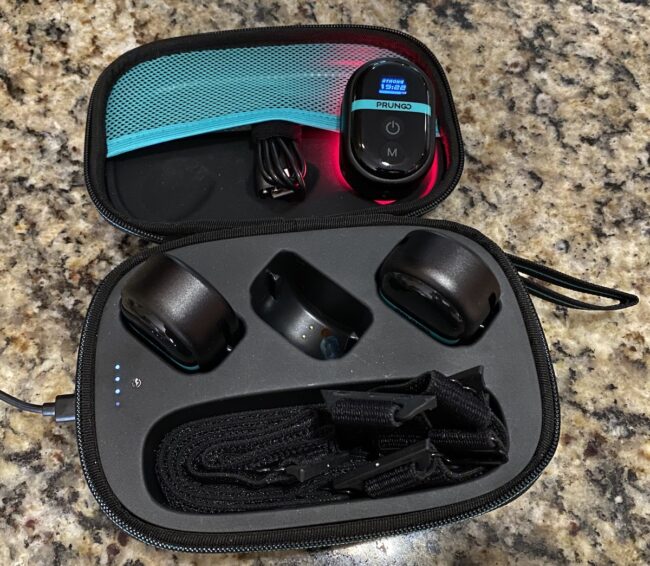
Most impressive to me is the simplicity and versatility of the design. There are three small individual rechargeable LED red lights, which I’ll call pods or pucks. Prungo calls them “medical-grade lasers.” Each puck measures approximately 1.8 inches wide x 2.8 inches tall x 1.1 inches thick (48mm x 72mm x 29mm).
There are 6 red LED lights on each puck, and each puts out 650nm (nm stands for nanometers). Prungo says they utilize both LED lights and infrared laser light.
The Prungo modules are constructed of a durable plastic hardshell case. Each is extremely lightweight at 96 grams (actual weight of one of mine). This makes for comfortable, wearable use. The pucks have slots on the sides. Included are several elastic adjustable straps with ends that push into the slots in the back of the lights.
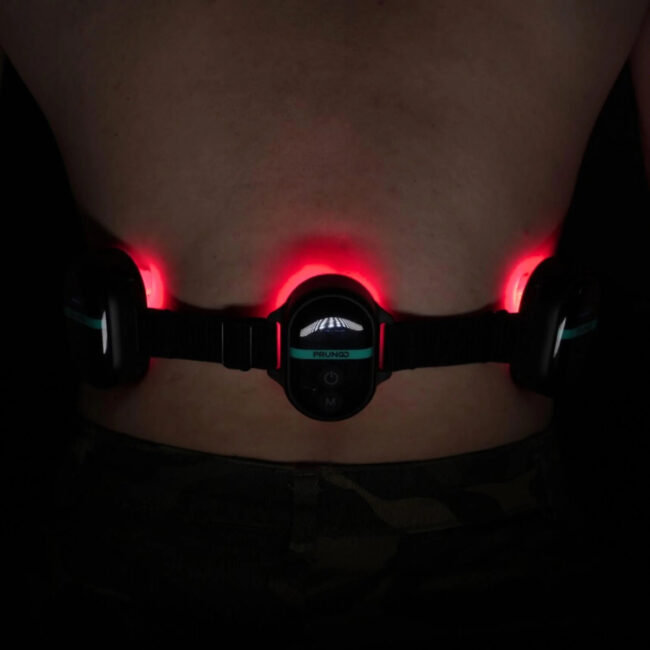
The straps included let you build a single-, double- or triple-light “belt” that you slip over or wrap around whatever body part is hurting, your knee, elbow, back, etc. Once the Prungo lights are in place, it’s simple to control them with the 2 buttons on each unit.
Intuitive controls with displays and built-in timers
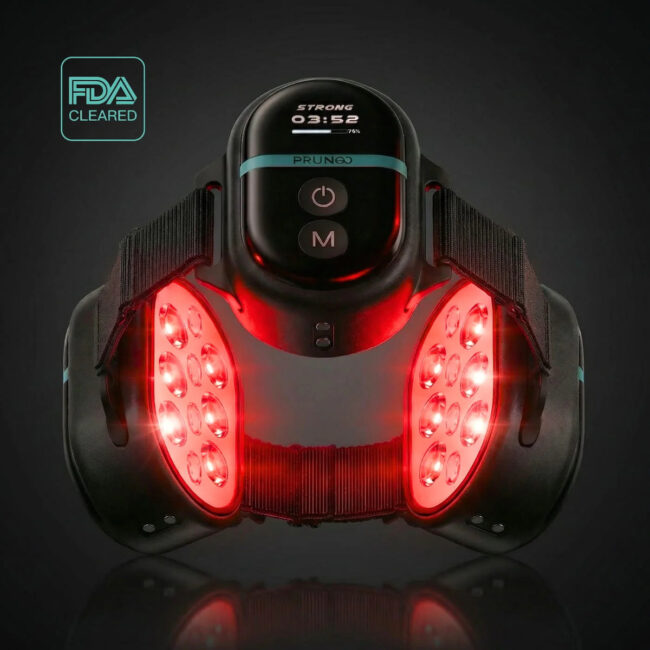
Pressing the power button turns them on. Next you press the mode button to select either MILD (8 minutes), MID (15 minutes) or STRONG (20 minutes). Pressing the power button again turns on the red lights and starts the countdown timer. When a button is pressed there’s a “beep” sound so that you know it’s working.
Above the buttons on each device is a screen displaying the modes you choose from and also the countdown timer so that you can check it as the therapy is happening. When the time runs out, the lights turn off on their own and a beep sounds so that you know the unit has turned off. If for some reason you want to pause during a session, you can hit the power button to pause the timer and turn off the light and hit it again to restart it.
My tests
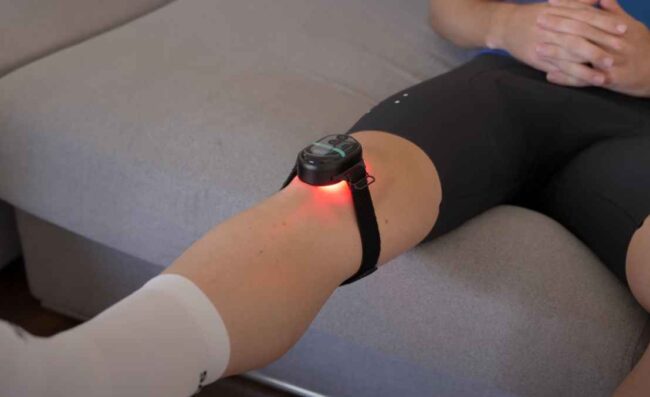
In my experience one of the challenges of recovering from injury is maintaining the motivation to do the work required to get better. Personally, I’d much rather be riding my bike than doing physical therapy exercises or icing aching body parts, etc. at home. So, I appreciated that the Prungo device was so easy to set up and use. Once I had it ready for my knees, I could simply slip it on and use it while watching race videos or eating breakfast. And changing it to use on my elbow was fast and simple.
I tried it on each of the modes and multiple times on my elbow and both my knees. I tested it with an individual module and with 2 and 3 modules too. What I felt using it was a warmth that gradually increased and felt like it was reaching further below the surface. It did not cause any burning sensation. After use, I couldn’t feel a change in my knee pain. But on my elbow, the pain was reduced and after five treatments the pain was almost completely gone.
As I did, you might wonder if it will burn your skin or cause a sunburn. I also wasn’t sure how the increasing warmth deeper in my elbow and knee was created. According to Prungo, what’s happening is that the “visible red and near-infrared spectrums from the lights are entirely free of UV rays” so they can’t harm the skin. They also explained that they’re using “cold” laser technology, which is safe, unlike surgical or cosmetic lasers made to cut or resurface skin.
They added that the warmth that you feel in the treated area actually comes from “vasodilation, where the light causes the blood vessels to expand and naturally increase localized blood circulation.”
For a deeper dive into red light therapy, see this white paper on the Prungo website: https://prungo.com/pages/science
Ease of charging, electronics and run times
It’s handy how the Prungo lights are recharged. There are two choices. One way is similar to how earbuds work. The kit comes with a zip-up nylon hard case for storing the three lights, the charging cords and the straps when they’re not in use. The charger is built into the case (there’s a battery inside it). When you put the pucks into their pockets, they start to charge. To charge the battery in the case, you just plug the cord into the case and into a USB charger.
The second way you can charge them is individually when they’re out of the case. A separate charging cord made for this is included in the kit. It plugs into a USB outlet and the other end attaches via magnets to the light you’re charging. As it’s charging, the display on the back shows the power level percentage.
The individual Prungo red light therapy modules use Lithium-Ion 700mAh batteries. The portable zip-up charging case actually has a 5000mAh Lithium-Ion battery inside it to recharge the modules on the go as well as when it’s plugged into USB power.
According to Prungo, once fully charged, each module delivers up to 240 minutes of therapy, depending on the intensity mode you use. And, it takes approximately 3.5 hours to fully charge a dead Prungo light. If the entire system is drained, charging all three in the charging case itself takes roughly 4 hours.
Verdict
I’m happy to have had this chance to test Prungo’s FluxGo Red Light Therapy Module kit. It’s impressive how small and portable it is and how easy it is to use. I’ve used it multiple times and it’s worked well every time. Charging is simple too. Overall, I think that if you benefit from and use red light therapy, you’ll find that this Prungo FluxGo is an excellent addition to your healing and recovery toolkit.
Sources, pricing and reviews
The Prungo FluxGo Red Light Therapy Module sells for $399 and is available at https://prungo.com/products/prungo-red-light-therapy-module-fluxgo where you will find complete specifications and user reviews. Prungo provides a 30-day trial allowing you to return it if it doesn’t work for you. They also offer free worldwide shipping.
While my test unit was sent to me from the company, in preparing this review I discovered that it is also sold on Amazon – just search on “Prungo red light therapy.” It is currently selling there for $339.99, which is a sale price so that might change. Also listed is an individual module for $139.99. To see what others have to say about the product, there are now 466 customer reviews on the Prungo website averaging 4.8 stars out of a top rating of 5 stars. There are 69 now on the Amazon product page averaging 4 stars out of 5.
Jim Langley is RBR’s Technical Editor. A pro mechanic & cycling writer for more than 40 years, he’s the author of Your Home Bicycle Workshop in the RBR eBookstore. Tune in to Jim’s popular YouTube channel for wheel building & bike repair how-to’s. Jim’s also known for his cycling streak that ended in February 2022 with a total of 10,269 consecutive daily rides (28 years, 1 month and 11 days of never missing a ride). Click to read Jim’s full bio.

3.8 / 5.0 on Amazon currently. Customers seem to complain about its battery life issues and design glitches (falls off, moves, poor strap system…)
Excerpt below from Harvard Health. https://www.health.harvard.edu/skin-and-hair-health/red-light-therapy-for-skin-care :
“For the devices to be effective, they must be used multiple times a week for four to six months,” she says. “It’s slow and steady. It’s not going to be anyone’s quick fix.”
Cut-pasted from Dr Google:
The biggest challenge with RLT is the gap between clinical-grade research and at-home consumer devices. To get the results demonstrated in studies, devices must emit the correct wavelength (typically 600–900 nm) and irradiance (power density). Overpowered or improperly dosed lights can cause mitochondrial stress and inflammation rather than healing.You can consult the American Academy of Dermatology or review the multi-study overview on Harvard Health for more objective guidance on selecting and using these devices safely.
In my actual use of the product Giuseppe – and as I wrote in my review – the strap system works really well. My system electronics and batteries have been flawless as well. I bet people complaining about the straps is due to improper use.
Also, I don’t understand the Harvard review comment about “a quick cure.” What matters more is that it helps you, even for it takes more time. And they are saying it works too.
Jim
i would not expect that to do anything that a heating pad, or placebo, can do.
[placebo does work for some things though. it’s not all fake.]
for knee/arthritis stuff, glucosamine/chondroitin might help.
wle
You’re right, the data in this is not at all encouraging. Unfortunately it’s not good for glucosamine either. The heating pad comparison is 100% spot on.
Agreed 100%. It’s a. Elaborate warm water bottle. No data proves this works, unfortunately.
Joe
[[ i meant ” i would not expect this to do any more than a heating pad, or placebo, could do. ” ]]
i don’t see what the ‘red light’ part adds.
I have osteoarthritis in the family and mine is the worst in my knees. In early 2024 I was told I get one more steroid shot in each knee and then new knees. We belong to Golden Retrieve Rescue and we adopted our latest who had a completely dislocated front leg, ball out of socket and healed that way so our vet said leg must go as did two orthopedic vets I took him to. Desperate I searched for a better result and found dog and cat meds Duralactin, made for joint problems and made from the lactin (a dried milk protein) found in the few dairy cows that don’t have joint problem which all the rest do being stuck in milking machines all day. They saved his leg and it is now made for humans, Microlactin. I am careful to do no more thatn 20+ miles 3 or 4 times a week on road bikes and have not been back to my Orthopedic Surgeon in over two years.
Thank you for the tip Ken, appreciate it!
Jim
Jim,
I’m 78 and have been riding for 35 years. I’ve logged over 200K on 2 wheels. A year ago I started having knee pain. X-Ray’s confirmed it was bone on bone. The steroid shot did very little to relieve the pain. Ironically I had no pain when riding the bike but walking and getting on and off the bike were painful. In November I had a partial knee replacement. One of the smartest things I’ve done. I have full functionality and very little discomfort. As with any surgery I’ve had the therapy afterward is key to a full recovery. Just do it.
Thanks Michael,
I’ll read up on what a partial replacement is to learn more. Unfortunately, I hear more stories of knee replacements gone wrong – sometimes horribly – than successful ones. That’s why I can’t bring myself to just do it. I can still ride too, just not like I could.
But I do appreciate you sharing and will read up on it,
Jim
Jim,
My surgeon was a team RAAM participant so I felt pretty comfortable he’d do a good job on a fellow cyclist.
FWIW, I know a few people who’ve had knee replacements and every one has said that their only regret is that they didn’t do it sooner. Some of them have had both done and they’re pain-free.
Fortunately, I don’t have any significant knee issues at this point, just a little post-ride soreness that goes away on its own.
Best of luck with whatever you decide.
Same here, good friends had great outcomes with the first knee but not the second. Fred is still in physical therapy (which he says is very helpful) but for almost two years now long after insurance coverage. Howard had a fall right after surgery with his walker and believe it or not do to ligament damage they attached a steel bar from above and below the knee by drilling through the femur and tibia bone above and below the knee and bolting through the bone to positively eliminate a possibility of movement. For 90 days Anne helped him out of bed into the wheel chair, out of the chair onto the toilet and back in the chair and then back into bed. I has been over a year and he is just now graduating from a walker to a cane.
I’m most interested in whether this device will assist with chronic neck muscle tightness related to arthritis which is sometimes aggravated by riding (I’m not ready to go fully upright yet!) Heating pad somewhat helpful but also very inconvenient.