Newsletter Issue No. 971
July 1, 2021
Why Strava May Be Bad for Your Training

By Coach John Hughes
I’ve been getting a number of e-mails with variants on the same questions, “My Strava times are getting worse. How can I train better to go faster?” Or “My Strava times are worse than my buddies. What can I do?” Read more.
Another Tool Tip For Removing (Not Installing) Tight Tubeless Tires

By Jim Langley
In several recent columns like this one, I’ve offered tool tips and ideas for a common and extremely frustrating issue with some tubeless tire and tubeless-ready rim combinations. Read more.
Saddle Surgery: Cutting Out the Numb

By Greg Conderacci
They’re heavy. They’re expensive. They creak. They stretch until they become unusable. Sometimes, parts break (ALWAYS at the worst time).
So why do so many ultra-endurance cyclists ride Selle Anatomica saddles? Read more.
Muc-Off High-Pressure Quick-Drying Chain Degreaser – Quick Review

By Sheri Rosenbaum
I’m a big fan of Muc-Off and have reviewed many of the company’s products over the years. Last month they sent me a couple of cans of their new High-Pressure Quick-Drying chain degreaser to test. It comes in a huge 750ml (25.3 fl. oz.) can that provides high-pressure turbo-spray action. The heavy-duty formula cuts through dirt and grime with virtually no effort. In addition, per the company, the unique quick dry ‘zero residue’ formula evaporates after application to leave components clean and dry with no need to rinse after use. Read more.
How to Make the Most of Training
By Martin Sigrist
Take away: “Every performance related ride should have three clear objectives, improving power, improving mental strength and reinforcing perishable skills.”
A while back I made a comment on an RBR article saying that it is just not true that the older you get the worse you get. Lars got in touch and I’ve since contributed a few articles expanding on that thought along with the related topic of how important strength and mobility training are at all stages of life. Read more.
Shimano RC7 Road Cycling Shoes Review
By Rick Schultz
My old SH-R320’s are wearing out. I have been using them for indoor cycling ever since wearing out my SH-R321. For outdoor cycling, I still favor my Lake Cycling CX-332 in custom color day glow green (yes, I chose that color so the cars can see me better). My 320’s are completely soaking wet after a workout, and they never seem to dry completely. So, when I got notified by Shimano that a shipment of their shoes came in, I jumped at the chance to pick up a pair. Read more.
How Hot Is Too Hot for Cycling?

QUESTION: How hot is too hot to be out riding my bike? I came home the other day from an afternoon ride and felt a little sick for the rest of the afternoon, with no appetite. – Arnold W
RBR’S STAN PURDUM REPLIES: If you’re looking for a number, start with a feels-like temperature of 90 degrees (Fahrenheit), which is about where many forecasters start warning about dangerous heat, but several factors can move that limit up or down. Read more.
Quick Tip: Start Hills in an Easier Gear
Start up each hill in one gear lower than you need.
Let’s say you come to a hill that you usually begin in your 39×19-tooth gear. On a good day you make it to the top in this gear, but sometimes you don’t. You have to shift to the 21 cog or even the 23, and you really slow down. Read more.
Your Best Season Ever Bundle
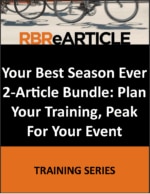
In Your Best Season Ever 2-Article Bundle: Plan Your Training, Peak For Your Event, Coach John Hughes, drawing on his 20 years of coaching experience in these two eArticles, explains how to use current training science to plan and reach your goals.
- In Your Best Season Ever, Part 1 Coach John Hughes explains how to improve, by doing: The right kinds of workouts → At the right times → In the right amounts → Resulting in continuing progress. I walk you through how to create your own specific, personalized training plan and then get the most out of your training.
- Your Best Season Ever, Part 2 takes what you’ve learned in the first article and builds on it. Coach John Hughes teaches you how to peak for your own key event. You will learn how to: Analyze your event; Develop specific training objectives; Create and test a personal strategy; Train for peak fitness; Learn what you should eat, and when; Select the optimum equipment; Learn mental focus; Taper so you are fresh; and Control how you ride your event.
Question of the Week
Do you have a maximum temperature for riding in the summer?
Other Cool Stuff to Read
Road.cc: Leah Goldstein makes history by becoming first female cyclist to win Race Across America
YouTube GCN: We Designed The Hardest 100km Bike Ride Possible
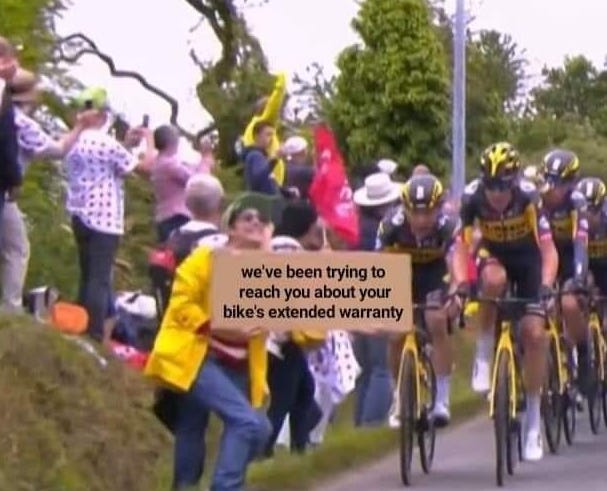
Sticky Bottle: Is pro cycling’s focus on data, Strava helping to cause crashes at Tour de France?
VeloNews: Officials arrest woman who provoked stage 1 crash at Tour de France
End Note
I just discovered that my TT bike has cranks of two different lengths. The left 0ne is labeled 172.5, the right is labeled 175. What the heck? Do you know of a reason why they might be that way? I can’t believe I’ve had the bike 10 years and just now noticed that. My power meter fairly consistently shows a L/R power balance of 53%/47%. My road bike with 175 mm cranks is routinely 50/50. Do you think the imbalance indicates that I can produce more power with a shorter crank?