
New Helmet Technology: Designed to Reduce the Risk of Concussions

By Sheri Rosenbaum
At the end of September, a new helmet technology was introduced. Designed to reduce the risk of concussions, the Release Layer System (RLS) addresses one of the most common causes of brain injury: rotational motion during impact. RLS is designed and manufactured in East London, UK.
How RLS Works
RLS uses a patented layer that fits under a helmet’s shell, engineered to react instantly upon concussive impact, allowing portions of the helmet shell to release and roll on lightweight polycarbonate bearings. This helps redirect rotational energy away from the rider’s head.
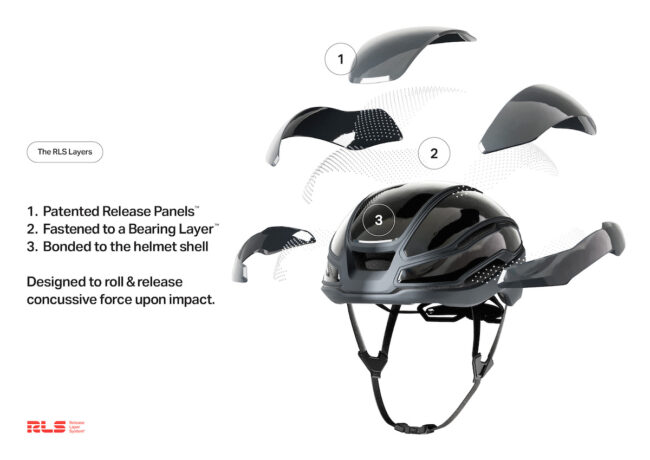
Within the layers of a helmet using RLS technology, RLS panels are connected to a lightweight polycarbonate bearing layer designed to activate upon detection of a significant impact force. Upon impact, the technology engages within milliseconds. The bearings are free to roll in any direction, allowing the RLS panel to release and thereby redirect concussive forces away from the brain.
- React: The patented RLS adhesive layer is engineered to react instantly to a specific impact force, releasing its grip and allowing the bearings to roll.
- Roll: The RLS Panel is now free to roll on lightweight polycarbonate bearings in any direction, redirecting rotational energy from the brain.
- Release: The RLS Panel releases to dissipate further rotational energy, which can help better protect helmet wearers from concussive force.
According to the company, conventional helmets are designed to address linear impact forces, even though most real-world accidents generate significant rotational forces. Some technologies, such as MIPS, aim to mitigate these rotational forces by allowing the helmet to rotate independently from the skull. These technologies, generally located inside the helmet, offer a limited range of motion during the critical milliseconds of an impact. RLS addresses rotational motion through the free release of panels located on the outside of the helmet.
The RLS technology, like many innovative breakthroughs, was accidentally discovered by Jamie Cook, the founder of RLS. While working in the helmet industry as a co-founder of HEXR, a company specializing in 3D-printed custom helmets, Jamie observed that the outer shell of a colleague’s 3D-printed helmet released during an accident. This release significantly reduced rotational forces and the risk of concussion. Intrigued by this finding, Jamie and his research team investigated the most effective methods for releasing helmet panels, eventually leading to the incorporation of small, lightweight bearings between the shells.
Does the RLS System Add Weight to the Helmet?
The additional weight of adding the RLS system, including the release panels, is about 45 grams. The extra weight of the MIPS system is about 25-45 grams.
Which Helmets Are Using RLS?

The company is working with several helmet manufacturers to incorporate RLS technology. Currently, the first RLS helmet available to consumers is the Canyon Deflectr Trail. I received a Canyon helmet for testing, but its unique, rigid, plastic HighBar 1.5 chin strap (unrelated to RLS) was uncomfortable and didn’t fit my face shape well.
Simply glancing at the Canyon helmet, it wasn’t apparent that the RLS technology was part of it, looking like any other bicycle helmet shell.
I’m hopeful another helmet brand with RLS will be available for testing soon.
Independent Testing Results
The RLS helmets from Canyon and HEXR each received a Virginia Tech 5-star rating and ranked 1st and 2nd, respectively, for bicycle helmets. As of December 10, 2025, the Canyon Deflectr ranked #1 for MTB helmets, and HEXR Miden ranked #1 in the Urban category.
Tests conducted by ICUBE at the University of Strasbourg, a world-leading research center in biomechanics, found that helmets with the RLS reduced Peak Rotational Velocity by an average of 56-66% across different impact locations, compared to the same helmets without RLS. This corresponds to a 68-84% reduction in the probability of brain injury, as estimated by the Abbreviated Injury Scale (Level 2).
Does a Helmet with RLS Require Any Special Care?
The company’s website states that, although RLS release panels are designed to react, roll, and release only when concussive force is detected, it’s a good idea to handle the helmet with care when you’re off the bike. Remember to put it in a bag when not in use, and take a little extra care not to snag or pry up the edges of the release panels; you should have no issues.
Does RLS Work in Any Temperature?
RLS works in almost any temperature and was tested from -4 to 122 degrees F (-20 to 50 degrees C).
Bottom Line
RLS marks a meaningful step forward in helmet safety, offering a unique, fresh approach to reducing the rotational forces most responsible for concussions. Early independent testing suggests the technology’s potential is more than theoretical, with strong performance results and top safety ratings already emerging. While adoption by helmet manufacturers is just in the beginning stages, RLS offers a new option for riders seeking better protection without compromising weight or comfort.
Sheri Rosenbaum regularly contributes articles and reviews products for RBR. She’s an avid recreational roadie who lives in the Chicago area and a major advocate for women’s cycling, serving on the board of directors and volunteering with the Dare2tri Paratriathlon Club. Click to read Sheri’s full bio or visit her web site sunflowersandpedals.com.

Thanks for highlighting this important new breakthrough in helmet safety. I was considering a new helmet for next year and this helps inform my decision.