
1X vs. 2X: My Response Is Classified! by Charles Wells

Jim’s Tech Talk
By Jim Langley
Our conversation in the last two episodes of Tech Talk about choosing between a traditional double chainring or a newfangled single chainring drivetrain for your next road bike (referred to respectively today as a 2X or 1X drivetrain — say “two by” or “one by”), attracted some great comments, thank you!
My friend and master wheelsmith, Charles Wells of Jet Bicycle Wheels in San Diego took it a step further by submitting an entire story about his choice, which is definitely worth sharing as it’s an entirely different approach. You’ll see that it’s definitely a single chainring 1X drivetrain but it actually functions more like a 2X drivetrain, which is what makes it so interesting.
If you missed them, here are the first two stories (with all your comments below):
Part 1: Should You Consider a 1X Drivetrain on Your Next Road Bike?
Part 2: 1X vs. 2X Drivetrain Comparison Follow-Up
And, here’s Charles’s story, beginning as the next paragraph. Be sure to comment with any questions as he’ll be following along:
I found myself eavesdropping on the recent 1X versus 2X debate here on RBR. To the initial question, Should You Consider a 1X Drivetrain on Your Next Road Bike?, I’m a hard “No.” But the conversation is worth having, and the thoughtful comments kept me engaged in the question.
The 1X versus 2X Drivetrain Comparison Follow-Up article led me to suggest a third alternative. I offered Jim Langley a turn on a bike of mine with this third option — something that could muddy the waters a bit — but instead I find myself gleefully roped into sharing my thoughts with you, dear readers, directly. [EDITOR’S NOTE: I live about 8 hours away from Charles by car so it wasn’t feasible to try out his bike and I asked him to write this article instead]
The mud I’m slinging today involves the third alternative, as I see it, which is going with the TRP Vistar drivetrain components paired with the Classified Powershift internally shifting rear hub. [EDITOR’S NOTE: both are electronically shifted.]
Let’s look at three factors I considered:
• Efficiency Matters
• From Simple to Complex
• Is it really that Expensive?
Wasted Watts
I say I’m a “No” on 1X road drivetrains, and it’s really because I’m a no on 1X gravel drivetrains, though I’ve been trying to get over it. I come to gravel bikes from road cycling rather than mountain biking, and that’s surely influenced my thinking.
I have little objection to front derailleurs. While I can appreciate the value of simplicity, especially for those new to cycling who might be intimidated by all the gear shifting, that’s certainly not the case for me nor most of you reading this. The cynic in me sees the emergence of 1X road as a way for bike and component manufacturers to simplify production and reduce manufacturing costs, rather than benefit cyclists. 1X drivetrains should be cheaper to produce, but they don’t appear to be less expensive at retail.
Among the truly compelling attributes of bicycles, I’m particularly enamored of their efficiency. Thus, anything that hinders a bike’s efficiency without good cause offends my sensibilities. 1X drivetrains are decidedly less efficient than 2X (for an easily digestible assessment of 1X vs. 2X drivetrain efficiency, see this CyclingAbout comparison).
The degree to which this matters depends on you, as a cyclist. Are you fastidious when it comes to cleaning your chain, hot waxing even? Did you calculate your optimal tire pressure down to the fractional PSI, including the delta between front and rear? Buying your jerseys a size smaller to minimize the wrinkles? I shan’t go on, but if you’re answering in the affirmative, you just might want to join me in the “No” camp. While there’s arguably a place for 1X, I don’t think it belongs on high performance road bikes.
A Simply Complex Alternative
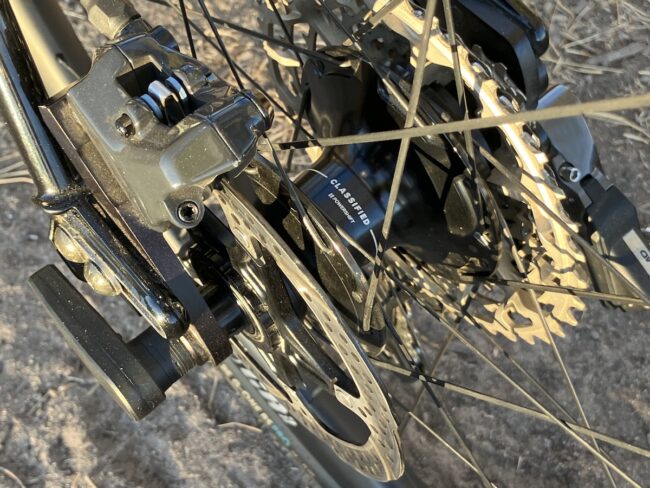
It is my interest in drivetrain efficiency that attracted me to Classified as a potential solution to my own 1X vs. 2X conundrum. Classified Powershift uses a planetary gear in the rear hub to effectively replace the front derailleur and chainring, an arguably complex “simplification.”
It provides the mechanical simplicity of the single chainring, while reducing the inefficiency of constant cross-chaining of wide range cassettes, and affording a few more useful gears to boot. There are likely some losses associated with the hub itself, but for what it’s worth, the manufacturer claims they are minimal.
Classified hubs have been out for a minute now, but a couple of things further moved the needle for me: the integration with TRP’s Vistar group simplified the shifting operation, and I discovered that J-bend hub shells were available in 28 and 32 hole options (this wheel builder did his happy dance — *for more on this, see editor’s note at the bottom of the page).
TRP’s Vistar group was the first to integrate wireless electronic shift/brake levers with Classified’s Powershift hubs. It allows for a 2X12 drivetrain, or up to 1X16 in their Quantum Shift mode. While conceptually similar to Shimano’s Synchro Shift mode available with later Di2 systems, Vistar’s Quantum Shift is a very different experience.
I chalk this up to the nearly imperceptible feeling of the Powershift rear hub’s shifting, even under load. Quantum Shift allows me to use only the right-hand shifter to utilize 15 or 16 gear options, eliminating the duplicate gears while maintaining the most efficient chainline. Brilliant! Without a single synapse firing, I spend most of my ride at or near the center of my cassette, saving watts and wear.
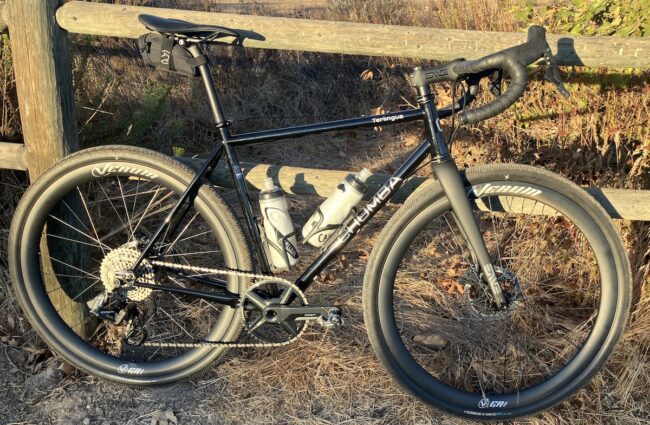
The bike I offered Jim is my Chumba Terlingua, so-equipped. It’s a spry gravel rig that doubles as a lovely all-road bike. For the dirt I strap on a pair of gravel wheels with 700x45c tires and an 11-40 cassette, while for mostly paved adventures I switch to road wheels with 700x35c tires and an 11-34 cassette. If circumstances dictated that I reduce my quiver to a single bike (oh, the horror!), it might have to be this one.
My wallet is lighter; my bike is not (I’m oddly okay with that)
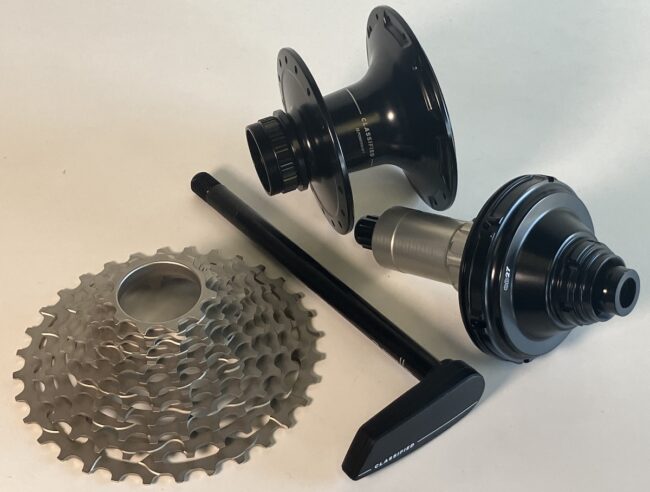
Maybe it’s fair to view the Classified Powershift as both the world’s heaviest and most expensive front derailleur, and arguably its most complex. It’s a bit heavier than premium quality 1X and 2X systems (sorry, hard to quantify exactly, but about 200 grams).
Brevity dictates that I stay off my soapbox about the degree to which weight in this range really matters, but I’ll get on up there another time should the audience demand it. A single Powershift hub and compatible hub shell approaches $1,100, not including Classified’s Smart Thru Axle and Classified or TRP cassette cogs required to complete the system.
I’ve amortized the hub cost over two wheelsets and will likely add a third. For each additional wheelset, I need only purchase a hub shell, as the Powershift hub moves easily from one rear wheel to the other. At three wheelsets, I’ll probably be at the same cost as three premium wheelsets without Powershift.
I’m not advocating for Classified, but riding their hub with the TRP Vistar group has piqued my curiosity: can this be a reliable alternative to the 2X drivetrains that I otherwise prefer? That said, I am rooting for them, both Classified and TRP. I appreciate such innovation, even if it’s not for everyone. Whatever you choose, do keep turning pedals.
EDITOR’S NOTE: In case it’s helpful to understand the system Charles is describing here’s a good video on it:
About today’s guest contributor, in his own words
Charles Wells is lucky: Lucky to have discovered what would become a lifelong passion for both bicycles and cycling, lucky to make bicycle wheel building his profession, and now to have you reading his contribution to the RBR newsletter. He operates both Jet Bicycle Wheels and Verum Velo Inc. in San Diego, California. You can read more of his considered thoughts, focused on bicycle wheels, on the Verum Velo Blog.
*[EDITOR’S NOTE on spoke types: “J-bend is the type of spokes that have bends, elbows and heads at the hub ends of the spokes” compared to “straight-pull,” also called “direct-pull” spokes (no bends or elbows) that require a different type of hub. A few reasons why many wheel builders prefer J-bend spokes and hubs over direct-pull spokes and hubs are because J-bend spokes are more widely available; less likely to twist when building and truing; more likely to stay tight; and because J-bend hubs are far more widely used on bicycles worldwide.]
Jim Langley is RBR’s Technical Editor. A pro mechanic & cycling writer for more than 40 years, he’s the author of Your Home Bicycle Workshop in the RBR eBookstore. Tune in to Jim’s popular YouTube channel for wheel building & bike repair how-to’s. Jim’s also known for his cycling streak that ended in February 2022 with a total of 10,269 consecutive daily rides (28 years, 1 month and 11 days of never missing a ride). Click to read Jim’s full bio.