
Product Review: Silca Hirobel Frame Clamp

Jim’s Tech Talk
By Jim Langley

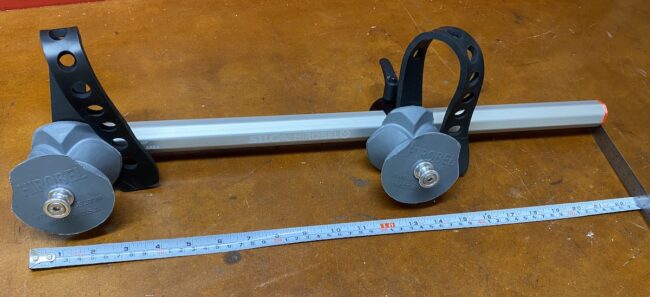
Source: https://silca.cc/products/hirobel-clamp
Price: $150
How obtained: I bought it during Silca’s 4th of July Sale for 20% off
Materials: Extruded aluminum, rubber frame holders (“cones”) and rubber cinch straps
Other: Lifetime guarantee
Hot
- To safeguard bikes, Hirobel provides twice the support of single-clamp repair stands
- Bikes can’t pivot left and right as you work on them the way they can when held by the seatpost in a standard clamp
- Hexagonal main rod fits perfectly in Feedback Sports and Park Tool repair stands, which are popular models
- Rubber cones and straps hold frames securely to protect the bike and paint job
- Both cones are adjustable and one has a lever for fast & easy fitting to bicycle frames
- You’ll never need to check or adjust a seatpost again before working on your bike
Not
- Won’t fit all frame types
- As expensive as some repair stands
- Holds bikes higher than when they’re held by the seatpost so you may want a height-adjustable repair stand
- The hexagonal rod won’t fit perfectly in all repair stands meaning it could slip and/or twist
- Beware the metal buttons the straps attach to as you could hit your frame on them putting your bike in and taking it out of the Hirobel
Stop worrying about your frame when working on your bicycle
With Silca’s Hirobel Frame Clamp, you get the peace of mind of knowing that both ends of your bicycle are cradled in soft rubber holders that Silca refers to as “cones,” and held fast with even softer and stretchy thick rubber adjustable straps.
This is at least twice the support provided by the clamp that comes on most repair stands. These clamps are designed to hold the bicycle by the seatpost (for dropper posts, always clamp the fixed end of the post, never the dropper end). Seatposts are made to support the rider, so they can handle the weight of the bicycle no problem – even heavy e-bikes.
However, you may not want to hold your bike by the seatpost if it means having to raise your post (if the repair stand clamp won’t fit otherwise), or if you are doing a repair that requires significant force, such as loosening a frozen part, removing a bottom bracket, even taping handlebars. Because round seatposts can twist in standard repair stand clamps, which can cause the bicycle to move around as you work. That’s not ideal and can make it harder to get the job done.
Lastly yet equally important, seatposts can be a little loose in the frame or not inserted far enough. These issues can cause the seatpost to come out when you’re working on the bike and that can spell disaster in frame and component damage if your bike hits the deck hard enough. I’ve seen it happen and it isn’t pretty. The lesson is that you should always check seatposts for insertion and tightness before holding a bike by them in a repair stand.
Well-made
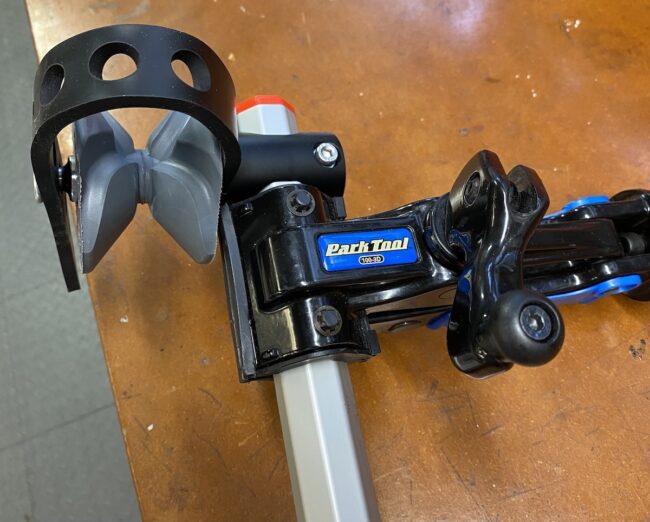
The Hirobel is a substantial tool. It weighs 2 pounds and the cones extend to 21 ¼ inches. The rod is made of a heavy-gauge extruded aluminum and the cones are held on aluminum sliders that mate with the hexagonal rod so they stay in position and cannot twist around the rod. The repair stand clamp-end cone (left side) is held in place with a hex bolt. The other end (right side) features a lever that lets you open and close the slider wherever is right for your frame size before tightening to lock it in place. The Hirobel has a stop pin that ensures that you can’t push the sliders off the end of the rod too.
The hexagonal rod is marked on the left side showing where to clamp it with the repair stand. The cones that the frame rests on are made of a harder rubber than the rubber straps yet both are gentle on the frame tubes.
I mentioned above that the rubber straps attach to metal buttons that are on the outside ends of the cone sliders. That’s the only thing that I think could be improved. Because if you’re working quickly and not paying close attention, those 2 metal ends could bump into your bike since you have to lift it over them. The buttons are rounded and smooth but they’re hard too and possibly could nick your finish.
Easier to use
With a standard repair stand clamp that holds the bike by the seatpost, the bicycle has to be lifted and held in order to put it in the stand. Alternatively, on some stands it’s possible to remove the clamp so that it can be attached to the seatpost while the clamp is off the repair stand. Then the bike and clamp can be lifted together to put the clamp back in the repair stand (note that clamps are usually on the heavy side so doing it this way means lifting even more weight).
If you lift a bike to put it in a repair stand by the seatpost, you have to hold it for a bit as you fine tune the repair stand clamp’s adjustments before you can close the clamp locking the bike in place. Plus, if the seatpost doesn’t have enough space to accept the clamp, you’ll need to raise the seatpost first and then remember to put it back when you’re done with the repair.
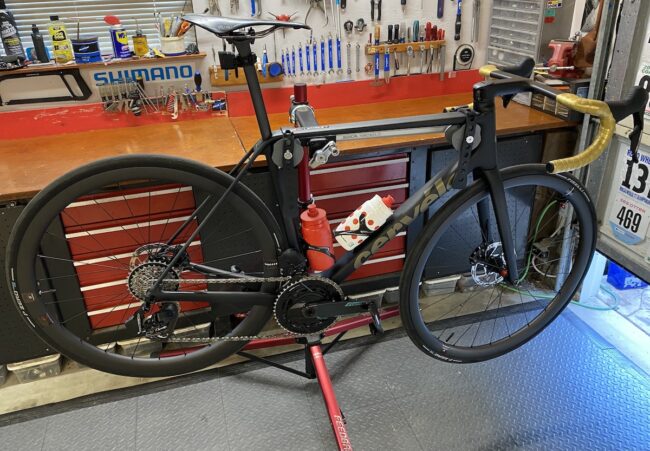
In comparison, with the Hirobel, once it’s in the repair stand, its two cones form a shelf for the bike’s top tube. To put a bike in, all that’s needed is lifting the bike up and onto the two cones, and sliding the right cone to ensure both cones are holding both frame tubes at each end of the frame. By nestling the top tube plus the seat tube and head tube, the Hirobel holds in 4 places and prevents the bike rocking toward the repair stand as well. To finish mounting the bike, you pull the straps tight and lock them on the buttons.
Safer
If you’re a seasoned bicycle mechanic you likely learned early on (and maybe the hard way) that repair stand clamps can harm bicycle frames. If they’re clamped too tightly they can dent metal tubes and crack or crush carbon tubes. For example, my new Cervelo R5 in the photo has a frame weight of only 651 grams. The total bike weight is 15 pounds-even. What this means is that some areas of the frame tubes are incredibly thin and not made to be held by a repair stand clamp.
And keep in mind that even if the clamp can hold the frame without damage, the weight of the bike and how long it is, puts way too much force on the tube, which only increases as you work on the bike. This is why the best practice now is to hold bikes only by their seatpost.
Silca’s Hirobel nicely addresses all these issues so I think you’ll appreciate adding it to your workshop. Just double check before placing an order that the Hirobel’s hexagonal main tube will be securely held in your repair stand clamp or else you may need to shim the clamp somehow to keep the Hirobel from twisting and letting the bike move out of position. Please share how you like yours in a comment if you already own a Hirobel.
Send Jim a new question
Have a question for Jim about something else? Send it here for a future Tech Talk column. Jim has been a professional mechanic and cycling writer for more than 40 years, and no question about bikes or bike gear is too simple or too complex. We publish questions using your first name and last initial only. To comment on this article, scroll down to the comments.


Jim Langley is RBR’s Technical Editor. A pro mechanic & cycling writer for more than 40 years, he’s the author of Your Home Bicycle Workshop in the RBR eBookstore. Tune in to Jim’s popular YouTube channel for wheel building & bike repair how-to’s. Jim’s also known for his cycling streak that ended in February 2022 with a total of 10,269 consecutive daily rides (28 years, 1 month and 11 days of never missing a ride). Click to read Jim’s full bio.


I have a Silca Hirobel Frame Clamp I bought last year for holding my carbon frame ebikes while working on them. I use it on my Park Tool work stand and it is very stable while working on my 36 lb. e-road bike and my 46 lb. emtb. It’s a little difficult mounting the emtb but doable. It pretty much takes all the pressure off of the frame. I’d recommend buying one for carbon frames particularly e-bikes.
my bikes are mostly not worth the trouble and time and money
if you are a shop, it might save 2 complaints a year [excluding the fake complaints]
ebikes usually don’t have top tubes
will it work on seat tube also ?
{though the ebike i used to have, had a huge square seat tube,
and that mostly didn;t fit my stand either,
plus it weighed about 65 lbs and lifting was hard too,
i think i ended up clamping the downtube somehow}
wle
Most modern ebikes have top tubes. I know for a fact that all of Trek’s and Specialized mountain, gravel and road bike have top tubes and they weigh anywhere from 26 lbs. to 48 lbs. I think the Silca Hirobel Frame Clamp is well worth the money and peace of mind knowing your not overloading the carbon top and risking crushing it.
I think that clamp leaves a lot to be desired. For any frame material, carbon, aluminum, steel, and titanium, and any bicycle weight, the Park Tool 100‑3D Micro‑Adjust Clamp is the strongest, safest, and most universally compatible of the three. It’s the only one engineered to handle all tube shapes, all materials, and heavy shop‑level torque loads without risk, and it only cost $20 more.
The Park has dual‑linkage micro‑adjust mechanism distributes clamping force evenly, it has large jaw surface that reduces point‑loading on carbon which you can clamp a thin‑wall carbon seatpost without crushing it. It is forged and machined steel/aluminum offering the highest durability and strength which makes it the safest for any heavy bikes up to 80 pounds.
Works with round, aero, oversized, and odd‑shaped tubes, plus it works with steel and titanium without marring the paint or metal.
If all you have are pro race level thin-walled Carbon fiber frames, then the Silca would probably be the safest to use, but it won’t have the torque load capacity that the Park has. That is the only advantage that the Silca has over the Park.
Yes, that Park clamp is great and I reviewed it when it came out way back when, jackalope. I’m not sure what you are talking about though when you mention torque load capacity in reference to the Hirobel clamp as they’re not the same type of clamp at all.
I think I mentioned this in the article, but in case I didn’t, the way the Hirobel holds bikes, it prevents an issue with all clamps that hold by the seatpost or by the seat tube, such as Park’s have. With those stands, as you’re working on a bike, the bike can have a tendency to rotate in the clamp, turn to the right or left basically. This is how all those Reynolds 531 stickers on steel bikes got ruined back in the day – if you remember those days.
But, back to the Hirobel, it holds the bike in such a way that the bike cannot move the way it can in standard clamps like Park’s. That’s another advantage to its other advantages.
That’s not to say that I don’t love my Park clamp, just pointing out why many people like the Hirobel and why I wanted to review it.
Thanks,
Jim
I have one. There is a learning curve, but not a bad one. Also, it is designed so that on the stand it is “drive train side out). Not mentioned is the grooves in the cones. If one has external cables, one loosens the Allen bolts a bit and rotates the cones (each cone has separate halves) so the cables go into these grooves. It is well thought out!
Thanks for mentioning the grooves Richard, appreciate it!
Jim
Ok, but it will not work for all bikes (those without a normal top tube).
And, for a fraction of the cost, one might try a bike frame adapter which will work on most all bikes (example below).
https://sparehandsystems.com/product/bicycle-frame-adaptor-for-bikes-without-top-tube/
Thanks Walt, those adapters are handy to have for some car bike racks too. Good idea, thanks!
Jim
I have had the Hirobel for years. It’s fantastic. I have an older Park tool stand and it mates perfectly with that. I don’t feel comfortable clamping any part of my carbon bikes with a traditional stand clamp. The bikes gently rest on the Hirobel and the straps are just there so the bike doesn’t fall off. I can still use the Park tool clamp to rotate everything, such as when doing brake bleeds. Silca makes very quality products. If you can wait, the Hirobel will go on sale periodically. For me it has been 5/5 stars.
That’s true about Silca having sales Eric, thanks for mentioning that.
Appreciate it,
Jim
I’ve become concerned about putting my Trek Domane into a standard repair stand, as it has a seatmast and the stand clamps onto that. I’m always worried that the clamping force will crack the carbon frame. This Silca clamp looks like it should be much less stressful on the frame.
I think you’ll like it and feel it’s worth the price Steve.
Thanks,
Jim