
Park Tool’s CC-4.2 Chain Checker

Jim’s Tech Talk
By Jim Langley
With modern 11-speed (and up) drivetrains, it’s important to keep track of chain wear because if you use a chain for too long it will begin to wear. It’s not that older chains didn’t wear too, such as 5-, 6-, 7-, 8-, 9- and 10-speed ones. It’s just that some manufacturers are recommending replacement earlier than they did before on those wider chains.
Chain wear is commonly called “chain stretch” since the way it’s checked is by taking a measurement. Stretch isn’t actually what’s happening though. What makes the chain get longer is that the small parts that make up the chain, the pins and rollers wear over time. That creates clearance or looseness, which lengthens the chain. And when that happens, the now undersized parts of the chain no longer fit onto the cassette cogs or chainring teeth correctly, which accelerates the wear on these expensive components. It can also cause balky shifting.
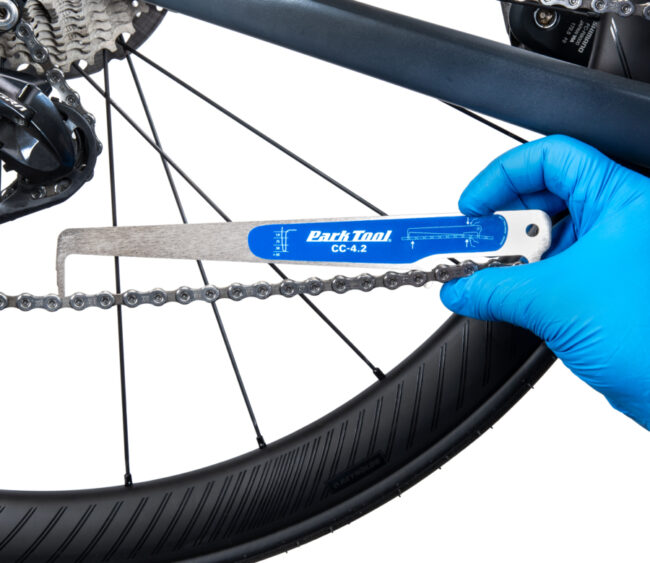
By paying attention to your chain condition and replacing it before it’s really worn out, you’ll protect the other drivetrain parts and get more miles out of them. That’s where Park Tool’s CC-4.2 Chain Checker tool comes in. It’s designed to work on all chains including SRAM flattop models and even all of the wider chains.
It’s an easy tool to use with directions printed on the label. In the photo you can see how one end of the tool has two feet that fit into the chain. The middle foot is hooked and it’s put behind a roller and between the narrower chain plates. I put that in bold because it’s important to place that correctly.
The foot on the far right then drops down where it fits into a link. The mechanic then squeezes the chain up and into the tool between these two feet while holding the tool. The chain wear reading is taken at the other end of the tool. There’s a longer “foot” on that end with 3 steps on it.
As you hold the tool on the chain and squeeze it, you lower the stepped “foot” down and in to the chain. How far it goes in tells how worn the chain is. The first step indicates that the chain is .5% or more worn. The second .75% or more. And the third 1% or more. If it doesn’t go in at all the chain is still fine.
As a guide for how to know when the chain you’re checking should be replaced, since it varies with chain type, Park recommends:
General chain replacement guidelines:
- Two-sprocket (single-speed) chains: replace chain at or just before 1.0%
- 5-to-10-speed chains: replace chain at or just before 0.75%
- 11-to-13-speed chains: replace at or just before 0.5%
Whenever the topic of chain wear gauges comes up, people point out that you can measure chains for wear with a ruler too, which most people already have. But in my experience it’s not as easy doing it with a ruler or tape measure etc., and I find it can result in mistakes. Once you get the hang of using Park’s tool, it’s quick and accurate and no measurements are needed. Plus it sells for $17.95, is made of sturdy laser-cut steel and has a hole in one end for hanging it on your workbench.
The only thing I wish is that the tool had Park’s guidelines for different chains on it (the little chart above) – maybe on a second label on the backside of the tool. That way you wouldn’t have to remember this information, or have to try to look up at what wear percentage your specific chain is supposed to be replaced. I’m going to print it and tape it onto the tool.
This excellent Park Tool video shows how the tool is used:
Jim Langley is RBR’s Technical Editor. A pro mechanic & cycling writer for more than 40 years, he’s the author of Your Home Bicycle Workshop in the RBR eBookstore. Tune in to Jim’s popular YouTube channel for wheel building & bike repair how-to’s. Jim’s also known for his cycling streak that ended in February 2022 with a total of 10,269 consecutive daily rides (28 years, 1 month and 11 days of never missing a ride). Click to read Jim’s full bio.


I prefer thr Park CC-2 chain check tool.
the CC-2 is certainly WAY easier to use, but not accurate for SRAM Flat top 12 speed chains (0r so I’m told by SRAM and my LBS mechanics)
Perhaps you could explain the difference between the Park CC-2 chain check tool and the new CC-4.2.
the Park CC-2 has a rotating cam-like device to indicate chain wear as it is fit into the chain being measured.
Works fine for all chains up to and including 11 speed.
SRAM ingeniously designed their 12-speed flattop chains (which are single sided) to NOT be capable of being accurately measured with the CC-2.
Not really new – Pedro’s has had this same checker for years already..
Thanks Karl. I wish Pedro’s did a better job of reaching out to the industry about their new tools as they bring them out. I found what you’re talking about and it looks like the same tool basically but with a couple of other features. It’s called their Chain Checker Plus II. Here it is for people to see and compare: https://amzn.to/3P5SRwZ
Thanks Karl!
Jim
I’m riding a SRAM eTap 12 speed drive train and after 2 years with about .5% + chain wear, I called SRAM and asked them their spec for chain replacement. I was told to let it wear to .8% and then replace the chain rings, cassette and chain. Anybody heard this before? Seemed excessive.
I’ve stayed with my <.5% rule. I'm on my second chain with this drive train and haven't had a problem with components or shifting.
Thanks Rick. In writing this article I attempted to find chain wear specs from different chain makers and didn’t have much luck at their websites. But I did come across the same thing at SRAM, they said 8% in their docs.
Hope this helps,
Jim
Hi Jim,
Two thoughts:
First, what is a comparable stretch of a Shimano chain to a .8 stretch on SRAM chain? More or less? The comment about the effect of different sized components on wear measurement was interesting.
Second, recommending a complete drive train replacement based on chain wear may make sense for a racer or a stomper, but for the rest of us avid but recreational cyclists it seems over the top. What did I miss in their recommendation?
Hi Rick,
Below, in another comment, Coach Rick says Shimano requires using their tool to measure their chains. The tool they provide doesn’t actually read in percentages of wear though. But here it is in case you’d like to see it:
https://amzn.to/49OtCZG In their docs Shimano says replace at .75% wear so similar to SRAM.
Regarding what SRAM told you about replacing the chain and at the same time as the rest of the drivetrain components, I don’t know what to say. Cassette cogs and chainrings should last a lot longer than a chain and especially if you keep your chain clean and lubed and don’t go way past that 8% before replacing it. Maybe SRAM meant that at some time after replacing chains that wore out you will need to replace the other parts. Personally, I don’t replace things until it’s needed.
Thanks,
Jim
As noted, some of us always come back to the simple ruler as an accurate and low-cost chain wear measurement tool. Note that the difference between this chain checker and most others is that it is much longer, therefore making accurate measurements easier.. It looks like it is about 12 inches long 🙂
Sorry Kerry. I replied the other day but it didn’t stick. So I’ll “say” again, good point, it is about 9.5 inches long.
Thanks!
Jim
A one who always notes that a ruler is a low cost and accurate way to measure chain wear, it’s worth observing that this tool is much longer than other chain checkers. It looks like it’s close to 12 inches 🙂 The longer the chain segment that’s measured, the more accurate it is.
There is a lot of discussion about measuring chain wear on bicycle web sites. The most common objection to wear indicating devices is that they are affected by wear on the rollers, which is not the wear that causes chains to elongate. In practice, I find that this causes the gauge to *over-estimate* the wear, resulting in a somewhat sooner-than-necessary replacement of the chain. This doesn’t bother me, because when I shoot for “1%” elongation, I will be changing the chain a bit prematurely. “Chains are cheaper than gears”.
Some chain wear gauges are designed to compensate for roller wear in order to deliver a more accurate result. One of these is the Shimano TL-CN42 gauge, which uses spring pressure to eliminate roller wear during the measurement process. I have one of these, and it seems to work, but I haven’t done any actual measurement of any chains to see if it’s more accurate than some others I have. It does require a very light touch to avoid overpowering the spring, which results in an erroneous reading.
I also like the Park CC-2 because it allows monitoring of the chain as it wears. It still suffers from the roller wear problem, but as I indicated, this is a “safety factor”. One interesting thing about the CC-2 is that it won’t even fit into a new chain. I wrote Park Tools about this, and was told that the gauge is calibrated to be most accurate at the “1%” mark.
It looks as if the Park CC-4.2 has a similar function to the Shimano gauge. It’s inexpensive enough that I may get one for comparison. (I like tools!)
The C-2 is inserted into the chain and you the press the lever on the side to show the amount of chain wear.
If you test for Shimano, they will only accept wear results using their tool.
I have moved using:
https://www.abbeybiketools.com/collections/new-additions/products/chain-wear-tool
What are the issues with measuring chain wear? Well there’s a couple of them, the biggest is the diameter difference of SRAM’s flat top chains found on most of their modern drivetrains. The rollers on these chains are .010″ (.254mm). Now that doesn’t sound like a lot but when you do the math to convert that to a percentage of wear over 5 links that’s a .2% difference. When we’re replacing chains between .5-.7% of wear that .2% can easily be the difference between replacing just a chain and and entire drivetrain. But wait, there’s MORE! Most chain wear tools currently on the market are laser cut metal. This is a pretty cool process that’s great for making sheet metal parts, problem is the accuracy of this process isn’t great at +/-.010″ (.254mm). If you add the error of the tool itself to the roller variable it’s possible to double the error of the tool.
Thanks Ron. You should have put quotes around the paragraph as it comes straight from Abbey as far as I can tell. Also, I bought the Abbey tool and like it. I wrote about it here too: https://www.roadbikerider.com/abbey-chain-wear-tool/
Thanks!
Jim
Interesting article! The one thing I don’t understand is why the wider (less gears/speeds) chains have a higher percent replacement guideline?
Thanks for the question Lloyd. As I understand it, it’s because they have more material – thicker metal, which allows them to continue to work longer.
Thanks,
Jim
As a shop mechanic, the CC-4.2 is our go to device for chain wear check across all the different drivetrains. Both accuracy and repeatability are good, and the tool is easy to use. For those who want to geek out on chain checkers, Zero Friction Cycling has a looong video that pretty much covers all the different popular tools. Yes, I watched the whole video 🙂
What do you mean the “new” CC-4.2? Haven’t I had this on my tool wall for a year or two now?