12 Winter Training Tips for Cyclists

1. Accept it’s winter
Last week I was talking with my 73-year-old friend Gary. He told me about friends his age who lament they aren’t a fit as they were. “Get over it.” he tells them. “Accept who you are.” The same applies to winter. You will lose some fitness this winter and that’s okay.
2. Think pre-season
Other than a few weeks break, the pros don’t take an off-season. They have a pre-season doing the kinds of training that will help them race. Focus on the future, what you want to do this year. How can you improve?
3. Work on marginal gains
In 2003 Sir Dave Brailsford started as the performance director of British Cycling. He used an approach called the aggregation of marginal gains, small improvements in many ways that add up to victories. Under his leadership, the cycling team won 22 gold medals in three Olympics and won five Tours de France. Six factors contribute to athletic improvement:
- Goal setting and planning
- Effective training
- Equipment and clothing
- Cycling skills
- Nutrition on and off the bike
- Mental skills
Where can you make small improvements in each of these?
4. Focus on purpose not volume
Pre-season training is often mentally challenging. You love riding your bike outdoors but in many parts of the country this isn’t possible unless you’re willing to suffer. Give up trying to log X miles or hours on the trainer, aka garbage miles. Have a purpose for each workout.
5. Include appropriate intensity
Including much harder rides helps are roadies. However, whether you should include some form of intensity this winter depends on your goals and winter training opportunities. The normal training progression is:
- Early winter: Build leg strength and maintain some endurance
- Late winter and early spring: Build endurance and maintain leg strength
- Late spring: Increase speed and power while maintaining endurance
- Summer: Have fun!
If your summer goals include some tough rides then somewhere in this sequence you want to include intensity riding. If your winter opportunities for endurance riding are limited and you don’t like cross-training, then you could change the pattern to so that phase two builds power and maintains some endurance (but stop leg strength training so you can get maximum benefit from the intensity). Then in phase three you build your endurance while maintaining your power. You can learn more here:
- Why Increasing Intensity is Good for All Road Cyclists
- Should You Do Intensity Training This Winter? (Part 1)
- Should You Do Intensity Training This Winter? (Part 2)
6. Improve muscle firing pattern
Your muscles are composed of many motor units, each of which is controlled by a different nerve. When your brain tells these motor units to contract they don’t all naturally contract simultaneously. If you can get the motor units to fire simultaneously then you will get more power without expending more energy.
To improve the coordination of the motor units do sprints, which demand maximum power. Over time your body learns to better coordinate the firing your motor units to give you more power. When you’re riding throw in two or three short (30 to 60 second) all-out sprints with full recovery between each sprint. Don’t think about your heart rate or power — those are irrelevant, just go as hard as you can. If you want to impress your buddies tell them you’re working on “neuromuscular facilitation.”
7. Increase pedaling economy
You can increase your power and speed by learning to ride with a smooth round stroke. You can improve your pedaling by concentrating on four parts of the stroke:
- Top: Apply power forward, imagining you are pushing your knee forward toward the handlebars.
- Front: Apply power downward.
- Bottom: Apply power backward, with your toes pointed slightly down. Imagine that you are scraping your toes across the floor.
- Back: Don’t try to pull up on the pedal (which is inefficient); rather, just lift your leg so that your other leg doesn’t need to push it up.
Riding a fixed gear bike is the classic way to improve your stroke but may be hard on your knees. Riding on rollers is another great tool—if your stroke is jerky you may find yourself on the floor. Some computerized trainers have programs to help you balance the power of each leg and to develop a rounder stroke. One-legged pedaling on the trainer will improve both your muscle coordination and your functional leg strength. The French have a term for a smooth, round stroke: souplesse. Tell your buddies you’re working on “souplesse” this winter.
8. Get a bike fit
Bike fit is dynamic. As you change your goals, or get a different bike, or get fitter, or lose flexibility, your correct bike fit changes. I’ve been to the Boulder Center for Sports Medicine many times with clients to have bike fits with Andy Pruitt, one of the leading experts on bike fit. I’ve seen a rider’s power increase by up to 5% just by improving the bike fit!
9. Include resistance (strength) training
General strength training increases the size of your muscle fibers and strengthens your ligaments and tendons. These are the foundation for later more specific hard rides. You can read more in these columns:
10. Resistance training increases longevity
One study followed 100,000 people for 15 years. The researchers found that people who met both the guidelines for moderate-to-vigorous aerobic activity (at least 2:30 a week) and did strength training once or twice a week lived significantly longer than people who did either aerobics or resistance training. You can read more here:
11. Resistance training combats aging
This is important for three fundamental reasons:
- Muscle capacity, to prevent the atrophy of muscles as you age.
- Bone strength, to prevent the loss of bone mass as you age.
- Weight management, as your muscles atrophy from less use, they are replaced by fat and connective tissue
You can read more in this column:
12. Prevent injuries
Almost every roadie suffers an overuse injury at some point. When you ride your legs go through about 5,000 pedal revolutions per hour! If you have a weaker muscle, tendon or ligament it is overly stressed 5,000 times an hour. With regular resistance training you can build stronger muscles, ligaments and tendons and be ready for longer, harder rides this spring.
- 5 Simple Exercises to Keep Cyclists Injury-Free
- 6 Muscle Strengthening Exercises to Prevent Cramps
- 4 Reasons Why Core Strength Is Important
My eBooks:
My eBook Productive Off-Season Training for Health and Recreational Riders explains in detail what you can do to become a better rider this winter. The book includes:
- A 12-week off-season exercise program to keep you healthy during the winter months.
- A 12-week, more intensive off-season program for recreational riders to build your endurance, power and speed, preparing for base training.
The 28-page Productive Off-Season is just $4.99.
If you’re in your 50s, 60s, 70s (like me) and beyond my eBook Off-Season Conditioning Past 50 includes recommendations for outdoor and indoor cycling, cross-training, circuit strength training, flexibility and core strength. I include a sample 12-week program incorporating all of these. I explain how to tailor the program to your own interests: if you’re a health and recreation rider, club rider or endurance rider. You can also tailor the program if you have limited time to train or are a beginning cyclist. The 26-page Off-Season Conditioning Past 50 is just $4.99.
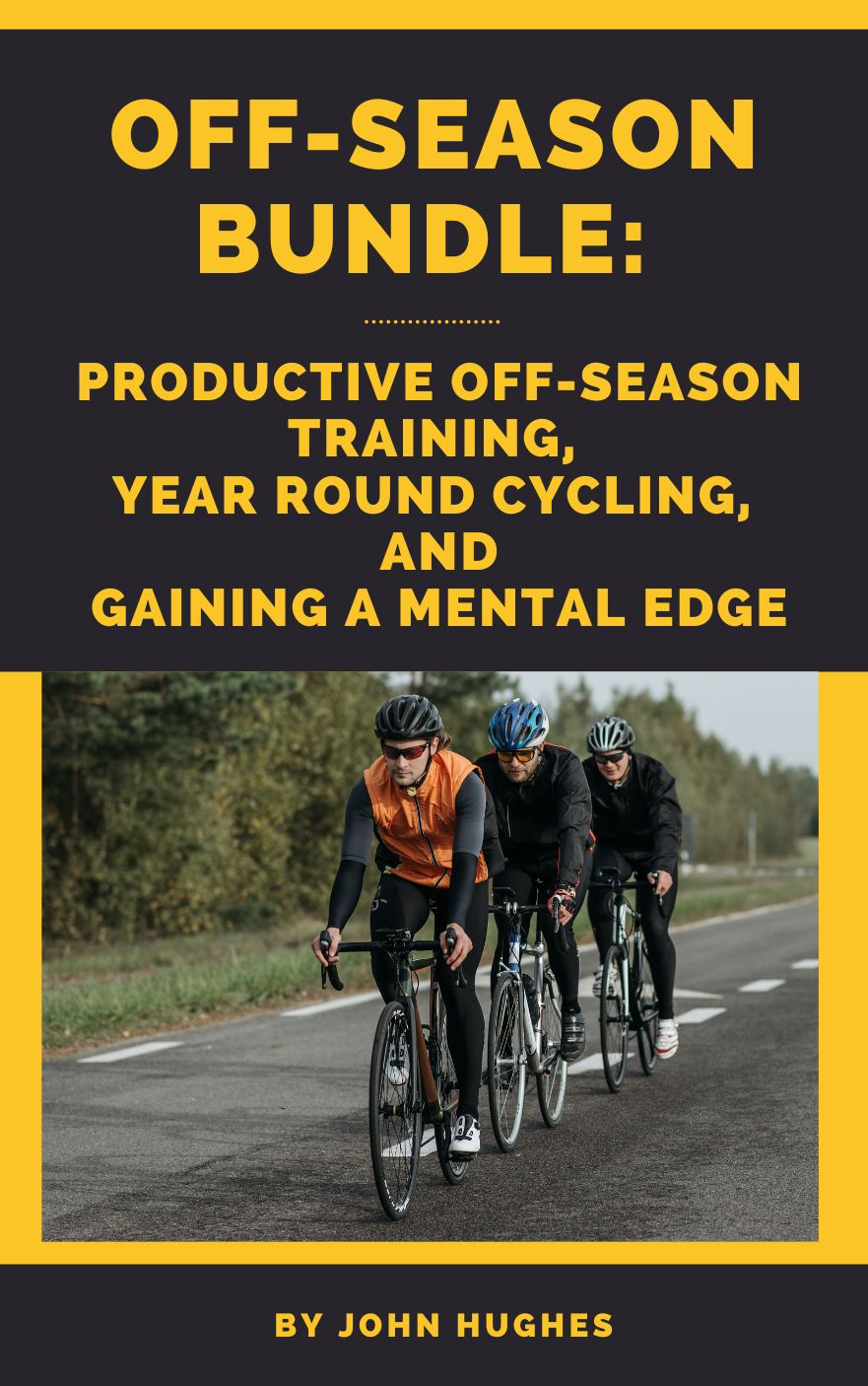
My 3-article Off-Season bundle includes:
- Productive Off-Season Training with: A 12-week off-season exercise program to keep you healthy during the winter months. A 12-week, more intensive off-season program for recreational riders to build your endurance, power and speed, preparing for base training.
- Gaining a Mental Edge: Using Sports Psychology to Improve Your Cycling Most cyclists can get greater improvement from investing some time each week in practicing mental skills than they could investing the same amount of time in training! I show you how.
- Year-Round Cycling: How to Extend Your Cycling Season I give you six factors to successfully ride year-round, with in-depth information on all: 1) Goal-Setting and Planning; 2) Training; 3) Clothing and Equipment; 4) Nutrition; 5) Technique; 6) Motivation.
The 60-page Off-Season bundle is just $13.50,a savings of $1.50 off the full price of purchasing all three articles individually.
Coach John Hughes earned coaching certifications from USA Cycling and the National Strength and Conditioning Association. John’s cycling career includes course records in the Boston-Montreal-Boston 1200-km randonnée and the Furnace Creek 508, a Race Across AMerica (RAAM) qualifier. He has ridden solo RAAM twice and is a 5-time finisher of the 1200-km Paris-Brest-Paris. He has written over 40 eBooks and eArticles on cycling training and nutrition, available in RBR’s eBookstore at Coach John Hughes. Click to read John’s full bio.


And get an indoor stationary trainer such as Zwift.
“Five factors contribute to athletic improvement”
Yet six are listed?
Stages bike trainer with a Rouvy subscription.