
Your Flat Tire Prevention Tips And Product Recommendations

Jim’s Tech Talk
By Jim Langley
Thanks very much readers for sharing your flat tire solutions and thoughts on my repair in the comments to last week’s column. It’s at this link if you missed it or would like to read the comments: Sharing Lessons From a Flat Tire Fiasco.
Since flats are such a common problem, this week I want to share some of your recommendations. And, I’ll add my thoughts.
Go Tubeless
Several of you said that if I had been riding tubeless tires, I wouldn’t have had the flat in the first place. That’s based on the fact that most tubeless road tires have sealant inside. When you puncture a tire, the sealant is designed to travel with the escaping air to the hole in the tire. And particles mixed into the sealant clog up the hole fixing the flat (what these particles are varies depending on the brand/type of sealant).
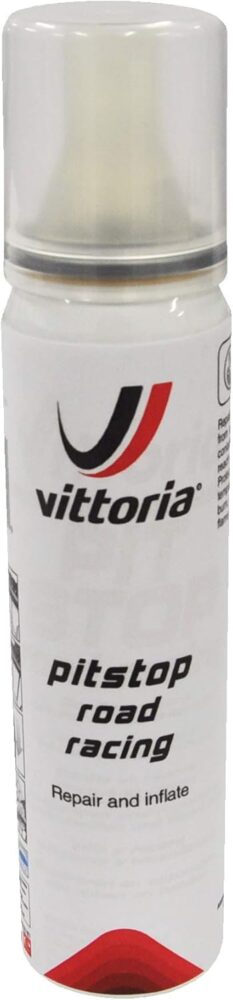
One reader said that he carries a small tube of sealant and an injector and that, with that setup I probably could have put sealant in my tube to fix my flat. He could be right. And that made me think of those flat-fix inflators with sealant inside, such as the one Vittoria sells called the Pit Stop https://amzn.to/4iPiLlR .
My thoughts
I’ve had good luck with tubeless tires with sealant. I once put a hole in the rear tire large enough that by the time I could pull over, the sealant spray had made a mess of me, my bike and the guy who was riding behind me. Yet, when I started to remove the rear wheel, I squeezed the tire to check it and was surprised to find that it was still holding air and was not leaking anymore. I just pumped it up a little more, apologized to my friend and continued riding.
If the sealant can’t stop a leak, the other thing that works with tubeless tires is plugging holes to fix flats. A popular brand of plug kits is Dynaplug.
Just like car tire repair plugs if you’ve ever seen those, the bike ones are forced into the hole to fill it and seal punctures. Any small leaks around the plug will be sealed by the sealant. One of the nicest things about these plugs is that you don’t need to remove the wheel, so you can plug a tire and be back riding in only minutes. You can see how they’re used in their instructions here.
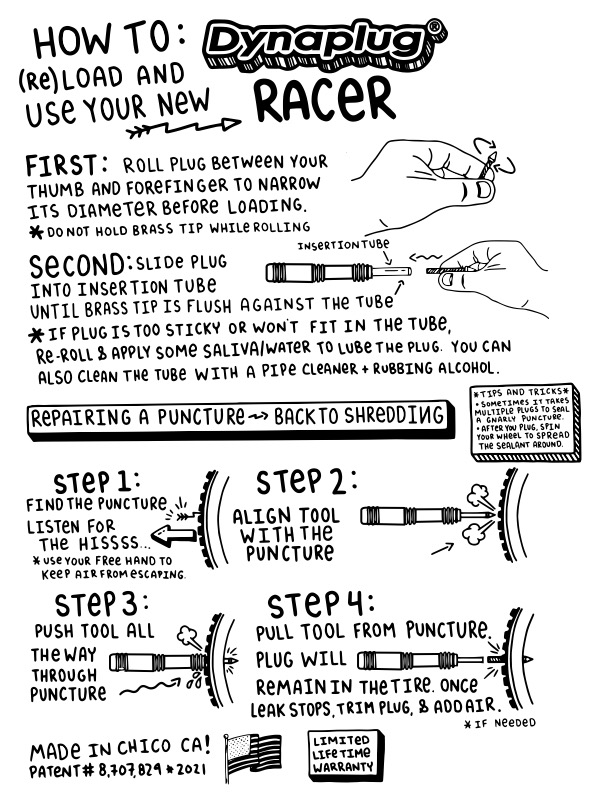
TIP: One thing to know is that, since many tires have tough flat resistant belts within the tread, it can take more effort than you expect to push a plug into a hole. I was surprised how much it takes the first time I used one. So you might want to practice on an old tire at home instead of out on the road or trail.
Caveat 1: The thing with sealant is that it doesn’t last forever inside a tire, it dries up. So, depending on the amount inside the tire and the conditions you ride in, you will need to add sealant regularly. You can buy injector tools that have nozzles to stick into a valve to check sealant levels. And these tools make it easy to add sealant to tires too. I use Park Tool’s TSI-1.

Caveat 2: To me this is not a caveat (and I will explain), but I mention it because some riders do worry about it when fixing flat tubeless tires. The issue is that with some portable pumps – the type usually carried for flat repairs – it can be difficult to seat tubeless tires on the rim. “Seating” a tire means getting it to sit properly on the rim so that there are no high or low spots in the tire.
When this happens to me, as long as I have enough air in the tire and there are only some low spots in the seating of the tire (no high spots, which can cause the tire to come off the rim), I will try to pull the low spots out by hand. If it’s impossible to get them out, I will just accept that the tire will feel a little wobbly rolling down the road and I’ll ride home on it. Often the act of riding on the non-seated tire will cause it to seat, which is always nice. But if it doesn’t seat, I don’t worry about it and will fix it when I get home and can seat it properly.
Airless Tires
Every now and then a reader will recommend airless tires as a great solution for those who suffer from flat tires, and that happened last week. It’s been decades since I’ve tried one of these tires and back then they felt too flexible – almost squishy to me.
But I thought, since a reader said he likes them, I would use this as an opportunity to ask if more of you are using new airless tires and if so what you think of them. Please let us know.
The brand mentioned in the comment is Tannus. They describe their airless road tires as follows: “Thanks to their lightweight material called Aither, Tannus tires are super light and durable. Tannus Airless Tires can last up to 3,000 miles. Tannus Airless is a solid tire and is 100% puncture-proof. Since there is no inner tube, it is impossible to get punctures.
The tires feature a locking pin system that keeps the tires on your rim. It’s nearly impossible to loosen the tire while riding.”
Interestingly or worryingly (?) They also say that the tires are extremely difficult to install because they’re a tight fit and because they use locking pins. To understand the process I went looking and found that they have a video showing the process. Have a watch:
I have no idea if airless tires like these by Tannus are worth trying. Please share your review if you’ve tried them and recommend them.
Patching Problems
One reader mentioned a common problem with traditional patch kits with the little tin tube of glue. He said that when he needs to patch a tube, it always seems that the glue in the tube has dried up.
My Tip
In my experience, as long as the tube of glue is still sealed, the glue inside will be wet and still functional. Sometimes if it’s an old tube the glue will be at the very bottom of the tube and it might seem like the tube is empty. But if you keep squeezing you’ll find that a blob of glue will come out and it’ll be enough to patch a tube.
It’s tubes of glue that have been opened that are the ones where the glue dries up and can’t be used anymore. And the reason that happens is because the tube’s seal was punctured to use some glue and patch a tube. But then, the glue tube wasn’t correctly closed.
If you just screw on the cap to close the tube of glue and put it back in your patch kit, the glue will dry up over time. This happens because by breaking the seal on the tube and using some glue, you let air inside the tube. The air will now dry the glue. To prevent this and to be able to have wet glue to patch a tube the next time, you must roll up the tube to eject all the air before putting on the cap.
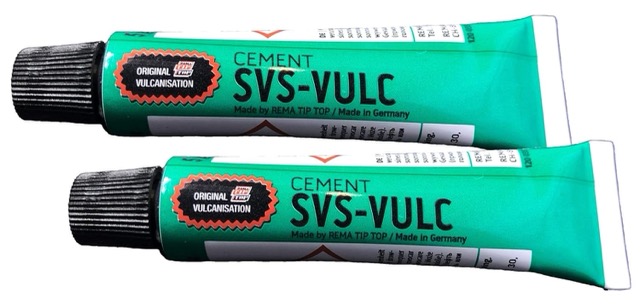
You can also just buy individual tubes of glue so that you have a spare tube no matter what happens.
My last glueing tip – since I’ve seen this mistake many times – is that you must wait for the glue on the tube to fully dry before applying the patch. The glue will go from glossy to matte. Wait until that happens and don’t touch the glue to feel if it’s dry yet or the patch might not stick fully.
And, I have to tell a funny story about patches. It happened when I was riding on a bus in Amsterdam. The bus had a huge rubber bellows type hinge in the middle (like the bellows on an accordion) to allow it to almost fold in half to turn tight corners. When we came to one of these turns, I watched in amazement as the bellows opened fully – because it had been patched with a Rema Tip Top patch that was about 4-feet in diameter. I had no idea there were patches that large or that they could be used that way either.
Mr. Tuffy Tire Liners
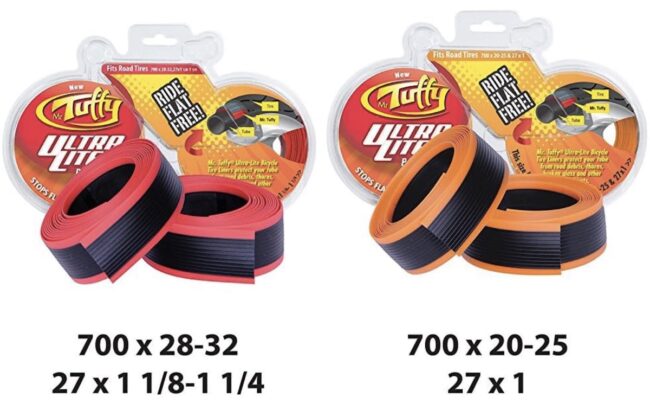
A reader with the great name FunHogs2 highly recommended Mr. Tuffy Tire Liners, which he said saved the day when they moved from Pennsylvania to Phoenix and had five flats in the first week riding there!
Mr. Tuffys have been around for a long time and I’ve heard from other riders that they love them. They go in between the tire and tube to add another layer of protection. They come in sizes to fit most bikes. https://amzn.to/4cdJK8b
Thanks again readers for sharing your flat tire tips and the funny stories too. If you missed those (comments keep coming in), be sure to head back for a good laugh: Sharing Lessons From a Flat Tire Fiasco.
Jim Langley is RBR’s Technical Editor. A pro mechanic & cycling writer for more than 40 years, he’s the author of Your Home Bicycle Workshop in the RBR eBookstore. Tune in to Jim’s popular YouTube channel for wheel building & bike repair how-to’s. Jim’s also known for his cycling streak that ended in February 2022 with a total of 10,269 consecutive daily rides (28 years, 1 month and 11 days of never missing a ride). Click to read Jim’s full bio.



Hi Jim and friends, I have a question about tubless tires, which I have used on my gravel bikes for around 5 years and generally like. I am still learning the tricks needed to live happily with tubeless tires. I have 50 years of experience with tubed tires and a long list of tricks, but I need to build the equivalent for tubeless.
The specific situation I am grappling with are the possible sources of the small leaks that other riders tell me are common with tubeless tires. On my regular ride, an Orbea Terra, I have replaced tires, regularly add sealant, etc, but one of the tires consistently loses 10 lbs of pressure overnight. One problem was that the valve core was not seated as well as it could be; fixing that improved things but did not fully resolve them.
I wonder if, with all the wisdom at roadbiker homebase and the readers, we could gather up a list of possible sources of small leaks in tubeless tires. Ultimately, these are likely to be installation hacks, but from what my buddies tell me, I am not the only one struggling to get things `just right’ with my tubeless tires.
Thanks for the great content and all you do for cycling.
Cheers,
Rob
(Salt Lake City)
I used “Mr. Tuffy” tire liners for many years with success. Not for preventing punctures from road sharps, but for preventing flats with studded tires. After a couple of winter seasons, especially on the rear wheel, the studs would wear through the carcass and cause a flat. The tire liners extended the life of these tires by several years.
This was on my folding commuter bike with 20″ (406) wheels and Schwalbe “Marathon Winter” tires.
I am a fan of refreshing the mini tubes of glue in my patch kit each year, but I have noticed that many bike shops have stopped selling the mini tubes of glue.
I carry more spare tubes than I think I am likely to need (2), then patch the tubes at home under more controlled conditions. I have a large can of vulcanizing fluid (glue) which I store upside-down to (theoretically) maximize shelf life.
I noticed you using a Park sealant injector to put sealant into the tire. I used sealant injectors until I got tired of trying to keep them clean once the sealant dried up inside the injector. I found a simpler way to put sealant into your tube if you have removable valve cores. . Simply buy a 2 ounce bottle of Stans sealant. Then remove the valve core from your tire. Then put the valve at the bottom of the wheel. Then tip of the 2 ounce Stans sealant bottle fits nicely into the opening of your valve with the core removed. Simply put the tip of the bottle at the top of the valve and pour. This eliminates the need for an expensive injector and cleaning them after using them.
Just put Flatout in your TUBES. It works and lasts and lasts.
Switch to latex tubes! In the 10 Years Pre-COVID, I was road riding about 75 mile per week on 25 mm Continental 4000 S2 tires. (Sometimes racing!) With the Conti tires I got about a flat a year with butyl (black) Conti tubes). Then I switched to Michelin AirComp latex tubes and would go three years plus without a flat. (Hint: check and remove any particles from the tire after every ride.) I think the latex tubes don’t puncture as easily is that the amorphous structure of natural latex stretches before it cuts. The crystalline structure of butyl tubes cuts more easily.
I always carry two spare tubes and on a long ride (centuries etc) may throw another in my bag. My buddy and I once ran over a brick hidden in shadow and each blew both front and rear tires. Maybe tubeless would have helped, hard to know as it was a hard impact, I have had sidewalls burp with tubeless with a crash so I have gone back to tubes on my roadie. Mtb tubeless has been fine and I have used the tire liners without noticeable weight gain.
Ever since I can remember — roadie since the 1970s — I’ve reached down and brushed off my tires after riding through broken glass or some other debris. The bad stuff doesn’t get a chance to work its way into a tire that way.
I’m pretty sure this has prevented flats for me. I’m totally sure it’s a good idea to wear gloves when riding, so I can do this when necessary without MY sealant leaking out of my hands 🙂
I was talking to a young rider a year or 2 ago and when I told him I brushed my tires any time I thought I might have ridden through glass, he was shocked and thought I was kidding or maybe crazy.
In nearly 50 years and many 100,000 kms of riding I think I have had less than 10 punctures on my road bike, most of those in the first couple of inexperienced years. In my experience punctures are either catastrophic (e.g. screw or large shard of glass) in which case nothing will stop it, or a tiny fragment of something that will take a while to work it’s way through.
The first kind is extremely rare, the second can be pretty much completely avoided by brushing while riding and checking tires after every ride.
We had an interesting experience a couple of months ago. Tree trimmers were working on the bike path. We saw tire tracks going into the adjacent horse path to get around the workers vehicle. We followed suit and road on the horse path and collected a ton of goat heads in our tires. It to us about 20 minutes to remove all the goat heads. Tubeless with sealant worked and we were able to ride away while cyclists with tubes had a nice walk home.
We ride 32mm tires and I would not recommend tubeless for tires smaller than 28mm.
I switched to tubeless probably in 2018 and have used the Dynaplugs successfully many times. They work well but have one annoying side effect: the little brass heads on the plugs tend to drop off inside the tire and rattle around at low speeds. It’s not a dealbreaker for me, but it may be more of an annoyance for others.
I have also dropped pressure on my road bike wheels (28 mm Schwalbe Pro Ones) to 60 psi and I haven’t had a puncture since.
Thanks for the great comments everyone, appreciate it!
Jim Langley
I buy small packets of super glue tubes (about little finger size). Rubber cement seems to have got progressively more useless over the years, whereas superglue works on tube patches every time. I throw the tube away after using it once.