Sharing Lessons From a Flat Tire Fiasco

Jim’s Tech Talk
By Jim Langley
Even with today’s availability of better tires, tubeless technology and wider rubber, flat tires remain a common breakdown. So I thought it might be helpful to share how everything went wrong when I punctured today. After you read my tale and my takeaway from it, please weigh in with a comment about your best puncture stories and flat fixing tips too.
A hasty out-the-door check
As I hurried to hit the road this morning, I thought I better grab a spare tube just in case. I wasn’t overly worried because I have new 30mm wide Grand Bois tires pumped to a compliant 34 psi with new butyl tubes inside.
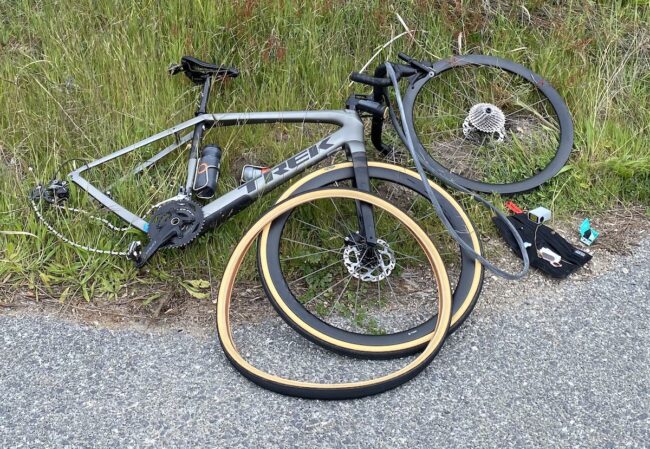
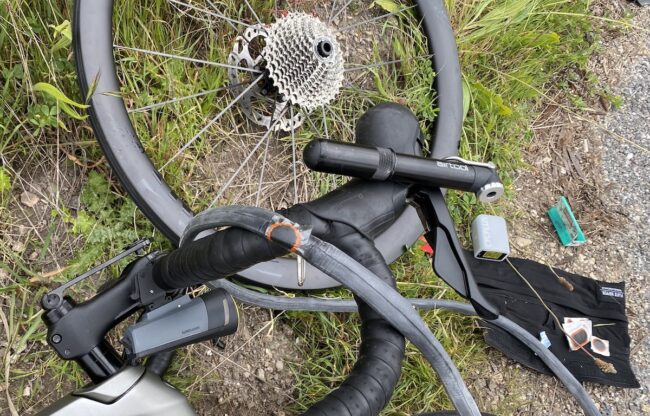
And for supplies, in the frame compartment on my Trek SL-5 gravel bike, I have a Specialized Air Tool mini-pump (they don’t appear to make the model I have any more or I’d provide a link), and I was pretty sure I also had a Park Tool Super Patch kit in there, which is already glued for quick and easy application: https://amzn.to/4iwwheh. Plus, I put my Cycplus tiny electric inflator – similar to the one we reviewed last week – in my pocket. You can see most of these items in the photos.
Valve trouble
Well, as bad luck would have it, I felt that sinking feeling about 6 miles out of town and soon had to stop. It was a rear flat. It wasn’t a safe place to do repairs where I stopped so I walked to a turn-out up the road.
I then removed the rear wheel thru-axle, pulled the rear derailleur back and the wheel dropped out easily. I took the tire and tube off. I put enough air in the tube to hear and see the hole, which was close to and above the valve. That told me that something entered the tire near the valve to pop a hole in the tube. Since I align tire labels at the valve, I knew exactly where to look for a piece of glass or a staple, etc. – whatever caused the damage. I didn’t find anything. It must have fallen out. There was no sign of a hole either.
Next, I pulled the spare tube out of my jersey pocket and immediately discovered that its 45mm-long Presta valve was too short for the depth of my wheel. The tip of the valve was visible but there was no way to put either of my pumps onto the valve.
‘No problem, I’ll just have to patch the punctured tube,’ I thought. I opened my frame compartment and pulled out the internal tool bag and guess what? The patch kit I thought I had inside wasn’t there.
Time for plan B. But the only plan B I had was to call for a ride home. And that plan was foiled when I discovered that there was no cell coverage at my location.
Rescued by randonneurs!
Laughing at my predicament and contemplating how far I might need to walk while carrying my bike in order to get a cell signal, I heard a friendly voice and up rolled Bill and Lois, friends who are also the team behind the Santa Cruz Randonneurs Club.
If you know anything about randonneuring, you know that these long distance Ninjas ride prepared for anything. And Lois and Bill are legends of the sport, she having completed Paris-Brest-Paris a whopping 7 times (finishing one on a broken wrist after crashing and refusing to quit); and he having finished it twice.
Quickly assessing my situation, Lois said, “Looks like you need a patch kit.” And it was with her new Rema patch kit that I was able to fix my tube and get back to riding. If you heroes are reading this, thanks again Lois and Bill and Bon route!
A tiny accessory would have saved the day
Yes, it was stupid of me not to double-check the spare tube to be sure its valve was long enough for my wheel. And, I should have also made sure that the patch kit was along for the ride. I’ll do both next time.
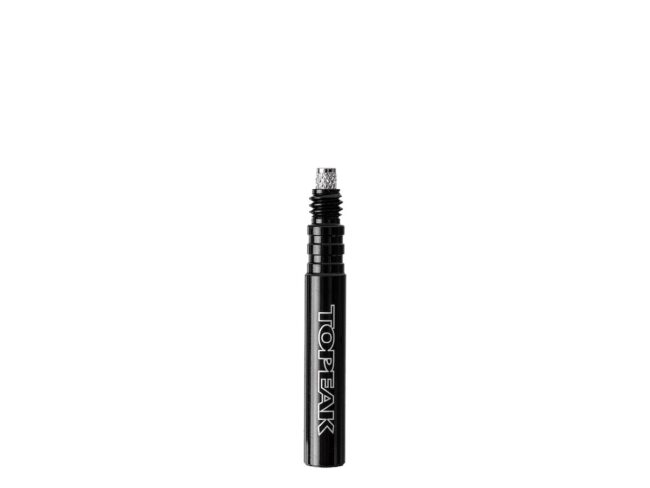
But there’s something else that would have easily and quickly saved me: a Presta valve extender. These tiny devices screw on to Presta valves to make a short valve tube work in a deep profile rim. My favorite is made by Topeak. I like it because it works just like the Presta valve works. By tightening the tip of the extender, you close both tips so that air cannot leak out of the valve. Topeak’s also has an O-ring that helps with this.
Here’s a link to the extender (about $8) if you’re interested in joining me in adding one to your flat repair kit: https://amzn.to/4iVO4eE
Now that I’ve come clean, don’t forget to share your on-the-road flat tire fiasco stories and tips for being prepared for anything. Thanks!
Jim Langley is RBR’s Technical Editor. A pro mechanic & cycling writer for more than 40 years, he’s the author of Your Home Bicycle Workshop in the RBR eBookstore. Tune in to Jim’s popular YouTube channel for wheel building & bike repair how-to’s. Jim’s also known for his cycling streak that ended in February 2022 with a total of 10,269 consecutive daily rides (28 years, 1 month and 11 days of never missing a ride). Click to read Jim’s full bio.
Good morning, Jim. I wish there was a commission system available to you other than promoting sales on Amazon. I understand you want to earn money for your efforts, but Bezos has more than enough of our money already. He is anti-democratic and anti-union and let’s face it: a money hoarder. I will continue reading your reviews, and if I want to purchase the product, ask for it at my local bike shop, where the money stays in my community. I will continue to occasionally purchase an E-book, since I know that payment will go to you and the other writers.
Without commenting on your opinions, my reply is that this is a bicycling article. Political opinions are not welcome
Good morning and thanks for the feedback, Lee. I understand the issues with supporting AMZ and Bezos. I’d like to explain that my primary goal is to help readers purchase what I recommend in my articles.
Please look at the link I found for the Topeak Valve Extender: https://www.topeak.com/global/en/product/227-PRESTA-VALVE-EXTENDER For me, it doesn’t show a price or a way to purchase the product from Topeak. Instead it offers a shop finder tool to find a store that sells it. This is fine, however, my experience with these online tools suggests that they are more frustrating than helpful in most cases. And, I think, since we’ve all done it regularly, that it should be obvious to we cyclists that you can call any bike shop you wish and ask if they have the extender and find out for 100% if they have it in stock.
Still, for various reasons some people can’t or don’t want to call or travel to a shop. So to provide a way to actually buy the product, I give the Amazon link when I can. It is an affiliate link, which means I get a few cents on the purchase of the item while the price stays the same.
I want to point out one more interesting thing. The link on Amazon takes you to Topeak’s Amazon store, so you are actually buying from Topeak. More and more bike companies have Amazon stores – even major players such as Shimano.
I hope this helps explain why I used that link and thanks again for the feedback,
Jim
All I’m going to say is, people have the right to make money in America, no matter what their political standing is.
Amazon has wiped out many companies by selling competing products at a loss until they go bankrupt, so no, they don’t, if an oligarch wants to destroy your ability to make money they can and will.
As I have many bikes with many different wheelset rim-depth , I did not want to keep track of what is in my saddle bag every ride. as far as tube and repair kit. Many many years ago I bought a pair of 88mm deep TT wheels that came with a long valve extension. I haven’t left home without it since then. And it prouved to be helpful more than once, even on group ride when someone lend a tube to a fellow rider with the mismatch tube valve stem length.
(Let’s say I ‘m better with flats than with adjusting headset ! Inside joke for Jim)
Pierre
Thanks for the great comment Pierre and I enjoyed participating in your headset adjustment!
Best,
Jim
Hey, hey!
I, too, have multiple bike with different wheel sets with different rim depths.
Seems simple enough to me to just buy tubes with a valve length that will be long enough for all my different bikes.
Is there a reason I shouldn’t be handling it this way?
No. But at the same time, way back then, I could think of price difference, availability, added weight that could cause imbalance … And as I metion, if you run out of tube, and are being offered a short stem tube by a fellow rider. I agree, all these reasons are marginal but I find the valve extender a better full-cover solution. Cheers
Just ordered a valve extender!
Riding tubeless has eliminated most of the small punctures. Loose valves account for the majority of my tire troubles – I’ve found it takes more force to close the valve core in the valve than I expect. On a related topic, I love my Rene Herse supple tires, love them so much that I’m tempted to ride them past safety wear margin. I wish they had wear indicator. What’s a reliable indicator of tire replacement time?
I run my rear tires until they wear through the first cord, then replace both of them. If that seems too long you can can replace them when you first see the cord showing. In 35 years I have never had a tire blow out, bulge or causeb a flat in the spot(s) where the cords are showing.
Uber, Triple A. also handle this. I can barely fix a FRONT tire and with the electric motor, I don’t even try for a rear tire. SOMEtimes carry a patch kit and small manual pump. The wide tires have NOT had an effect on flat tire frequency, roughly q 500 miles (n = 3) The other prevention methods seem to work and it has been ONE flat total for over 2000 miles using EITHER the Tannus or injectable. It would be decidedly difficult to get data to compare Tannus versus injectable. My data is consistent with what the companies claim.
Probably a freak here, but in the land of unswept shoulders/bike lanes, of “partial re-paving”, and of a plethora of goat-heads, I run tubes, loaded with a charge of Stan’s No Tubes, in all my “no tubes” wheels. And all those tubes have super long stems. On my trad, read old school, wheels I look like a dork. Works though… so far.
Tubeless is all I’ll say.
In a group ride, I hit a piece of metal which I did not see as it was in a shaded area. Flatted both tires. Replaced both tubes and got less than a mile when both flatted again. Determined that both tires were damaged so that the replacement tubes were also punctured. Gave up and called my wife for a pick up.
I ALWAYS carry 3 spare tube. Call it overkill, but I often needed more than one because the first tube had a hole in it, even though it was new. (I can’t get patches to stay on for the life of me, so I don’t bother.) A leaky valve or a hole near it is more common for me than a puncture.
I flatted on a trail and was starting to deal with it (slowly, as I haven’t done it very often). A cyclist came from the other direction and asked if I needed help. Not too proud to turn down an offer of assistance, I said yes. Turns out he was a professional triathlete and had that tire done and dusted in about 30 seconds. It was AWESOME. I’m still impressed at that speed, and that was around 15 years ago!
I run tubeless tires with sealant inside but if a puncture is too big for the sealant to work, also carry plugs. There are several manufacturers. Here is one that I have successfully used: https://tinyurl.com/mv3bykyp
And if the puncture is more than one plug can seal you can add 2 or 3 plugs if needed. I used 6 plugs one time on my four wheeler.
My friend laughed at me as I have a huge valve stem on my 45mm depth wheel. The tubes are leftovers from my triathlon days and my deeper wheel set. I used to run tubeless until I had a blowout during Ride the Rockies. My rear camera light showed me when I blew my tire as sealant went all over my camera. The tire would not seal. I put on a spare tire with a tube. Funny item, I almost fell down a cliff pumping up my tire on the side of the road. I have not bothered with the goo since. Too much crap to deal with and 25mm tires at 80-90 psi seems to work well. Having said that, I hope I did not jinx my next ride.
I carry 2 tubes and glueless patches. The problem with carrying a glue type patch kit is that the glue will probably be dried up when you need it. Just carry the proper length spare tubes. No need to carry a valve extender although that would work if you bum a short valve tube of of someone.
Never tempt fate! 😉 It’s rare, but I’ve had rides where I’ve used both spare tubes and then started using up the patches in the patch kit. The Flat Tire Gods are just waiting for us to make a mistake, so always bring the pump, tubes, and patches.
While I somewhat sympathize with the predicament, I’ll be smug here and say “this could never happen to me.” My on-bike kit is always the same and always works for me: correct tube (it’s the only size tube I have on my bike or in my bike stuff cabinet), Park patches for the rare occasion when I get more than one flat, etc. I haven’t needed a ride home or help from another rider since the 1970s when I learned these lessons. The one exception to this is when the check valve on my frame pump locked up and I couldn’t pump. I’ve helped lots of other riders, and heard lots of stories about “I forgot to put a tube in my pocket” but if you structure things right, these issues won’t arise.
There was the time I tripped and hit my foot on my wheel while fixing a flat. I hit the valve and broke it off. Blush.
Well Jim, that was quite a convergence of circumstances! Sometimes we old-timers get a bit complacent when things are going well and end up getting a reminder that we need to pay attention. I’m sure you’ll never make the same mistakes again.
For example, last week I decided to take my trainer bike out for a road ride, as I had put a new saddle on it for a couple of trainer rides and wanted to test it on the road. About seven miles from home, I realized that I hadn’t reinstalled the seat pack that I normally use, so I had no spare tube, no tools, and no pump. luckily I was able to ride home without incident. Lesson learned!
As for your predicament, two things I always carry are a small bottle of tire sealant and a valve core wrench.
Although it seems that most riders don’t realize it, sealant works as well in tubes as it does in tubeless tires. Based on y0ur description of the puncture, it probably would have worked for you. FWIW, I always use sealant in my tubes and haven’t had a flat on the road in years.
Jim,
Something unrelated to your tube issue. You mentioned your bike has thru-axles. What are you using in your bag to remove the wheels? I ask because I am still on quick-release wheels and have seen videos from the Tour de France where team mechanics are using a cordless impact driver to get the wheels on and off. Thanks!
Thanks for the great question Karl. My Trek bike came with a thru-axle removal lever that stays in the rear axle. The lever can be removed to use it in the front axle to remove that wheel. So it’s kind of like a built-in QR lever.
Thanks again!
Jim
Barring that, a 5mm Allen wrench is generally all that’s necessary. The pro team mechanics only use an impact driver to speed up the process in the heat of a race.
If you had a patch kit you probably won’t have to remove the wheel & tube. when I think that it is a normal puncture, I usually do the following. I leave the wheel and tire intact and I put some air in the tire and listen for the sound I then go to that part of the tire and wheel and I only remove that part of the tube and then pump it up again to listen where the hole might be. when I find it I then take my patch kit and I patch it up hold it down firmly when I think it’s the glue has dried then reinsure the tire. Then I reinsert the tire, making sure that the tire is seated properly. then I pump the tire up and I’m ready to go usually takes only a few minutes and I don’t have to go through a lot of trouble..
My wife and I ride road bikes in metro Phoenix, AZ. We ride about 150 miles a week. Riding here can be characterized as highly urban. The bike lanes are great but they are generally littered with the debris from the three lanes of traffic in each direction. . Among other things, there is a great deal of gravel from the landscaping stones that are kicked into the lanes by landscapers and the numerous pickup and dump trucks. The first we rode here 12 years ago I had 5 flats in the first week. I ride Continental Gatorskins which rarely resulted in a flat tire back in Pennsylvania. Since I don’t patch tubes, riding here was getting to be expensive proposition at about $5-8 a tube. . After some research on the internet I discovered tire liners. Since installing them I can count on one hand the number of flats I’ve had in the last 12 years. We also use them on our touring bikes when we do loaded touring in Europe. Tire liners are easy to install and inexpensive to purchase. I use the “Mr. Tuffy” tire liners that I found on Amazon.com. I recommend them to all my friends and feedback is always positive. For about $15 for a set of two tire liners it is inexpensive insurance against flatting. Try them…you’ll love them!
On flatting several years ago I went through the usual process to replace the tube, only to find that the lone CO2 cartridge I had with me was empty. The previous time I’d flatted, I had screwed the empty cartridge into a holding bracket that’s mounted on the bike frame, and had forgotten to replace it with a fresh one. Since then I make sure to periodically check the status of the mounted cartridge, and carry a second one in my bike bag!
Well, looks like you learned the hard way! I’ve been promoting this simple “hack” for years. I actually prefer the valveless extenders because there’s even less to screw up – just a simple screw on extender tube and you’re set; takes up zero space, every flat kit should include one.
Thanks for all the great flat tire stories and tip everyone, appreciate you sharing very much!
Jim
I havent changed wheel depth, tire size, tubes or pumps for so many years I’ve lost count. On the other hand, when I flatted on Wednesday, everything was there and I was back on the road in less than ten minutes. Does that make me prescient or a retro-grouch?
classic story. Thanks for sharing,,Jim. One ride I had at least five flats had to stop at a country feed store and use their sink to find the hole in the tube so I could repair it. Only to have flats happen every 20 minutes after that. I limped home, pumping up my tire every five minutes. Discovered the fine little wire sticking out of the tire once I could inspect it at home. Probably from a street sweeper our local mechanic said.. Or trying to pump up a new tube with a Lezyne pump which screws onto the valve where I could not remove the pump without unscrewing the valve core. Of course I had not tightened down the valve core on the new tube. Fortunately, I also had along a miniature pump which after 100 strokes got me to enough pressure I could get home.
In 2004 I was riding in Shannon Ireland and got 3 flats in a row. By then I was out of tubes, so began walking toward Limerick. I have, in other places such as French Polynesia where I had 3 spare tubes and still ran out and got a ride from a French woman in a pickup which worked out fine since I speak French and she didn’t speak English, there are no vehicles in Ireland large enough for one to hitchhike with a bike. So I walked. 4 or 5 miles and came upon a high school that was getting out and got a ride holding my bike on the back of a crotch rocket the remaining two miles into Limerick. He did a wheelie for half a block leaving the HS, which I survived. At the bike shop I got a bunch of tubes and a great Zefal pump that I still use two decades later!
On tour once, I got a flat, spare tube 1 defective valve, spare tube 2 worked. Few more miles on the same day another flat. Patch glue dried up. Electricians tape (both flats were from the small wires found in tire retreads from trucks) around the hole. Held for a while but many repumps needed. Final solution, lots of tall grass twisted together like a very fat rope stuffed into the tire (really really stuffed) made it into camp for tube + glue replacements and repairs to the punctured tubes.
Carry glueless patches.