Should You Replace “Old” Carbon Forks?

Jim’s Tech Talk
By Jim Langley
Who knew so many roadies had questions about carbon forks? The fork fun started a couple of Tech Talks ago and a new Q came in this week from a reader named “Steve.”
Steve wrote
“I have a 2001 Litespeed Classic, which is a titanium frame. When I purchased the bike in 2001 I had a Reynolds Ouzo Pro carbon fork installed with a carbon steerer tube. My question is should I be concerned that the fork will fail due to its age?
Also, will the age of the fork cause a deterioration of ride quality for me? From what I understand, carbon being essentially plastic “cures” and as it “cures” hardens and may become brittle and risk failing. I’ve researched this online and by discussing with my bike shop mechanic but no one seems to have a concrete conclusion. Any thoughts?”
My reply
“But no one seems to have a CONCRETE conclusion… “ Carbon. Concrete.” I like what you did there Steve, thanks for the laugh.
Regarding your carbon fork, I actually own a 1999 Litespeed Vortex, only two years older than your Classic – which came stock with a Look HSC full-carbon fork (carbon steerer and blades). HSC stands for High Stiffness Carbon.
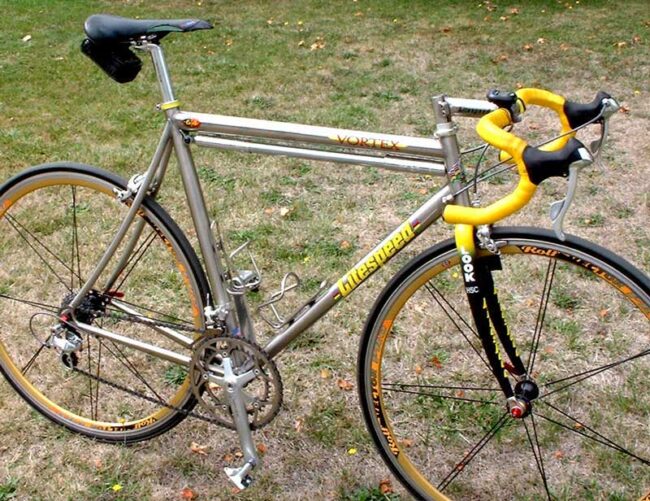
These forks were considered ultra light at the time, weighing a mere 330-360 grams depending on size. You should be able to make out my fork in the photo. In comparison your Reynolds Ouzo Pro All Carbon Fork from 2001 is just a tad heavier at 370-385 grams (I could not source a photo of the fork I believe you have or I would have shared it). Compared to modern forks, our old ones are actually on the heavy side. As an example, on my new 2026 Cervelo R5 climbing bike, its all carbon fork is claimed to weigh 298 grams – with tapered steerer, thru-axle ends and disc mounts!
Reynolds stopped making carbon forks some years back. But, it’s easy to find information on your fork from back in the day online. And the good news is that the original Reynolds documentation stated that the fork would “last forever” provided it has suffered no impact or crash damage. And also that it does not have a strict expiration date or structural mileage limit.
I don’t ride my Vortex regularly anymore, but it was used heavily up until 2018 and the Look HSC fork worked flawlessly all that time. I wouldn’t hesitate to ride the bike and have no plans to replace the fork.
Does carbon break down over time?
I’ve been asked this question before. I think it’s a carryover from the debate going on since forever in cycling circles as to whether metal bikes lose their ride characteristics over time from the repeated stress of pedaling and flexing the frame. Some riders – usually sprinters in my experience – believe they have worn out a frame and it’s time for a new one, because the old one is now slower, or they might say it’s “dead” or words to that effect.
Personally, I’ve never felt or experienced this myself with any of the bicycles I’ve owned, which include steel, aluminum, titanium and carbon. But I know cyclists who believe they wear out frames, and that the concept is in riders’ minds. And that’s easy to understand. After all, you can bend any wire coathanger and break it as a simple demonstration of how enough flex can weaken and eventually break metal.
Carbon is different than metal
The thing is, carbon as a material is different than metal. Carbon is composed of fabric (woven filaments) and an epoxy resin. The resin is like a glue that when heated and cured, joins the fabric and turns it into a solid. This solid – the tubing shapes making up the carbon frame (and fork) behaves more like glass than metal. Metal bends before it breaks and it takes a lot of bending before it fails (how much depends on what type of metal).
The carbon tubes won’t bend. But with the right type of structural damage they can break. As an example, in the early days of carbon forks, before people knew better, the forks were sometimes installed with star-shaped inserts inside the carbon fork steerer (to install the headset). This was the perfect storm for breaking carbon forks because this sharp metal insert would cut through steerers. On a bike with a different carbon fork, I experienced this the hard way and was very lucky to have only been going 10mph at the time. Luckily fork inserts were invented, which eliminated that problem.
Reasons to replace an old carbon fork
If we go back to what Reynolds said about your fork when it was new, that it would last forever provided it has suffered no impact or crash damage, the last part of that statement is the thing you need to consider in evaluating your fork Steve. The question is, has it suffered any impacts or crash damage? If it has, that would be the reason to replace it, not that it has “cured” or “hardened” as you’ve heard.
Some things to look into:
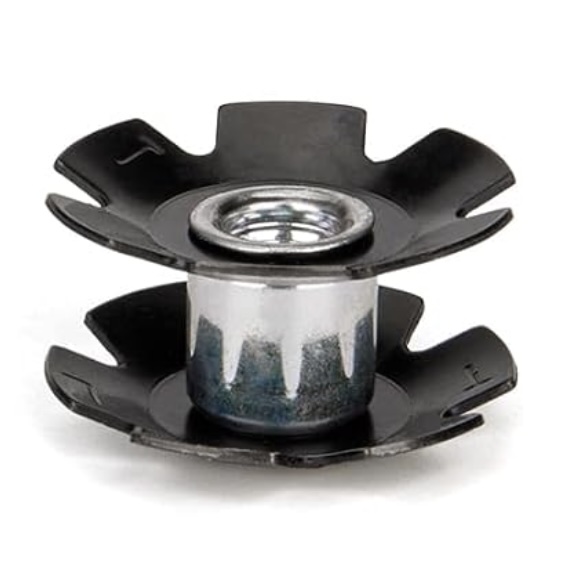
1. Do you have a star insert?
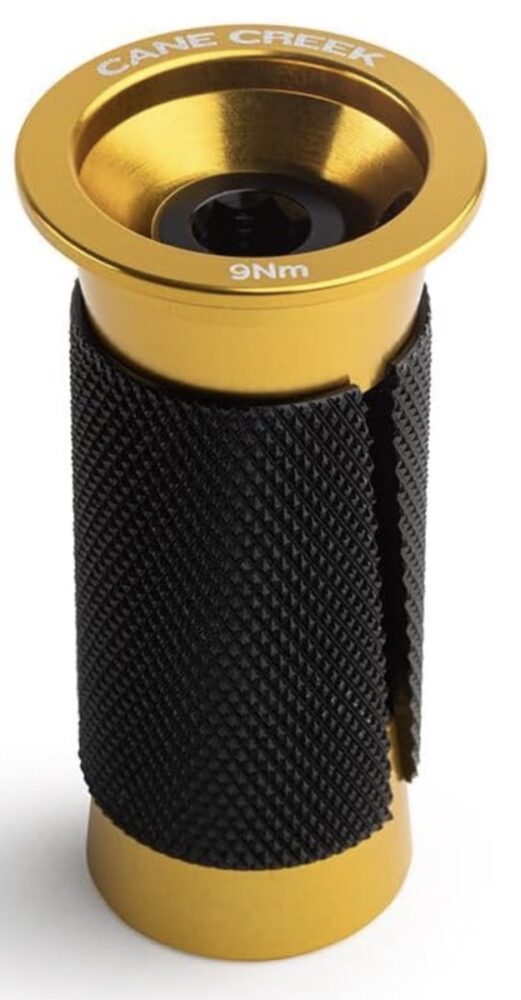
This is what I just mentioned about the possibility of a star insert (photo) having been used in the installation of your fork. You’ll see this if you unscrew and remove your top cap and look inside the fork steerer. There should never be one of these inside a carbon steerer. Hopefully, your carbon fork has an insert, which looks like the second photo here (shown is a modern Cane Creek insert, earlier inserts had fewer components but worked similarly).
2. Has the stem damaged the carbon steerer?
When two different materials are joined, there’s a possibility of them bonding to each other, an annoying phenomenon called galvanic corrosion, which happens with steel, aluminum, titanium and carbon. To check your fork for this, you would look closely at where the stem is attached, which in most cases is with two bolts. If you can see past the bolts to the fork steerer beneath, it should look like carbon, definitely not like white powder, which is a sign of corrosion taking place. If you see anything resembling that, you’ll want to remove the stem (if possible) and see if there’s been any real damage yet. Sometimes you can clean the corrosion away. But, if it’s been corroding for years, it could have eaten into your fork meaning it’s time to replace it. In bad cases, you may have to cut the fork to remove it.
3. Has your fork been crashed or abused?
It’s possible for a fork to become damaged even without crashing it. The bike might have gotten knocked over by someone else. A helpful friend may have yanked it out of a roof rack that held it by its fork dropouts, stressing and possibly weakening the dropouts. Maybe you’ve had to bunny hop the bike to clear potholes and save your wheels and you’ve come down hard when you landed? Or maybe you ride wheelies and slam the front end down or jump curbs – riders do do these things and they’re hard on bikes. You can look at dropouts to inspect for damage. The other things might not leave any signs of abuse, but if you know they’ve happened it’s worth considering how much of a beating the fork has taken (see the coin test below).
4. Is the fork showing signs of wear and tear?
Since it’s an all carbon fork, you don’t have the aluminum corrosion issue that carbon forks with aluminum dropouts have such as on my Look HSC fork (the bonds where the silver dropouts are joined to the carbon fork blades look suspect). But, if the protective finish on your carbon fork is scratched or worn away, it would be worth looking closely to see if there’s any noticeable damage to the carbon beneath. You hope not to see any deep cuts penetrating the carbon.
5. Simple tests to judge carbon forks, squeezing and the “coin test.”
If the fork passes the visual test, another simple one is removing the front wheel and squeezing the fork blades towards each other with one hand – just enough to feel for any movement or play. The blades might flex a little but it shouldn’t be much at all. Another easy one is to take a coin and gently tap up and down the fork legs. If carbon has been hit hard enough, the affected area can become compromised and the coin will make a dull thud instead of a crisp “click.” That’s a sign that the fork has been compromised.
6. Other tests.
There are companies that test carbon forks (and frames) using ultrasound and thermography with infrared cameras, which are claimed to find any problems inside. However, I looked into this a little and learned that Calfee Designs, one of the earliest and original carbon frame makers, say that this technology can give false readings – and that they do not evaluate carbon this way and don’t recommend it. Similar concerns were expressed by Lennard Zinn in his Velo columns too. So do your own research on this before paying to have it done.
Your turn
Readers, if you have stories to tell about the longevity (or lack of it) on your Reynolds Ouzo Pro carbon road fork, please share it in a comment. If you’ve broken a carbon fork and if you know, it would be interesting to learn what caused it to break and how it failed – what specific part of the fork failed. Thanks!
Jim Langley is RBR’s Technical Editor. A pro mechanic & cycling writer for more than 40 years, he’s the author of Your Home Bicycle Workshop in the RBR eBookstore. Tune in to Jim’s popular YouTube channel for wheel building & bike repair how-to’s. Jim’s also known for his cycling streak that ended in February 2022 with a total of 10,269 consecutive daily rides (28 years, 1 month and 11 days of never missing a ride). Click to read Jim’s full bio.




I worry even more about a carbon fork than a frame. I’m always fooling with my fit — because it never feels right — so it’s not uncommon for me to change stems 4 – 5 times a week. I dread to think how fast I’d ruin a carbon fork! Even if that weren’t the case, my bikes have an annoying habit of falling over, so Id still be very worried.
We do A LOT of bike fitting and I have seen too many cracked steerer tubes from overtightening of the pinch bolts. There was 2 problems you will be seeing
1) MOST carbon road forks are 1-1/8″ steerer tubes, I believe yours in 1″
2) MOST modern carbon forks are make for disk brakes – reference current ENVE road forks, all 4 are for disk brakes only.
Recommend: put you bike on a trainer and get a new modern bike – start with the higher quality chinese frames WINSPACE, etc.
Reynolds fork with carbon steer tube… It should have come with an expander plug and torque settings (one to secure the bolt in the tube and another for the final assembly with the stem). It should also have come with a “nut” for the front brake caliper. They (Reynolds) did not want to presume that the caliper manufacturer supplied a nut the exact length.
Follow up question to the article about forks but a broader concern. I have a 2014 Specialized Roubaix which has a full carbon frame. I’ve kept track of the mileage and it has about 24,000 miles on it. It has never been in a crash but has endured the usual occasional knocks and bangs from storage, travel and riding over rougher roads (with me a my stuff on it).
Does a carbon fiber frame have an expected “life”?
Hi Dan,
The same basic concerns for carbon forks apply to carbon frames basically, so the frame should last as long as you take care of it. Without any real damage the frame should continue to work just fine.
Hope this eases your concern,
Jim
I had this concern when the Reynolds Ouzo Comp fork on my Land Shark steel bike turned 21. I contacted John Slawta about checking it and possible alternates to replace since Reynolds got out of the fork biz. To paraphrase he said as long as I don’t crash it it will be fine and my heirs will enjoy the bike someday.
Jim, I had a fork fail at the crown on a custom built Ti bike.
Habanero frame – Alpha Q Z-Pro fork. This was basically a tandem fork, I needed that because the head tube on my custom Habanero was approx 330mm.
This was a catastrophic failure that landed me in ICU for 5 days!
The people behind me said the front wheel just moved off to the side and I face planted right in. Luckily it was at the top of climb in a saddle before a descent. Going maybe 8mph or so. I have pictures of the fork and headset if you are interested.
herb
Sorry to hear about your crash Herb, I know how painful a broken fork can be so I feel for you and am glad you’re ok. I don’t know if I’d learn anything useful looking at the photo and I believe Alpha Q stopped making carbon forks but if you want to share the photo you can send it to me a jimlangley at sign Gmail dot com and I’ll take a look. Thank you,
Jim
Hi Jim,
I also have a Litespeed bike from 1999. It’s the Arenberg, a Ti bike with, you guessed it, a carbon fork. I’ve mostly used it on the trainer for the last 2-3 years, but I’ve put thousands and thousands of miles on that bike.
A friend of mine has a similar Litespeed, and his fork collapsed, leaving him badly injured. I think it was nearly 5 years ago that it happened. Since then, I’ve been concerned about my fork collapsing under me. I had it checked at the time by my mechanic, who said it was fine. Nonetheless, I just brought it to the shop to have the fork replaced with an Enve fork. I’d rather be safe than sorry!
Do carbon handlebars fail? I have an old Specialized carbon handlebar that has been hanging uninstalled in my garage for the past 8 years or so. It’s older than that and I wonder if it’s safe to use on another bike?
Hi Lisa,
Carbon handlebars are similar to forks and frames, if they’re damaged they should be replaced. If there are no damages, they’re fine to keep using. What you would look for are any signs of cracking or wear and tear around the stem where it meets the handlebars and at the levers where they’re clamped on the bars and also check the tape carefully. If the tape is torn it might indicate a crash in which case you’ll want to remove the tape to inspect for handlebar damage.
If there are no signs of damage or wear and tear the bars should still be fine to use.
Jim
It’s worth addressing one issue raised by the original question: do CF composites “age” buy continuing to cure after manufacture. The answer to that question is a resounding NO! A CF composite is fully cured out of the mold unless there has been a serious mistake in the manufacture.
Regards durability of CF forks, my 1998 Litespeed Vortex with a Time CF fork (steel steerer tube) has 170,000 road miles plus about 60,000 roller miles on it. No issues. My Lynskey has a house brand all-CF fork with 110,000 miles. Likewise no issues. I weigh 175 lbs (80 kg) but I do “ride light” though I do have several rail track crossings on many of my routes.
Thanks Kerry, appreciate you weighing in and sharing your experience with your carbon bikes.
Jim
My 1998? Litespeed Classic had a Look Carbon fork. A number of years ago the drop out on one side broke. I replaced it with a Ritchey carbon fork. I still ride that bike in the winter.