
Quick Review: Pirelli Smartube RS TPU Tubes

Jim’s Tech Talk
By Jim Langley
In case you haven’t yet heard of – or tried thermoplastic polyurethane inner tubes for tires (“TPU tubes” for short), the reasons a lot of roadies have switched to them is because they’re much lighter than standard butyl tubes (one third to one quarter of the weight) and they’re so much smaller, that you could carry several in a pocket or even the smallest seatbag and not even see or feel that they’re there.
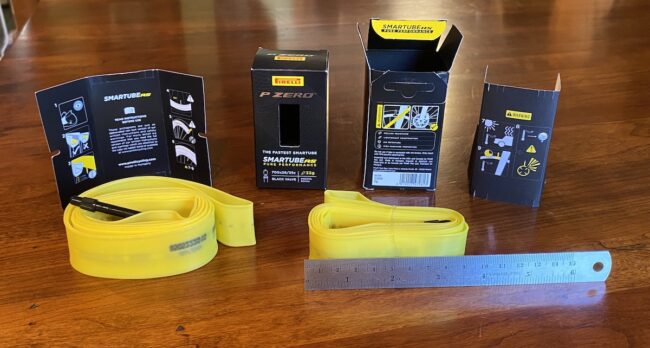
What’s more, unlike latex tubes, which previously were the choice for weight savings, TPU tubes hold air better over time. Most latex tubes go soft after a few days, sometimes overnight. Plus, like latex tubes, the thinner, more supple polyurethane material means a smoother, more compliant ride. And TPU offers better puncture protection than butyl tubes too.
As for disadvantages:
- TPU tubes are significantly more expensive than butyl tubes
- They usually feature plastic valves, which can be fragile (Rene Herse makes TPUs with metal valves)
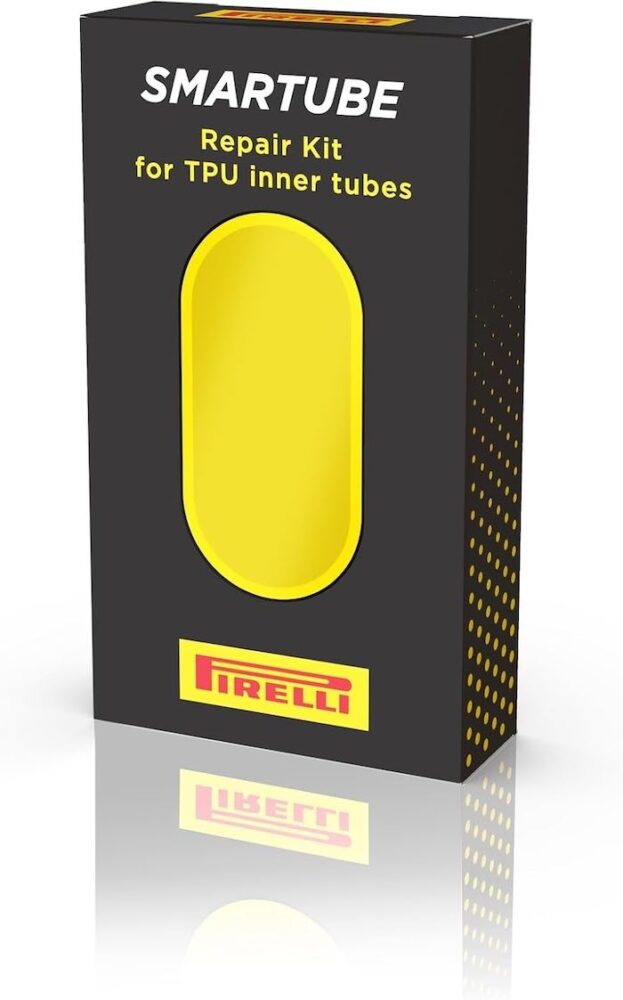
- TPU tubes require a specific patch kit to repair punctures (photo)
- And, here’s a big one to be aware of: some models may not be approved for use with rim brakes (as is the case with this Pirelli Smartube RS). Yes, a lot of riders still have rim brakes and if that’s you, there are TPU tubes for them too.
Pirelli’s New Super TPUs
The TPU tube we’re looking at here is Pirelli’s new Smartube RS, which is designed to go with their P Zero Race RS tubeless ready tires. I have put many miles on P Zero tires and love the ride. Pirelli has a wide range of Smartubes for all purposes at various price points.
This new model is their highest performance race tube yet, so it’s ideal for use with their top tier tires. The suggested retail prices I could find currently online range from $37 to $50 per tube. (Pirelli has other Smartubes starting at $28, so they’re not all this pricey.)
If you’re looking for every possible advantage in your racing the price might not matter though. According to their lab tests, when paired with their tubeless-ready tires, the Smartube RS boasts 12% superior rolling resistance over their other TPU tubes and up to 24% over classic butyl inner tubes. And they found that the performance levels are nearly identical to those of a tubeless setup with sealant, without the complexity of dealing with sealant and sealing.
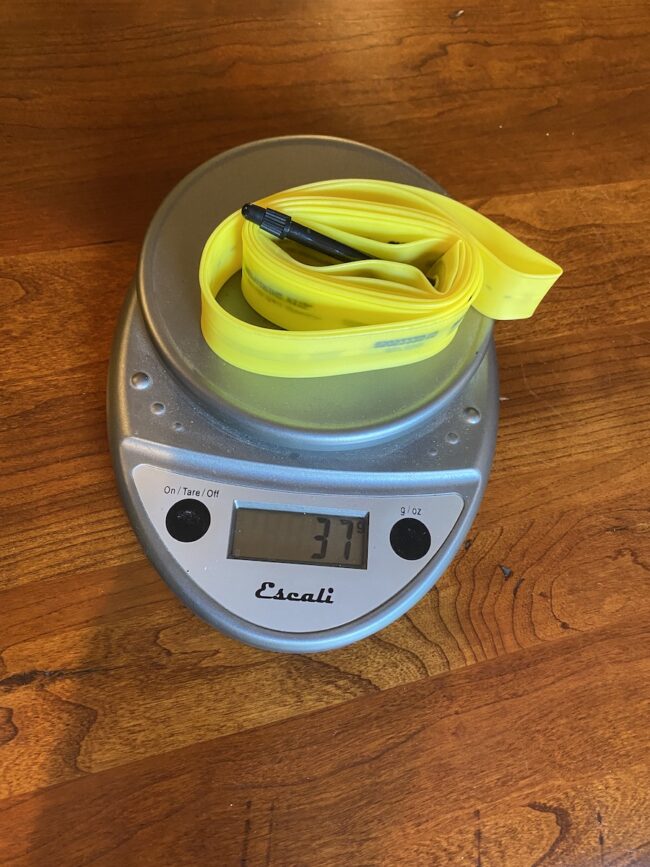
The Smartube RS is available in a size 700 x 26/35c, with your choice of a 42, 60 or 80mm Presta valve. The valve is made of plastic and has a replaceable core. Our 60mm valve test tube weighs 37 grams (photo). The 26/35c size makes them ideal for use with the wider tires used today.
Ride Quality
Pirelli sponsors the Alpecin-Deceuninck and Lidl-Trek teams, which are already using the P Zero Race RS tires with the Smartube RS tubes setup in mountainous time trials.
I haven’t put many miles on the Smartubes yet but if you haven’t tried TPU tubes, you’ll notice the difference between one and a butyl tube within about ten pedal strokes. You’ll feel how much lighter they are and you might feel more compliance and comfort from the tire as I do.
As I mentioned, I love the ride of Pirelli P Zero tires. They feel faster and easier to get up to speed and stay there. They’re lively, compliant tires that grip great too. This makes it difficult to feel if these new Smartubes are actually 12% superior to other TPU tubes. To me, they feel similar to the TPU tubes I already use.
I’m not racing right now. When I was, I was competing at the masters age group level and one of the first lessons you learn is that the guys winning the races are using the lightest fastest equipment. The reason is that as we age we lose strength. Any extra weight on the bike wastes your energy or strength. And, you can’t afford to give anything away even racing against a bunch of old codgers.
If I was still pinning on numbers I’d definitely run the very highest performance tires and tubes, such as these Smartubes from Pirelli. And even without racing, I think anyone will definitely enjoy the wonderful ride.
For more information visit: https://www.pirelli.com/tyres/en-ww/bike/accessories/inner-tube/smartube.
Jim Langley is RBR’s Technical Editor. A pro mechanic & cycling writer for more than 40 years, he’s the author of Your Home Bicycle Workshop in the RBR eBookstore. Tune in to Jim’s popular YouTube channel for wheel building & bike repair how-to’s. Jim’s also known for his cycling streak that ended in February 2022 with a total of 10,269 consecutive daily rides (28 years, 1 month and 11 days of never missing a ride). Click to read Jim’s full bio.

The price is ridiculous and the ones I tested were too fragile for practical use as spares. Nope.
I agree. Plus, the first one I tried was flatted by a goathead and the patch didn’t hold. I ended up finishing my ride by riding on the rim for a block and a half.
I agree. And as to puncture resistance, my first ride with TPU resulted is a rear flat from a goathead. It was extremely hard to find the hole, and then the patch didn’t hold.
I have a rim brake bike and I don’t use the most sensitive tires. Would I be able to detect a difference between these and my butyl tubes if I’m using Continental Gatorskin tires?
I think you would Steve. If you give TPUs a try, let us know what you think.
Thanks for commenting,
Jim
“if you haven’t tried TPU tubes, you’ll notice the difference between one and a butyl tube within about ten pedal strokes. You’ll feel how much lighter they are and you might feel more compliance and comfort from the tire as I do.”
Placebo effect most likely. While there are lab tests and calculations of such benefits, even the claimed advantages are well below the generally accepted limits of human perception (up to 16% for tangential forces- see Wheat HE, J Neurosci, Mar 2004). I would like to see blinded (rider unaware of tube type) cross-over testing with a different tube as the only variable (same bike/wheels/tires/pressures). While such a test could provide powerful product advertising fodder and be relatively cheap to perform, the LACK of such published testing says something to me.
I concur with Lee. they are bloody expensive and in my experience do not offer better puncture protection. Not suitable for rim brakes well that’s an issue for sure.
« …. According to *THEIR* (i.e. Pirelli’s) lab tests,….. …. the Smartube RS boasts 12% superior rolling resistance over their other TPU tubes and up to 24% over classic butyl inner tubes…. »
Lol, ok then.
I have no reason to believe for a second that Pirelli or Continental or Michelin or Specialized or Schwalbe or Panaracer or Kenda or Maxxis or Rene Herse or any other tire company would lie about their tire testing. Why do you?
Jim
In any realm I prefer to rely on INDEPENDENT testing rather than manufacturer claims. Not accusing anyone of “lying”, but testing protocols can be designed to favor certain outcomes most useful for marketing. .
Here’s a well-respected source of independent data: https://www.bicyclerollingresistance.com/specials/tpu-inner-tubes
The report is too old to include the Pirelli tubes, but it does compare other TPU tubes to butyl and latex tubes.
Thanks for the link Brian!
Jim
The bicyclerollingresistance.com has been updated and includes Pirelli RS and non-RS. Big difference.
They may not be doing it properly. Getting lab to correlate correctly with real world is an art and science. Can be expensive.
I switched from tubeless to TPU (Ridenow brand) for road tires in April 2025. The TPUs are supposed to be more puncture resistant than butyl also. No flats yet (no jinx). Perceived advantage for me is needing to inflate them less frequently than tubeless (so the sealant doesn’t dry out), not dealing with sealant refresh, not having sealant (and weight) build up in the tire over time as it dries out. Also with TPU, one does not need to use Tubeless Ready tires, which have heavier sidewalls. So with TPUs can achieve less rotational weight.
I still have tubeless gravel and MTB setups; may try TPU gravel in the future.
Thanks for your take on TPU tubes DK, appreciate it. I’ve used the RideNow tubes too and they’ve worked really well for me too.
Thanks again,
Jim
Plastic valve stems leak and fail, poor joint quality where the stem pad seals to the tube have been my experiences
Silca and Rene Herse have solved those problems.
Clear TPU is stronger than dyed TPU. Patches work better. Tube joins are not glued but welded (electron beam or ultrasound). Metal valve and metal/TPU/metal valve joint eliminates the failure point there. I have ridden for many years and can immediately tell the difference between butyl and latex. TPU are similar in feel to latex. Lighter weight too. The difference between Rene Herse regular and extra light is immediately noticeable as well. both in ride feel and weight. Not suitable for rim brakes is only for the lightest tubes. Read the manufacturer’s label. Chinese tubes are the worst. Inflate to proper pressure using Silca or Herse online pressure calculators. A Rene Herse setup rides similar to Clement silk sewups w/o all the hassle. See the Herse and Silca websites for more info.
Rene Herse regular and extra light TIRES 🙂
One of the things I find interesting when comparing to butyl tubes is that every reference seems to say they weigh 100 gm or more. I’ve been riding 70 gm Michelin A1 butyls for decades. So half of the weight savings that is often claimed doesn’t apply. That said, it seems the big barrier to TPU tubes is cost. Rene Herse among others have gone to metal valves so that issue is moot. Maybe when I use up all my (multi-patched) Michelin tubes, I’ll switch to TPU.
Thanks Kerry. I had forgotten about that tube. I think though that it’s the Michelin 700c AirComp Ultra Light Inner Tube (Presta) (18 – 25mm). As far as I can tell, that’s the lightest butyl tube and according to online info it’s the one that weighs 70 grams. I found them listed on Performance FYI for about $10 per tube, a nice price. RideNow TPU tubes are about $13 each on Amazon.
Thanks for the reminder!
Jim
I’ve also ridden those Michelin tubes for years and have no inclination to pay 3-4 times the cost for TPU tubes. For the type of riding I do, and the very occasional flat, I’d rather spend the money on other things.
Hi John,
TPU tubes can be purchased at similar prices to the superlight butyl tubes so they won’t cost any more unless you choose to buy the expensive ones.
Jim
I too have been using lightweight butyl for many years: the referenced Michelin AirComps, Continental Race Lights and, more recently, the newer Pirelli ROADtubes which are rated for 23/30 so can easily handle the currently fashionable 28 and 30mm road tires. BicycleRollingResistance.com shows the Conti Race Lights to be similar to TPU tubes for rolling resistance.
I have tried TPU, and still have a couple of TPU tubes mounted on my bikes. I’ve had my share of leaks at the base of the valve stem, patches that just peeled off, etc. One thing I particularly dislike is that, when you deflate them, they stay stretched and do not rebound to original size. So, when you go to reinstall them, they want to get trapped under the bead of the tire. It takes me much longer to install a previously-used TPU tube than a new one or, easiest of all, a butyl tube.
So, tube-type tires and lightweight butyl tubes for me, for as long as the manufacturers keep making them.
Thanks for mentioning how TPU stay stretched out, Stephen. That’s a disadvantage I forgot to mention. Here’s a tip to prevent all tubes and any type of tube from getting trapped beneath the beads: never ever install a flat tube (one with zero air in it). Always inflate the tube a wee bit. The goal is to just get the wrinkles out and shape the tube fully. The easiest way to do this is to blow it up with you mouth the same as inflating a balloon. Inflated like that it won’t want to stay underneath the beads and is easy to get out and up inside the tire where it fits nicely. Once the tire and tube are on the rim and it’s time to get that last tight section of tire up and onto the rim right next to the valve stem, at that point, you let the air out of the tube. You push the valve up slightly as you do this to create clearance. Using this technique you’ll never trap the tube beneath the beads again. This works with all tubes whatever they’re made of.
Thanks for commenting!
Jim
I’ve been riding “Ride Now” brand for 7000 miles.
10 bucks a pop on Amazon. Zero flats. The big brand names are ridiculously priced.
I find I have to add air about once every 2-3 rides. No biggie for the weight benefit. The ride is a tad harsher than butyl. I’m loving the Ride Now’s.
Thanks for sharing George, appreciate it.
Jim
One other advantage is that TPU tubes are brightly coloured. That makes it easier to see what you are doing when changing a flat. I wear glasses for reading and close work but I don’t carry my glasses when riding, so being able to see the bright colour against the black of the tyre makes it less likely that I will inadvertently pinch the tube while changing a flat.
Thanks John, that’s a good one I didn’t think of, appreciate it.
Jim
Bought 4 RideNow tubes last year. Paid about $8 each. Love how light and strong they are. Only one flat late last season, a large metal staple that eventually got through tube. Was stuck in the Conti GP5000 a while, too: very worn down when I finally flatted (usually hear these, but not this time). So, I’d say they’re more puncture resistant than butyl, at least in that instance. As for fixing that hole, the first 2 self stick (supplied with tube) failed overnight following rides. Tried again using some normal patch cement first (leaving it wet) and that held, to my surprise.
As for ride, I agree with John above: too subtle to notice. Otherwise, the only complaint is the valve. Mine are metal, but for some reason the stems tend to loosen from unscrewing the tops repeatedly, developing slow leaks and needing to be tightened every few months. Also, one of mine failed where the valve’s metal shaft attaches to the tube’s hard plastic base (cracked, probably from using a mini pump on it). Even if no good for riding anymore, it’s now a donor for future patch material.
Overall, no complaints at the price point I paid, but I’d never drop $20+ for a Pirelli or other name brand. That’s too much for saving a few grams in weight and slightly better puncture protection.
Thanks a lot for sharing your experience Mike, appreciate it.
Jim
One issue I’ve found with the TPU tubes is that it’s nearly impossible to find a small puncture. When out of the tire, you can’t inflate them enough (without permanently over stretching) them to find the leak, even with the tube submersed.
I bought four to test last year. Under normal, non-adverse road use, I got at most 180 km before they flatted. One lasted just 24 km. Ridiculously fragile; I’ll never buy another.
Until last year, I’d been using TPU tubes on my road bikes for maybe 10 years. Before that, tubeless, and before that butyl. First, the Tubolito, then the Schwalbe,, then the Pirelli, and finally the Ridenow. The most important thing I learned was that none of them were patchable long-term, and I tried numerous methods (stick-on, glue-on, gorilla tape on top of patches, etc). Every method failed eventually on the road, so I’m back to tubeless – and happier. I still carry the Ridenow TPU tubes in my saddlebags for spares though.