Beware Over-Inflation When Seating Tires

Jim’s Tech Talk
By Jim Langley
Recently I heard from two friends, Tony and Seth, who blew new tires off the rim during installation. They both were trying to seat their tires with an air compressor and over inflated them. Which caused small yet scary explosions.
Be Seated Tire
In case you don’t know what “seat their tires” means, to “seat” a tire or “seating” a tire is the act of making sure a tire is fully and properly installed on a wheel. Tires should sit perfectly aligned with the wheel.
To check, after it’s installed and inflated, when you spin the wheel and watch the tire in relation to the wheel, there should be no wobble to the tread or high or low spots in the tire. These defects would ruin the ride and could even cause speed wobbles, which can result in crashes. Here’s a recent article on that subject: Things to Know About Speed Wobble.
To help with seating tires there are almost always clearly visible “bead seating lines” molded into the bottom edges above the beads on both sides of tires.
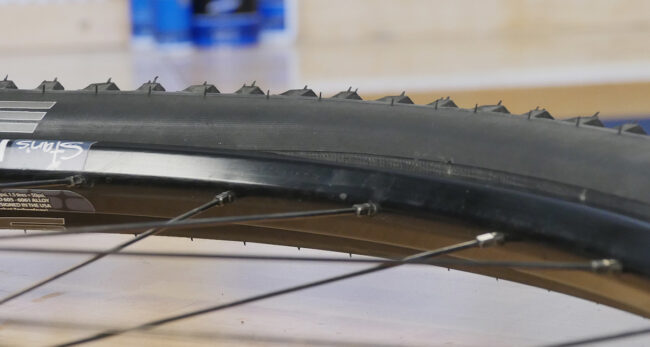
In this photo (thanks Park Tool!), the bead seating line is visible on the right and lower portion of the tire a little above the rim. As you follow this line to the left you’ll see that it disappears. That’s because the tire is sitting crooked on the rim. The tire is not yet fully seated.
When the tire is correctly mounted, the seating line will be visible just above the rim and equidistant to it all around the wheel and on both sides of the wheel. Whenever installing tires you want to take the time to get this right, and it can take some time.
Because it can take a little time and effort, a common and dangerous technique is to keep adding air until a tire seats. This is what happened to my two friends. I’ve made this mistake too and paid for it with hearing loss that lasted for months. I wrote about it back in 2018 when it happened: Overinflation Explosion: A Cautionary Tale About Very Wide Tires.
An Easy Mistake to Make
Over inflation can happen because of a misunderstanding of the recommended pressure for the tire, or the rim too. Another issue that can cause it is a pump with an inaccurate gauge. And with power tools such as air compressors, the air can rush in so quickly the max psi is exceeded before you even realize it.
For these reasons it’s important to know what pressure is correct for your wheel and tire setup. Even the width of the tire affects this. And also to use a quality pump and do so carefully. Note too that some compressors inflate much quicker than others.
The most important thing is to sneak up on whatever the target pressure is because the tire is much less likely to blow off if it’s at a lower pressure.
Never Over-inflate to Seat Tires
The moral of the story, and what I recommend is to stop using over inflation to try to seat tires. I know it can work to seat them. But the thing is, with the way tires and rims have been changing, what with tubed, tubeless, liners, sealants plus wider rims, carbon and aluminum hoops and hooked-bead or hookless construction, it just keeps getting riskier to do it.
And, if you think about the mechanics of over inflation, the practice doesn’t really make sense. Since the tire is basically stuck in a crooked or twisted position on the rim, adding more and more air is as likely to get it stuck worse as it is to get it to correct itself and seat
So instead of that risky brute force approach, use your hands to seat tires. You do need the tires fully rounded out with air first, but they don’t need to be anywhere near fully inflated. The most common issue is that the bead seat line is below the rim like it is in the photo.
You can pull this up and out from under by using the heels of your hands to roll the tire away from the rim at that point. It may take a few tries but you should be able to get the tire seated there. Then you repeat around the rim on any other low spots.
If a tire won’t cooperate, let some air out and try again. Still no luck? Try letting all the air out and applying a little liquid soap mixed with warm water in a squirt bottle to spray the beads of the tire, inflate and try again with your hands to seat it. To improve your grip, put on rubber-palmed garden gloves.
Hopefully with these tips you’ll never experience any exploding tires and they’ll always ride smoothly and straight too. Please share your favorite tire tips in a comment. Stories of blowing off tires are also welcome.
Jim Langley is RBR’s Technical Editor. A pro mechanic & cycling writer for more than 40 years, he’s the author of Your Home Bicycle Workshop in the RBR eBookstore. Tune in to Jim’s popular YouTube channel for wheel building & bike repair how-to’s. Jim’s also known for his cycling streak that ended in February 2022 with a total of 10,269 consecutive daily rides (28 years, 1 month and 11 days of never missing a ride). Click to read Jim’s full bio.
Most of time tires just seat themselves no problem however I have had this issue with Schwalbe studded tires. Getting them to seat properly is always an adventure. The trick of using soapy water in spray bottle helps a lot and the bonus is that you get to clean the tire and rim. I do have to inflate check and then deflate and adjust the tire to seat properly. I can see this is more of an issue with tubeless but I have no experience with them.
All true… One other issue I have experienced after mounting several hundred tires is that not all tires are manufactured to spec. (not sure why this should happen but it does). This is an issue especially with new tires….after mounting the tire/tube and before inflating, hold the tire at the top and lift the tire/wheel. The tire should not come off the wheel at the top…if it does, very slowly inflate to make sure it does not blow off the rim. I have seen some new tires too loose (too large a diameter) to be installed safely). I have taken some of these new tires to my LBS and they gave up trying to install them without them blowing off the rims. Some could be inflated to minimum recommended pressure but would blow off when ridden.
Good morning Jim,
I have stopped using a compressor. Instead, I put the new tire in the sun while I remove the worn tire. #2. install the new tire by hand making sure the tire is positioned correctly on either side of the valve stem. #3. Using a # 16 CO2 I inflate allowing the tire to seat. ( hear the pops as the tire seats). This seats the tire without over inflation and can be controlled using a trigger CO2 inflator. Add slime, valve stem and hand pump the tire to the desired pressure.
I continue to learn something new each time I replace a tubeless tire. If I learn more ways to change a tire, I will send updates.
I wonder if one could seat tires using water, a non-compressible fluid. No compression, no explosion.
I have tubeless and learning some tricks. One is to place the tire toward the center of the wheel where there is a deeper depression. I have been able to get the bead to seat with a regular floor pump but not always. I bought a Topeak with the cylinder that allows more pressure to seat the bead without an air compressor.
I haven’t tried the soapy water yet, but I will next time. Also with our dry climate in CO I have been told to check sealant every 2-3 mo. as it can dry out. I checked mine and it was totally dry! yikes!
I’ve found that, given a few minutes, tires often seat on their own without exceeding max pressure. It’s more fun than watching paint dry to observe a bead slowly migrating into place, sometimes with a little pop as it finally locks into place.
Hi Jim
I’ve had good luck using bead seat wax. I buy it from Amazon, here is the product;
Brand: Shindy Mfg
SHINDY TIRE BEAD WAX 08-901
I also help the tire with bead seat tires if necessary.
Keep up the good work, Dave
Being an old reprobate, I still very much use and appreciate tubular tires, so I avoid all those problems. Thanks to tubular gluing tapes I’ve found using tubular tires easier to use and easier to change than other systems. minor punctures on the road fixed with the insertion of tubeless sealant plus carry a spare, which can be replaced in minutes.
My LBS demonstrated the perils of high-volume / over-inflation as a tire dressing method, The explosion was so loud, everyone in the shop came running. Wheel was destroyed. I got a free set of wheels. Photo available upon request.
Thanks Terry and yes, if you can send in the photo, I’ll share it with everyone. Please send it to me at jimlangley at gmail.
One thing, I didn’t understand what you meant by tire dressing?
Thanks a lot,
Jim
Jim, he likely meant tire “seating” not “dressing”, but hopefully he’ll let you know!
Pete
Thanks for the great tire tips everyone! Appreciate it very much.
Jim
Baby powder also works as a lubricant for the tire to seat more easily on the rim. And it’s a good idea to have it on the inside of the tire to prevent the tube from sticking to the inside of the tire, which can result in a flat over time.
I also had a tire blow of the rim that had been inflated in cooler weather at a gas station. The tire blew off the rim about 10 minutes after the bike came inside. I think the air expanded enough as it warmed up to increase the pressure. Rim is okay, but the tire was stretched and would not stay on the rim.
Blow-off issue is well known, and this is a reason for specifically using an air compressor with a tank, and NOT using blasting pumps or CO2 Cartridges. With an Air Compressor, you have two gauges and a knob. You can set maximum output pressure to an amount that is lower than the maximum pressure of the tire. This does NOT reduce the power of the blast, it simply guarantees the blast will stop before exceeding maximum tire pressure. Blasting floor pumps and CO2 cartridges do NOT have this safety limit capability.
Prestacycle has built Prestaflator tools since the beginning of Bicycle tubeless. Safety and prevention of damage have always been within our focus for tubeless, combined with proper use of the features of an air compressor.
I have a Joe Blow Booster for inflating tubeless. I havent tried it yet but it was recommend to me..
Exactly. That is an example of NOT having a safety limit. 1 litre at up to 160 psi could be too much for some tires.
A 6 gallon electric air compressor (example Home Depot Brand link below) is around 100 dollars. It has two gauges and a knob. The knob sets the maxium pressure. You set that to your inflation pressure, and it will never go over. Meanwhile is has much more power and volume to be sure you get your tire mounted quick and easy..
You’ll need a hose and a Prestaflator mini inflator. Total cost 160+, depending on the hose. Tubeless seating and everyday tire inflation will take 2 seconds without pumping – provided you have access to a power outlet.
https://www.homedepot.com/p/RIDGID-RDGD-6-gal-150-PSI-Portable-Electric-Pancake-Air-Compressor-02106416/330282430