“Jim’s” Hitch Rack Recommendation and Will it Work for You

Jim’s Tech Talk
By Jim Langley
In last week’s Tech Talk, we reviewed an excellent new hitch rack from the company Saris called the Cycle-On. If you missed the story, here’s the link: Saris Cycle-On 2 Bike Hitch Rack – E-bike Ready.
In response to the article, a reader named Jim Kemper was kind enough to leave a comment recommending a rack he uses. Jim’s rack is a different type of hitch rack from the Saris model that we reviewed. So I thought it would be helpful to explain the differences in case you’re in the market for a hitch rack and would like to know. First up is Jim’s comment and then I offer my thoughts.
Jim wrote
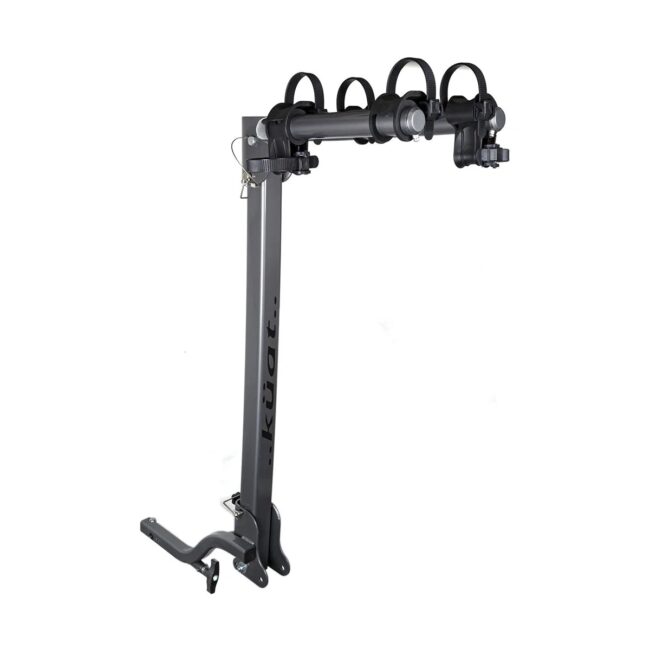
“I know this rack touches the bike, but the Kuat Beta that I use weighs only 14 pounds and it folds up very small. It also carries bikes up to 40 pounds. Which means it holds my Specialized Creo e-bike easily. I thought other readers might be interested. Here’s a link: https://kuat.com/products/beta?variant=47366608355626”
My reply
Thanks for the link to the rack (photo) so that I could check it out Jim. Kuat makes excellent racks and we’ve reviewed several over the years, which you can find by searching on “Kuat.” As you pointed out, this rack differs from the Saris Cycle-On because it holds bicycles by the top tube instead of mainly by the wheels.
Also, the Kuat Beta has a 40 pound limit per bike and it’s not RV-compatible (the Saris rack’s bike weight limit is 70 pounds per bike and is made for RV use too). I don’t know what your Specialized Creo e-bike weighs (maybe you’ve added accessories), but according to Google, I found approximate weights as follows:
- S-Works Turbo Creo 2: 28 pounds
- Turbo Creo 2 Expert / Comp: 30.7 to 32 pounds
- Turbo Creo 2 Comp E5: 33 pounds
If you have one of the lighter bikes and you haven’t added too many accessories, I can see how the rack could work fine for you. However, if you have the heavier model and you added enough accessories (a couple of full 20-ounce bottles alone could add upwards of 3 pounds), personally I would be a little concerned about the bike.
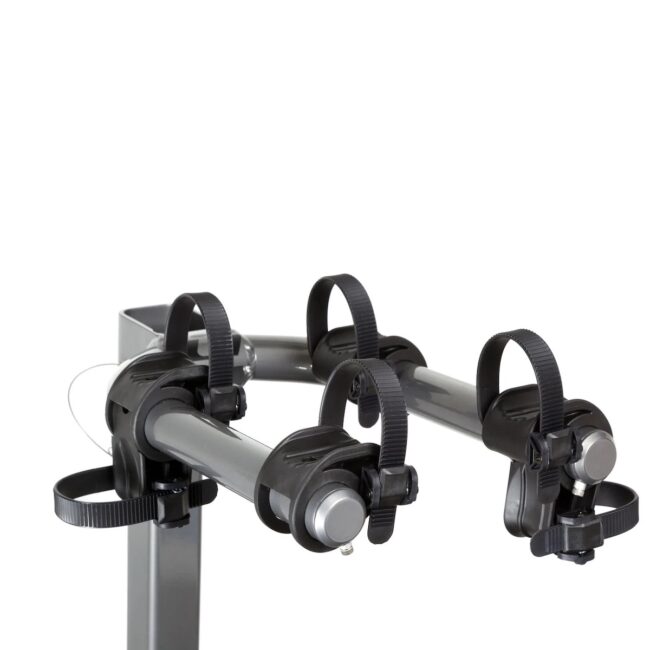
The issue for me is how the bikes are held by the top tubes. This tube on many bicycles is one of the lightest on a bike, which can make it among the most fragile. The Kuat rack has what appear to be rubber holders to cradle and protect the top tube and they prevent the bikes swaying and bumping into each other (photo).
Because you might have the S-Works Turbo Creo, which is Specialized’s highest end bike and made of carbon, I dug into Kuat’s FAQ about the rack to find out what guidelines they give for carbon bicycles.
It reads,
“Q: IS THE BETA SUITABLE FOR CARBON BIKES?
A: Yes, however, you should take some precautions due to potential pressure on the bike frame, such as adding protective padding or a top tube adapter to minimize risk.”
I assume the reference to a top tube adapter is for step-through carbon frames, which do not have top tubes (though off hand I can’t remember ever seeing any carbon step-through frames).
Summing up
Overall, my takeaway on Jim’s recommended Kuat Beta rack is that it’s a nice superlight and very portable 2-bike hitch rack for only $349 (the Saris Cycle-On is $899.99), and I understand why he loves it. But, whether it’s the right choice for you depends on what types of bikes you carry and also where you take them.
For long trips where you could encounter bad road or off-road surfaces, I would be concerned that all the force of impacts is concentrated on the top tubes of the bikes. I also wonder if the anti-sway holders, which look good, could prevent the bikes from bumping into each other over a badly pot-holed or dirt road? The beauty of hitch racks that support only or mainly by the wheels (sometimes called “platform racks”) is that no or little impact force can affect the frame at all.
And even with these racks, I’ve seen cars on the side of the highway stopped because a bike has bounced out of a wheel tray after hitting a section of bad pavement. In my experience, it’s not like America’s roads are getting any better. On our recent RV trip to North Carolina and back, we drove over 9,000 miles and some of the roads we encountered were horrible, which always makes me worry about the bikes even on our platform rack.
Which is not to say that there’s anything wrong with Jim’s choice to use Kuat’s Beta rack but just to point out what to consider if you are hitch rack shopping.
Jim Langley is RBR’s Technical Editor. A pro mechanic & cycling writer for more than 40 years, he’s the author of Your Home Bicycle Workshop in the RBR eBookstore. Tune in to Jim’s popular YouTube channel for wheel building & bike repair how-to’s. Jim’s also known for his cycling streak that ended in February 2022 with a total of 10,269 consecutive daily rides (28 years, 1 month and 11 days of never missing a ride). Click to read Jim’s full bio.
I transport my Turbo Creo 2 Comp E5 regularly on a Saris Bones 2 trunk rack. The bike by itself weighs about 33 pounds, but with the range extender battery, pedals and a few small accessories, it probably weighs about 40 pounds. The Bones 2 has a weigh limit of 35 pounds per bike, or a total of 70 pounds, so I don’t put a second bike on the rack, though probably could get away with a regular lightweight bike. But for the Creo itself, the Saris Bones 2 trunk rack works fine.
I recently replaced a Thule tray style hitch rack I owned for 20 years. It was a reliable rack that served it’s purpose but when pricing replacement parts I would have ended up spending half as much as the cost of a comparable replacement. My wife wanted a new rack that allowed her to load her ebike without assistance from me and I’m good with that. My choice with some regrets, I’ll explain later, was the Yakima Stage 2 with the optional ramp. In all fairness it’s an extraordinary rack built like a tank with every feature of it’s predecessor plus much improved security and locking systems. The ramp is easily stored in a trunk or truck bed and drops into a dedicated slot on the tray attaching without tools.
It’s pricey at around $1000 but generally you get what you pay for with these things. The regret I spoke of is it’s weight and heft. If one plans to mount and unmount the brute regularly you could build a strength training program around putting this rack on and taking it off. None of this of course is a concern for the wife since heavy lifting is my job. On the other hand permanently mounted say on the rear of an RV it would be a near a perfect solution.
For that type of rack (suspend from the top tube), it may be fine if carrying a single bike. In the case of my Thule, the bikes do indeed sway. I MUST protect the chain stays with pieces of padding made from pool noodles. I also wonder about having more than one bike with the now common sloping top tube…
The “top tube adapter” referred to by Kuat might be something like the Hirobel from Silca:
https://silca.cc/products/hirobel-clamp
Thanks Jeff. The Hirobel, which I reviewed a few Tech Talks ago is actually an accessory for use with bike repair stands and because it hold bikes by the top tube, I don’t believe it would work for holding step-through frame bikes on a vehicle rack.
The “dummy” top tube accessories made for this purpose are available from rack companies, such as Saris, Yakima, Thule, and probably other companies making racks and rack accessories. They should cost less than the Hirobel too.
Thanks for commenting,
Jim
There are many types of hitch style bike racks on the market. I believe for a hitch brand, 1UP USA is the best. A few company’s have copied their design. I think a bike, especially carbines frame should be fully supported. Have traveled over a thousand miles carrying one of two bikes with zero problems. One is a Specialized Creo XL Expert, the other is a Forbidden Druid Lite.
1UPusa sells direct and is not available in stores. Now you can find some used ones if you look at “Craigslist or FacebookMarket Place”. Well made product coming from the USA. And not plastic or composite material.
This comment would never appear in print, but I marvel at the concerns of the 0.1% with their $13K, 40 pound e-bike tanks and which thousand dollar hitch rack to choose from to mount on their $50K+ motor homes- spare me please. How the leisure class embraces “cycling” is worlds apart from when I took it up, and my new 77’ Toyota pickup was $2K out the door including tax and license (kept it 23 years, and still being driven by a friend). A new Masi (yes that’s a pedal only bicycle) was maybe $300-400 (and out of reach). The cost of everything now is so absurd, and I easily understand the concerns of Generation Z who can barely afford rent, and resent the perks of us fortunate elders who have little to no financial worries. I’ll stick with my 20+ year old, 17 pound (16 if I splurged for a Dura-Ace chain and sprockets again, which I won’t) S-Works Roubaix (a cheap discarded Gerolsteiner team issue one). At 77, nothing will make me any faster at this point, and I can pick it up without getting a hernia. If I need a ramp to get my bike on a hitch rack, it’s time to find another activity. My rant for the day.