
Fizik Vento Antares R1 Adaptive Saddle Review

By Brandon Bilyeu


Hot!
- Tailored zones of padding from 3D printing are very comfortable
- Grippy texture keeps you in place
- 3D printed saddle at a ‘reasonable’ price point
- Two widths and rail materials available
Not!
- Open structure can collect dirt and water
- Grippy texture can be harsh on bike short seams
Price: $299 R1 (carbon rails, 180g)
$259 R3 (Kium metal hollow rail, 220g)
How obtained: review sample from Fizik
Available: retail, online
Website: Fizik Vento Antares R1 Adaptive
RBR Sponsor: no
Tested: 75+ hours
Saddle Disclaimer
Saddles are a very personal contact point with the bike. Everyone’s body, and thus saddle needs, are different. What is comfortable for me might be the world’s most perfect torture device for you. It is recommended to test saddles at a bike shop or make sure the return policy is generous.
Fizik Vento Antares Line of Saddles
Fizik offers both a standard and Adaptive (3D printed padding) version of the Vento Antares saddle. Previously, I reviewed the standard Vento Antares R3 and that review is a good introduction to the Vento Antares saddle shape and fit that I got on with really well. Having now ridden both the standard and Adaptive versions I can comment on the differences and hopefully help you decide if the price premium for Adaptive is worth it.


Vento Antares R3 (left) and Vento Antares R1 Adaptive (right)
Fizik Adaptive Technology
3D printed saddles have been around for a few years now and Fizik’s versions are denoted by the “Adaptive” moniker in the saddle name. In the case of the Vento Antares Adaptive, the saddle takes the general shape of the standard Antares but the foam padding is replaced by a 3D printed lattice. The benefit of 3D printing is the ability to perfectly define and transition between padding zones.
Generally speaking, sitting on the Adaptive version feels similar to sitting on the standard version, but exploring the Adaptive with your fingers reveals the extreme padding differences allowed by 3D printing. Push down in the sit bone support area and you will feel the lattice is very stiff to hold your weight. Push down in the center rear or side wings and your finger will easily collapse the lattice so that it does not interfere with your pedal stroke.
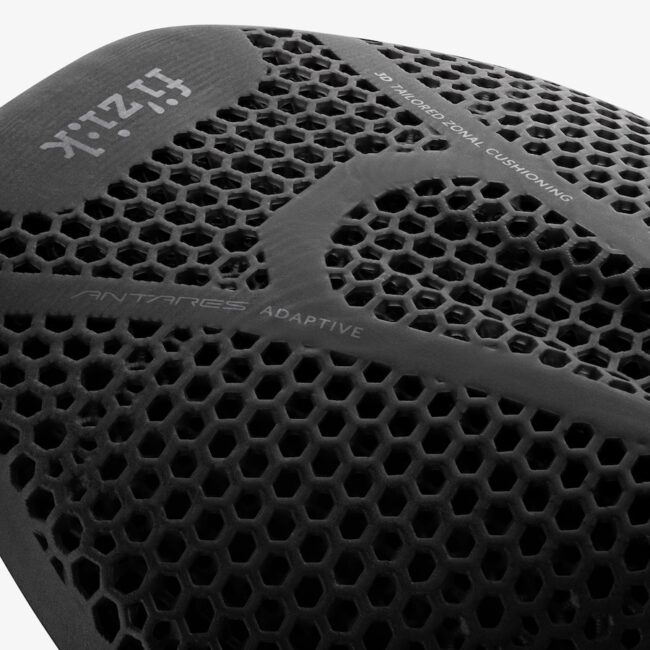
Interestingly, while the Adaptive R1 saddle looks mostly made of air, it is actually a little heavier than the standard R1 saddle at 180g versus 161g.
On the Bike
Immediately upon rolling away on my first ride with the Adaptive saddle I noticed that the 3D lattice is much gripper than the smooth cover on the standard saddle. This is great for getting locked into position and reducing unwanted movement on the saddle (which can be a cause of saddle sores). But at the same time means you can’t easily slide around to find the perfect position; you have to lift your weight off the saddle to move which is a little more hit or miss than just sliding into place.
Sit bone support is excellent with gradual transitions to softer areas so there is no abrupt end to the support or stiff edges to cause discomfort. The lattice adapts and cradles your sit bones a little better than the standard saddle padding for a small but noticeable improvement in comfort. A quality chamois does a good job of cushioning the sit bones and makes the subtle differences between the two saddle padding types less noticeable.

Moving fore/aft on the saddle remains supportive as long as you stay centered on the width. Lateral shifts will fall into the soft padding and you will quickly feel lopsided. The edges of the nose provide ample support for riding aggressively with the center depression keeping pressure off the perineum soft tissue.
Out on rides the question I have been asked most often is whether the saddle is comfortable, and if it’s more comfortable than a standard saddle. My answer is yes, it is a very comfortable saddle and yes, I find it slightly more comfortable than the standard version. The Adaptive refines the comfort that already exists in the standard version. Given everyone’s saddle comfort is so different I think the Adaptive saddle is another great option for people to try out.
The second most popular question is whether the Adaptive is cooler due to air flow through the saddle. The answer is no as sitting on the saddle blocks most of the openings for air flow and the shorts/chamois are too thick to feel a difference from below.
The only negative I found was the grippy lattice is abrasive on bike short seams. Specifically, I have larger thighs and they rub the nose of any saddle I am riding. Some shorts have seams along the inner thigh and when these rub against the Adaptive material the threads start to fray and over several rides can be worn completely through. This only effects threads and has no detrimental effect on short material where there are no seams. If you don’t experience thigh rub then you have nothing to worry about.
Bottom Line
The Vento Antares R1 Adaptive saddle is a very comfortable saddle and brings improved comfort over the standard Vento Antares. The 3D printed lattice has support in all the right areas and provides a grippy interface to the bike.
Brandon Bilyeu is an avid recreational roadie who lives in Regensburg, Germany. He’s a year-round bike commuter and is a mechanical design engineer by trade. Click to read Brandon’s full bio.
Old joke: there are two kinds of cyclists, those who ride Brooks B-17 and those who will eventually.