Discs Brakes On Tandems & A Reader’s Epic Story

Jim’s Tech Talk
By Jim Langley
In last week’s Tech Talk, I asked you to weigh in on a few recent thoughts I had on disc brakes on road bikes – and BOY, did you ever! So many comments came in that I’m still reading them. Thanks so much! Here’s a link to that story and the comments so that you can dig in if you missed it.
Along with opinions, tips and advice, there were some great questions and stories. I’m going to answer a couple of the questions today and share one story that was submitted. Coincidentally they’re all about tandems. I love riding tandems and I bet some of you do too.
Disc Brakes on Tandems
A reader named “Mike” commented, “I remember reading an article from one of the tandem makers I think about 10 years ago. They did testing with disc brakes and managed to smoke/fail them all and said there are no tandem rated disc brakes.”
Yes, Mike, I remember that article. It was from Bill McCready of Santana Tandems, who some would say revolutionized tandems when he founded Santana in 1976.
I could not find his article about disc brakes on their website. Maybe some readers will remember it and be able to share a link to it so that we can go back and take a look.
But, I wanted to look into modern tandems to see if Santana and another leader in the field Co-Motion (in business since 1988) come with discs and it looks like they do.
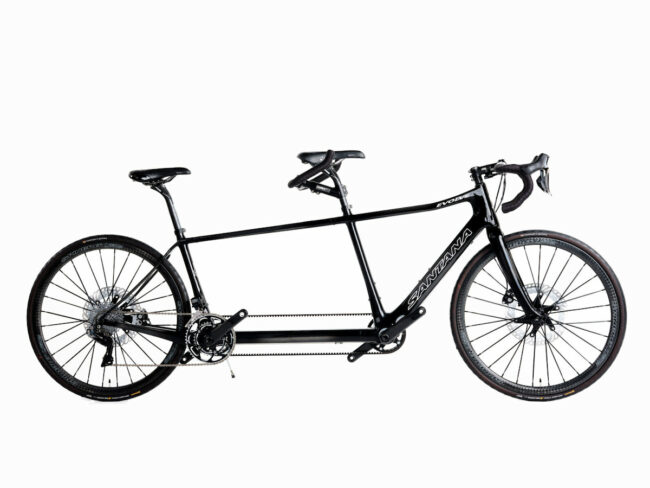
The only thing is that the dates on Santana’s site suggest it might not have been updated since 2018, so I’m not certain they’re still selling bikes or if the spec is the same today in 2024. Here’s a photo of one of their top-line Evolves though, which shows the discs.
Co-Motion’s website looks up to date and most of their bikes feature disc brakes. Here’s a photo of their Macchiato.
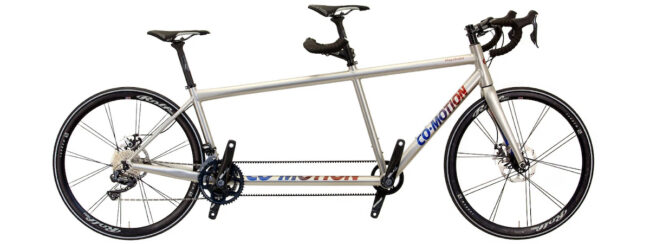
I think this shows that tandem makers feel that disc brakes work fine on tandems. That doesn’t surprise me at all.
A Scary & Funny Story
This exciting tandem tale is from a reader named “Greg.”
He wrote:
My tandem has disc brakes because of heat. Back when it had cantilever cable brakes it melted the glue holding the carbon inset to the rim on a ride. But the best option that never fails in the event of braking problems is the Fred Flintstone approach.
Did that on a Burley Duet – rim brakes going down an 18% grade, heading into a reverse Y intersection, traffic, preceded by a 90 degree curve in the middle of a hill. Brakes fully applied and the bike is picking up speed. Tell the stoker hold on, unclipped and planted the feet on the pavement and leaned into them hard. The soles of the shoes started heating up (and got pretty hot) but it did stop the bike and we walked the rest of the way down after resting with the shoes off to cool down!
Man, good save Greg, I wish I had seen that! A tandem is a big beast to wrestle to a stop in any emergency. It would never have occurred to me to try to stop one Flintstone-style.
But, there is an old trick that can be handy to know for anyone worried they might lose their brakes. It also involves using your foot and shoe to stop.
You don’t put your foot on the ground though. You remove only your left foot from the pedals. You then carefully place the toe of your foot on the bottom bracket of the frame. Then with your toe there, you can bring your heel down onto the rear tire and it will make a nice drag brake. You’ll burn through the shoe if you over use it, but it can save you in an emergency. It works best on a smooth tread tire.
Thanks again for all the great comments. I will share a few more next week with my thoughts.
Jim Langley is RBR’s Technical Editor. A pro mechanic & cycling writer for more than 40 years, he’s the author of Your Home Bicycle Workshop in the RBR eBookstore. Tune in to Jim’s popular YouTube channel for wheel building & bike repair how-to’s. Jim’s also known for his cycling streak that ended in February 2022 with a total of 10,269 consecutive daily rides (28 years, 1 month and 11 days of never missing a ride). Click to read Jim’s full bio.
Some motorcycles have twin discs up front. Just curious why tandem bikes don’t have twin discs on the front wheel.
I have a Da Vinci tandem that Da Vinci modified for me. The front wheel now sports two disc brakes, one on each side, one facing frontward, one facing backward with a cable splitter used to divide the braking force. I use the right lever to operate both brakes together. The pads last a long time, and I have never experienced over heating brakes on even steep descents in the Sierra Nevada Mountains. Da Vinci built a steel fork to mount the brakes on. The bike was a tad heavy to begin with, and now it’s a double tad heavy. I like the security of knowing we have strong brakes, and got the idea after seeing a motorcycle parked in front a bicycle shop.
Probably don’t want to ride tandems down 18% grades! ; )
My two cents: riding tandems since 1996, road, racing and gravel, fully loaded touring, in the Rockies, Alps, Sierra Nevadas, Pyrenees and Andes, in rain, muck, gravel and sun = made rim brakes work (sometimes dicey!) until we got discs, and no question they are superior, safer, and (in nasty conditions) totally easier to maintain AND don’t grind the rims down to the point of failure (had that happen way back in Slovenia.) Jes’ sayin’.
1983 tandem has an Araya drum drag brake on rear. Saves rim brakes on descents. Araya no longer made – swap meets? 1997 also has an Araya. CoMotions handle WAY better than Santana or Calfee.
I want to hear more about how Greg slowed down by dragging his feet! Seems to me like it would be extremely awkward/difficult to drag them behind his riding position, and extending them forward would kick his feet backwards if they were going at any speed. Either way, sound scary – kudos to him for pulling it off.
Hi Gary, Didn’t drag the feet as I can’t figure out how one would do that. The pedals were at 0 and 6 the lower back planted firmly against the saddle nose point, I don’t remember the speed but I had started applying the brakes at the top of the descent, before any high speed accumulated. If I had to estimate I would estimate 15-20 MPH by the time my feet were planted on the ground. The decision was made when, with the brakes fully applied the tandem started picking up speed, and yes I was riding the brakes from the start of the descent. Yes I could have probably easily broken some bones, but as they say, “God watches over fools and children”. I guess carrying 6 bottles of wine in the panniers down that grade puts me in the first category. 🙂
I’m sure the wine added some incentive to not wipe out. Though the added weight didn’t help the situation, I’m sure….lol!
I had a tandem built back in 1977 with Phil Wood discs. They looked pretty cool but didn’t stop the tandem. Anyone else have Phil discs?
Yes, I have them. Phil Wood discs were never meant to stop the bike, the purpose was to drop load so that the rim brakes would be more effective.
Different topic but relating to disk brakes. Would it make sense to use cable actuated disk brakes on new frames with disk brake mounts to utilize classic brake levers, including DI-2 group sets that were orignally designed for rim brakes?
That’s definitely possible. Of course you’ll have cable stretch. Not all cable actuated discs are equal. Check out Paul’s Klampers as they are one of the best.
We have a Co-Motion Mocha tandem purchased new in 2019 and it has disc brakes – TRP Spyres with 203mm (8 inches) rotors. They are cable actuated which one would assume to be a requirement for S&S coupled bikes.
We ride a few fully loaded tours each year and the brakes have worked sufficiently; definitely more robust than the rim brakes on my old Burley tandem!
After doing a lot of the descents in the PNW, we finally got an Araya drag brake fitted to our custom tandem. The work was done at Santana. Our rim brakes were Shimano RX100’s and we had ceramic-coated rims. The combination worked well, but we found that the rear wheel could lock up with the drag brake alone. We were told that was impossible. But doing a steep descent on a 300 in BC that is exactly what happened. The bike fishtailed all over until we could regain control. The tread was scraped off own to the threads, but we were able to ride to the control a few miles away. Fortunately, we had a spare tire. Unfortunately, the delay caused us to miss the time for the 300 and so we did not qualify for PBP 2007.
Anyway, drag brakes work, and they don’t set panniers on fire like discs!
Thanks everyone for commenting! Very helpful!
Jim
This is a motorcycle story, but seems appropriate. Putting down a foot is almost intuitive as your life starts to pass before your eyes. A friend was cornering on I-480 in Omaha when he slid both wheels on an oil patch. I think the foot went down without a thought. He ruined his boot but saved the bike.
You guys that are using disc brakes in your tandems, what brakes do you have? Are they rated for tandem use? The Shimano dealer manual for their disc brakes says not for use on tandems saying that they may fail and cause serious injury. I guess they work great until they don’t.
We’ve had Co-Motions, all with TRP Spyres; on the Co-Mo webpage, looks like that’s stock across most of their bikes. Re: Shimano’s disclaimer, was that for road our mountain brakes? Regardless, brakes work: we used Campy rim brakes on a prior tandem, and tho they weren’t designed for tandem use, they were awesome. Disclaimers necessarily try to put up a firewall against liability by excluding as much as possible; doesn’t mean the component won’t do the job.
With disk brakes, it is very critical that you employ the braking technique called stab braking instead of riding the brakes down a steep descent, it’s very similar to what big trucks are suppose to do when descending long steep grades to keep the brakes from getting to hot and end up with no brakes. With stab braking you hit the brakes real hard for about 5 seconds, then release, the bike will gain speed, but while the pads aren’t touching the disk the rotor is trying to cool down, then after about 10 seconds if you have went back up to a unsafe speed, you hit the brakes again hard, and you keep doing that.
Another variable to that stab braking is if you are descending too fast you hit the front brake only real hard, let go, as the speed builds up over a 10 second period hit the rear brake only, keep alternating the brakes in this manner and that allows longer cool down cycle for the rotors.
I use to ride in mountains, and even with rim brakes we practiced this stab braking, that wasn’t because the brakes would fade, but it was because the glue on the tubulars would get too hot and soften thus allowing the tire to roll off the rim on a high speed turn, that happened to me once, it was not pleasant, no broken bones or bike, but lots of nasty road rash. Tandems using tubulars had a lot of problems with inexperienced riders on mountain roads of coming off, which is why the drag brake was added to tandems. Rims will not heat up enough to cause brake fade due to the larger surface area of the rim, but smaller rotors can and do heat up to the point of fade.
While I’m ready to grant that with practice, one can develop most any technique and make it work, I also have to say this strikes me as badly misguided advice: stabbing brakes on a nice heavy truck with four+ wheels firmly and vertically planted should work, but not on two wheels, and for sure not in any kind of a curve, and certainly not in anything less than clear dry conditions. Smooth, strong, quick application front to rear, release & repeat keeps the tires doing their job on the pavement and the bike under control. Bottom line, if stabbing was a bike thing / not a truck thing, we’d be seeing the pros do it on their descents out of the Pyrenees and Alps at 80kph, which they just don’t.
I think you should note that while Santanas come with disc brakes now, they use massive (non-standard) 10″ rotors and what looks like mechanical disc brakes (no hydraulic fluid to boil). The TRP Spyres that Gary claimed he used says this in their manual “WARNING – This braking system was designed for use on a single rider bicycle. Use of this system on any other vehicle or apparatus will void the warranty, possibly causing you great personal harm and injury.” The Campy disc brake manual says the max weight limit for their disc brake is 265 lbs. (rider, bike, and gear total weight). That’s pretty low. Their max rotor size is 160 mm.
It’s you skin/life guys. Hopefully, you’ve got a good drag brake that can take enough of the load off your regular brakes if you’re doing mountain descents, IMO.
Clearly we’re missing some key info somewhere in the discussion: Co-Motion is a top seller of tandems and has been so for years = I sincerely doubt they would open themselves to significant liability by selling bikes with brakes that are unsuited for the task. That’s my speculation; my reality is we’ve had several (Co-Mo) tandems with (cable-actuated TRP) disc brakes, and have ridden them in extreme conditions with notable success. And by extreme I mean fully loaded at 450lbs rolling, down steep (8-12%) long (3-11km) grades in icy rain on gravel roads, multiple times in the same day, for days in a row (welcome to Patagonia in autumn). So for me, the proof is in the pudding, not the warranty statement.
You say you rode down a descent in cold weather with icy rain. You should consider that those conditions were cooling your brakes down. Try that on a hot, dry day and your results might have been different.
With regard to the bicycle industry not taking safety risks and opening them up to liability, what’s your take on hookless rims and tires blowing off? And before that, the carbon rim failures due to rim braking heat at Levi’s Grand Fondo where they subsequently recommended not to use carbon rims at their event because of these problems (pre widespread disc brake use).
A couple of references: https://santanatandem.com/brake-tech/
https://tandemgeek.wordpress.com/2011/09/18/hot-disc-brake-news-or-news-about-overheated-disc-brakes-if-you-prefer/