From the Adriatic Sea to the Apennine Mountains: Cycling Riccione, Italy

Last December, a rider from my local cycling club announced a trip to Italy scheduled for September 2026. He and his wife had visited the Hotel Dory in March and enjoyed it so much that they decided to return. I was initially unsure, but after hearing his presentation at the club’s holiday party and seeing an irresistible price, I was all in.
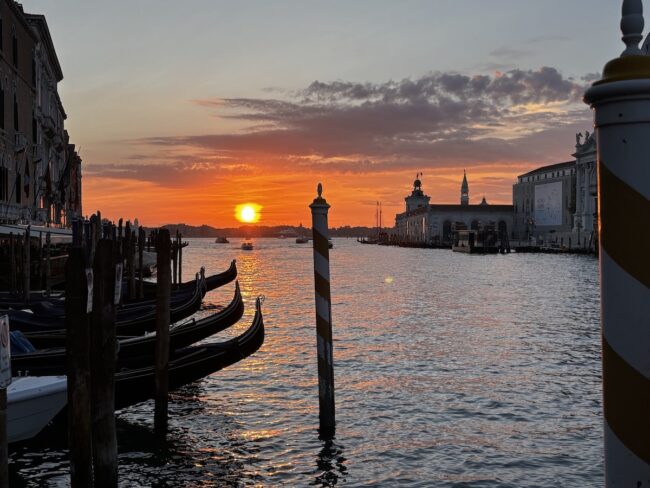
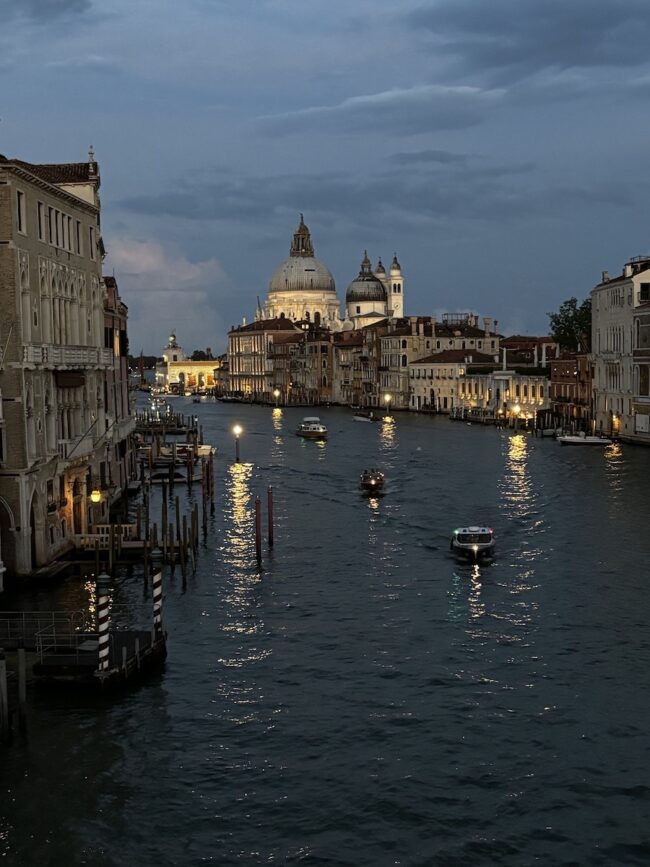
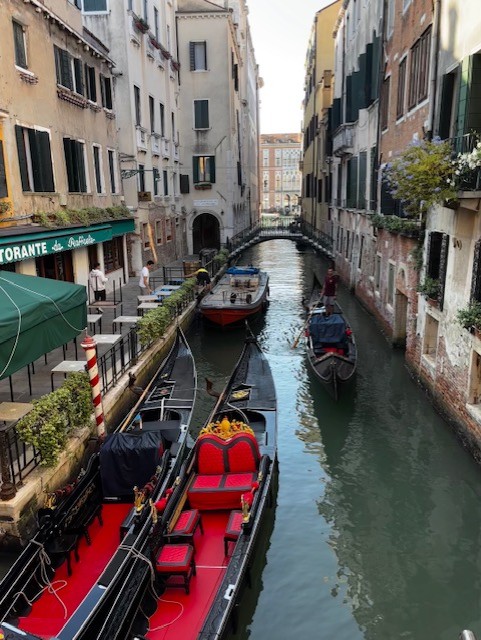
The cycling portion of the trip was seven days, but since I was traveling all the way to Italy—my first trip there—why not tack on a few extra days? My traveling companion Mitch and I started in Venice. We flew from Chicago to Newark to Venice and spent four incredible days exploring the city by boat and on foot. We toured the Doge’s Palace, the Bridge of Sighs, St. Mark’s Basilica, St. Mark’s Square, the Naval Museum, the Arsenal Museum, the Jewish Ghetto, Murano Island, and, of course, took a gondola ride.
If you have the opportunity to visit Venice, I highly recommend it for its history, beauty, cuisine, and culture. But since this is a cycling publication, I’ll share a couple of my favorite photos of Venice and get to the biking.
A Complete Cycling Experience Package
The Hotel Dory, located in Riccione, specializes in vacations that cater to a cyclist’s every need. From three meals a day to fuel demanding mountain climbs to bike rentals and spa services, the package covers it all. If your travel companion isn’t a cyclist, the Hotel Dory has plenty of activities to keep them busy, too.
Our Chicago group included about 45 cyclists of varied abilities and speeds, along with five non-bikers. In addition to our group, more than 100 other hotel guests came from the New York area, Canada, and Australia. It was common to hear several languages spoken on rides and at meals.
The hotel packages may vary, but ours included the following for the seven days:
- Room and three full meals a day.
- Five guided cycling tours per week (guides are off Saturday and Wednesday) with a choice of five group levels.
- Full access to the hotel’s Aqua Wellness Area, which includes a sauna, steam room, cold plunge, and spa. Massages are available for an additional fee.
- Two blocks from the Adriatic Sea with beach access. If you want a beach lounge chair and umbrella, you can purchase them for 5 euros each per day.
- Transfer service to and from the airport (Ancona, Bologna, Forli, or Rimini) and the Riccione train station.
- Two lunch stops during the week: one at the owner’s family farm, where they make balsamic vinegar, and a second at another farm to taste local foods and wines.
- Free daily laundry service for your cycling gear.
- Hotel Dory T-shirt and cycling jersey. Discounts on other Dory cycling gear.
- Daily guided hiking trips.
- Optional excursions for a nominal fee: San Marino, cooking classes, wine tasting, or a boat trip.
- 10% discount on bike rental.
The Hotel Dory has three properties. The first is the main hotel, with the second an apartment building next door. The third is a building a couple of blocks away. Mitch and I chose the apartments adjacent to the hotel and couldn’t have been happier. Our apartment included two bedrooms, two full bathrooms (one with a shower, another with a tub), a dining room, a living room (with a pull-out couch), a kitchenette, and two balconies. Even by US standards, the apartment was huge. The accommodations are perfect for a family traveling with kids, since there’s a day-care facility right in the building.
Those in our group had positive feedback about the hotel rooms, but folks in the apartments a few blocks away said they were sparsely furnished.
Bring Your Own Bike or Rent
The Hotel Dory also owns the Bike Hub Riccione, a bike shop located about a half mile from the hotel. The shop rents Scott regular bikes and e-bikes in a variety of models: road, gravel, townie, and MTB. If you prefer to travel with your bike, their mechanics will assemble and repack it for a fee.
I rented a Scott Addict Disc road bike, and since Mitch mostly mountain bikes, he rented a Scott Speedster gravel e-bike. It was a great equalizer because we could ride together in the same group.
Day 1 – Saturday: Arrive in Riccione and Test Ride
After four unbelievable days in Venice, we took an early morning train south to Bologna, then transferred to Riccione on another train. As with my past European rail experiences, it was quick and convenient. At the station, a Hotel Dory driver met us and drove us the short distance to the hotel. I was surprised by how large Riccione is, with the Adriatic Sea on one side and the Apennine Mountains on the other.
The friendly Hotel Dory staff greeted us, quickly took our suitcases, arranged a time slot to pick up our rental bikes, and showed us to our apartment. We grabbed lunch in the dining room and explored the hotel amenities.
At our assigned time slot, we scanned the QR code on the slip provided at check-in and followed the Ride with GPS directions to the Bike Hub. I brought my pedals, saddle, and Garmin mount from home, along with the measurements from a recent bike fit. The mechanics quickly set up the bike; I rode around the block and was pleased everything was dialed in perfectly.
Heading back to the hotel, we got our first taste of Italian traffic and very narrow roads. The Adriatic Sea is only two blocks from the hotel, with a multi-use path running along the coast. Mitch and I headed out for a test ride to get a feel for the bikes and make any necessary tweaks. The path was congested, with walkers, runners, cyclists, e-scooters, and cars coming from every direction. It was insane, and after five miles I’d had enough and headed back to the hotel!
Happy hour was at 6 p.m., dinner at 7 p.m., and an orientation at 9 p.m. During dinner, I was introduced to Stefano Giuliodori, the CEO of the Hotel Dory. Stefano’s grandparents started the hotel in 1954, and for the last 29 years it has focused on cycling. During the week, Stefano could be found mingling with guests, making sure everyone was enjoying their time, and even joining the group rides.
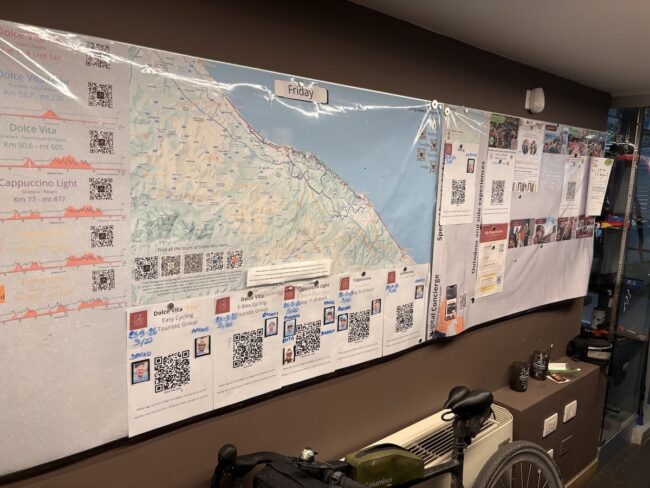
That evening’s orientation was important, as they explained the different-level group rides, how to sign up for a ride and download the route, and how each day would unfold. A bulletin board in the bike room was the hub for all our information. Each afternoon, they posted routes, maps, and QR codes to register for the next day’s ride and download Ride with GPS files. The main bulletin board also listed registration for hikes, afternoon excursions, and other events.
Day 2 – Sunday: Tavoleto – Mondaino
43 miles
2,543 ft of elevation
The bike room was bustling as over 150 riders grabbed their bikes, inflated tires, snagged a banana or sandwich, and filled water bottles. At the previous night’s orientation, they told everyone to congregate at the intersection down the block, where signs for each group ride were posted on one of the four corners.
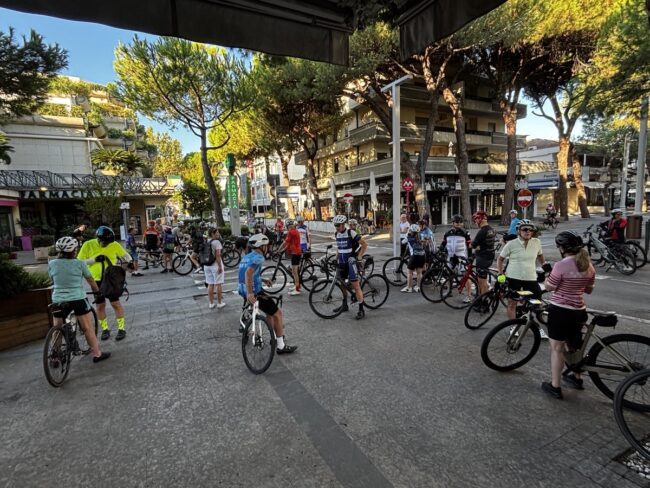
The group rides were broken down as follows, and yes, all week we were constantly converting metric to imperial:
Limoncino (road bikes) – 14-16 mph (23-26 km/h)
Cappuccino (road bikes) – 12-14 mph (20-23 km/h)
Cappuccino Light (road and e-bikes) – 11-12 mph (17-20 km/h)
Dolce Vita (e-bikes) – tourist pace
Dolce Vita – tourist pace
Mitch and I selected Cappuccino Light. The average speed was a bit slower than I prefer, especially on the flats, but this group allowed e-bikes, which let us stay together. Because so many people wanted Cappuccino Light, four sub-groups formed. Micol led our group, and David was our sweep. We had 15 riders, primarily French Canadians, so you often heard three languages spoken. The group stayed together most of the week, though some riders dropped down a group or took a day off.
Micol was the ideal guide. She joked that the other guides called her the German because she was very regimented. Her style kept our group together, on time, and safe. David is British and new to guiding but soon got thrown into the lead role.
The description in Ride with GPS of today’s route was as follows:
This route is an inland conversation between ridgelines and strongholds, where the Adriatic feels close enough to brighten the stone—yet the atmosphere belongs to valleys, fields, and old frontiers. It begins quietly in Falda, a small hamlet of Montefiore Conca: not a “sight” to tick off, but the kind of place that sets the tone—rural, open, and rooted in the everyday geography of Valconca.
From there, Montefiore Conca rises like a promise. Its Malatesta fortress crowns the hill town, and the view explains why these places mattered: power here was once measured by what you could see and defend.
Crossing into the Marche, Tavoleto adds another layer—an old fortified site of the Duchy of Urbino, where walls still hold the memory of a disappeared Rocca and later transformations.
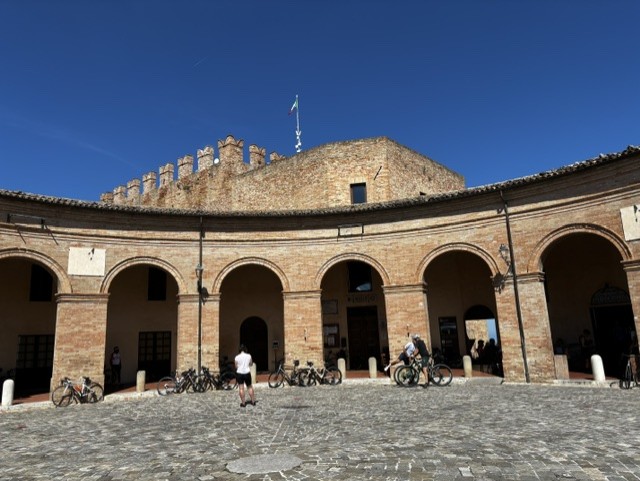
Mondaino brings you back to the Romagna side of the border story: the Rocca Malatestiana, expanded across centuries, still anchors the village.
In Saludecio, history turns into color: “painted walls” inspired by 19th-century inventions, and a fortified gateway that frames the town’s medieval outline.
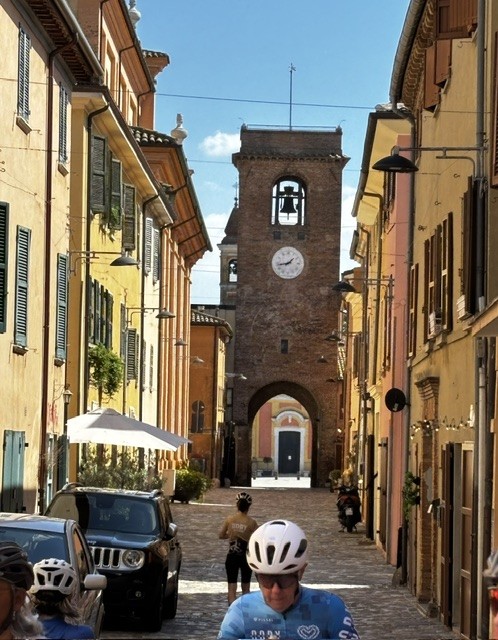
Finally, Via Montelupo ties the landscape together as a named ribbon through the countryside—one last reminder that routes are part of the heritage here.
Today was a beautiful, scenic ride, but I wasn’t prepared for the Italian traffic, single-lane roads, and deteriorating asphalt. Every ride used the multi-use path along the Adriatic Sea and then turned inland via roads. Traffic was heavy, and you needed to be alert for potholes and cracks in the road. Drivers were more courteous than they are back in the States; however, some of the roads were simply not wide enough for two-way traffic and a group of cyclists. I was never able to take photos while riding like I often do back home; it was simply too dangerous.
Day 3 – Monday: San Marino and Lunch at Stefano’s Family Farm
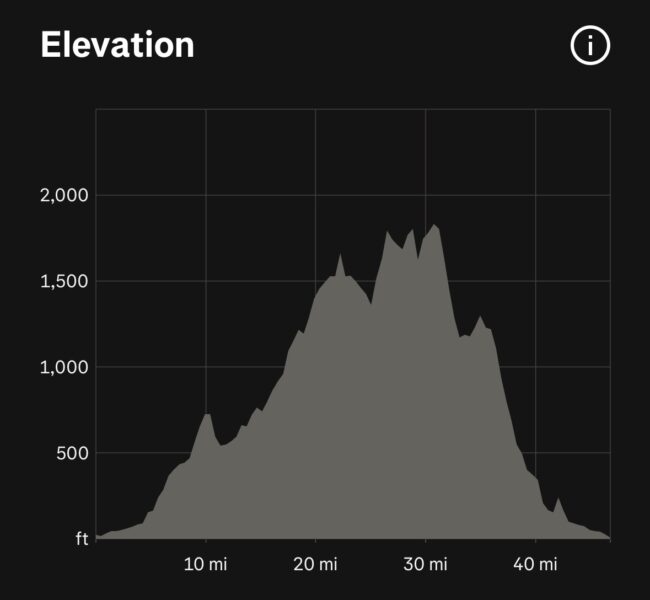
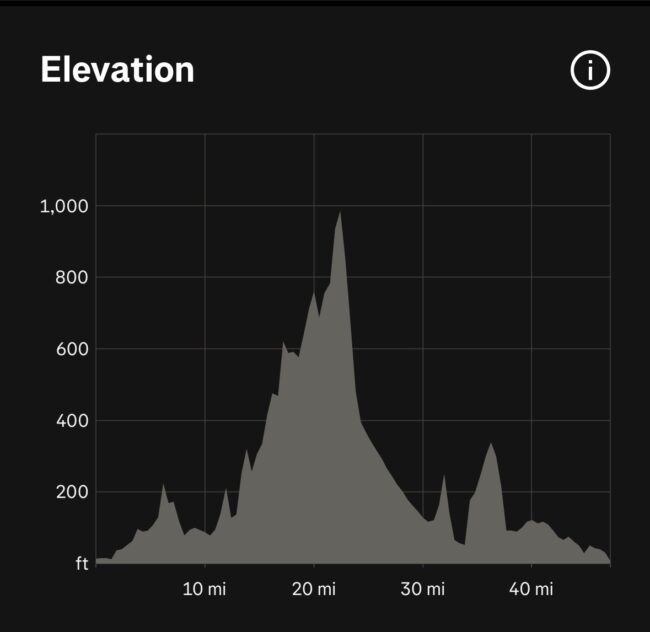
37 miles
2,467 ft of elevation
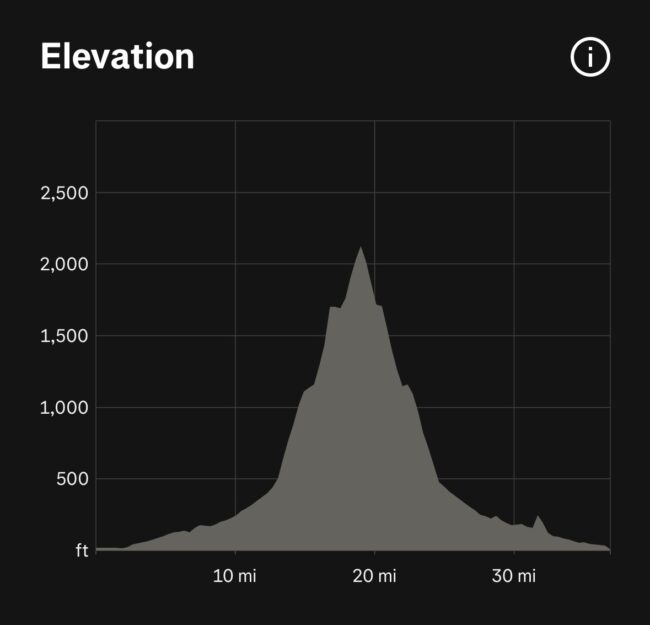
Walking through the bike room this morning, I couldn’t help but notice the increase in e-bikes. On the first day, there were maybe 15 e-bikes, but many riders found the mountain climbs too challenging and traded in their regular bikes for e-bikes. By today, there were at least four times as many e-bikes. No judgment here. It’s good to know that the Bike Hub could easily accommodate the guests’ changing needs.
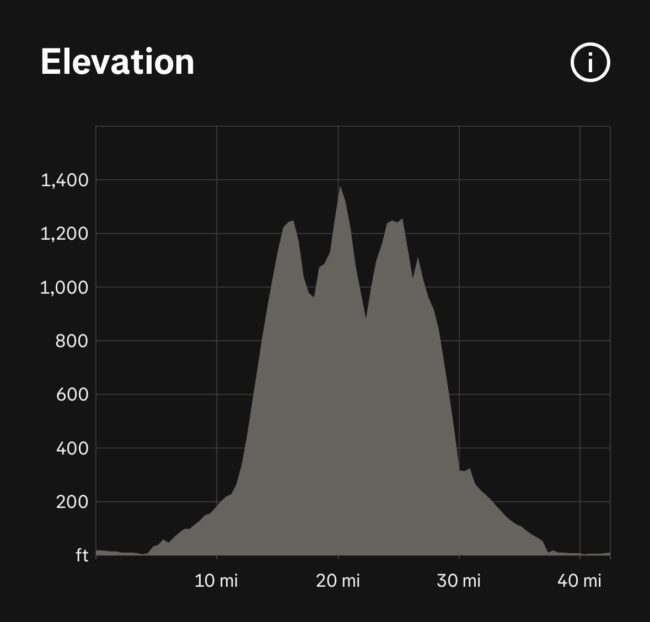
I giggled to myself when I turned on my Garmin this morning; it displayed “Rest Day.” But the elevation map above shows that today is far from a rest day. We had one long climb up to San Marino, the world’s fifth-smallest country.
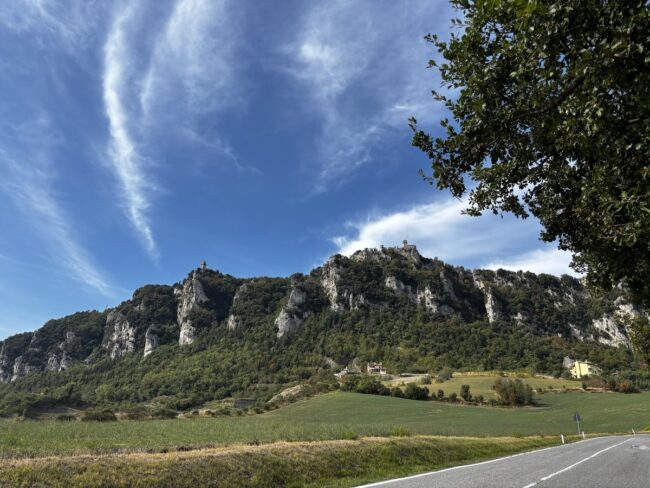
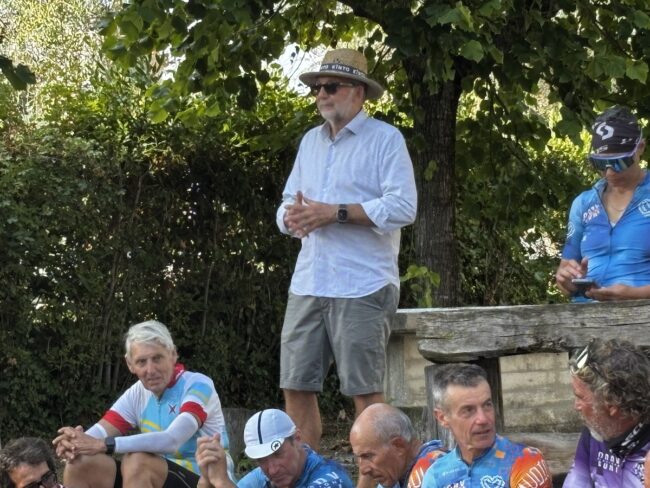
After descending from San Marino, we had one more short, steep climb to reach lunch. We stopped at Stefano’s family farm, surrounded by grapevines and olive trees. Stefano first had us taste balsamic vinegar, traditionally made by his family for centuries, drizzled over fresh Parmigiano cheese cut from a huge wheel. Delizioso! After a BBQ lunch, he showed us how balsamic vinegar is made and aged using traditional methods. Nothing like the store-bought stuff.
The description in Ride with GPS of today’s route was as follows:
This ride traces a living borderland: Romagna’s soft inland ridges, the Montefeltro’s lookout hills, and the stone skyline of the Republic of San Marino. Starting near Fratte—where fields and small farm roads open wide views—you slip into the quiet rhythm of the upper valleys, the kind of landscape shaped as much by centuries of passage as by the seasons’ crops.
At Montelicciano (in the municipality of Monte Grimano Terme), the scenery feels distinctly “between worlds”: a handful of houses, wooded folds, and the sense of an old route that once linked coastal towns with inland strongholds. From here, the story becomes unmistakably Sammarinese. In Fiorentino, the countryside holds traces of fortified sites and paths that still guard local memory, before the tour rises into the UNESCO-listed historic center of San Marino and Mount Titano—walls, gates, and civic buildings that continue to embody one of Europe’s most enduring republican traditions.
The return via Faetano brings you back to a more intimate scale: a castello of hilltop streets and valley views, where the frontier softens into rural calm. The day ends in Vecciano, in the municipality of Coriano, where the Marano River corridor and the surrounding farmland set the scene for a relaxed country welcome.
Day 4 – Tuesday: Monte Cerignone – Monte Grimano
47 miles
3,527 ft of elevation
Our guide, Micol, had a personal day, and there was a mix-up about who would be our lead guide. With a last-minute switch, David quickly downloaded the map and nervously set off as our new leader. Our group worked as a team to help David navigate and sweep.
Today was one of the longer rides, with the climbing broken into three sections. A few times on the climbs, David would ride next to me, saying, “Put it in boost! Put it in boost!” I couldn’t understand why he was saying that. Finally, it dawned on me that he thought I had an e-bike. Insert eye roll here. I shouted, “I am THE boost, and I don’t have an e-bike.” David responded, “Well then, I’m really impressed.” Needless to say, he was teased about this the rest of the week.
The Ride with GPS description for the route was as follows:
This ride follows the subtle logic of borders: the gentle ridges behind the Adriatic that once separated lordships, dioceses, and small republics—yet always remained connected by paths, water, and shared markets. In Coriano, the story begins among the evocative ruins of the Castello Malatestiano, where a surviving gate, traces of polygonal walls, and archaeological discoveries reveal a fortified center documented from the late 12th century and reshaped during the Malatesta era.
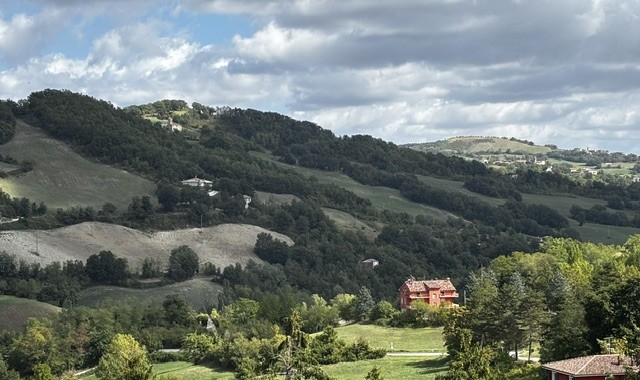
A quieter, more intimate chapter appears in Taverna, a hamlet tied to everyday rural life: the municipal pages recall how it links to the nearby hill village through historic lanes, and they highlight a 19th-century public fountain—small heritage that speaks of water, work, and community.
Then the landscape tightens into the dramatic stone geometry of the Montefeltro. Monte Cerignone’s Rocca, today home to the Museo della Rocca, retains its powerful 15th-century image despite later changes: vaulted spaces, a courtyard and loggia, and wide views over the Conca valley connect architecture to territory.
In Monte Grimano Terme, official local history reads like a compressed frontier chronicle—Albornoz, the Montefeltro and the Malatesta, and, much later, the modern choice to add “Terme” to the town’s name.
Across the border in San Marino, Montegiardino offers the smallest “Castello” and a strong sense of place, rooted in tradition and landscape.
The finale is a green exhale along Via Parco del Marano: a riparian park where woodland, vineyards, and water bring the journey back to nature.
After lunch at the hotel, we went for a dip in the Adriatic Sea, which was surprisingly warm. Umbrellas and lounge chairs lined the beach, reminiscent of Miami Beach. Later that evening, Stefano held a wine tasting for guests interested in learning about the region’s wines.
Day 5 – Wednesday: San Marino Excursion
Wednesday was a rest day, and the guides were off. Some people went for rides on their own, and some took the train to another town, but we chose the bus excursion to San Marino, which the hotel arranged for only 35 euros. The drive up to the top of Monte Titano was full of switchbacks and steep grades. I kept saying, “We rode up this on Monday?” There wasn’t time to explore the fortress of Guaita on Monday, but this time we had a local tour guide and learned about this small country’s history and customs.
Fun fact about San Marino: It is led by two Captains Regent, elected to office every six months. This helps ensure that no one person has all the power.
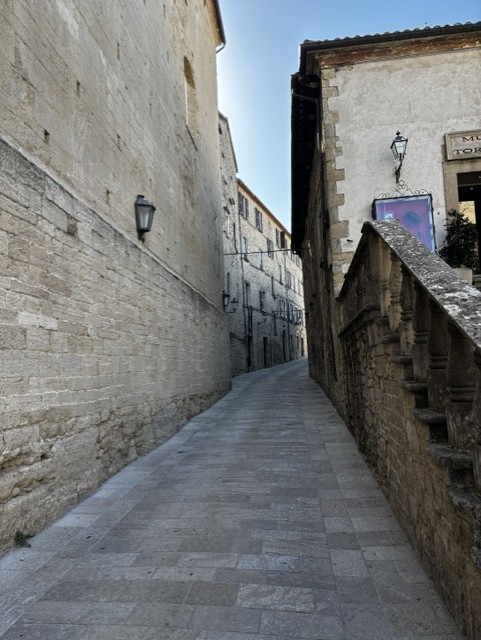
It was far from a true rest day, as climbing the steep, narrow cobblestone streets on foot gave our glutes a major workout. If you travel to this area, I recommend spending some time walking through the fortress.
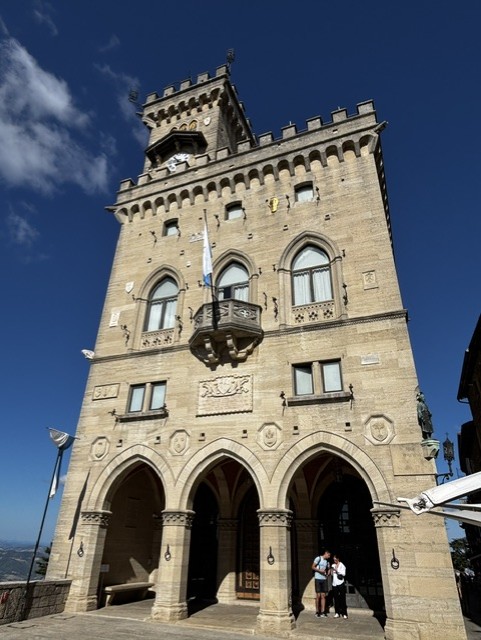
The tour guide repeatedly described his people as peaceful, but then you’d walk the city streets and come across numerous weapon shops interspersed among the other tourist stores. You could buy Italian leather goods in one store, scarves in the next, and a gun, machete, or crossbow in the third.
Day 6 – Thursday: Verucchio – San Francisco (Frontali G)
48 miles
2,677 ft of elevation
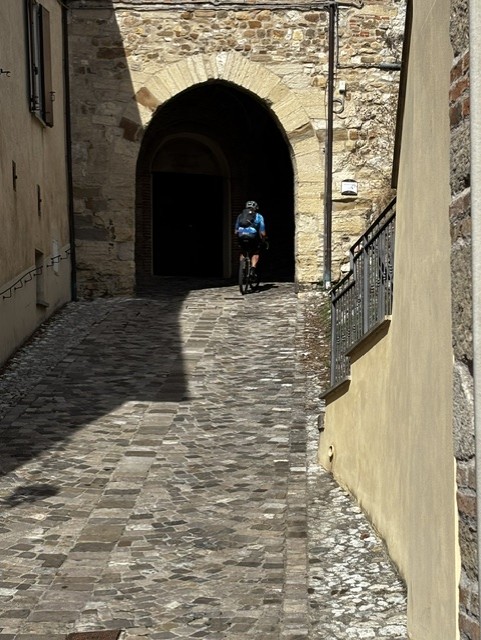
Today’s scenic ride took us to the Rocca Malatestiana, a fortress built in the 11th century atop Verucchio’s highest point.
The Ride with GPS description for today was as follows:
This journey climbs from the Marecchia Valley toward Verucchio, a hilltop village that seems to keep the Middle Ages in plain sight: stone houses, quiet lanes, and broad views that open from the Adriatic coastline to the Apennine ridge. Above it all stands the Rocca Malatestiana, a powerful fortress linked to the Malatesta family—lords who shaped much of Romagna’s history—and still a dramatic lookout over the valley corridor that has connected sea and mountains for centuries.
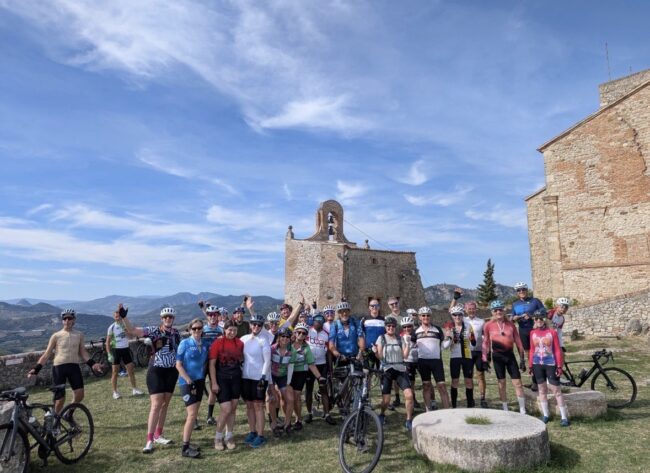
From fortress walls to cloistered calm, the atmosphere changes at the Franciscan convent of Santa Croce in Villa Verucchio, where tradition recalls the passage of Saint Francis and where the celebrated ancient cypress in the cloister has become a living symbol of that memory.
Down in Villa Verucchio, the landscape becomes more rural and river-shaped, a natural threshold between the historic “upper” town and the working valley floor.
The route then threads into the countryside toward Sant’Ermete, where a small community gathers around its church—rebuilt in the 20th century while preserving an older bell tower on the hill—before the day concludes with the pleasure of a farm tasting: local flavors, extra-virgin olive oil culture, and a glass drawn from the area’s IGT wine tradition.
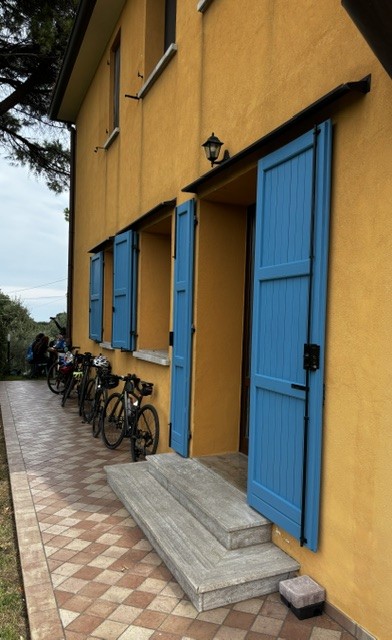
I started to see a pattern: every lunch or coffee stop was at the top of a steep climb. Today was no different. We literally had to work for our lunch. But it was well worth the effort. Lunch today was at a farm belonging to Stefano’s friends. Long tables under a large tent were waiting for us to sit and enjoy a sampling of local wines, olive oils, balsamic vinegar, and food. So the non-cyclists wouldn’t feel left out, the van brought them to join us for lunch. Riders had to be careful not to overindulge in the wine since there were still 15 miles back to the hotel.
Day 7 – Friday: Hike or Bike Gabicce Mare Monte San Bartolo Natural Park
Hike option: 6 miles and 1,064 ft of elevation
Bike option: 47 miles and 2,556 ft of elevation
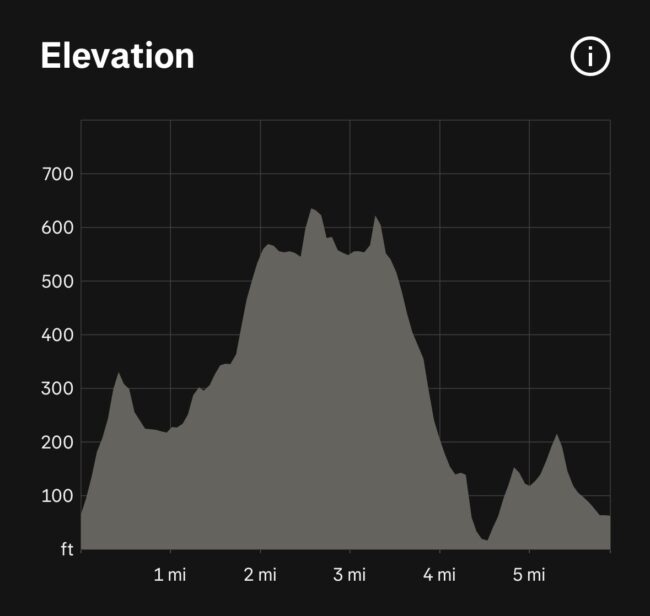
Today I was torn: should I bike or hike? To get the full Hotel Dory experience, I decided to hike. We took two vans from the hotel to the start of our six-mile hike. We’d be in the same area, Gabicce Mare Monte San Bartolo Natural Park, as the folks biking the roads. Some of the hiking trails used local MTB trails. I couldn’t imagine how someone could navigate these difficult grades straight up and down on a mountain bike.
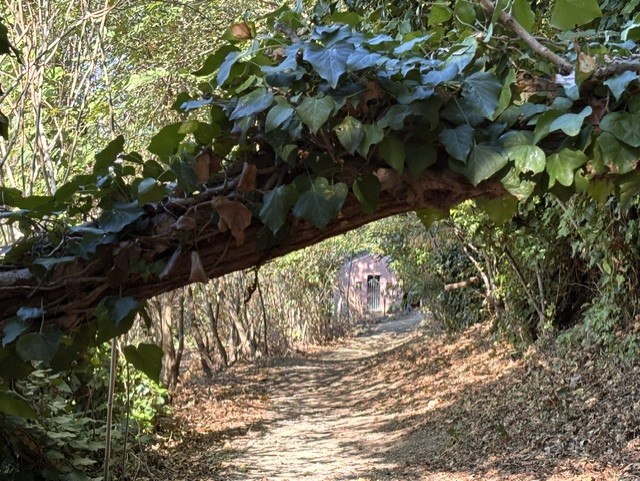
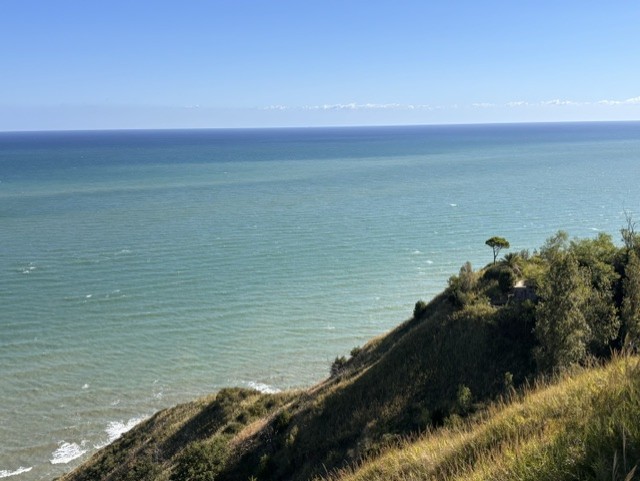
The hike took us straight up the side of the mountain, through harvested potato and onion fields, past an 1846 pink chapel in the middle of nowhere, then down to the sea.
The cyclists used some of the same roads Giro d’Italia and Tour de France winner Marco Pantani once trained on. At one point we popped out of the woods to cross the road, only to see Mitch riding past.
Farewell to Italy – Transfer to Bologna Airport
And just like that, our Italian adventure came to an end. Today we bid Italy and the Hotel Dory farewell. Mitch and I, along with two other couples from Chicago, were driven an hour and a half to Bologna Airport. After 12 days, I was ready to get home to start planning my next adventure. I’ve traveled all over the world, and this trip ranks in the top 10.
I highly recommend the Hotel Dory if you’re planning to ride in the Riccione region. Its friendly staff, reasonably priced all-inclusive packages, and non-cycling options make it an excellent choice. I’d also suggest going toward the end of the tourist season. Mid-to-late September offers fewer crowds and ideal weather. Arriving in Italy a few days before the cycling portion let our bodies adjust to the seven-hour time change, and we were ready for the first group ride. During the 12 days in Italy, we enjoyed temperatures between 70 and 80 degrees F and only one day of rain, which was in Venice.
Ciao!
Sheri Rosenbaum regularly contributes articles and reviews products for RBR. She’s an avid recreational roadie who lives in the Chicago area and a major advocate for women’s cycling, serving on the board of directors and volunteering with the Dare2tri Paratriathlon Club. Click to read Sheri’s full bio or visit her web site sunflowersandpedals.com.
