
Quick Review: Knog Blinder 900 Front Light

Jim’s Tech Talk
By Jim Langley
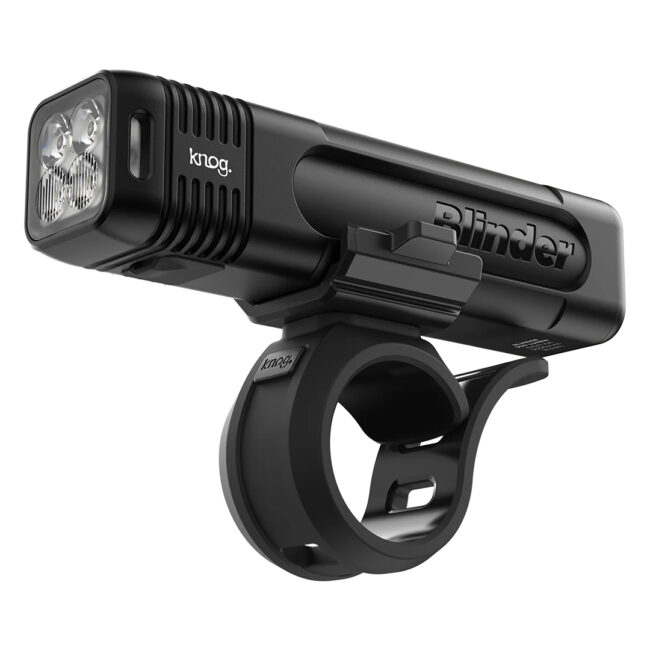
Price: $89.99
Source: https://us.knog.com/products/blinder-900-front-bike-light
Availability: bike shops, online
How acquired: sample from company
RBR advertiser: no
Tiny Powerhouse of a Light
Knog makes an entire line-up of front lights to choose from. The one I’m reviewing is from their Blinder series. I requested the Blinder 900 (for 900 lumens). They also offer the Blinder 600 and 1300 which share some of the same technology and mounting features.
In case you’re curious why I wouldn’t request the more powerful Blinder 1300, mainly it’s because my nighttime lighting needs aren’t that extreme. I use the light twice a week on a route that’s 50% bike path, 50% city streets. As I bet you’ve experienced too, the bike path is scarier than the street since there can be pedestrians in dark clothing, cyclists without lights and other difficult to spot creatures of the night.
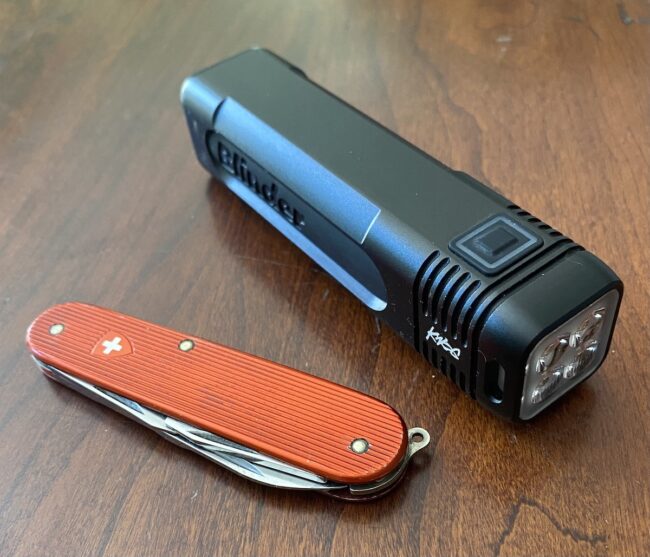
I also chose the 900 because it’s tiny. I hope you can see that in the photo here with it next to a pocketknife. In case it still looks large, it’s just an inch square by 4.25 inches long. It weighs 150 grams plus 19 for the strap mount or 12 grams for the computer mount. The small form factor makes it a breeze to find a place to mount the light. And it’ll go above or below the handlebar.

Mounting versatility
Two types of mounts are included. One uses a rugged rubber strap that stretches around the bars (22 – 28mm & 29 – 35mm). That’s how I have it mounted. Once the mount is strapped on the bars, the light itself snaps into the plastic light holder built into the strap. To release the light, you press on the side of the holder that has a small tab on it to flex the holder a little and the light comes out. I do this to use it as a flashlight for dog walking at night.
The other mount is a GoPro type mount. It’s for use under a computer. That mount works differently. It’s spring loaded and has a closure. So the light snaps into the mount and you lock it in place with a little cam lever. To release it, the lever is opened and you pull to spread the clamp and take the light out.

I wondered, and you might too, why one clamp uses a simple press fit and the other has a locking lever. The difference seems to be based on carrying the light under the clamp when it’s used below a computer and carrying it above the clamp in the handlebar mount. In the latter, it’s unlikely to come out since it’s not hanging below the mount.
An extreme test
This mount issue concerned me a little because on my bike and with the rubber strap mount, I need to run the light beneath the handlebars. This puts the light in a position where if the snap-in mount were to let go, the light would drop off and might get damaged. I checked how secure the light was held by the mount tugging on it by hand and it felt like it was rock solid, so I decided to run it that way.
Then a couple of weeks later I gave the mount a great test. Not so great a test for me, but definitely for seeing if the Blinder 900 could or would fall off. What happened is I hit a patch of sand and gravel and crashed. The front wheel let go, so it was the front end that hit the deck first. But it didn’t affect the light at all. It was still safe and sound in its mount. I should make it clear that this crash happened when it was still light out and the Blinder 900 was off.

Four beams of light
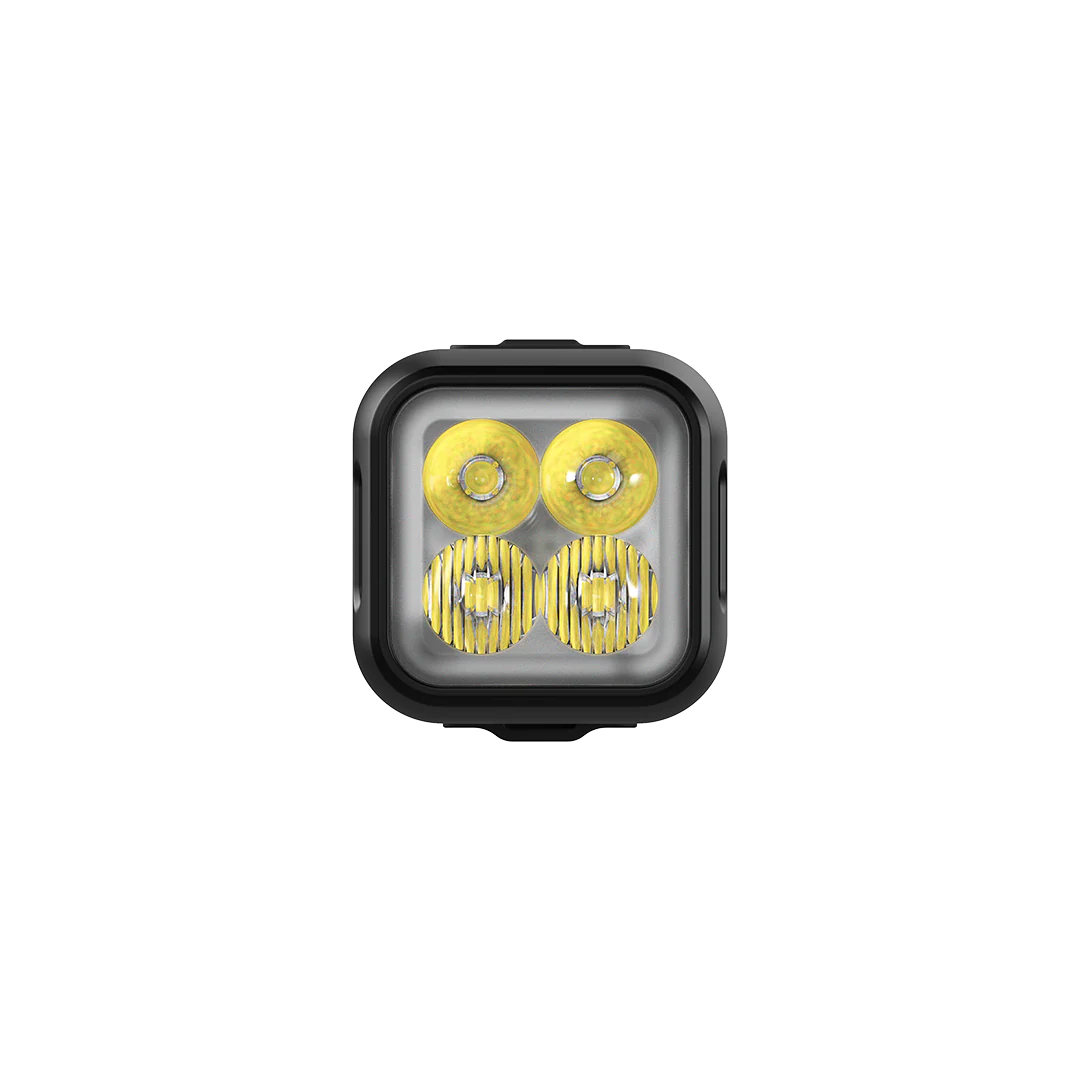
In the photo of the front of the light you can see that there are 4 beams providing the illumination. Two are wide beams and two are narrow. Knog says these beams are focused and angled at 22 degrees to provide the best illumination.
I notice that it fills the lane ahead nicely with an even pool of light that lets you make out any obstacles in the road. Also, some of the light comes out of windows on the sides of the case for peripheral visibility, a helpful feature in traffic.
Lighting levels, power and controls
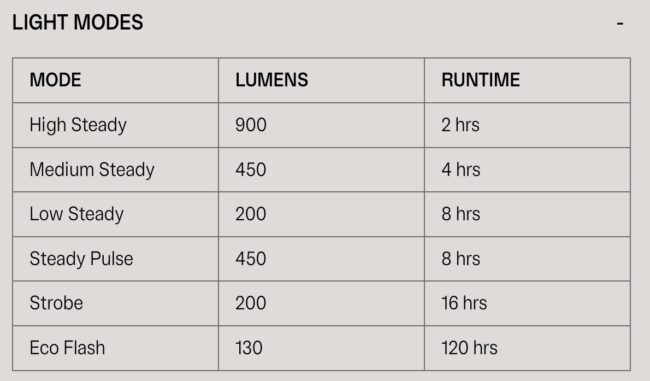
You can choose from high, medium and low plus three flashing modes. On high, which I use most of the time, the light will run for 2 hours. In Eco Flash mode it can run up to 120 hours.
The Blinder 900 is powered by a 5000 mAh 21700 3.7V lithium ion rechargeable battery, which is charged with a USB-C cable (not included). Charging time is 5 hours. The light is 100% waterproof too with an IP67 rating.
The light is controlled with what Knog calls an intelligent button because it has an LED light around it. Quick pressing this soft touch silicone button when the light is off allows you to quickly see the remaining charge and the charging status. Green: 100-50% charge remaining; Yellow: 50-25%; and Red under 25%. It can also show Flashing Red. At that point the light will be reduced to 30% illumination to preserve runtime.
When charging, the LED flashes yellow indicating the light is being charged, which turns green when it’s fully charged.
Operation
To operate the light, you press and hold the button to turn it on. When the light’s on, pressing the button twice will change between steady and flashing modes. To choose brightness and flashing modes, you press the button once when the light’s on.
Conclusion
Knog’s Blinder 900 is a well built, easy to operate and versatile little light with plenty of power for seeing the road and being seen too. I especially appreciate its tiny footprint on the handlebars, quick and easy mounting, extended runtimes and excellent brightness.
I also like that it only has 3 steady and 3 flashing modes. Some lights today have so many modes it’s a pain trying to get back to the one or two you use all the time. That’s not an issue at all with this light.
Overall, I think you’ll love it, or if you need even more power, consider Knog’s Blinder 1300.
Jim Langley is RBR’s Technical Editor. A pro mechanic & cycling writer for more than 40 years, he’s the author of Your Home Bicycle Workshop in the RBR eBookstore. Tune in to Jim’s popular YouTube channel for wheel building & bike repair how-to’s. Jim’s also known for his cycling streak that ended in February 2022 with a total of 10,269 consecutive daily rides (28 years, 1 month and 11 days of never missing a ride). Click to read Jim’s full bio.
Nice summary. Thanks Jim.
Regarding the “peripheral” lighting – to help car drivers on the side, to see the light / bike / rider…. If the peripheral lighting is basically only that small rectangle of side light – as shown in the picture above, then it seems highly unlikely that any driver at night would notice that minuscule sliver of light.
Also – regarding run times. Thank you for posting the manufacturer-supplied runtime claims; however, it would’ve been interesting to know what your actual, real-life runtime experience was, as sometimes – certain manufacturers have been known to exaggerate their specs somewhat.
You’re welcome Giuseppe. I wouldn’t have mentioned the side lights if I didn’t think they’d have a good chance at attracting drivers’ attention. And regarding run times, I did run the light on high for an hour and it was still going strong. That’s not the full 2 hours but I wouldn’t be riding for that long at night. Now, I could just let the lights run without riding the bike, but if you do that you risk overheating and I didn’t want to take that chance.
If you read the next comment from Doug, he says he’s super satisfied with his Blinder 1300. I consistently hear good things like this about their lights and other Knog lights I’ve used have worked as promised too.
Thanks!
Jim
I got the Knog Blinder 1300 last winter. I am super satisfied.
I put reflective velcro-pant-cuff straps on my ankles after dark to provide additional side and rear visibility in addition to a red flashing strobe.
Thanks for letting us know Doug and thanks for the tip on reflective leg bands and a rear blinkie, appreciate it,
Jim
Jim and others,
Do you consider ‘top cutoff’ when you review or buy a front light? Schmidt from Germany used to make these wonderful lights that spew no light in others’ eyes because of how the reflectors are built – like car headlights. And, Peter White Cycles has reviewed these and many other lights for beam pattern. There are big differences in how well lights illuminate the road near and far from the bike.
No Dave. I’m familiar with that feature, but unless it’s part of a light that I’m reviewing’s design I wouldn’t be expecting to find it or consider it when checking out the light.
Back when I was the technical editor for Bicycling Magazine, we had a staff available and nicely equipped lab to help and we could do extensive testing of beam patterns. It’s not an easy thing to capture and/or evaluate. The only way I can do it now is with my eyes. But I do have the experience of having done this type of evaluation in the past and use that in considering a light’s ability to light up the road ahead.
Thanks Dave!
Jim
Knog has had reliability problems in past years, and when a light fails it was a long wait for a replacement, which never lasted longer than the first failed light. If the quality has improved, great, but my experience with ALL Knog products, headlights and taillights, was not very good.