Lessons From Two Weeks Cycling in the Alps

By Ric Stern
You’ll hopefully have noticed that my column has been missing for a few weeks (if you haven’t noticed, well, then I’m hugely upset and I will subject you to a series of 20 efforts of 30 seconds each at maximal effort with 5 minutes in between, followed by 200 push-ups!). I’ve been on vacation with Claire (my better half) and one of the athletes I coach (Ros) and her hubby. We’ve spent two weeks by Lake Annecy, France, near the town known as the “Venice of the Alps.”
I’ve ridden the Alps (and other mountain ranges) previously, but it’s been a while. The others hadn’t really (Ros had done a couple; Claire had never ridden an Alpine pass). It was interesting, reacquainting myself. I’d ridden the 1990 Tour de France route in front of the pros, and I’d run a training camp with some USA track endurance riders in the Swiss Alps, but as I said, it’s been a while! I noticed a few things (yes, an old dog like me can still learn a few tricks). I thought it’d make a good column.
Cycling long Alpine climbs is a bit of a serious undertaking. They’re long, arduous, and, in places, steep. They’re also fun, exciting, and totally different from riding in the UK and, I expect, certain parts of the US (I know there are some long, similar climbs in the States — but they’re not everywhere). Here’s what I learned (or remembered as the road battered my legs!).
Strength work: The long climbs are leg-sapping and back-breaking. There were one or two we did that took Claire close to two hours to summit (I tended to ride a few yards (meters) in front so she didn’t have to listen to me talking about the Tour de France this and that, and I didn’t have to listen to her singing songs from The Sound of Music). Unlike the flat or rolling roads, there’s no respite — so it shows up in your weak areas. In my case, the sustained climbing position exposed a weakness in my trunk endurance, so I’ll be adding some work aimed at resisting extension and lateral flexion, and maintaining position under fatigue. I’ll be adding these exercises to my repertoire:
Bird dog — 2 sets of 6 each side
Side plank — 3 sets of 30 seconds each side
Suitcase carry — 3 sets of 30 seconds each side
My legs seemed generally OK, so the squats, single-leg press, and other exercises seemed to have been good for me.
Power to mass: At 143 pounds (65 kg) and a functional threshold power (FTP) of 285 watts, my power-to-mass ratio is decent. But it’s never enough, and there were times I was trashing myself at FTP and riding at 6 mph (10 km/h), which felt depressing! As a mainly criterium racer and someone who rarely rides longer than four hours (unless Claire badgers me to do a 124-mile (200 km) ride), I noted that my power started fading as the ride went on, so I know that I need to work on my durability. My FTP wasn’t really the problem; maintaining a high proportion of it several hours into a ride was. I’ll be adding intervals into my longer rides.
Lower gears. In 1990, I probably had a 6- or 7-speed bike with two chainrings. Gearing was limited. In 2026, you can get quite wide-ranging gear ratios, but I appear to have missed that memo! 39 x 30 as my lowest gear (which I only use for mountains in the UK) meant that my gearing wasn’t actually low enough to be comfortable. Changing cassettes and chainrings is easy enough and well worth doing. It’s better than being stuck at 70 rpm!
Eat well. You need carbs, lots of them (probably more than you think), while sufficient protein helps with repair and adaptation between rides. Hopefully, you’re already fueling well, but a big day in the mountains burns through your carbs and the damage that occurs within the muscles needs protein to keep repairing it. I’d taken gels, energy drink powders, and protein powder with me to help keep me going. Bread, starchy vegetables, rice, and pasta are easy to obtain in France. You just need a lot to keep the engine fueled! And, because we rode every day, you can’t let up with your nutrition. Allied to this is the heat — most days it was over 86°F (30°C) with one particularly unpleasant day being 100°F (38°C) in the valley. I’ve never drunk so much!
Pace the climbs. Some days we just did one col (pass); other days we did multiple passes/cols. Taking them as easy as possible is often the best way forward. However, be warned that this ties directly to your power-to-mass ratio — and it isn’t always possible to take them easy. Claire can sustain around 1.4 watts per pound of bodyweight (3 W/kg) for roughly an hour. Often she was stuck at this power because physics dictates that if she’d ridden any slower she’d have toppled over. In this instance, it became crucial that she put in no top-end efforts (above FTP) as she’d have fried her legs. If you do have the capacity to ride easy, then it’s also important to not keep smashing the legs. I rode a lot of the cols at Claire’s pace, but putting in full-gas efforts over my FTP was extremely fatiguing.
Be terrified on the descents. OK, this one is going to be highly dependent upon your own psychology… but where I’m happy to ride a criterium at an average of 31 mph (50 km/h) bumping shoulders with others, I found it terrifying trying to descend at the same speed, when I could see no actual barrier at the side of the road and large vertical drops over the edge. I’ve previously seen some horrendous crashes on the descents where people have gone way above their ability level and ended up in the hospital. I wouldn’t want to ruin a vacation this way. Often we don’t get a chance to practice high-speed descents (or the traffic stops us), so I’d suggest that you ride within your limits rather than finding the limits of your tires’ grip!
For those of us who are used to riding in the UK or North America, it’s worth mentioning what the traffic was like, at least in the Annecy region. First, there were multiple bike paths through towns and some villages — this keeps you off the road, but be aware that there are thousands riding on the bike path. On the road, motor vehicles were generally courteous and far more courteous than I’m generally used to in the UK. On the descents where I did open up, the cars would sit behind you and let you take your own line through the corners. Not once did anyone overtake on a corner (especially hairpins); however, in total, we had one or two close passes on the straights (versus multiple close passes every ride in the UK). No mountain goats chased us either, but we did hear lots of cowbells!
Even after 43 years of racing, two weeks in the mountains pointed out some of my issues and weaknesses — new demands expose what your normal training doesn’t. If you’re preparing for a cycling vacation, an event, or simply want training that targets your own weaknesses, take a look at MAP: The Build. We can’t promise to steady your nerves on an Alpine descent, but we can certainly help make you faster.
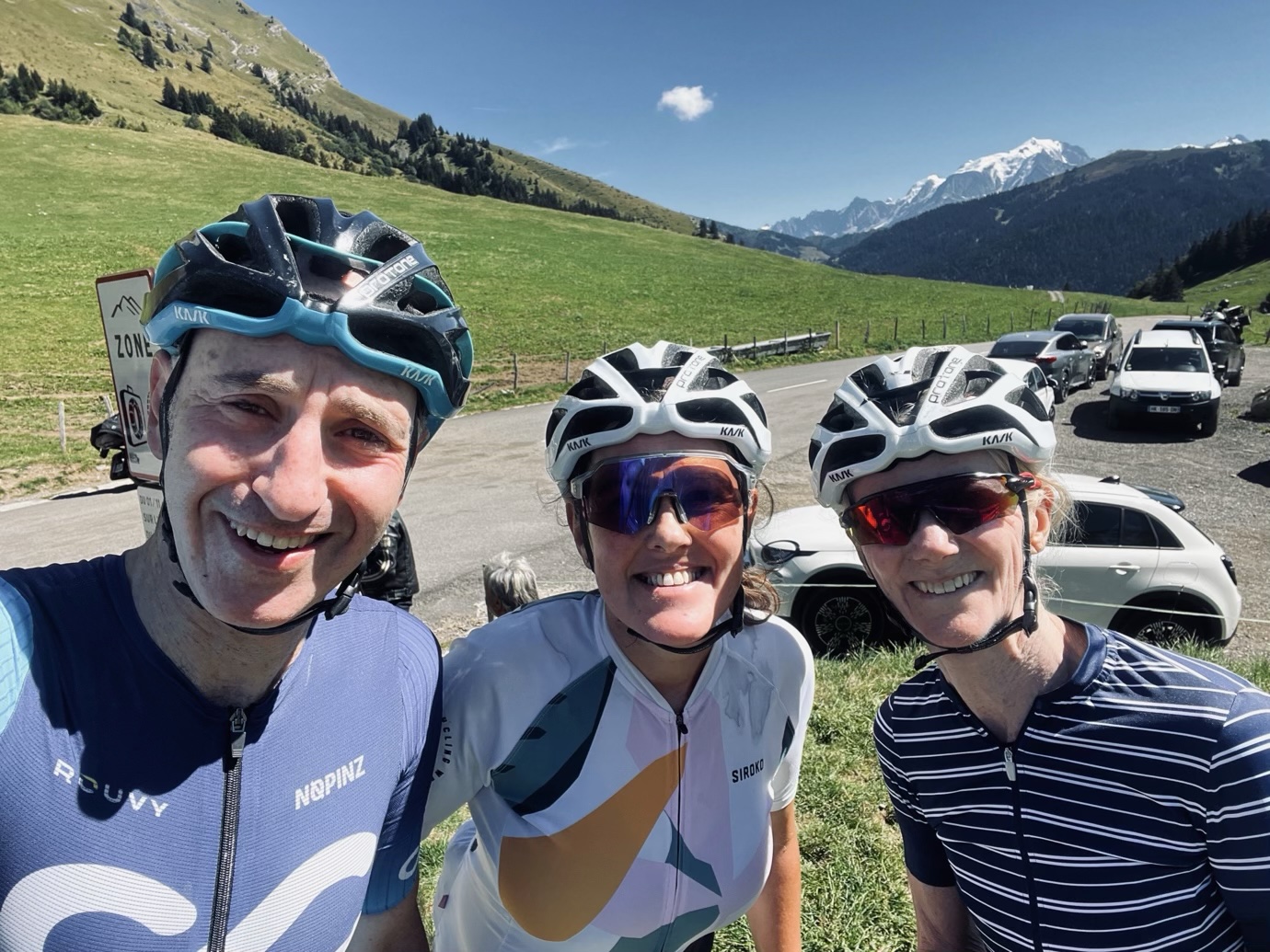
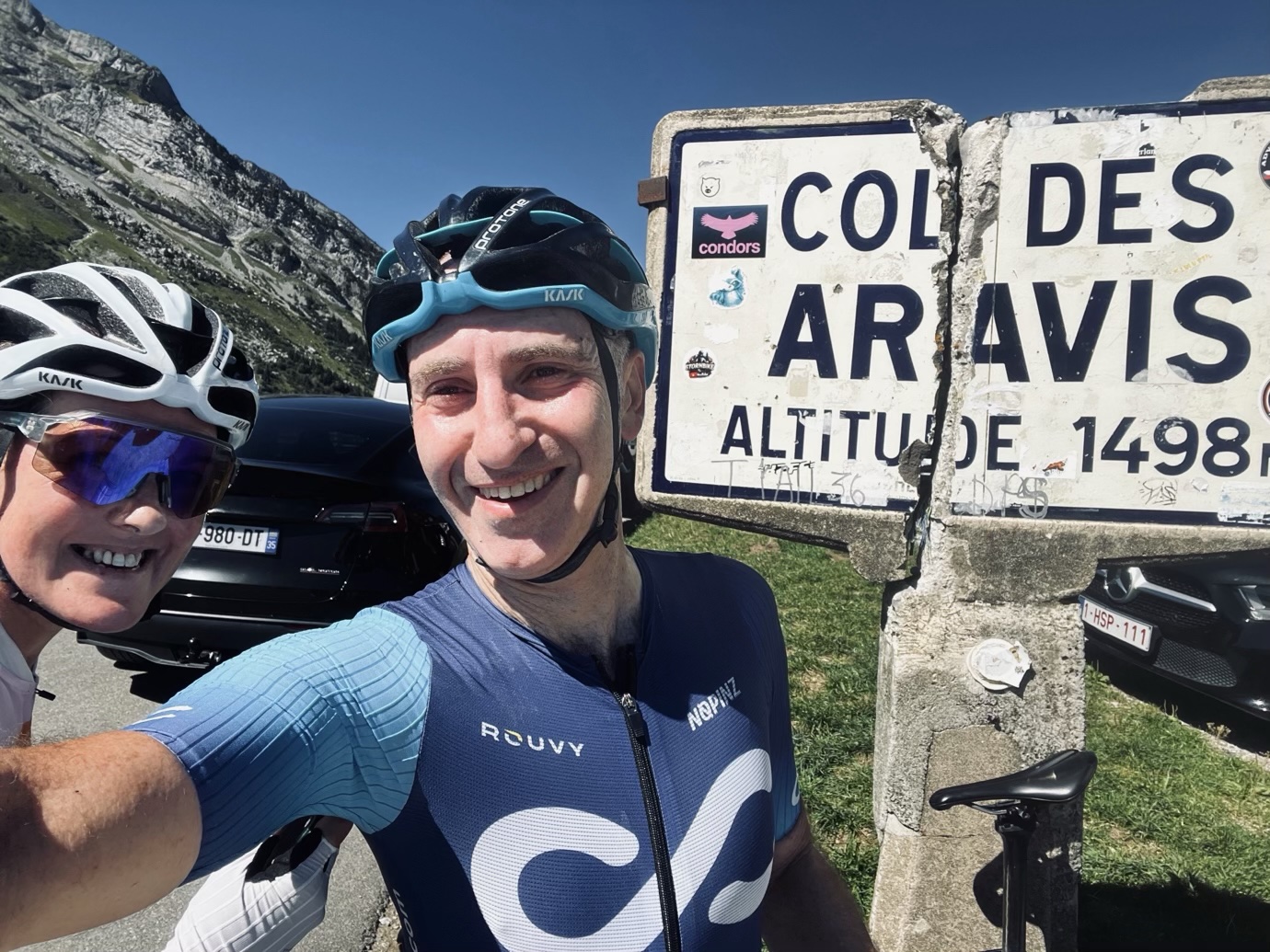
Photos below were taken on the Col des Aravis (me, Claire, and Ros). The second one shows the Mont Blanc massif in the background, which includes the highest mountain in the Alps.
Have a training question for Ric?
Ric Stern has spent decades answering riders’ training questions and has coached cyclists since 1997, from club racers to Paralympic medallists and Tour de France professionals. Cardiovascular fitness, strength training, VO2 max, race tactics, nutrition, or whatever is keeping you from a stronger season: ask away. We publish questions using your first name and last initial only.


Ric Stern is founder of CycleCoach and has coached athletes to World Championship gold, Commonwealth medals, and Paralympic podiums across 29 years.