Road Cycling Shoes – A Short Primer

by Rick Schultz
During bike fitting client interviews and evaluations, many questions come up. One category that always brings questions is cycling shoes. Are these good shoes? I just bought them. What’s the difference between my $90 shoes and your $550 Lake CX-402? Etc.
The first and most important thing I cover when I answer questions like these is the sole of the cycling shoe.
Roughly speaking, a
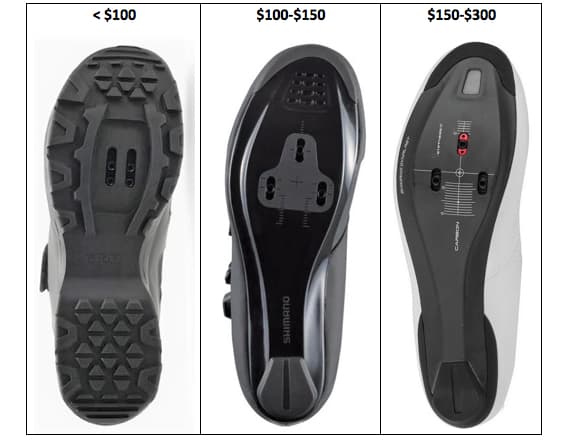
- $50-$100 shoe will usually have a rubber sole with a thin plastic (Delrin or Zytel) insert under cleat. Also known as a spin shoe, most shoes in this category are SPD or similar.
- Advantage : Entry-Level Price Point for Beginning cyclist and spinners.
- Disadvantage : Once you start getting stronger and applying more force, you will feel the pedal uncomfortably poking up through the bottom of the sole.
- $100-$150 shoe will usually have a (fiber)glass injected plastic sole. A color additive (green, red, yellow, etc.) or UV inhibitor (Carbon Black) can also be used.
- Advantage : Low Price Point for a real cycling shoe.
- Disadvantages :
- Heavy and quite a bit of flex in the sole.
- Beware that some manufacturers consider the use of ‘carbon black’ as actual carbon fiber and will market their shoes in that way.
- $150-$300 shoe will usually say ‘carbon’ except that they actually mean a carbon injected plastic sole. Carbon Black is usually used to give the look of carbon.
- Advantage : Best bang for the buck for most cyclists
- Disadvantages :
- Some manufacturers cut some corners on this level shoe.
- You know that there is one more level shoe that’s lighter and stiffer.
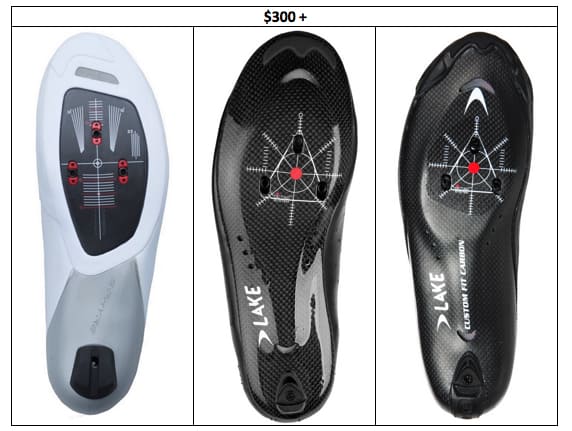
- $300+ shoe will usually have a full carbon fiber sole.
- Advantage : The lightest and stiffest real pro-level cycling shoe
- Disadvantages :
- Might not be as comfortable as a $150-$300 shoe
- BEWARE – To reduce costs, some manufacturers are making a hybrid shoe where they create a carbon-injected plastic sole, insert a carbon fiber plate under the cleat and call it a carbon-fiber sole.

What about mid cleat shoes?
You won’t talk me out of my Shimano sandals.