Tracking Your Ebike Battery Range

By Stan Purdum
A long-time reader of Road Bike Rider named Bob Williams recently contacted me after seeing some of my articles about my experiences with ebikes. He’s 77 years old, and states that he has enjoyed RBR’s “focus on riding well as we age.” Bob and his wife are members of the Portland Velo bicycle club and participants in Cycle Oregon, which runs large cycling events yearly around Oregon and the Pacific Northwest. He has also co-written, along with Cycle Oregon’s marketing manager Chris DeStefino, some articles for the Cycle Oregon blog page about riding e-bikes and integrating e-bikes into both organizations.
In our correspondence, Bob mentioned that he owned a Specialized Turbo Creo SL Comp E5 ebike, which is the same model I ride. He purchased his back in 2020 at his wife’s recommendation “as she’s younger, faster, stronger — and we were riding together less and less due to the variation in speed.”
He went on to say, “My original intent with getting the e-bike was to use it mainly to ride with my wife and sometimes her group — which I could keep up with on the e-bike. It turned out that the e-bike became my main bike and has continued to be. And it’s also turned out that many of the folks we regularly ride with on gravel have also switched to e-bikes for gravel — as it’s simply more fun and allows the group to stay together better.
Apparently, Bob is an analytical thinker, so when he discovered how little information was available regarding how far a rider could go on a battery charge “other than what the manufacturers used in marketing — and some of this seemed very reasonable and some not,” as Bob put it, he decided to do some testing of his own.
Posted below is a chart Bob made when doing his initial research. He tracked 30 rides of different lengths and characteristics and then plotted each ride with its elevation gain in feet per mile and what the computed battery range was in miles (miles ridden/battery percentage used). Bob then line-plotted these 30 points with feet of elevation gain/mile on vertical axis and battery range in miles on horizontal one.
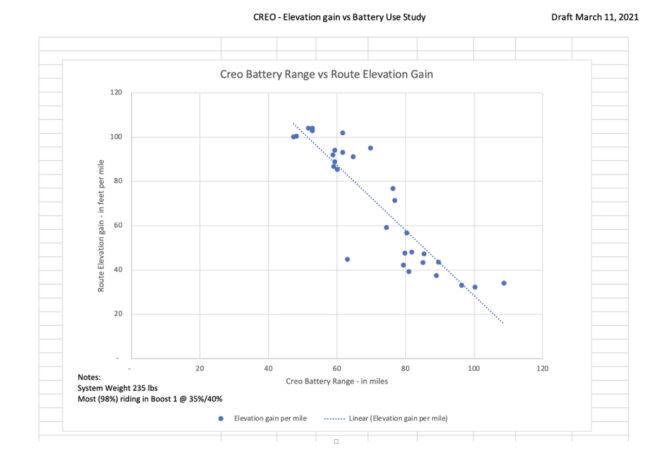
This record-keeping allowed Bob to use the length and elevation of an anticipated ride and employ the chart (where a horizontal line from expected feet/mile hit the dotted plot line) to yield the expected battery range.
Bob is quick to acknowledge that while the chart is useful to him, it isn’t broadly applicable as is because of the numerous additional variables: system weight (the weight of the rider plus the bike), the assist level used, wind speed, gear range of your cassette, route surface, tire type and tire pressure.
Bob’s system weight is 235 and he mostly rides in what he calls “Boost 1” (Specialized calls it “Eco” mode). The Specialized app allows the rider to select how much assistance each mode provides, and when doing the testing, Bob had Boost 1 set to 35%. Bob has since purchased a Creo 2, where lower gears make it possible for him to set his Boost 1 assist at 30%.
As an example of how the variables affect battery range, Bob explains that the chart for his wife would probably generate a similar line pattern — but with a top range more like 200 miles vs. 100 for him. “The boost one gets is a percentage of motor capacity — 240 watts,” he says. “I weigh 200, my wife weighs 135 — so the same 30% [assist] in Boost 1 applies the same 75 watts of power — in addition to your own personal power.”
To explain it further, Bob adds, “Say we were both capable of 2 watts/KG — 180 watts for me and 122 for her. So at the 30% boost level, I’d get a 42% (75/180) assist while she’d get a 62% assist (75/122). This is why she can run Boost 1 at 20% (vs. my 30%) and be equivalent to me — and yet get much higher range from her battery.
If you are an ebike rider, the variables are likely to limit the direct application of Bob’s chart to your rides, but his tracking process does provide a place to start should you want to predict your battery range.
Bob says that creating the chart made it easy to see the impact of climbing and other variables, and that it really explains why it’s so hard for bike manufacturers to use a set number for range. “System weight (rider plus bike) on these bikes really makes a difference,” he said.
See the blog Bob cowrote here regarding Ebikes & Range Anxiety.
Stan Purdum has ridden several long-distance bike trips, including an across-America ride recounted in his book Roll Around Heaven All Day, and a trek on U.S. 62, from Niagara Falls, New York, to El Paso, Texas, the subject of his book Playing in Traffic. Stan, a freelance writer and editor, lives in Ohio. See more at www.StanPurdum.com.

I have a 2021 Creo SL Expert. Stock chainring changed to a Wolf 50t. I was riding mostly in the Echo mode. But I was told that it is important to vary your motor selection for even internal gear wear. Not sure if this is a real problem. So, getting back to your motor mode selection, it will also affect your battery life. And if you are not feeling your best, you may be using more motor than you normally do. I believe echo mode reduces the bike’s weight. My brother has climbed with his 2023 Creo XL Expert and found that his battery has really diminished. A lot of Variables here. Oh, and there is the wind to deal with. HA!
I enjoy riding my E-bike because it can take the edge off my replaced joints. Just keep it up!
My Domonie + is handicaped with 1 x 11 gearing, 50 – 34 lowest gear. If you go to Trek’s web site enter info: total weight 190. rpm 90, speed 18 to 22, terain rolling, assist Tour, result is 54 miles. On a ride like that when I got back to the car the computer said 4 miles left, my Knees said O miles left.
Am riding a Cervelo Rouvida with Fazua motor, 430 W/hr battery. In my opinion range cannot be measured in miles, but in time. I ride mostly in “eco” mode. Power supplied is 60 w. At 60 watts I can confidently allow for 7 hours of ride time regardless of ride conditions (wind speed, elevation gain, etc.) Distance will be based on your ave speed. A fast group ride (19mph) will get you a nice 100 mile ride. A hilly gravel ride (11 mph) will get you a nice 50/60 mile ride. Range = watt hours of power and speed.
Are you saying you can do a fast group ride of 19 mph in eco mode? That’s great if that’s what you mean.