
Tech Q & A: Nathaniel’s Too Tight Tire Troubles

Jim’s Tech Talk
By Jim Langley
Even with all the new tire technology available today, plus more rubber choices than ever, problems with tires remain the most common frustration for cyclists. For example, here’s what’s troubling Nathaniel from New York:
The Problem
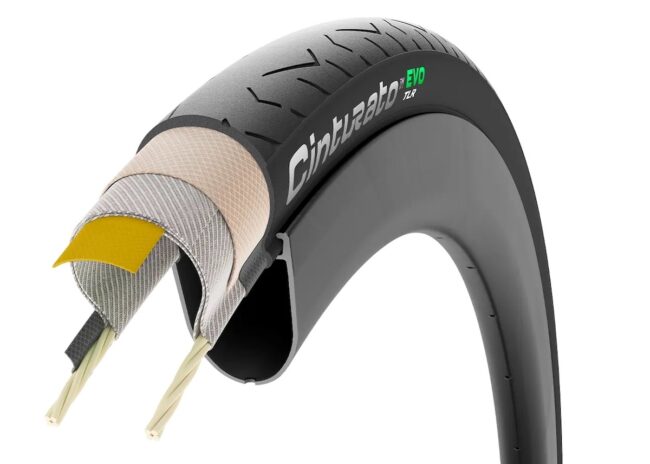
“Recently I have had major trouble removing tires and putting them back on. The tires are Pirelli Cinturato Velo 32s, now called Cinturato EVO TLR. The wheels are DT Swiss M462.
After deflating, it is virtually impossible to move the rubber from the edge of the rim to the center. The rubber is stuck. All my hand strength cannot move it, so I can’t get the tire iron under the bead of the tire. The tires are also incredibly tight. This is a new problem! I haven’t ever experienced this in my 45 years of riding!”
My Reply
Thanks for the question Nat. You’re actually asking two tire questions that are related yet different. The inability to push the tire beads off the side of the rim to remove the tires has to do with tubeless tire and rim technology. Basically, tubeless technology can lock the tires onto the rim so that they are more likely to stay on even under extreme situations. That’s what’s causing your first problem
Your second issue, which you described as “the tires are incredibly tight,” is a different problem. That’s most likely because the tires have been resized to a smaller diameter. Some tire companies are doing this for the same reason that there are locking beads on tubeless setups: to make sure they’re less likely to come off on their own.
I’ve covered both these problems over the years here in my column. Keep reading for some tools for dealing with them and links to the articles where I cover them in depth. Also, by coincidence, I recently tested two sets of Pirelli tires, both size 700c and was surprised to find that the newer of the two fit much much tighter. I have some thoughts on that too.
Problem 1: moving the tire bead off the rim shelf to the center
Nat called this a “new” problem, but ever since tubeless tires came out, which have been around for decades now, it’s been possible for this to happen. Nat was probably just lucky to never have had a tubeless tire and rim combination that caused it to happen. But it’s a relatively common problem that mechanics deal with in the shop on a regular basis.
When it happens, it can definitely seem impossible to get the tire bead off the side of the rim (the tire seat) to remove the tire or fix a flat. Some sealants used inside tubeless tires can make the problem worse when they dry and basically glue the tire to the rim.
What makes the tire bead stuck is that it’s impossible to get a tire lever in between the rim and tire to push the tire bead off of the rim shelf and into the center. And, it’s stuck on so tightly that you can’t push it off with your hands no matter how hard you try. Because the tire is mechanically locked onto the rim.
In a follow-up email Nat told me that his mechanic at the shop was able to get the tire beads off the edge of the rim by using a wood block as a press. This can work, or even better would be two wooden blocks – because there’s enough surface area to grip the rubber and the blocks are rigid. When they’re clamped together against the tire (in a vise, for example), they could provide sufficient force in the correct place to push the bead(s) off the rim shelf.
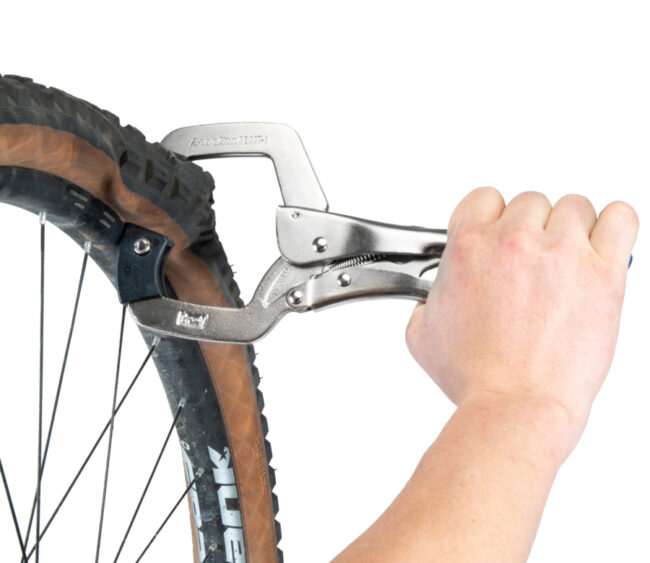
If you don’t want to look for some wood blocks and a vise, the best tool for the purpose in my experience is Park Tool’s BMT-1 Tire Bead Breaker. It’s a large heavy tool, so it’s not made for taking along in a seatbag, but it’s up to the job and makes getting stuck beads into the center of the rim manageable. To learn more and see the tool in action, here’s a link to my article on the BMT-1: Quick Test & Review: Park Tool’s BMT-1 Tire Bead Breaker.
For a smaller portable tool to carry, something I’ve used is a small putty knife. The thin blade on these tools can usually be forced in between the tire and rim, and if you can get it in there it has the leverage to work the beads off. You must work carefully though not to cut tires or scratch/damage carbon rims. Here’s a link to my article with more information: Another Tool Tip For Removing (Not Installing) Tight Tubeless Tires.
Problem 2: tires getting tighter
As I mentioned, I recently did some Pirelli tire testing and found that two 700c tires (both Pirelli Zero tires) were different diameters. This happened when Continental first came out with their GP 5000 tubeless tires too. They were much tighter than the GP 2000s, 3000s and 4000s that preceded that tire model.
I strongly believe that bicycle tires should be made to go on by hand, no tools required. And, all it should take to remove them is good technique and your two hands or tire levers.
Because when tires are too tight to get on and take off, a simple flat tire can leave a rider stranded with no way to get home, which could put them in danger. So I don’t get why some tire companies apparently think it’s okay now to downsize tires.
For more about my Pirelli tires, how I tested the sizing and what Pirelli had to say about it, watch the beginning part of my video:
The solution
Unfortunately, the only foolproof method of avoiding too tight tires I can offer is to test them yourself to make sure you can get them on and off your wheels. You could do this at some bike shops that are okay with it. And some online sellers offer this as you can read here: https://www.biketiresdirect.com/returns Just be sure to treat the tires kindly as you attempt to put them on your wheels, and save the original packaging to put them back in or they might not accept them.
About Rims/Wheels
You might be wondering if the rims or wheels are the reason that some tires are fitting more tightly. It’s a reasonable question but when two tires that are the same size fit completely differently on the exact same rim, it’s clear that the tire is what changed.
Your Turn
It’s always interesting and helpful to hear about other tight tire troubles and solutions so please share your experiences and tips. Especially helpful will be recommendations for easy to install and remove tire brands and models – and ones you would avoid.
Jim Langley is RBR’s Technical Editor. A pro mechanic & cycling writer for more than 40 years, he’s the author of Your Home Bicycle Workshop in the RBR eBookstore. Tune in to Jim’s popular YouTube channel for wheel building & bike repair how-to’s. Jim’s also known for his cycling streak that ended in February 2022 with a total of 10,269 consecutive daily rides (28 years, 1 month and 11 days of never missing a ride). Click to read Jim’s full bio.


Thank you again for helping make things up. Sorry Gin I just couldn’t help myself! That’s why I have you? But seriously keep it up.
TLR – I hate ’em! I was on a “large tour” and found myself in a group of 9. Too of them had rims and tires with “TLR” on them. The bead-and-hook design is quite serious. It turns out those too had 2 flats each. Out of the group, I was the only one that had tire irons that worked. These ae Silca and are quite expensive! They have metal cores, and the “business” end is quite narrow. The situation remained difficult, but eh narrow end made it possible to work it between the rim and the bead. I learned that Cannondale has these same levers and, as they are in their “discontinued” site, are about 1/3 the price.
I have a very small bottle of liquid soap in my seat bag I dilute with some water to help slide the tire on and off the rims. There’s no question the tires are tighter and I’m not as strong as I was 35 years ago
RDL
I had my first flat on my 1 year old Trek Domane AL and I struggled trying to get the tire off and on and they are not tubeless. I could have sworn the tire was too small….thanks for clearing this up.
Great article Jim,
I have found Hutchinson blackbird tlr tires go on easy, and have a consistent fit that is not too tight and not too loose.
They don’t test a high highest for rolling resistance, but the weight, grip, and comfort is very good.
I am currently running Continental GP 5000 S TR tires on my Hed Vanquish wheelset and they seem to be working out well also.
I agree on some tires being too tight/hard to remove and reinstall. To break the seal, I use a large slip-joint/adjustable pliers with tape over the gripping ends or a thin piece of wood or plastic on each side of the tire so I do not damage the tires.
As I repair bikes for our community (including many flats), I have also found the opposite problem…Some tires are too loose and have a tendency to blow off the rims. I have had particular issues with a brand which I will not mention but it starts with Schw (and the next letter is not an i) . I have had some of these tires that even my bike shop could not get to stay on the rims. When a tire will not stay on a rim, they need to be discarded as they can be dangerous.
I always use the Jim Langley install & remove with no tools technique. I have occasionally experienced stuck beads, and I use a tool much cheaper than that Park tool you illustrate: A quick clamp. You can get one at Harbor Freight for under $3.00! Also, that Park tool is nothing different than a Vice Grip brand welding clamp, if you desire the heavy duty metal construction.
Thanks for commenting Steve. One correction, so that no one gets the wrong idea: the Park BMT-1 bead breaker tool is actually very different from quick clamps and from the Vise Grip welding clamps. Those won’t budge truly locked on tires. Park’s tool will.
Thanks again,
Jim
On trail I had a flat with a 27.5+ tubeless with an insert that was stuck tight and a long walk ahead of me. Determination won by stepping on the side of the bead. A year or two later I saw a shop guy use a vice to compress and un-stick a sidewall as you also suggested. What a great technique to keep in mind; I have not needed it yet but a reminder is always helpful. Great tips!
I have the Conti GP 5000 on my road bike and it is impossible for me to break the bead with my hands. I have to clamp the tire in my repair stand (nice soft plastic jaws). On the road that tire is never coming off, so I run tubeless. It’s reassuring to know that tire won’t roll off the rim if I flat. I seldom flat (once in the last four years, and the sealant held even with a good sized cut). Plan B is to call a friend for a ride and Plan C is hitchhiking. I hope the newer version of this tire is a little easier to get off.
As an apparent retro-grouch, every time one of these conversations comes up it makes me all the happier that I’ve never switched to tubeless. It’s my bicycle schadenfreude.
A word of caution when using putty knife or any relatively thin metal object to remove stuck or tight tires be very carefull not the damage the rim tape particularly on tubeless wheels.
This isn’t just an issue with tubeless, though tubeless are more consistently tight. Getting these tires on is even more difficult than getting them off. I now resort to using a blow drier on the final portion that I can’t get over the rim. Heat it up nicely and it goes on easier—still requires a tire lever to help it over. I don’t even bother carrying the old road levers anymore either. It’s Pedro’s, which are thick and won’t break. As the article says, god forbid I should have to do something out on the road!
If you keep the new tires in the hot sun for a few hours they soften up which makes its easier to install by hand.
I have tried this several times and it works, but you need hot sun.
I purchased a Cervelo with Reserve carbon wheels that can be tubeless but I use tubes. Have used Conti GP tires for 25 years on other bikes – never a problem. Here, could not get tire off bead when I got a flat on road. Solution – searched for and tried different tire brands – found Vittoria tires, preferably not tubeless, have softer sidewalls. Also changed rim strip to wide Stans tape – now I only run those tires and no problem changing tire without tools.
Just another tubeless tire issue that I have avoided by avoiding tubeless tech. On my road bike, still using 15mm rims (inner width) and 23 or 24 tires. Yes, and tubes. Rare flats are easily changed and the tube repaired later. Cheap, too, if that is important. No messy sealant. Wider rims are inherently more difficult from which to remove tires. Most tires I can remove and replace without tools. During winter months or if I want a softer ride, I ride a steel bike and rarely use a 25 mm tire, which is even easier to remove.
There is a less expensive alternative to the Park BMT-1 bead breaker tool, and that is using a C-Clamp with pads of some sort like wrapping the metal pads with section of innertube. You can find these cheap at any home improvement place or Harbor Freight. But the Park one is specifically made for that task.
Jim, did you try removing the 40 mm tires after they had been inflated and ridden for a while? They’re likely to be somewhat looser at that point.
What kind of rim strips do those wheels have, if any? Perhaps something thinner – like Kapton tape – would create enough room to make removal easier.
One (hopefully) final thought. Plastic scrapers and plastic automotive trim removal tools should work as well as a putty knife, but without the risk of damaging the rim.
Agree 1000% with Jim’s point about test mounting/unmounting your tires at home PRIOR to taking them out for any long rides. Any fix is never easier (or safer!) stuck on the roadside than it is at home. Blows my mind every time I run across experienced riders who cannot change their own tire….expecting others to stop roadside to do it for them.
BTW-Anyone know of an on-line site for reporting particularly tough specific tire-rim combos? I’ve (thankfully) never run into one I could not get off/on with decent tire levers, but then I don’t run sealant on my road bikes.