The “e” in ebike stands for “equalizer”

By Stan Purdum
At 57, Dave packs a lot of muscle on his six-foot-three frame, and the bit of middle-age spread around his waist only increases his visual impact as a powerful guy. The fact that he’s a serving police chief adds to his aura of authority.
I’m a couple weeks shy of my 80th birthday, and I pack more fat than I like on my five-foot-seven frame. The fact that I’m a retired preacher adds to my aura of long-windedness.
Perfect cycling partners, right?
Actually, it turned out to be so.
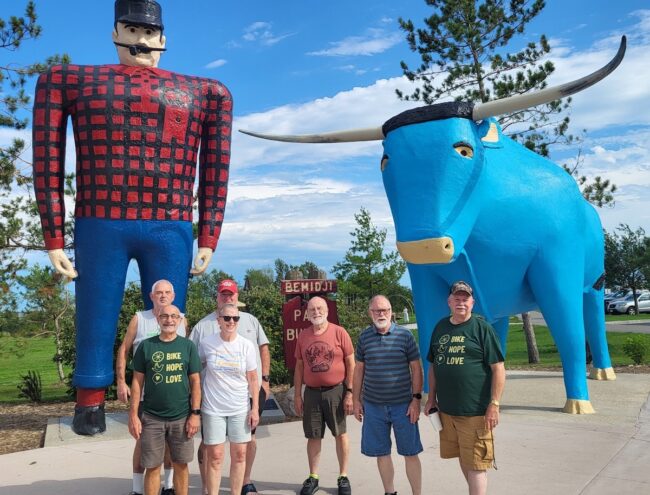
In July, we were both participants with four other cyclists and one support driver on a ride on the Paul Bunyan Trail in Minnesota, sponsored and supported by the nonprofit organization, Bike Hope Love (formerly called Pedaling Parsons when I wrote about it before in Road Bike Rider). The group rides to raise money for mission projects.
For the approximately 200-mile ride, we pedaled the trail out and back from Crow Wing State Park, south of Brainerd, Minnesota, northward to the college town of Bemidji on the lake of the same name, using two days in each direction. As we rode, we just naturally paired up in two-rider groups, switching the pairings as we each found our preferred speed, so it wasn’t until the return leg that I fell in beside Dave. And when I did, we found that we both liked a faster pace than the group as a whole was traveling.
Ebikes, which are great equalizers, made it possible for us to pedal side by side. Dave normally rides regular (non-electric) bikes, but because his years of participation in athletics and weight-lifting have left him with sore knees, he uses an e-bike for longer cycling jaunts.
The ebike equalization worked like this: Because Dave added so many watts simply through the power of his pedaling, he kept the assist setting on his bike on “Eco,” the lowest level. To keep up with him, I kept the assist setting on my bike on “Sport,” the middle level.
A powerful rain and wind storm hit the area on the morning of our third riding day. Our group waited out the storm in a restaurant, but once on the trail, Dave and I, riding ahead of the others, found fallen limbs and trees blocking the trail in places, so he and I cleared much of this as we went. Dave, strong man that he is, was able to heave some tree trunks out of the way, while I moved smaller debris.
The final day’s ride took us from the small community of Hackensack to Crow Wing Park, a distance of 61.2 miles. The first several miles of the trail below the start point had been recently repaved, and simply cruising along, Dave and I averaged 18.5 mph. Because I have both the battery that came with my bike and a range-extender battery, I had plenty of power for the day’s mileage, even riding in Sport mode, but Dave’s bike had a smaller battery, so we had some concern about whether it would last for the full day’s ride.
Most of the Paul Bunyan Trail, built on an old rail line, is flat with gentle grades here and there, but the final 10-mile stretch into Crow Wing Park is not on railbed, and it lopes up and down. Before we started the final climb, Dave mentioned that his battery was nearly drained, but we pressed on. Eventually, Dave pulled in behind me so he could ride in my slipstream. I assumed this was to extend the remaining power in his battery. I was pulling at 16 mph and Dave had no trouble keeping up, so I guessed the slipstream gambit was working. But when we got to our destination and I said, “I see your battery lasted,” Dave replied, “Actually, it ran out about three miles ago.” The last miles were under pure Dave steam, and he pedaled so strongly that I couldn’t tell that his battery was no longer assisting.
Dave himself was the ultimate equalizer.
The ride with the whole group was as good as a hot-fudge sundae, and the part I pedaled with Dave was the cherry on top.
Stan Purdum has ridden several long-distance bike trips, including an across-America ride recounted in his book Roll Around Heaven All Day, and a trek on U.S. 62, from Niagara Falls, New York, to El Paso, Texas, the subject of his book Playing in Traffic. Stan, a freelance writer and editor, lives in Ohio. See more at www.StanPurdum.com.



In Stan Purdum’s e bike article, I would like to know what make and model of e bike he and his friend were riding?
Mine was a Specialized Turbo Creo SL Comp E5,
Dave’s was a comfort bike from Trek, I think, though I don’t know the model.
Thank you Stan! If and when I decide to go that route, the Creo was on top of my list. You like? Cons?
William,
Here’s my review of the Creo: https://www.roadbikerider.com/specialized-turbo-creo-sl-comp-e5-review/
Great article, and I couldn’t agree more. My 71-year-old husband is still a strong rider on his Trek Emonda, so I bought an e-road bike so we could continue to ride together. I’m younger, at 64, but not so fast a cyclist. I’m able to ride my Zinn Tui ebike in Eco mode to stay together. Rides are fast and fun again! I don’t consider ebikes “cheating” at all. I can simply ride further, faster, and together with my life partner.
Not to be rude but why do people riding e-bikes bother to say what their average speed was? Is it really relevant when you are using more than human power? If you rode a motorcycle you could average even greater speeds, or even faster in your car. I believe e-bikes are great as is anything that gets Americans off their couches and outside but who really cares what your average speed was on a motorized vehicle? I simply don’t get it.
I basically agree with you about recording the speed. But in this case, one point of the article was that both Dave and I enjoyed the faster pace, and our speed meant we used up our batteries faster — in Dave’s case, before we reached our destination.
And pedaling vigorously on the ebikes meant we both got a good workout. Unlike a motorcycle or a car, an ebike only assists when the ;rider pedals. (At least, that’s the case for ebikes without throttles, and neither Dave nor I have a throttle nor do we want one.)
I’d like to know the range you got on each battery.
Dave had a 400 watt-hour battery. In Eco, he got close to 60 miles range at high speed
Here’s the info on my batteries: https://www.roadbikerider.com/review-of-range-extender-battery-for-specialized-sl-ebikes/. Riding in Sport at high speed, I got the full 61.2 range but had enough power left for at least another 20 miles.
Range depends on how fast you go & how much you weigh. Trek has a web site for range calculation. You enter Total weight, cadence, speed, terrain == distance.
Average speed applies to all forms of transport, walking, running bike, e-bike car. At 83 and a heart attack I can ride my e-bike with my younger friends for 50 miles but not the 70 or 80 miles they might go.
My Creo experiences:
1. Those who scorn ebikes have not yet experienced the vicissitudes of age. They will.
2. I typically ride the Creo on rides of >45 miles, or with lots of climbing (avg more than 65 ft/mi), or most especially if I want to try and hang with the younger folk.
3. I set my usual eco boost at 25% motor assist at which I could get around 100 flattish (avg 50 ft/mi elevation) miles per single charge, but putting on the turbo and climbing with a 30 year old is a bit of a giggle.
4. The benefit of remote control is that when I lost a shift cable (Creo is a 1x) very much on the wrong side of a steep river valley, I still had a three speed to get home. I couldn’t pedal up one 14% hill even at 100% boost, but did okay on 10%
5. It really is you only faster.
This is all great information. I’d love to get one now and interlace it with my non e bikes – ride one or the other depending on my mood, etc. But I imagine once you start e biking, you do not want to go back to non e bike.