SQLab One11 Insoles Review

By Rick Schultz
Rating: See my ratings below.
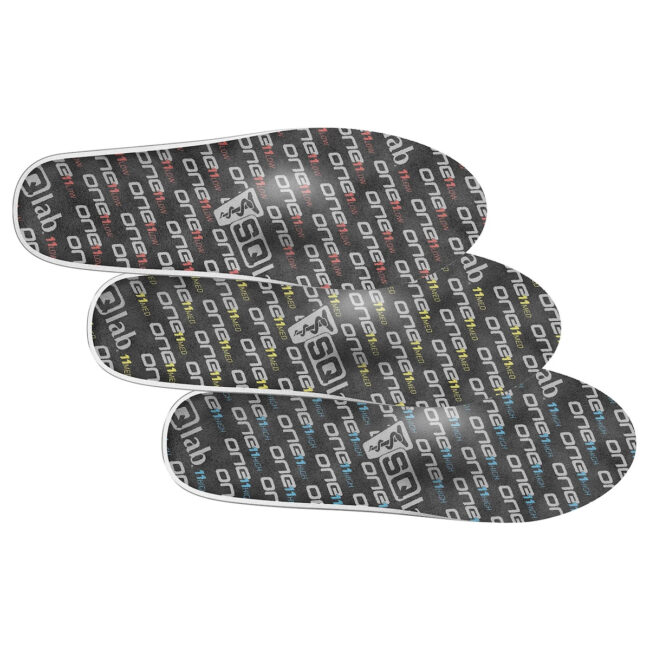
Hot!
- Easy to Trim
- Met bump supports transverse arch
Not!
- Takes a little time to get used to especially if you have been using another insole such as ICEBUG
Source: Bike shops, Amazon, websites
Features: Metatarsal Bump, LOW/MED/HIGH arch support options
Sizing: 36-48
Price MSRP: $110 USD
How obtained: Manufacturer Sample
Summary: Great insoles for all bicycle riding
https://sqlab-usa.com/collections/insoles
SQLab is known for their saddles and handlebar grips. They also manufacture bar ends, stems, apparel, pedals, insoles and other cycling accessories. For this review, we have chosen the One11 Insoles to test.
Insole Products
SQLab manufactures only the ONE11 for the USA market.
Like most high-quality insoles, the ONE11’s are offered with three arch support options, LOW, MED, HIGH.
Finding Your Size
Every insole is different. A HIGH arch support from one company might be a MED in another.
For SQ Lab, they have a quick set of measurements to make sure you get the right model.
- CHOOSE YOUR FOOTPRINT
- WHAT IS YOUR LEG AXIS
- COMBINE A, B above to find your insole.
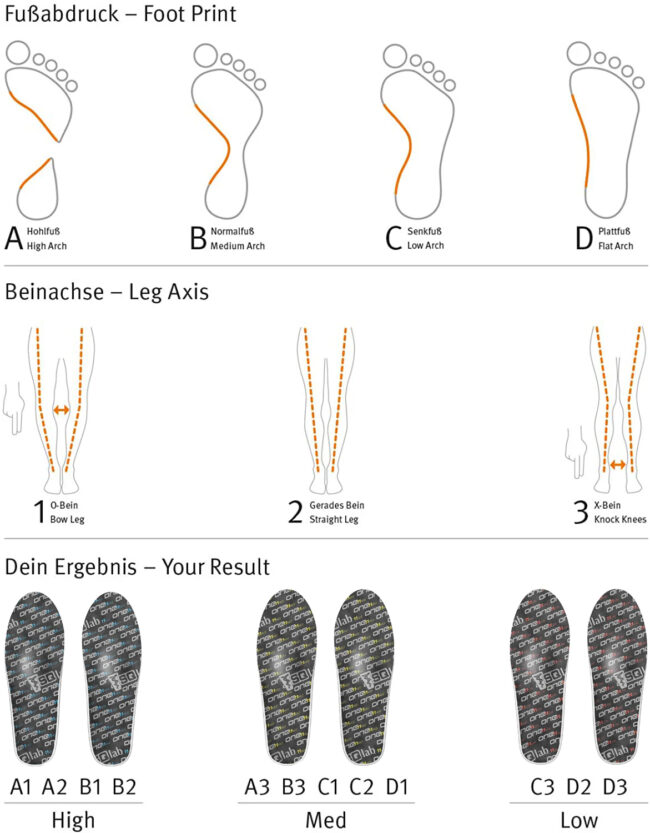
In my case, I measured A2 so I requested the ‘216’ High Blue Insoles.
The next step was to trim the insole. I immediately noticed that they were very difficult to cut. Luckily, I have a new pair of sharp scissors, but it was still like cutting through thick leather. The key to trimming is to take little snips at a time.
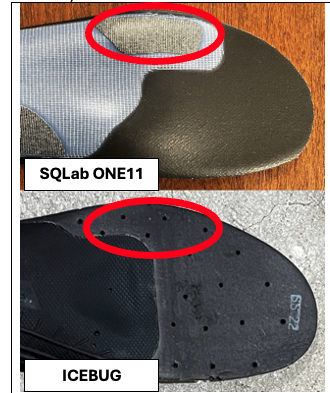
Once trimmed, I wanted to compare placement, height and size of metatarsal bumps. A ‘met’ bump is required in an insole in order to support the foot’s transverse arch. See photos below.
The SQLab ONE11 and Icebugs have the best placed Met Bumps of insoles tested. The Icebug is a little larger and a little taller, offering those with very high arches great support. The ONE11’s would be more comfortable for those with MEDIUM-HIGH to LOW arches. The original Lake insoles were too floppy to offer any support, and the MET bump was microscopic and placed too far back to offer any support for the transverse arch.
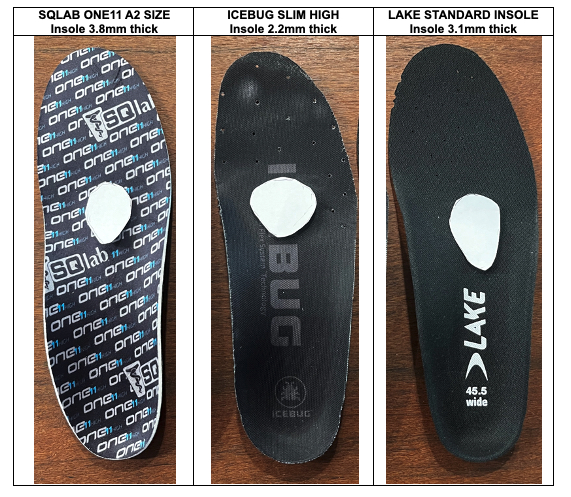
Since the ONE11’s are 1.6mm thicker, and since cycling shoes are considered low-volume shoes, if your shoes are already tight, you should measure the thickness of your current insoles to see if these and your feet will still fit into your cycling shoes.
The ONE11 insoles consist of five layers of material. The first three layers create a thickness of 3.8mm. Adding a fourth and fifth layer, the insole is now 2mm thicker, bringing the total thickness to 5.8mm.
Top – microfiber cover
2nd – Dense foam layer
3rd – Firm Rubber or neoprene
4th – Firm Rubber plus fiberglass with integrated met bump
5th – Lateral foot support consisting of firm fiberglass
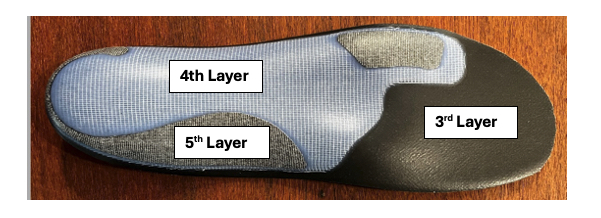
Overall, I was really impressed with the quality of the materials and construction.
Bottom Line – how did they feel and how did they work out as insoles?
What I noticed is that if you are used to a good quality insole, it is hard to adjust to another one, especially if that insole has firmer support than the one you are used to (i.e., 4th and 5th layers of the ONE11).
The ONE11 is a great insole with great support. I have been using Icebugs since 2015, and they are setup without any foot correction (in contrast to Specialized Body Geometry insoles and road shoes that include a built in Varus wedge).
The ONE11 felt like the insole was trying to rotate my forefoot inward by adding two additional millimeters of height under my fifth metatarsal. SQLab calls this “Lateral Forefoot Support.” This is something that I am not used to with Icebugs. Unlike the Specialized varus wedge technology, since the added material is on the outside of the foot, this would be more of a valgus wedge, twisting the outside of the foot up, forcing the knees inward at the top of the pedal stroke. This is the same technique as adding a wedge under the cleat. Very few cyclists actually require a valgus wedge.
Conclusion
I will get 25,000+ miles (40,000 km) of hard road riding out of a pair of Icebugs. I have no doubt that the ONE11’s will last at least that long. They are very well constructed with high quality materials. For me personally, I would prefer that SQLab remove the Lateral Forefoot Support wedge. This new insole would still have all of the support needed but without the feeling of a wedge under your foot.
Rating
For quality, construction and materials used, these are five star!
But due to them forcing my forefoot inwards, I personally cannot get used to them. Others might like this additional support; it all depends on if your feet are naturally big toe up or big toe down. Again, for me, I give these an overall three star.
Post Analysis
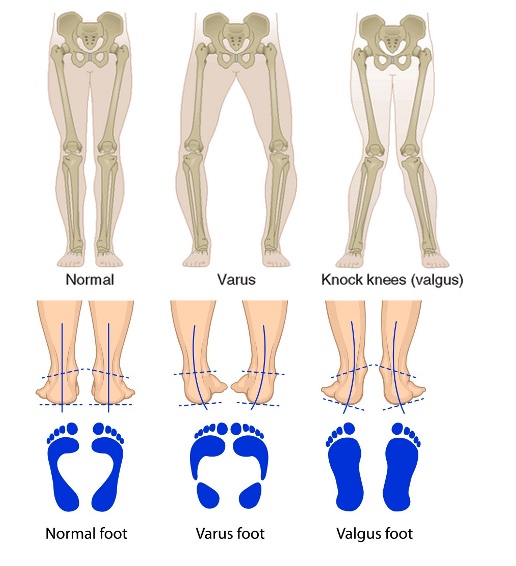
Valgus = Pushing towards the Center of the Body
Varus – Pushing outward or away from the Center of the Body
In bike fitting, the common issue the education courses teach the student fitters to look for is knee tracking, where the knees go out at the top of the pedal stroke and to (incorrectly) fix this with a wedge under the cleat that forces the outside of the foot upwards thereby forcing the knee inwards. There are several other ways to solve this without a wedge. During my 20 years of bike fitting, I have removed more wedges than most fitters have installed. By the way, half of the wedges I have removed were installed the wrong way forcing the knee in the opposite direction as intended.
Specialized says:
“Varus Wedge
With a 1.5mm built-in varus wedge, Body Geometry shoes stabilize the natural movement of your forefoot and improve foot, knee, and hip alignment, which increases power output and adds an average of 10 seconds to your time to exhaustion during maximum efforts. https://www.specialized.com/us/en/bodygeometry“
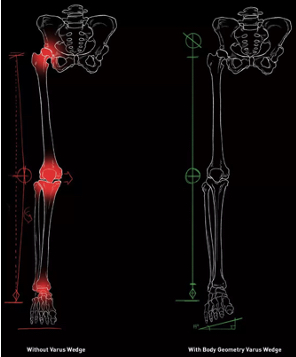
Analysis:
A varus wedge will rotate the big toe upwards moving the knee outwards. Since most cyclists knees go OUTWARDS at the top of the pedal stroke, a VARUS wedge would seem to exacerbate this issue.
So, it appears the Specialized shoes are turning the feet the wrong direction and forcing the knees even further out at the top of the pedal stroke.
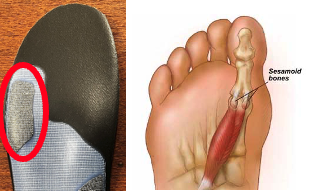
SQLab valgus wedge
As measured and stated in the article above, the SQLab ONE11 has a built-in 2mm valgus wedge, which rotates the outside of the foot inwards, i.e., lifting the little toe upwards. This is completely opposite of Specialized’s varus wedge. When one pedals with the SQLab ONE11 insoles, their knees would be forced inward at the top of the pedal stroke. But what about those with knees that track straight and feet that are level or have a slight valgus tilt to them already? This will place even greater strain on their knees as well as place greater stress on their sesamoid bones.
Sesamoid bones are small, round or oval shaped bones that are embedded in tendons or muscles near joint surfaces. They act as pulleys to reduce stress on the muscles or tendons they’re connected to.
There just happens to be two very small sesamoid bones under the big toe of each foot. Applying too much pressure or repetitive stress can inflame the tendons surrounding these sesamoids. Think about it, tilting the outside of the foot inward will place a lot more pressure and stress on these sesamoids and once the tendons get inflamed, it takes a long time for them to heal. This is because you are always using your feet to walk or stand. This is called sesamoiditis and is a form of tendonitis.
So, as you can see, I am not in favor of tilting the foot inwards to force someone to pedal straight up and down, there are other more effective and non-damaging ways to do this.
Coach Rick Schultz is an avid cyclist who has trained, raced, and coached in Southern California and now resides in Bend, Oregon where he works as a bike fitter and bike fit educator. Rick is an engineer by trade and a prolific cycling product reviewer. He’s the author of Stretching & Core Strengthening for the Cyclist in the RBR eBookstore. Check his coaching site, www.bikefitnesscoaching.com. Click to read Rick’s full bio.

Would be the perfect insole if they removed the ‘forefoot stabilizer’