Rene Herse Handlebar Roll Bag Review

By Stan Purdum
Available here: www.renehersecycles.com/shop/equipment/bags/rene-herse-handlebar-roll-bag/
Price: $98
How obtained: Sample from Rene Herse Cycles
RBR Advertiser: No
Typically, on day-long rides, I don’t want the weight of a rack and a trunk bag or panniers on my bike, but I nonetheless like convenient, lightweight ways to carry two general groups of items with me. Group 1 includes those items I hope not to need but am glad to have along should a mechanical problem arise: a spare tube, a patch kit, tire levers, few small tools and a pump. I carry those in a bag that hangs behind my saddle.
Group 2 includes items I’m more likely to use during the ride (such as snacks, sun cream, sunglasses, medications, maps, etc.), which I want easily accessible. (I carry my phone and wallet in my jersey pockets, but I don’t like stuffing those pockets with lots of other stuff.) Group 2 also includes items I may start the ride using but later want to remove (such as a skullcap, arm warmers, a vest or jacket, etc.), for which I want an easily accessible storage place when I take them off mid-ride.
A handlebar bag is the obvious solution for the Group 2 stuff, but several bags I’ve tried have proven too small, too bulky, not sufficiently water repellent, droopy or have inadequate straps for attaching the bag to the handlebars. (This is a pet peeve of mine. I had to tie knots in the straps of a bag I tested from a different manufacturer to keep them from slipping so far through the friction buckle that the bag hung two inches below the handlebar, and the strap on a bag from yet another maker wasn’t long enough to attach firmly around a road bike handlebar.)
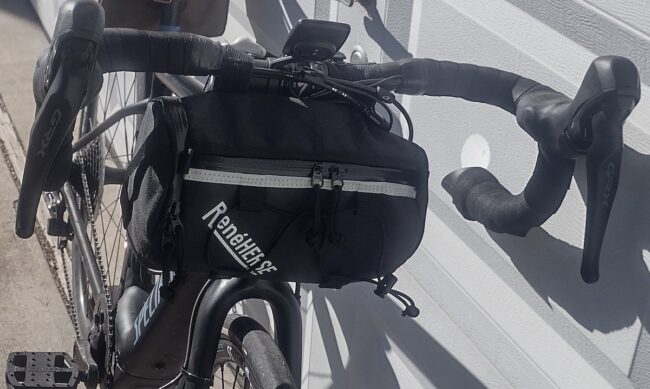
The Rene Herse Handlebar Roll Bag avoids those problems. The bag is also available in small and medium sizes at less cost, which may be all some riders want, but I like the roominess of the large one (3.7 liters — nearly the equivalent of a liquid gallon — not, of course, that you want to fill the bag with liquid).
Bike bags take a beating, exposed to sun and rain, and constantly being bumped and banged around as you roll over road irregularities. So Rene Herse Cycles has made its bag from the trademarked ECOPAK polyester fabric designed by the Challenge Sailcloth company to be durable and waterproof. That material is also an environmentally friendly alternative to traditional laminated nylon, and each yard recycles about 20 plastic water bottles into durable technical textiles.
The zippers are also waterproof, made by YKK, a manufacturer known for reliable zippers. The bag has a main compartment, with zippered entry at the top of the bag, and a small side compartment with zippered entry at the top of the right end of the bag (the right end from your perspective as you sit on the saddle). A pull tab at each end of the main zipper makes the bag easy to open and close, plus the tabs provide convenient attachment points for race or event-participant numbers without having to put a safety pin through the fabric of the bag.
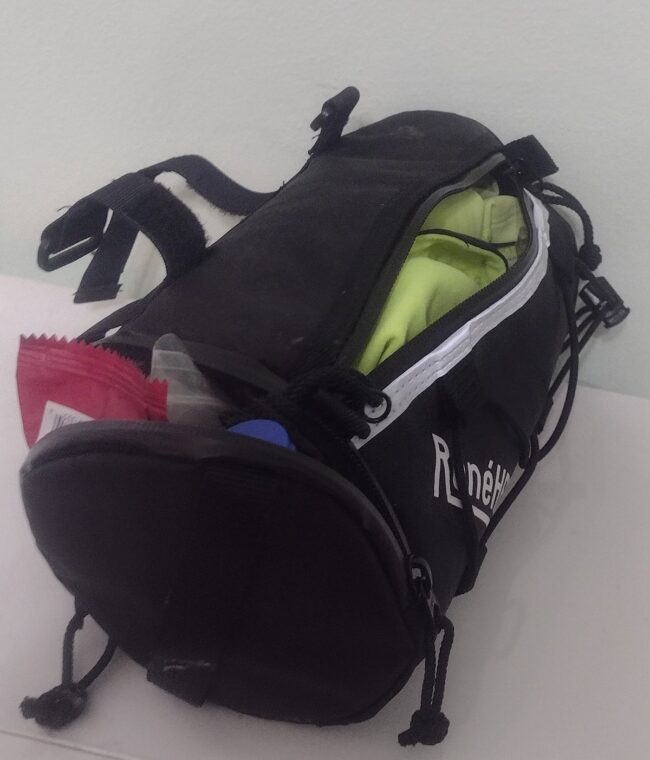
The side compartment allows you to segregate a few items you want quick access to without digging through contents of the whole bag, but because the side compartment is completely collapsible, you can utilize the full size of the bag if you need it simply by leaving the side pocket empty.
When a product is announced as waterproof (versus water repellent or water resistant), I like to check it to be sure. So I filled the roll bag with paper towels, and then put it in my kitchen sink, where I used the faucet sprayer to shoot water directly onto the bag for a full minute — probably the equivalent of a sudden downpour. The water beaded up nicely and did not penetrate the fabric, and water did not seep through the zipper itself either. However, the two zippers have a slider at both ends, allowing you to close the zipper by moving the left slider all the way to the right, or vice versa, or having the two sliders meet nose to nose somewhere in between the two ends. When I checked the paper towels within, I did find a tiny water spot on the towel beneath where the slider noses met. But then I realized that I had the bag oriented in the sink with the zipper facing straight up, whereas when the bag is mounted on my handlebars, the zipper is on the front face of the bag, where water is more likely to roll over it than penetrate it. Bags that are 100% waterproof usually have a roll-top closure system, which would be a great inconvenience on a handlebar bag. So I’d put this bag’s waterproofness at 99.9%, which is better than many bike bags.
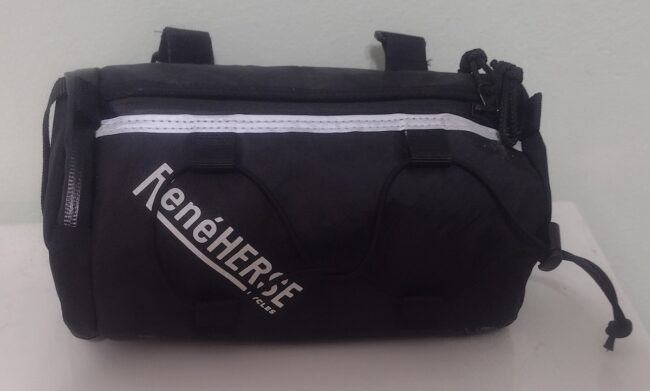
The attachment straps are made of one-inch-wide webbing with reinforced seams. They can be repositioned to work around lights or other accessories you may have mounted on your handlebar. They wrap around the handlebar and then through a nylon loop before folding back on themselves and attaching with Velcro. There’s also a strap for anchoring the bottom of the bag to your bike stem or head tube.
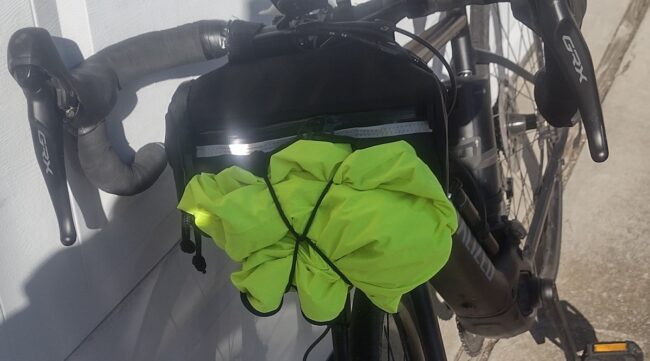
The elastic webbing on the front of the bag is a perfect place to stuff my windbreaker, whether it’s dry or wet. (The small and medium size bags do not include the webbing.)
What’s more, the bag is roomy without being heavy. By itself, it weighs 157 grams, but there is a removable stiffener sheet (included with the large and medium bags) that weighs 38 grams. Altogether, 195 grams — about 6.9 ounces. The stiffener ensures that the bag will hold its shape when it is only partially filled.
The brightly colored liner and stiffener sheet make it easy to spot items in the depths of the bag.
There is a web strap handle on the small compartment end of the bag that you can use to carry the bag if you use it off the bike, but it also makes a good pull option to open the bag end when accessing the side pocket.
On the moving bike, the bag is steady, neither swaying nor drooping, and I like it a lot. Because I’ve not had this bag long enough to have tested it over miles and miles of travel, I can’t say with certainty that it will outlast other bags, but its construction is impressive, and I’ll be surprised if I’m looking to replace it anytime soon.
Stan Purdum has ridden several long-distance bike trips, including an across-America ride recounted in his book Roll Around Heaven All Day, and a trek on U.S. 62, from Niagara Falls, New York, to El Paso, Texas, the subject of his book Playing in Traffic. Stan, a freelance writer and editor, lives in Ohio. See more at www.StanPurdum.com.