Can You Quiet Down a Loud Cassette?

Jim’s Tech Talk
By Jim Langley
This week we’re answering a great question from a roadie named Tom. Please read our conversation and share your thoughts and advice in a comment.
Tom wrote:
“I went for a ride with my wife the other day. She’s got a modern carbon road bike with a 10-speed freehub whereas I (perhaps by mistake) chose to ride my ‘70’s era road bike with a 6-speed freewheel. She immediately noticed how much quieter my bike was than hers when coasting. She decided she had to get her bike modified so it coasts quietly (and she is not a woman easily denied).
For kicks this afternoon I measured the difference with the app that comes on my Apple watch. I was surprised that her bike is about 20dB louder than mine.
The question is, what to do about it? It happens I was measuring the sound from her Cole wheel’s freehub, but I suppose the noise level is about the same as more common Shimano or SRAM freehubs. Do I have any recourse? What’s the quietest freehub? Is it significantly quieter than what she’s got?”
My Reply:
Thanks for the question Tom, a very timely subject. Because, it turns out that I did a video for my channel here similar to your comparison, asking the question if bikes have gotten too loud.
Most viewers said they preferred quiet freehubs but a lot more than I expected stuck up for modern loud ones and the louder the better for them. One theory I’ve heard is that they make more noise because they’re higher quality hubs with more parts inside or higher tech parts inside. While that may or may not be true, depending on the hub in question, I think the more important issue is if loudness can cause unexpected consequences, maybe problems.
For example, after I did that video I received another set of Chinese carbon wheels for testing from ICAN Cycling that were much louder than my other wheels of which I have several sets. They’re fantastic riding wheels yet at speed and coasting they are so loud that when I enter intersections I cannot hear if a car is coming. This means that I have to stop or at least almost stop, to hear if it’s safe. Safety is a pretty good reason for cassettes to not be overly loud, I think.
And don’t jump to the conclusion that I’m blowing through stop signs or red lights. I’m talking about intersections where there are no lights or stop signs and where it’s safe to roll right through, so long as no one is entering the intersection who has the right of way.
Quieting a Loud Freewheel or Cassette
The thing that makes the noise in a freewheel and cassette is the drive mechanism. There are different designs. Freewheels and older cassettes usually have pawls – little metal wedges – that engage a drive ring that looks like a gear with teeth on it. Look closely at this first photo and you should be able to see the pawls on this hub along with part of the toothed ring inside the hub.
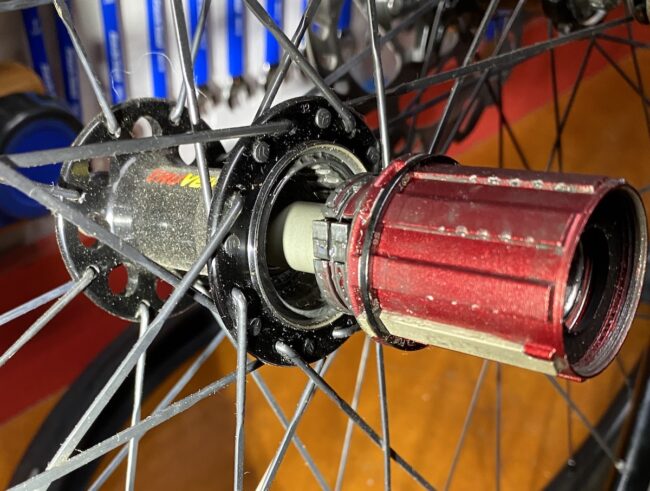
Pawls
When you pedal, the pawls engage the teeth to drive the bike. When you stop pedaling and coast, the drive ring spins which causes the pawls to ride over the teeth making the happy tick, tick, tick sound as you sail along down the road. The pawls are on springs so that they will always find the drive teeth when you pedal.
Ratchets
More cassette hubs are coming out now with a different system where there are two toothed discs that engage with each other to drive the bike when you pedal (I believe DT Swiss invented this ratcheting mechanism and now that their patent has run out, others are using it).
On these, when you coast, one disc spins with the wheel and the other stops. The sound comes from the teeth on both rings riding over each other. A spring allows this to happen by letting one disc to lift off the other when you’re coasting. In the second photo, you can see these two ratcheting rings.
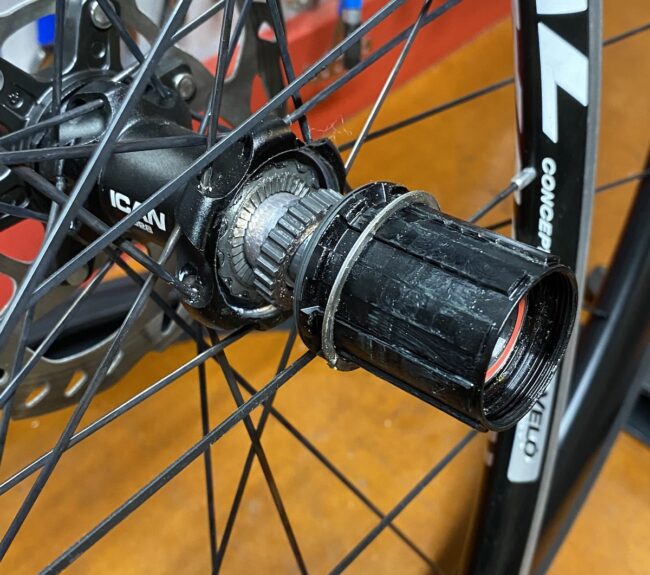
Can You Turn Down the Volume?
The way to try to quiet freewheels and cassettes is to put a thicker lube inside them. Tom’s dealing with a cassette, but because you might still have a freewheel bike that you want to try this on, I’ll explain how to do it with those first. If you’re cassette-only, feel free to skip ahead.
Lubing Freewheels
With freewheels it can be a little tricky to get the lube inside. You’ll want to remove the rear wheel and lay it flat on a workbench with the freewheel facing up. Then, drip an oil the consistency of motor oil onto the crack between the moving and fixed parts of the freewheel, which you can see if you look closely and turn the freewheel by hand.
Rotate the freewheel as you do this and the oil will be drawn into the body and down to the bearings inside. If you have the tools, you can remove the freewheel for access to both sides and can apply oil to the crack on the back too. But, so long as the freewheel is flat, gravity will pull the oil down and into the bearings on both sides of the freewheel so it will work even with the freewheel still on the wheel.
TIP: It’s not worth the trouble to take freewheels apart and it usually ruins the freewheel too because most are locked at the factory not to come apart. As long as you get some oil inside it’ll get it smooth again and can change its sound too.
Lubing Cassettes
The two photos above both show cassette freehub bodies. That’s so that you can see the common two types.
The most important thing when working with cassette hubs is to pay attention as you take things apart so you can get them correctly assembled again. Take photos every step of the way. There are small parts in hubs and they can easily fall out. Be sure not to let that happen until you have documented carefully how it all goes back together.
Start by removing the cassette cogs. You’ll need the correct lockring removal tool for your brand of hub and a chainwhip tool.
I haven’t worked with the Cole hubs on Tom’s wife’s bike, and they didn’t appear to have a good manual online regarding their freehubs. But typically, you either have to remove the right end cap, which you can usually do by hand or by using a pair of pliers with rubber over the jaws (use pieces cut from an old inner tube) so as not to scratch up the end cap.
Or on the other type of cassette hubs, you might need to unscrew the ends of the axle to remove the freehub. Usually on that type, you will see wrench flats on the end caps or the insides of the axle ends might be hex-shaped to receive hex wrenches to unscrew the ends of the axles.
Once the end cap is off, if you carefully pull on the cassette body gently and slowly, it’ll come off the hub and you’ll be able to see and access the parts inside. Again, take photos and don’t drop any parts until you are sure you know how to put them back where they were.
The goal is to find the ratcheting mechanism. When you find it, you want to clean the parts with solvent to remove any dirt and grime that has gotten inside.
At that point you can use whatever good quality grease you have to put more on there. The part making the noise is mostly the ratchet or drive ring of the body or hub or the ratchets. Those are the parts you add grease to. You can buy grease made for the purpose such as Dumonde Tech Freehub Grease, which some of my viewers recommended in their comments https://amzn.to/48EHgQf
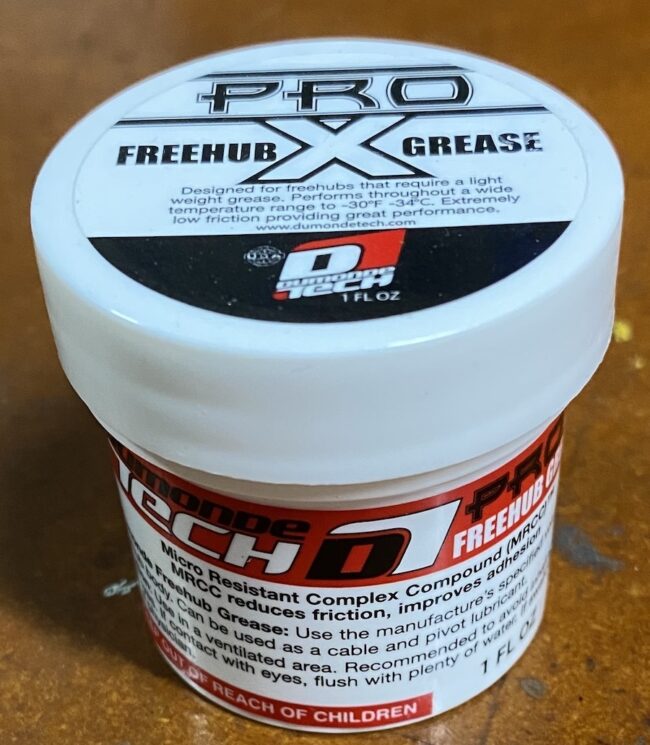
I’m sure some of the other bicycle lube companies offer freehub grease too. And as long as it’s not too thick, other greases made for bikes should work too. You don’t want to put too much on there though. Too much can cause the mechanism to gum up and not work as well. And with winter approaching, it might be more likely to do that when it’s colder. If you have pawls in the freehub, those are even more susceptible to gumming up so don’t over grease the pawls themselves.
That’s the basic idea, to put a thicker layer of grease to muffle the sound.
The Quietest Freehub
There are some hubs that make hardly any noise if you want to rebuild the wheel on a new one. Onyx is one I’m familiar with because I’ve built a couple of wheels with them. They’re pretty much silent and have super fast engagement too. Here’s a link: https://onyxrp.com/ If greasing the freehub doesn’t do the trick, that sure would Tom.
Your Turn
Readers, please weigh in with your tips for quieting down Tom’s wife’s noisy cassette and comment on anything else I brought up in my answer. Thanks in advance!
Jim Langley is RBR’s Technical Editor. A pro mechanic & cycling writer for more than 40 years, he’s the author of Your Home Bicycle Workshop in the RBR eBookstore. Tune in to Jim’s popular YouTube channel for wheel building & bike repair how-to’s. Jim’s also known for his cycling streak that ended in February 2022 with a total of 10,269 consecutive daily rides (28 years, 1 month and 11 days of never missing a ride). Click to read Jim’s full bio.


The bike itself can also make a huge difference. A TT bike I bought years ago, a model ironically named ‘Stealth’, had the loudest freewheel I’ve ever heard! At some point I bought it new aero wheels (with added benefit: quieter freewheel) and put the original wheels on my road bike, expecting that I’d just have to live with the noise. To my astonishment, on my road bike the freewheel hardly made any noise at all when coasting. I guess something about the frame design of the TT bike was amplifying the sound, and doing an astoundingly effective job of it.
That’s a good point Claire, oversize aluminum and carbon frames can amplify sounds for sure. Thanks!
Jim
On the same bike, I have gone through three sets of rear wheels manufactured by Fulcrum. What they all had in common is that during the first several rides you do not hear a thing when coasting; completely silent. The sound comes up afterward and matches the sound produced by wheels manufactured by others.
it is a lot of trouble and may not work very much
best if you have $250 is a new freehub that is known to be quiet
but $100 labor and $150 at least
side benefit, now you have a new really good freehub that will last 75000 miles
[though your original probably would have lasted another 70,000]
wle
I am spoiled by my Campagnolo hubs. My collection includes “Daytona”, Chorus, and Record from between 1997 and 2004. They are quiet – nearly silent, so much so that on long down-slopes, other riders are not aware of my presence. (On a recent group tour, people noticed that in the carpeted hotel halls, the bike was silent!) However, in 2018, I added a pair of Campagnolo Zonda wheels to my collection. The mechanism (and likely some parts) are the same, but it is definitely louder than the old hubs. (DA Shimano hubs sound like a snare drum when coasting!)
Please be aware that the sound of a freehub freewheeling can frighten horses, maybe to them it sounds like a rattlesnake and can cause them to rear up. So if you are riding near equestrians just keep the pedals turning
All my bikes have quiet freehubs and tbh I wouldn’t ride one of those superloud freehub-equipped bikes.
They lack civility, They exist mainly so other people know when you’re coasting!
I built a set of wheels for a previous bike I owned and used the Onyx Sprague Clutch hubs. They were not just quieter, they were absolutely silent since they have no pawls or ratchets. They also have immediate purchase when you start pedaling, absolutely no hesitation. I sold that bike and SO miss that silent coasting. The Onyx hubs are expensive but I will never build a new set of wheels with any other hub.
I had a very loud Hunt rear hub and tried several different brands of grease–they all worked for about one ride. Hunt sold a set of pawls that were supposed to be quieter. I installed those but it didn’t help much. I even tried filing down the pawls which did not affect their effectiveness nor did it lower the decibel level much. End solution was I gave away the wheels. (Note that not all Hunt wheels are that loud.)
That said, I like some noise from the rear hub for safety. It has kept some squirrels and other animals including humans from darting in front, especially when there is not enough time to hit the bell.
I have a set of Princeton wheels built with the White Industry hubs chosen for great bearings and almost silent.
Have White Industry hubs. Very quiet but I’ve swapped wheels between a Jamis Endura from 2014 and my Landshark steel. The carbon makes hub noise louder as previously mentioned.
Resonance in carbon rims and frames is a major reason for excessive noise. Those deep rims in particular, and huge frame tubes that are so aero and stiff amplify freehub noise. It’s similar to the difference between tapping on a tin can and a metal bucket. Unfortunately, there’s nothing you can do about it unless you want to plaster your bike with sound damping material.
Per Escape Collective, a reportedly silent retrofit for DT Swiss hubs is coming out of Australia. https://www.williamsracingproducts.com/shop/p/zero-drag-dt-swiss-internals
I like a hub with some noise for safety. My regular rides include a couple sections with pedestrians on the trail. When approaching the people I let off the pedal so they hear the hub clicking noise and are made aware of my presence. Having said that, yes there are some hubs that are excessively loud. Sometimes I’ll hear those in an event ride and think how do they stand that noise and I’ll moves away to where I can’t hear them.
Thanks for the great feedback everyone, appreciate it!
Jim
Jim, I have a set of first generation Zip wheels (no disk brakes) they are loud enough for people ahead of me to hear me coming into an intersection. I gave that bike to my son in South Africa when I switched to disc brakes. Those wheels were great until you needed to stop on a wet ride. Then you really needed a Bible.