
Tech Q&A: Joe’s Lower Bicycle Gearing Plan

Jim’s Tech Talk
By Jim Langley
The following technical question arrived the other day. It’s a good one because going to lower (easier) gearing is something most cyclists must do sooner or later. I provide some ideas below in my reply. Please chime in with your lower gearing advice for Joe and others in the same situation in the comments.
Joe’s question
“I am 71 and my wife is 72, and we live in western North Carolina where hills are just part of life. I read your article “Going to Lower Gearing on My Gravel Bike” https://www.roadbikerider.com/lower-gearing-gravel-bike/ with much interest as we too are faced with the hills, age, and respect for our knees.
In the article you cautioned “you also must be sure to never try to shift onto the 40 when you are on your large chainring! If you do that you could damage the drivetrain.” I fully understand the reason for this. But I am more interested in lower gearing than high gearing.
Here is my question:
What if I have the chain long enough so as not to get into the problem if I use the 46 chainring and 40 tooth cassette by using the H derailleur limit screw to eliminate the offending small cassette rings to overcome the excessively slack chain? Any idea of how many rings I would lose?
Thanks for all you do for the bicycle world!
Joe”
My thoughts
Nice to hear from you Joe. Let me run some ideas by you:
On “cross chaining”
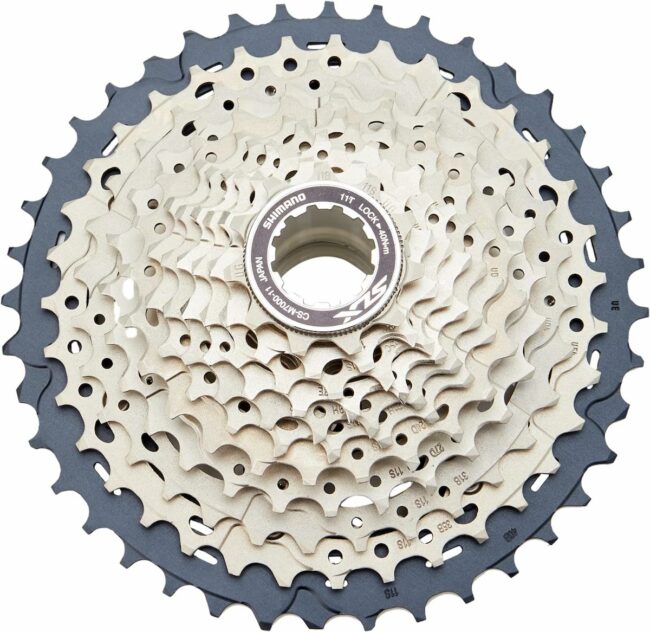
The first one is that a lot of people would say that you don’t want to use that large chainring/large cassette cog gear because it puts the chain at an extreme crossover angle – from the far right in front to the far left in back. That’s when you’ll have the most wear and tear on the chain, cog and ring. But there are others who ride in that gear and don’t worry about it. So you can make your own mind up about that.
Your slack chain idea
Regarding running a slack chain, in my experience, what you propose to do is something that’s difficult to predict the result of without trying it. Luckily with the chain “quick links” we have today (sometimes called “master links” even though those are for non-derailleur bikes), you can test different chain lengths fairly easily.
For this I keep a few used/old quick links in different sizes (9-/10-/11-sp) on hand. That way you aren’t sacrificing the new quick link that came with your chain to test potential drivetrain improvements (these used quick links are great for sizing new chains too). Note that most quick links are supposed to be used once only. If you have one that’s made to be used repeatedly, then no worries using it twice or more.
So what you could do is try a longer chain on your bike with the gearing you want to run and see for yourself how that big/big gear works and how much slack there is when the chain is on the smaller cogs.
Note that having a little slack in the chain on the smaller cogs may be something you hardly notice. I remember in the early 1980s that the Colombian team in the Tour de France ran slack chains because they believed it reduced drivetrain friction and gave them an advantage.
Stopping the derailleur from shifting to the smallest cogs
You’re right that you can turn in the H screw to limit the rear derailleur’s range and keep the chain from going down to the cogs where there’s more slack than you want.
However, depending on how many cogs you block out, one issue might be slack in the shift cable. Since the derailleur spring isn’t able to return the derailleur to its full range (the smallest cog), there will be extra shifts/clicks of the lever. And if you mistakenly shift further than the derailleur can move, it will create slack in the cable. It’s possible that the slack could allow the shift cable end to change position inside the lever as a result and that could cause shifting hiccups, maybe even a cable issue.
To prevent this you could readjust the cable tension so that the lever starts shifting at whatever cog you limit the derailleur to.
Maybe a better idea
But after all this you might still find with this experiment that the top pulley runs into the largest cassette cog – and if not on every shift, enough to potentially wear it or cause poor shifting.
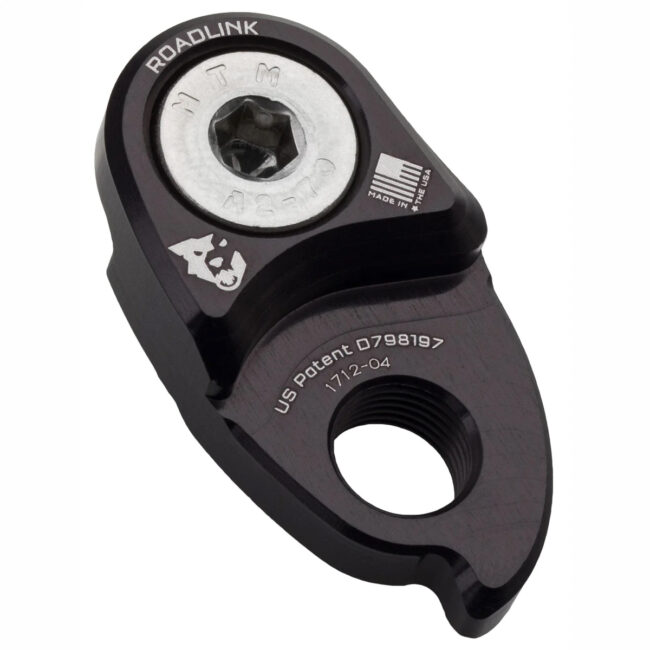
So, instead of going with the slack chain method, you might want to instead buy a Wolf Tooth RoadLink derailleur hanger extender. I think that will solve any possible shifting issues with no worries about a slack chain or pulley interference issues. Because it drops the rear derailleur lower providing the clearance needed for shifting into all cog/ring combinations.
https://www.wolftoothcomponents.com/collections/derailleurlinks/products/roadlink
Derailleur capacity
I almost forgot to mention that your rear derailleur capacity is part of planning lower gearing. Derailleurs usually have specifications you can find by searching on the brand and model of your derailleur. They tell the largest cassette cog the derailleur can handle and also its total chain wrap capacity.
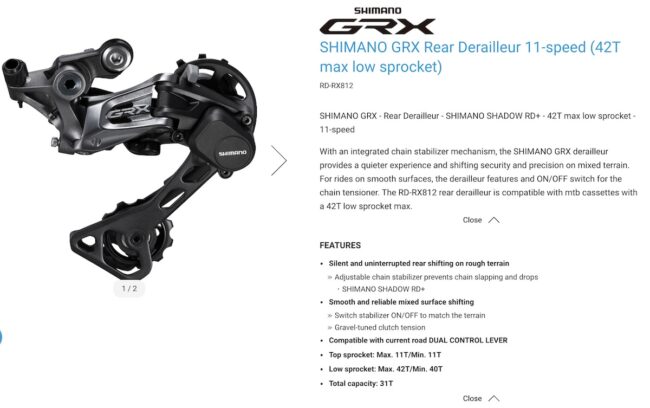
The largest cassette cog is easy to understand. If it says 42T it means it’s rated to be able to shift up to a 42 tooth cassette cog. What total capacity refers to is how much chain the derailleur can wrap, which tells you if you’ll end up with slack in the chain or if the derailleur will be able to remove it.
To determine that you subtract the number of teeth on the small chainring from those on the large ring and add that to the difference between the largest and smallest cassette cogs. So for example, if you have a 46/30 crankset and an 11-40 cassette, you get 16 + 29 = 45.
I hope these thoughts help Joe and I look forward to hearing what you decided to go with and how it worked out for you.
Jim Langley is RBR’s Technical Editor. A pro mechanic & cycling writer for more than 40 years, he’s the author of Your Home Bicycle Workshop in the RBR eBookstore. Tune in to Jim’s popular YouTube channel for wheel building & bike repair how-to’s. Jim’s also known for his cycling streak that ended in February 2022 with a total of 10,269 consecutive daily rides (28 years, 1 month and 11 days of never missing a ride). Click to read Jim’s full bio.

Jim,
Two thoughts, please comment.
1) Maybe gearing is only half the problem, the other half crank arm length?
2) Wolftooth is a great solution, including the tanpan. For ultimate gearing, you can now consider running XT rear der (XT M8100) on your Ultegra 11-speed drivetrain which can handle 51T. Due to different pull rates, the tanpan is required. So, what would be the idea gearing for taking your ‘hybrid’ ultegra/xt bike to europe and climb stelvio/motirolo/ventoux/galibier/etc?
Let’s talk about cross chaining and wear some more. My bike has a single chain ring (48 tooth). 11 options on the casette. Most of the time I’m riding in the 2, 3rd or 4 th smallest cogs (13, 15, 17) cogs and that creates cross chaining. I’ve accepted the fact that the chain will just wear prematurely. But at 5k miles, stretch is minimal and shifting is still like new. As a PM thing I’ll be changing the chain soon. Plus I’d expect that the chain ring and casette will be changed at around 10k.
Nat: Understand your PM but, since you are willing to replace those components, I might just run them until there is an issue before replacing them – I guess I am of the school that replaces things as needed rather than basis miles traveled. No disrespect intended…….
Walt
Interestingly, with DI2 (at least my current set up – 11sp with a Frankenstein set of generations of pieces) the 11 and 12 cogs are not accessible in the small chain ring. Not sure if this is programable in the app or not.
Here in the Central Valley of California we have a variety of hills. God made triples for a reason. I have been using a Campy Record triple with a long arm rear . Up front is 49-42-26,rear 13-30. There are places when it gets too steep I walk for a few steps, otherwise no problems.Thanks
I moved to a 11-36 cassette paired to my 34-50 crank last year after observing the high cadences of the riders in the 2023 Tour de France. I noted that during the ascents, all the riders had high cadences – even when out of the saddle. A higher cadence pumps more blood flow in and out of my leg muscles providing more energy for climbing with the same watt output..
I live on the Olympic Peninsula in Washington state and I am riding hills wherever I ride. After changing from an 11-32 cassette to the 11-36, my cadence is about 8 percent higher for the same watt output. I find climbs easier, less fatiguing, and with less grinding.
I use a SRAM Force 11-36 as the gearing profile is better than the Shimano 11-36. I also installed a Wolf Tooth RoadLink Derailleur Hanger Extension on my Shimano Ultegra groupset to facilitate the 36t. Shifting works fine.
I changed to a 170mm crank arm a few years ago to facilitate using a higher cadence for the same torque output.
Some would say way bother with all this when you can just go to an e-bike and be a lot more enjoyable. If not you maybe your wife might like the idea.
Even with an E-bike you may have gear issues. With a 1×11 I was constantly shifting trying to find my go to cadence riding with friends. I bought a 10/25 cassette and mixed it in with the 10/34, so I had my go to 15,16,17,19 gears. 11 & 12 went away.
I know the trend is away from triple chain rings to 1X drive trains but a triple works fine for me. I have an old touring bike (I’ve probably had it for 15 + yrs) as well as a road bike and a tandem. As things wore out on the touring rig over the years I have replaced them with lower geared components. I now have an 8 speed triple with a 44/32/22 crankset, an 11/32 cassette, and a long cage derailier. I live in NE Ohio where we have hills and also flat areas. At 72 yrs old I never run out of gears at the top or the bottom and it shifts fine.. Long live the triple.