
How often should I clean the pads inside my helmet?

QUESTION: I’d like to know how often to clean the pads inside the helmet, which is probably “never” for most people. I wash my gloves after every ride, but helmet pads are out of sight and out of mind. —DWilliams (DWilliams was a commenter on last week’s question “How often should I replace my helmet?” Some other commenters also expressed opinions about helmet cleaning, so I’ve chosen that for this week’s question.)
RBR’S STAN PURDUM REPLIES: To tell the truth, until you asked about cleaning the helmet pads, I don’t recall thinking about it since my first helmet, which I purposely didn’t clean.
I started cycling as a serious endeavor before helmets were in use. I wore my first helmet on my 1995 trip across America, (see photo of me at the Missouri line sign, below). It was basically a Styrofoam bowl with no internal harness or “halo” to keep it from wiggling around on my head. It had a stretchy nylon cover (sort of like a shower cap), and what I remember of the pads inside was that they didn’t stay attached very well; a day of heavy sweating would cause them to slide out of position. As best as I recall, I never tried washing the pads because I thought that would cause them to fall out altogether.

I haven’t kept track of how many helmets I’ve had since, but my best guess is five or six. I cracked two of them in crashes and so they were immediately replaced. But each one had improvements over the previous one. I don’t remember washing the pads in any of them, but I agree it’s a good idea. These days, I wear a skull cap under the helmet, using a lightweight one in the summertime, so the pads are protected from some of my perspiration, and I do launder that regularly.
Still, the helmet pads get dirty, so, prompted by your question, I decided to give my current lid a washing. Online, I found that some cyclists clean their helmet by taking it in the shower with them — soaping it up and rinsing it out there, and then letting it air dry. Others wash it similarly in the sink. I saw a suggestion that the helmet can be put in the upper shelf of the dishwasher, but I don’t like the idea of food particles getting sprayed on it, and I suspect the heat cycle in a dishwasher does the helmet no good either.
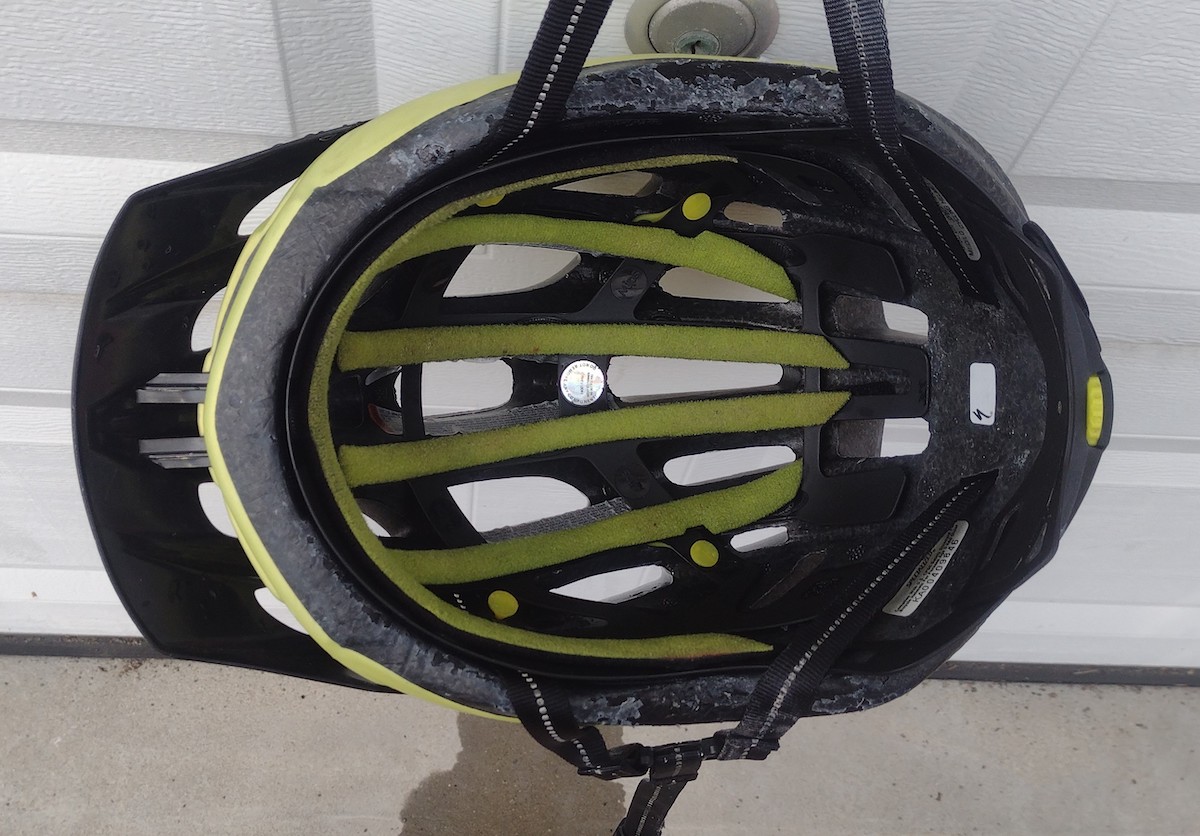
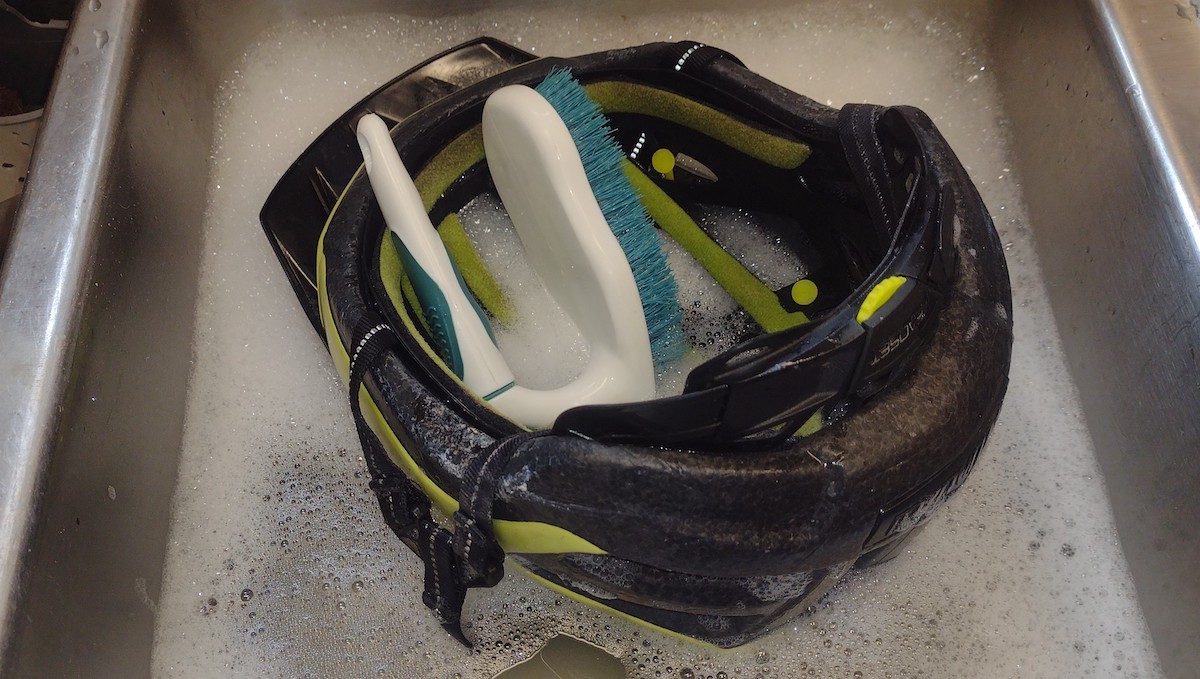
I washed mine in the kitchen sink. I used medium-hot water and Dawn dish soap. I also used a scrub brush (see photo with brush). The brush did an excellent job on the straps, especially where I had some zinc oxide on them (which for a while, I used as a sun guard on my ears, but it got on everything nearby, like helmet straps), but when I started scrubbing the down-facing rim of the brain bucket itself, I discovered that the brush was removing a clear plastic coating I hadn’t realized was there (see photo; look especially between the straps). So if you’re going to use a brush, look for one that’s less aggressive than a standard scrub brush.
To answer what you asked — “I’d like to know how often to clean the pads inside the helmet, which is probably “never” for most people” — I suspect you can do it frequently, and if you do, you probably won’t need a brush at all.
Allen, another commenter on last week’s Q&A, asked “Is it safe to use disinfectants, Lysol spray or the like, on a helmet? Does that breakdown the foam?” I don’t know the answer to that, but if soap and water do the job, I wouldn’t risk the chemicals. See Lysol ingredients here. And some other disinfectants contain bleach or ammonia.
Stan Purdum has ridden several long-distance bike trips, including an across-America ride recounted in his book Roll Around Heaven All Day, and a trek on U.S. 62, from Niagara Falls, New York, to El Paso, Texas, the subject of his book Playing in Traffic. Stan, a freelance writer and editor, lives in Ohio. See more at www.StanPurdum.com.
When I feel that it’s time, I grab the hose and rinse out my helmet with fresh water. No soaps and no scrubbing. Air dry out of direct sunlight and it’s good to go.
Many years ago, a friend recommended Febreze for eradicating nasty smells from the inside of crash helmets. I’ve found it to be excellent advice.
I can’t believe DWilliams actually washes their gloves after every ride. I just let mine dry between rides and wash them when they’re noticeably dirty or salt stained. If they have Velcro on them, I close it then toss them in with regular laundry.
As for my helmet, I rarely wash the pads and when I do, it just rinse them in plain water and squeeze it out. After repeating this a few times, I let them air dry. I always wear a thin headband or scull cap, which reduces the amount of sweat and such that the pads have to deal with.
One general cycling clothing tip. If you aren’t going to wash your clothes shortly after riding, hang them to dry completely before tossing them in the laundry hamper. This prevents bacterial growth and smells.
As soon as I see
salty straps, it comes in shower with me. I shampoo my hair normally, then with straps tucked in, place on my head and wiggle helmet back and forth to get shampoo all over it, then I rinse and hang up to dry!
I see so many disgusting helmets with caked in salt and riders have told me they’ve never washed their helmets!
Sounds like a good technique. I just need to think of a variation of it that works when one’s head, like mine, is bald. 🙂
Stan, wear your skull cap in the shower. Get shampoo on it and you do a 2 for one job cleaning both the cap the the pads!
For washing, I use an empty kitty litter bucket. I wash the helmet when, before a ride, the straps feel stiff or “slimy”. I do frequent washings because despite using a “skull cap”, the pads get loaded with sweat. When new sweat drips down from those pads, it is quite concentrated and burns when it gets into an eye. (BTW, many helmet makers supply replacement pad sets.)
I’m with Elizabeth. Every so often (whenever it starts smelling funky) I take my helmet in the shower and wash it with shampoo. Shampoo doesn’t lather as much as dish or body soap, so it’s easier to rinse out completely (and not have soapy sweat dripping out of the helmet on the next ride). I make sure to wash all the pads and straps (I like what Elizabeth does!) and then let it air dry.
As an aside, for many years I had problems with sweat running into my eyes when riding in hot conditions. Unpleasant, uncomfortable, and inconvenient.
A few years ago, I bought a Halo sweatband. It really does the job.
(I’ve also tried Sweat Gutr, but I found it uncomfortable and less effective. Your mileage may vary.)
Once in a blue moon I put my helmet in a bucket of water with some white vinegar added. I put a big full detergent bottle on top to keep the helmet submerged, let it soak for a while, then hang it up to dry out of the sun.
So many great answers, thanks everyone.
I first noticed I should wash the helmet pads when I was caught in a rainstorm and a salty fluid dripped down from inside my helmet onto my face, eyes, and into my mouth.. It seemed to be a bit of a biohazard, so now I don’t ride in the rain!
.
When I notice sweat salt on the straps I’ll use a Silca Gear Wipe to clean away the stains as well as the body of the helmet and the inside pads. On occasion I will wash the entire helmet as I wash my bike. I always let it air dry.
When sweat air dries there is a salt residual in the pads. When you
are riding and sweating the pads can become “full” of extra-salty
sweat. If that is pushed out and flows down to the eyes it can be
very irritating/burning.
I put mine in the washer with the clothes after its filled and before agitating, swish it around for a while and then rinse in the sink. Also fit a spare bottle of rubbing alcohol with a sprayer and when I am finished riding I spray the straps and pads. This seems to keep the smell down and I haven’t noticed any deterioration of the foam.
The dishwasher works charms on mine. Gloves? Who wears gloves?
I rinse with plain water after every ride and air dry. My wife loves it when I leave my biking stuff all over the counter top!
I’m a sweater! In the hot, humid weather of summer, I rinse the helmet pads in warm water after every ride. (I do this at the same time as I rinse the Halo sweat band and the HR monitor strap.)