
Tech Q & A: Hanging Bikes with Hydraulic Disc Brakes for Storage?

Jim’s Tech Talk
By Jim Langley
An interesting question came in from a longtime RBR reader named Phil. He didn’t mention it, but he might have asked about this topic because I mentioned the Stashed SpaceRail hanging bike rack last week. Read his letter and my short answer and if you hang your hydraulic disc brake-equipped bikes, please share your experience. You’ll understand why your feedback has value after reading my answer to Phil.
Phil’s question
I keep hearing that hanging bikes with hydraulic disc brakes is bad (might let air into the brake lines). True or no? If true, does that mean hanging upside down by both wheels or hanging by the front wheel only?
My answer
In my experience that’s true Phil. It’s best not to hang hydro-disc bikes either by both wheels or by one. It’s because if there is any air already in the system, that air can move around when bikes are hung.
This happens because air is lighter than the fluid in the hydraulic brake lines (either mineral oil or DOT fluid). If the air changes position by floating upward from the levers into the hydraulic lines or up to the calipers, since air can be compressed (hydraulic fluid cannot), it can make the brakes squishy-feeling at the least. In the worst case, there might be so much air inside that the lever(s) don’t even activate the brake(s) any more.
Sometimes, once you get the bike on the ground you can repeatedly squeeze the levers and restore the braking back to near where it was. But if not, you’ll probably need to bleed the brakes or have them bled by a mechanic to get them working optimally again. That will remove the air from the system and top off the hydraulic fluid.
Summing up, since you can’t be 100% certain that there’s no air in a system, it’s best not to hang bikes with hydro discs.
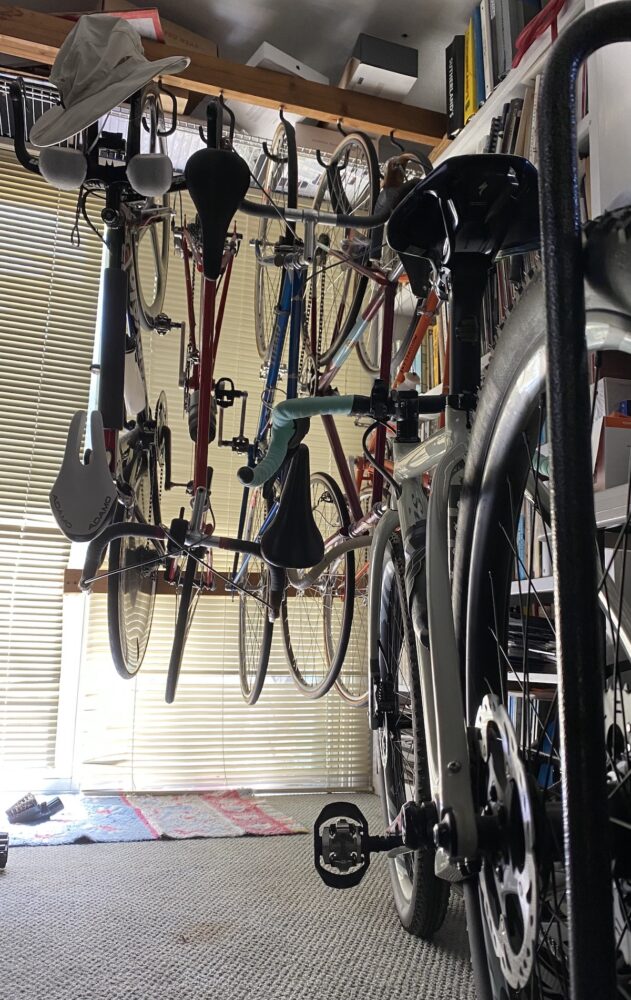
Personally, between my wife, daughter (who lives in our home) and myself, I care for 6 hydraulic disc brake equipped bikes and I store them all upright. The two I hang, I put the seat on the ceiling hook so that they hang upright. In the photo of my office here, you can see that the disc bike is resting on the floor, while 5 rim-brake bikes hang on hooks.
I do this because I’m confident that the brakes are functioning properly on all the hydraulic brake bikes and I don’t want to risk changing that.
Your turn
Readers, it would be helpful to learn how you store your hydraulic-disc brake bikes. And if you do hang them, let us know how it works for you. Please explain how they’re hung and share what brand of hydraulic disc brakes are on the bike too. (My disc brakes are by Shimano and SRAM.) Thanks!
Jim Langley is RBR’s Technical Editor. A pro mechanic & cycling writer for more than 40 years, he’s the author of Your Home Bicycle Workshop in the RBR eBookstore. Tune in to Jim’s popular YouTube channel for wheel building & bike repair how-to’s. Jim’s also known for his cycling streak that ended in February 2022 with a total of 10,269 consecutive daily rides (28 years, 1 month and 11 days of never missing a ride). Click to read Jim’s full bio.

I hang my hydraulic disc brake bikes (mix of SRAM and Shimano) and haven’t detected any issues. I hang some by the front wheel and some by the rear wheel with no observed differences.
Several thoughts:
1. If hanging by the rear or both wheels, air in the system shouldn’t move toward the levers.
2. I don’t know enough to know whether air at the levers affects braking vs. air in other spots.
I actually think that hanging by the front wheel, or standing up the bike, will not lead to this problem. This position keeps the levers above (or possibly even on the front wheel) the calipers.
I have seen this problem with my Ultegra Di2 levers when the bike was hung for a long time. I’m not talking weeks or even a few months, more like a year+. The bike was hung upside down in the garage from both wheels.
Interesting question. I’ve been hanging a road bike and a MTB with Shimano hydraulics for the past 4 years and don’t seem to have had any trouble. If there’s air in the system, there’s air in the system, and there’s therefore a compressible volume no matter where it is. Having said that, Im a physician and know very little about hydraulics! Would be good to get views of a hydraulic mechanic or engineer? I might have to review my storage. 🙂
You’re correct, Chris.
Correct, if there is air in the fluid, it doesn’t matter where the location of the air is. So don’t worry about hanging your bikes by the wheel.
I used to turn my bike with Shimano disk brakes upside down when fixing flats. This seemed to cause the brakes to get soft, so I quit the practice.
Steve- you’re violating rule #49; // Keep the rubber side down
https://www.velominati.com/
My, the Velominati didn’t age well! [grin]
Just read it might be even better to hang with handles up as it will encourage any air bubbles from the rear calliper to migrate up to the levers/reservoir where they can be bled out more easily. YMMV
Over the past six years, the only times when my disc-brake bike is not hanging upside down by both wheels is when I’m riding or the bike is being worked on. This includes winters when temps have dropped to zero in the garage. I’ve never noticed an issue with those brakes.
Same here!
I do the same. And I have noticed the brakes are softer when I start riding, and seem to revert to normal feel after a minute or a few squeezes. I plan to have the brakes bled and will see what happens afterwards.
I hang one bike from the rear wheel, the other from both. Going on 9 years, no problems.
I’m with Chris – If there’s air in the system, it shouldn’t matter where it’s at, braking will be less efficient. That’s the case with car systems. However, if your car is upside down you have more problems than inefficient brakes…
You win the Internet today!
Thats not true. You car has air in the top of the brake fluid reservoir. As long as the air is above the master cylinder or the mechanism pressing the fluid, you are ok. Once the air gets beyond the mechanism that creates the pressure in the line, that is when you have issues.
With the bike, if the air is in the top of the reservoir its not a problem. When you hang the bike with the levers down, the air will try to migrate into the lines which is what will cause problems.
I personally hang my bike from the rear wheel which is the worst case for this. But once I pull it down and squeeze the lever a few times, its fine. This happens even right after I bleed the brakes.
I have been hanging from both wheels three SRAM-equipped and one Shimano-equipped bikes with hydraulic disk brakes for at least several years and haven’t had a problem.
If there’s air in the lines, why would it matter if it’s at the front, the middle or the end? This seems like illogical reasoning..
“Tiny bubbles, inthe lines…”
There must be a tolerance level bearing in mind how hard it is to refit the fill screw without air 🙂 probably improves every time it gets bled as the tiny bubbles get moved around. There’s always the hand brake if they fail
To add a bit more to this, seems to me if there is air in the system, something is wrong. You should always be “sure” there is no air in the system. If there is, either 1) the brakes were improperly bled or 2) you have a leak in the system.
I generally agree that hanging bikes upside down, has caused my hydraulics (Shimano) to fail come spring, However, this past winter, 2 bikes had no brakes after hanging them upside down, but a third was just fine, like new. Its actually very easy to fix, I simply open up the brake lever oil port (keeping it level) top it up with a little fluid right from the bottle (not bothering with any bleed kit stuff) and grab the brakes for several hard squeezes. Then let it sit overnight, repeat lever squeezes and seal the port, and they work perfect.
I think the problem is, if there is any substantial amount of air in the lines, then moving the bike through any position other than upright can affect braking, including flipping the bike over to repair a flat.. However, if the brakes have been setup properly from the start, with little or no air in them, then it doesn’t matter how the bike is stored.
In the 14 years since I started going tubeless on my mountain bikes, this has never been an issue with my Shimano braking systems. Although I do my own maintenance and upkeep so I’m very meticulous about staying on top of things, as I don’t want to have to deal with mechanical issues while on a ride.
I have a GT mountain bike with Tektro hydraulic disc brakes. While I don’t hang it, I do have it standing upright (handlebar facing the ceiling) in my storage unit, and every time I take it out there’s never been a issue with the brakes.
hung bike upside down for 1 1/2 years, brake was locked on 1 wheel, $70 at bike shop to bleed, or $70 for bleed kit.
Campy Ekar experience. No issues with hanging the bike vertically. This is due to the system being sealed and fully bled with no air in the reservoir. As others have posted, storing the bike in any position that gives air in the reservoir the opportunity to move from the reservoir into the brake lines/system, however, will cause the brakes to feel soft and/or fail. Thus, if you are confident your system is sealed and bled well, hang at any angle you’d like. When in doubt, don’t.
Hydraulic brakes should be a sealed system. If hanging your bike in any way results in soft, squishy brake lever action you likely have air in the system or the fluid has been compromised. Hydraulic fluid is minimally compressible, air is very compressible. In addition to a less than ideal bleed, occasionally a component may be compromised allowing air and contaminents to enter. Ideally you should bleed brakes annually to help maintain the integrity. That said, I have seen hydros never bled for years and they function just fine, and when I do bleed them, something resembling thick black coffee is pushed out. Excessive heat generated by braking is also an issue. High temperatures can break down brake fluid, affecting its ability to transfer hydraulic pressure.
Been hanging both road and MTBs with hydro brakes by the front wheel for 10 or so years with absolutely no issues.
I have been hanging my Shimano hydraulic disc bike by the front wheel for 5 years a d have had no problems with the brakes. It’s a common practice at bike shops, too.
It doesn’t make any difference where air is located in the system. Unless you can isolate the air somewhere that it is not subject to the pressure exerted on the liquid, it has the same effect. Hanging a bike by the front wheel may help in getting any air to migrate to the cylinders. This simplifies bleeding the system and may be an aid to removing any trapped air in the system. I use this method after servicing my hydraulic brakes to insure there is no air trapped. Once the air is in the cylinders (the ones by the brake levers), put the bike horizontal and connect the fill hose, gently squeeze the brakes with fluid in the reservoir and you may see a very tiny, tiny bubble come up thru the liquid. Voila.
Thanks for all the great comments everyone, appreciate it!
Jim
I have hung my bike with disc brakes (Shimano) by the front wheel for years, no problem.
I have hydraulic brakes on my gravel bike and have never encountered a problem hanging it upside down on two hooks (since 2018).
My experience could be atypical since the brakes in question are TRP HY/RD hybrid “mechanical/hydraulic” calipers. They’re cable operated, but apply pressure to the pads with hydraulic pistons pressurized by another piston in the caliper that’s actuated by a lever connected to a brake cable that runs up to a mechanical cable brake lever. That means that there aren’t any long hydraulic lines running from the brake levers to the calipers. The fluid reservoir is integrated in the caliper itself. Therefore all the “hydraulic parts” are confined to the caliper.
However, looking at many of the responses above would seem to indicate that, for the most part, it’s doesn’t seem to be a problem for more conventional hydraulic setups either.
If you bleed your brakes properly they shouldn’t have any air at all. And if you do have air in the lines you’d get a squishy feeling when pulling the brake lever, or your levers will have a “dead” spot in the lever until the pad make contact with the rotors.
I’ve been bleeding my MTB and road brakes for years and never had an issue with dead spots or squishy levers.
Now, if you store an MTB upside down your suspension fork could leak.