
Quick Look: Connex Chainring Wear Indicator Tool

Jim’s Tech Talk
By Jim Langley
In the interest of providing every possible tool for checking your drivetrain – and thanks to RBR co-founder Ed Pavelka tipping me off to it, I present the Connex Chainring Wear Indicator.
It’s a simple go/no-go type gauge that lets you know when a chainring is worn out. Without a tool to check this, the best you can do is look at the chainring teeth to see if they’re getting short or hooked, or compare a new chainring to the old one (if you have one). Don’t be confused by teeth that have been shaped from the factory to shift better – these can look smaller and worn but they’re meant to be that way.
Another tell for a worn-out ring is when a chain becomes too loose on it. When you try to lift it at the front of the chainring (3 o-clock) the chain shouldn’t move much. If you see a sizable gap between the chain and ring, that’s a sign it could be getting bad.
It’s rare that you would find this problem, but one more way to know a ring is shot is if the chain skips on it when you’re pedaling. A bent tooth or defective tooth could cause this too. So, check for those first and if there are none and there’s skipping on an old chainring, it’s worn out. I’ve only seen this a couple of times.

Most of these ways to check chainrings are subjective whereas the Connex tool leaves little doubt. As shown in the instructions here, if it’s pushed in between the teeth and it bottoms out, you know the ring should be replaced.
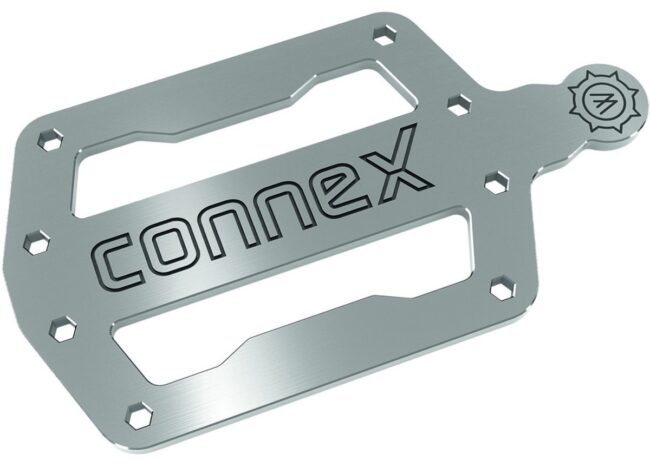
The Connex tool is made of chrome-plated steel in the shape of a pedal. Checking chainrings that are on and off bikes with it is easy. I tried it on a few of my newer bikes and one really old one and on that I found a ring that didn’t pass. It was the middle ring on a triple crankset from 1974.
This tool is not made for checking cassette cogs. It can be used to check singlespeed cogs and fixed cogs. If you’d like a tool for cassettes, Rohloff has one that’s been around for many years. It works on 9- and 10-speed Shimano cassettes https://amzn.to/3X44KYb
Without tools for checking, the best way to find bad cogs is a test ride where you shift through the gears putting significant pressure on each gear, trying to get the bike to skip. Be very careful doing this test because if a bike does skip when you’re putting force on the pedals and you’re not braced for it, you could fall and hurt yourself.
This test ride is usually done after installing a new chain since an old chain won’t normally skip even on old, worn cogs.. unless there’s something wrong with the chain.
Typically it’s the smaller cogs that you find worn-out. When I started working in bike shops and up through the late 80s, we stocked replacement cogs for entire freewheels. Suntour provided shops with a freewheel cog board for the wall with hooks for hanging every size cog needed. Regina put theirs in a wooden box with the different sized cogs stacked on dowels. Availability of every cog meant that you could replace only the bad ones, which was a lot less expensive than replacing the entire freewheel, especially since only one cog was usually needed.
You can still get some individual cogs for some cassettes but it’s hit or miss and it may make more sense to replace the entire cassette.
Even though it’s not made for cassettes, checking chainrings and cogs with a nice tool like Connex’s is more accurate, easier, faster and safer than test riding to check.
Jim Langley is RBR’s Technical Editor. A pro mechanic & cycling writer for more than 40 years, he’s the author of Your Home Bicycle Workshop in the RBR eBookstore. Tune in to Jim’s popular YouTube channel for wheel building & bike repair how-to’s. Jim’s also known for his cycling streak that ended in February 2022 with a total of 10,269 consecutive daily rides (28 years, 1 month and 11 days of never missing a ride). Click to read Jim’s full bio.



>> This tool is not made for checking cassette cogs. <<
But it says in the instructions that you can check your "drive sprocket." Doesn't that refer to a cassette cog?
Thanks for asking Steve. It says on the instructions that it’s not for checking cassette cogs. The instructions show a single sprocket being checked as you’d find on a coaster-brake beach cruiser, etc.
I’m not sure why it doesn’t work on cassettes. Maybe Connex will see this and tell us.
Thanks again,
Jim
I have the Connex tool. I find it works well on rings and sprockets that have consistent tooth profiles, but can give inconsistent results (“false positives”) when the tooth profiles vary. It works well on inner chainrings, but not so well on the typical outer rings. Similarly, it works on a single speed sprocket but not so well on the varied profiles of typical cassette cogs.
The tip on lifting the chain at 3 oclock: wouldn’t there always be some slack in the chain as you pull it forward and pull the rear derailleur against its spring?
They mean on the chain ring at the “front side.” The chain is fully wrapped around the ring at that point and if it lifts off the ring too far that suggests a worn chain ring. There will be no pull on the derailleur.
I’m pretty sure the chain has to be checked first, because a worn chain will pull away from the chainring in a similar manner.
I have had one of these Connex tools for a while, and can confirm that it works nicely on single sprockets. I’ll have a look at a cassette and see if the fit is the same.
Could one just use a drill bit shank of the same diameter as a check tool?
Yes, but it wouldn’t look as cool!
I got one.
Don’t waste your money.
It indicates that my wife’s bike chainrings are bad. It has only been ridden like 6 times and she never used the big chain ring.
On my 2 yo bike with between 1500 and 200 miles on it, the chain rings are supposed to be bad. I wax my chain and it is well under 0.5 wear.
It’s never been ridden in the rain.