
Tech Q & A: 3 Great Questions About CO2 Tire Inflators

Jim’s Tech Talk
By Jim Langley
Today’s questions about CO2 tire inflators are from Bill Thomson and RBR’s own Lars Hundley who saw Bill’s query and thought of another great one.
Let’s start with Bill, who wrote,
“I have been using CO2 inflators for years but don’t know if I have ever seen any information on how much pressure the different size cartridges give you. I have some 12- and 16-gram CO2 cartridges and ride 700 x 25c tires. Also, is there a danger in using too big a cartridge?”
Before we answer Bill, if you’ve never owned or used a CO2 inflator, the reason many riders love them is that they’re tiny (super easy to carry anywhere) and they fully inflate tires almost instantly – no hand pumping required! Here’s a video from CO2 pump manufacturer Genuine Innovations showing one in use.
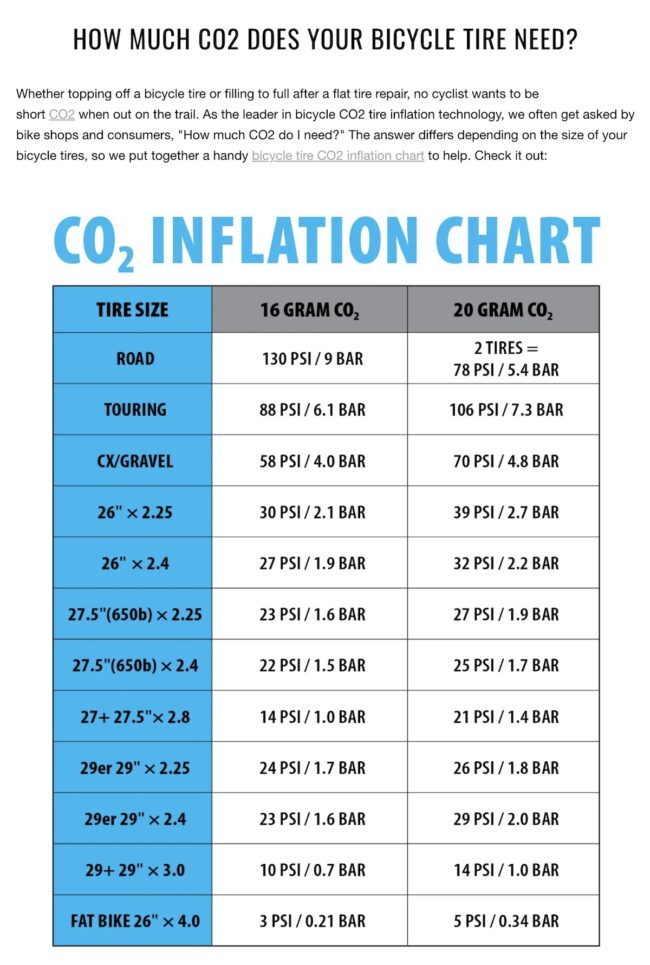
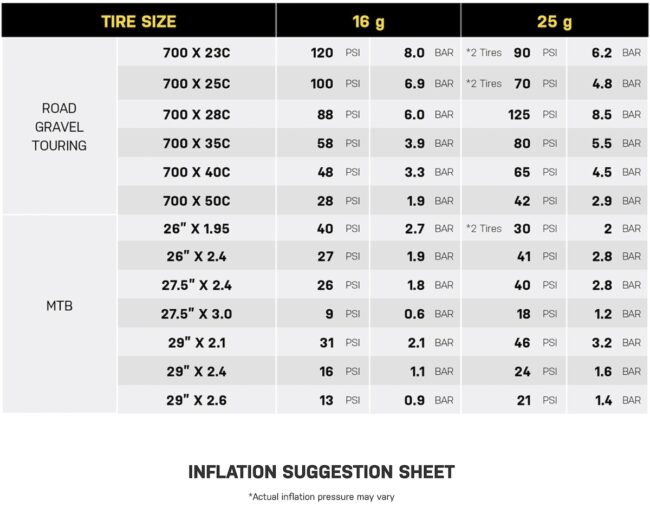
As to whether we’ve seen information on the pressure delivered from different size CO2 cartridges, yes this information is available on CO2 manufacturer websites. Here are three charts I found for your reference.
GENUINE INNOVATIONS https://www.genuineinnovations.com/
TOPEAK https://www.topeak.com/us/en
PLANET BIKE https://www.planetbike.com/
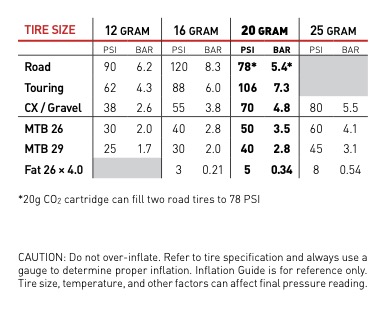
And, regarding if there’s a danger in using too big a cartridge, the answer is yes. Notice in the charts that it’s possible to put 120-130 psi in a tire. That pressure could easily blow off a tire that wasn’t installed correctly. For example, if the tube was pinched beneath a bead or the tire was not seated under the rim but sitting above it.
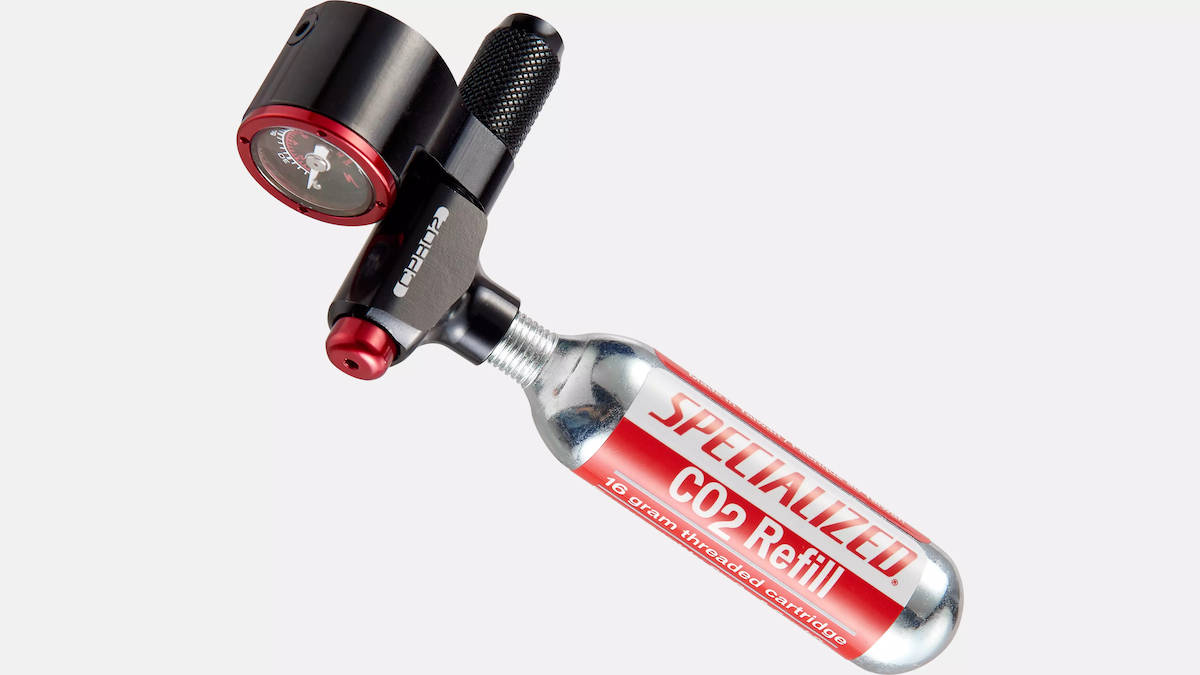
Yet, as long as the CO2 inflator has an on/off function to stop the CO2 rushing into the tire all at once you have control and should be able to prevent over inflating the tire. CO2 pump makers recommend checking the pressure to avoid over inflation. Some CO2 pumps even include built -in pressure gauges like Specialized’s CPRO2 Gauge Trigger (photo: about $35).
Now, on to what Lars asked, which is another excellent question that comes up with CO2 inflators. He wanted to know,
“I’ve read that CO2 is so cold that it can curdle your sealant and turn it into a solid. Have you ever heard anything about that?”
I don’t have any experience with CO2 inflators affecting tubeless tire sealant. My first thought is that the main use of CO2 inflators is to ensure riders can keep riding and get home. And that if it affects the sealant, you can worry about that later by replacing the sealant when you’re back at home – if you’re concerned it’s not working correctly anymore.
But maybe you just set up new tires with new sealant and you suffered a flat on the first ride. I can appreciate then how you’d rather not have to replace brand new sealant right away. So I dug into it a little and found that my friend Lennard Zinn over at Velo talked to some of the sealant makers and from what they told him, he concluded “You generally can’t count on using the same sealant long-term after having inflated it with CO2 or with a sealant-filled inflator.”
To read what the sealant spokespeople had to say: https://velo.outsideonline.com/road/road-racing/technical-faq-tire-sealant-questions/.
Your Turn
I know a lot of you have plenty of experience with CO2 inflators. If you have advice for Bill and/or Lars – or general advice on using CO2 inflators or which ones you like, please share it in a comment.
Jim Langley is RBR’s Technical Editor. A pro mechanic & cycling writer for more than 40 years, he’s the author of Your Home Bicycle Workshop in the RBR eBookstore. Tune in to Jim’s popular YouTube channel for wheel building & bike repair how-to’s. Jim’s also known for his cycling streak that ended in February 2022 with a total of 10,269 consecutive daily rides (28 years, 1 month and 11 days of never missing a ride). Click to read Jim’s full bio.

I’ve used CO2 with sealant and have not had an issue. I put the valve stem up and slowly fill the tire using short bursts of gas.
I like to carry 12g cartridges on the road. I’ve found that a single cartridge works for tires from 23mm to 32mm. 16g cartridge is too much for one tire and the excess will leak out before you’ll need it. Air gun cartridges are the most cost effective, I paid less than a buck the last time I purchased them.
Why are you directing us to a pay walled site?
It was not behind a paywall for me and I don’t know why it was for you Darwin.
I’ll stick with a pump, as it doesn’t produce unnecessary trash and can’t accidentally blow a tire off a rim, something I’ve observed more than once.
Ditto!
Make that 3!
Most on the bicycle pumps also won’t put the right amount of pressure into the tire without (depending) on an almost impossible amount of time/pumping…if you’re lucky. Tell me how much fun that is in a rain or during the cold areas in the world during winter.
I have a high quality pump on my bicycle as backup but there’s nothing as good as a CO2 fill. If you’re worried about “unneccessary trash”, note that the spent cartridges can be usefully recycled, something that I do once a year or less, as the accumulation of CO2 cartridges increases, if it does.
I’ll never blow a tire off a rim because I stop adding CO2 initially and give my tire/wheel a visual once over, making sure it’s all on correctly, something that even pump users should be doing. Technique and knowledge….they usually always help, a lot.
Agreed. Only when I was a rank newbie did I ever have an issue using a CO2 canister. You simply need to ensure the tube and tire are seated properly (as you would no matter the inflating device), and then inflate in a controlled manner..
I’ve found the simplest air chuck is best (the type you screw in to inflate and screw out to stop). Easy to modulate.
Finally — and this is for changing tires in general — practice at home, not on the road, and you’re less likely to have an issue.
Exactly!
My experience is that a 16 gm will give you around 90 psi in a 700X25 mm tubed tire. I buy them on eBay . The last buy was around $1 each from a seller advertising them for drink dispensers.
I have given up on CO2 cartridges, and now use a Cycplus as2 pro mini pump. It inflates the tires on both my road and gravel bikes quickly and the pressure setting seems to be very accurate. I have had the pump since last summer and have been very pleased with it.
That said, I still carry a frame pump. I have experienced multiple flats on rides, and as a cycle tourist, I am often in remote places. So, I want to be self-sufficient. For the same reason, I carry multiple tubes and a patch kit.s
Thanks Leon,
I reviewed the Cycplus in my column and on my YouTube channel a little over a year ago and I really like it a lot too. It’s so small I simply carry it in my jersey pocket. https://www.roadbikerider.com/product-review-cycplus-cube-mini-bicycle-tire-inflator/
Thanks!
Jim
I too use an mini pump. I couldn’t get the cycplus pump but got the Anoutway mini pump. It’s bascialy the same as the cycplus pump
The ‘snap’ connectors discussed several editions ago have become more interesting to me. If they are as ‘easy on – easy’ off as they appear on the video, I might consider trying them. What is holding me back is that there doesn’t seem to be a fitting for CO2 inflaters. Did I miss it somewhere?
What kind of fitting are you talking about Rick? Do you mean a mount for carrying it on your frame? If so, some CO2 inflators should come with mounts. But many are so small you just carry them in your pack or pocket.
Thanks,
Jim
Hi Jim,
I think it was the Schwalbe click or snap inflator. I’ll search for it and follow up.
Rick
It’s 2025, and I don’t use cartridges anymore. I use an electronic pump that is light enough and small enough to carry with me https://www.cycplus.com/
“belts and suspenders for me :)” I carry, CO2, mini-pump, patches and a spare tube. I seat the tube with the mini pump, (no pinch flats), then use the CO2..
One thing to know about CO2 cartridges is that the gas inside is not pure CO2, but a mixture of CO2 and butane. CO2 alone is not compressible enough to provide sufficient air volume when released. One effect of the butane is that a tire with butyl tubes will lose pressure faster after using a CO2 cartridge, as butyl rubber is more permeable to butane than to regular compressed air. I don’t know whether this is true for latex or TPU tubes, or whether this also happens in tubeless setups (I could not get past the paywall in the listed site where this may be explained). The presence of butane likely also explains why the sealant won’t last as long after using a CO2 cartridge.
I went to check the truth of your claim about butane in the CO2 tire refill containers and in several places I either found no evidence as to the veracity of your statement or actual denials of such claims. So…WRONG.
I have known some tubeless riders that have tried using CO2 for setup since you can get a high volume of gas going thru the stem. This has the effect of seating the bead on the rim. It met with mixed success, sometimes seating, but sometimes not depending on the tolerance of the bead to the inside of the rim. Not always reliable.
I ride tubeless 28’s these days and carry two 16 gram cartridges, two spare tubes, a Dynaplug repair kit and a frame pump when doing training and group rides. I do not use the cartridges to re-inflate a tubeless tire on the road. It’s too easy to over pressurize the tires and blow out the sealant. I use the cartridges when repairing other riders tubed tires on the road to save time or if I need to put a tube in my tire after flatting. On the road with a seated tubeless tire, I use the frame pump with a gauge.
I buy my cartridges thru Amazon and can get 50 cartridges for about $35 usually.
I find that you need to refill a tire inflated with CO2 after getting home. They do not hold pressure.
When you use a CO2 cartridge, protect your fingers. The external walls of the cartridge can go as cold as -40 degrees and cause serious frostbite. Use something to hold the cartridge and avoid direct skin contact.
Two ditto.
I agree with the cost of air that CO2 vs free air we get from pumps, and we don’t have anything to throw away with a pump. Unfortunately most CO2 users do not take them home to discard the spent carts, I see quite a few of those carts when riding that other riders simply tossed the carts off the side of the road, some don’t even make there, they’re just laying on the road for someone to run over.
The other issue, is once you pumped a tire with CO2 it will bleed out faster than regular air, about as fast as regular air would bleed out of a latex tube. Once you get home it is advisable to let all the CO2 air out of the tube and reinflate with regular air. Personally, I don’t like having to do things twice, which is another reason I use a pump on the bike when riding.
Using tubeless and sealant, a CO2 is used to top off the pressure.
Question for Jim, Once a CO2 is used partially (lets say 25%), should you toss it or will it hold air until the next flat?
I use a Lezyne CO2 inflator and it will keep the air in a used cartridge for surprisingly long time. It has a great seal on it.
I like teh comments with a low/no pollution perspective! To coin wording along Jan Heine’s line (see Bicycle Quarterly), too many riders have blindly followed racing idealogy, where being a weight weinie might determine your standings in competition. Even if most riders think they are competitors, we’re really riding so much slower than the pros that we should admit our frailty!
Back to enronment: RBR, how about an ongoing column on low-E and low-polluting bike stuff? Materials, design, ideas that are good but safer for our tiny blue planet??
I’ve found that the best way to mitigate any sealant damage when using CO2 cartridges is to first realize that the reason for CO2 undermining the sealant has to do with the low temperature that occurs in the tire when letting the CO2 fill quickly and at the wrong angle, near the pool of sealant.
The best way to avoid or mitigate this issue is to, first refill with CO2 if the tire’s bead came disconnected from the rim. Once seated properly, make sure the flat is repaired. Then, place the tire valve in the top, 12 o’clock position for a couple of minutes, to let the majority of the sealant settle to the 6 o’clock, bottom, position which is furthest from the point of CO2 entry. Then, SLOWLY, fill your tire with the CO2 gas (making sure to stop early to verify that you’re seated properly.
If you make sure the CO2 is entering furthest from the pooled sealant location and fill the tire with CO2 slowly you will reduce the dry sealant issue effectively.
John, my frame pump – 208 grams – fills even my 700×35 tires in very little time. Never going to CO2, don’t see the advantage!
Agreed, and lots of disadvantages (trash stream, multiple flats, etc)…
Good call
Seems to me if you’re a weight weenie you might prefer to fill your tires with hydrogen! ; )
I think you mean helium, not hydrogen.