
How do I carry clothing layers I take off during a ride?

QUESTION: I’ve finally graduated from the heavy hybrid bike I started on when I first got into cycling. I now have a lightweight road bike, and I love how it performs. On the hybrid, I had a rear rack with a trunk, which made it easy to store layers of clothing I started chilly days wearing but removed as the day warmed up. But on the road bike, I have only a small under-the-seat bag for a few tools, a spare tube and an e-pump. I don’t want to add the rack and trunk to the road bike as that defeats the purpose of spending all that money to minimize weight. Any suggestions? – Randall M
RBR’S STAN PURDUM REPLIES: One place to start is by looking at the layers to see what can be streamlined. In cool but not cold weather, arm- and leg-warmers are often sufficient in place of long-sleeve jerseys and tights, and when removed, they can be folded down to fit into a jersey pocket. Some windbreakers are designed to be stuffed into their own pocket, to which straps are sewn, which makes it possible to attach the pocket around your waist or to your handlebars.
Actually, don’t overlook the capacity of the pockets on your jersey, which are made to stretch. Some riders stuff so much into them that they look like they are wearing a fanny pack backwards, but who cares? They help you avoid the weight of additional bags.
Another option is to replace your under-the-seat bag with an expandable bag — such as those made for bikepacking that attach under the seat. When empty, they weigh a little more than your existing bag, but they can be collapsed. And when expanded, they can hold several garments.
You could also add a handlebar bag, which, while weighing a few ounces, is not as weighty as a trunk and rack. What’s more, it’s easily removable on days when you won’t need extra layers of clothing.
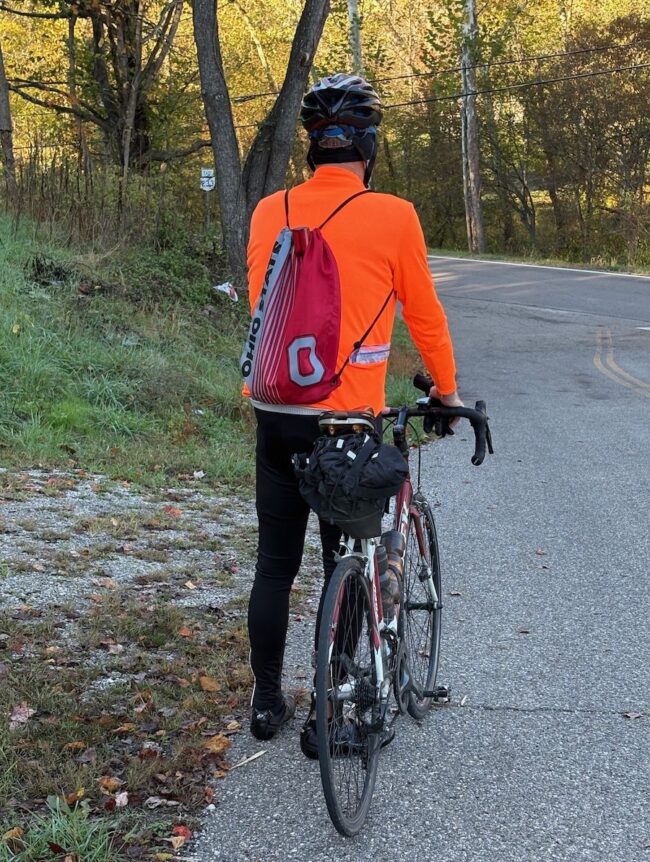
Yet another option is to acquire a small nylon bag with drawstrings such as those commonly used to hold gym clothes. Their primary design feature is the cinch-top with strings that double as shoulder straps. These weigh almost nothing and can start the ride stuffed into your jersey pocket or even spread across your chest inside your jersey as an extra layer against the wind. Later, after you’ve shed some layers into the bag, you simply wear the bag, backpack style. It’s light enough not to be bothersome. And, of course, on warm days, you leave that bag at home so it’s not a permanent part of your gear.
A suggestion I’ve occasionally heard but which I don’t recommend is to wrap removed garments around your bike frame or under your saddle and secure them with bungee cords. This arrangement is a problem waiting to happen: First, if any part of the garment or the bungee cord itself works loose, it can tangle in one of the moving parts of the bike and cause you to crash. Second, even if it stays secure, the garment is likely to become splattered by road dirt (or worse if it’s raining) thrown up by your wheel, and such stains may not wash out.
One exception to this is when one of your existing bags has an attached elastic webbing made for stuffing clothing under it. My handlebar bag has such a webbing on the front, but when using it, I’ve found that it’s best to first place the garment in a plastic bag to keep road splatter off it — plus the bag is extra insurance against some part of the clothing slipping down into the wheel and flipping you over.
Stan Purdum has ridden several long-distance bike trips, including an across-America ride recounted in his book Roll Around Heaven All Day, and a trek on U.S. 62, from Niagara Falls, New York, to El Paso, Texas, the subject of his book Playing in Traffic. Stan, a freelance writer and editor, lives in Ohio. See more at www.StanPurdum.com.

Good day.
As a road rider, I’ve tried most available solutions and found that a pack is a pragmatic and practical solution, when balancing all relevant factors.
Furthermore, a quality pack is important to a successful outcome and rider experience – and generally worth the extra money. Currently, I’m using a Camelback HAWG with the hydration bladder removed. In use, the pack is comfortable. has a close, comfortable, stable fit, and is normally, almost unnoticeable. Such a pack provides significant versatility and self-sufficiency. Success depends on a quality, well designed and executed pack, matched to its intended use, properly fitted, and thoughtfully equipped.
Personally, I’ve found that handlebar bags upset the bike’s balance and handling in ways that can be dangerous. Furthermore, anything attached to the bike (or the rider) must be attached in a way that does not allow movement of any kind.
Over the years, I’ve migrated from attaching things to the bike in various locations, to removing everything from the bike, except a water bottle, a computer, and lights.
I have a bag that attaches to my to tube. If I remember correctly has a 1.5l capacity. This easily holds my jacket and snacks. Look carefully before you buy to make sure you can still use your downtube water bottle.
the nylon backpack with the strings
or just don;t worry about the grams
they are slowing you maybe .0004%
I fold up warm-up jackets when no longer needed and tuck them inside my jersey between my shoulder blades. I find it to be very comfortable and secure.
Rather than remove arm warmers I just push them down to my wrists. You will have a bit of bulk at your wrists but I find it doesn’t interfere with bike handling and it saves room in my jersey pockets to store other items.
If you opt for the nylon bag with strings, consider adding a carbineer. You can clip the two loops going around your shoulders in front and it eliminates a lot of movement of the bag when riding. Forms a mini-harness.
Another storage spot I’ve been using in addition to jersey pockets is stuffing arm warmers or similar items in the top of my shorts on my lower back. Probably more of a challenge with bibs…
As mentioned do NOT wrap jackets or other items around your waist. I know of a rider who died when his came off on a descent and got into his rear wheel.w
I have 2 wide rubber bands (bought on Amazon) that are on either side of handle bars. Simply roll up jacket and securely put into bands – both. Never had a issue & very convenient.
I use a small-ish Arkel Signature BB handlebar bag for extra garments, which should all fit inside and not weigh too much to affect steering.
I also use a camelbak for food and extra water (self-sustained long rides) which can also carry clothing, inside or outside on straps (ie for a jacket).
Thanks for all the great suggestions
I just did a ride where I had to pull off a few different items as things warmed up. My preferred storage option is a Carradice saddle bag… either the Junior or Barley models. The bag mounts to loops on the saddle frame, as seen on a Brooks B.17. I have also used Cyclo saddle bag loops that mount to the saddle rails and provide a way to hang a Carradice bag from a saddle w/o loops. It’s a nice way to store stuff and doesn’t get in the way of anything.
Shameless plug for my company. Check out these bags which is similar in function to a Carradice bag (mentioned above) but made in the USA: https://kgear.eogear.com/collections/eogear-seat-bags
I’m an ultradistance roadi/randonneur and these bgs have served me well. Much lighter than a steel rack. The 10-liter r0ll top bag weighs less than a pound.
i favor necessary tools etc. rather than weight, tool bag and handlebar bag I’m good!!
Be sure to check out all the great bags I’ve reviewed for RBR over the years. In fact, there’s a review in this week’s newsletter for a Handlestash handlebar bag. Lots of choices for bags on your bars, frame, seat, or hydration pack (with storage). Just search RBR for lots of past product reviews.
I’ve tried most of the things mentioned and agree with the critcisms they earned. That guy with the drawstring pack has a ventilation blocking annoying thing on his pack and even in the picture you can see it is making him less conspicuous – even a semi camaflagoing..
After trying them all I took a tip from a ride buddy who was a regular Paris Brest Rider; those people have learned how to deal with this storage problem. They use a fanny pack. This makes so much sense, It rides low and doesnt detract from your visibility (may even enhance it dues to reflective material). It also means your valuables as well as clothing are attachhed to you – this is a big deal. I have had a saddle bag broken into when I turned my back on my bike. I have a couple of packs for light weight low volume summer use and a heavier pack for winter/cold riding (an Orvis fishing pack which can hold as much as you need). I have been through handlebar bags, racks, all kinds of saddle bags and I can tell you this works the best for me.