
Q & A: Stop Breaking/Bending Presta Valves

Jim’s Tech Talk
By Jim Langley
You may recall that we ran a two-part series a few newsletters ago on issues with leaks forming at the base of Presta valve stems in tubes and how to address them. Here are those stories in case you missed them: A Simple Hack To Prevent Punctures at the Base of Presta Valves and A Few More Tube Tips.
Well, a roadie named Reynaldo read the stories and sent in a complementary question that made me realize I’d forgotten an important tip. Here’s the question and answer. As always, after you see what I have to say, please share your tips in a comment for him too.
Question
Reynaldo asked, “I appreciate the articles with tips on leaks at the base of Presta valves but I have a different valve issue. My problem is that I have bent and broken Presta valves when inflating tires out on the road with my hand pump. While I try to be careful it takes a good bit of force to get up to riding pressure and quite a few pumps too. Do you have any tips for not breaking or bending these fragile little valves?
Answer
Thanks for the question Reynaldo. You’re asking about a pretty common frustration for new users of Presta valves. It’s one of the reasons a few companies have recently introduced beefier alternative valves to replace Prestas, such as the Click Valve, which we have a review of here: Rick’s Review of Clik Valves.
But, based on my experience supporting cycling events, watching and helping riders fix flats in a hurry, I think your issue probably isn’t the fault of the valve. More likely it’s that you may be using your pump wrong.
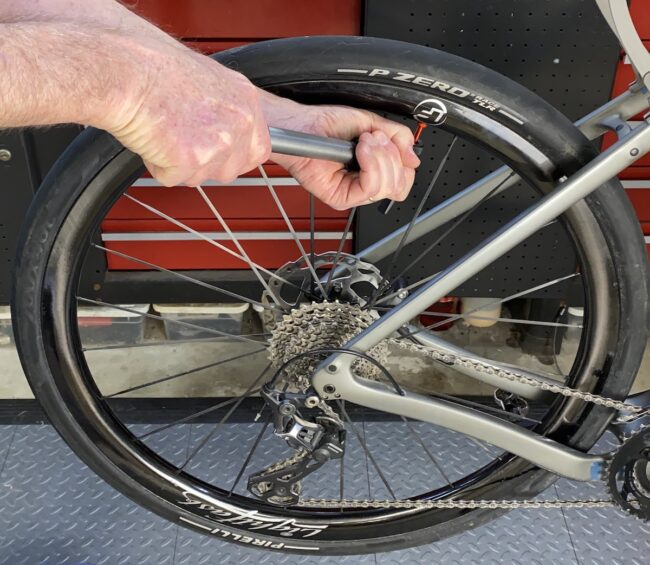
The mistake I’ve seen most often occurs while using basic pumps that have two handles, one on the end for pumping and the other at the pump head end (the part that goes onto the Presta valve). If you look at these pumps it seems completely obvious that you should grip the pumping handle with your dominant hand and the handle near the valve with your other hand and commence pumping to inflate the tire.
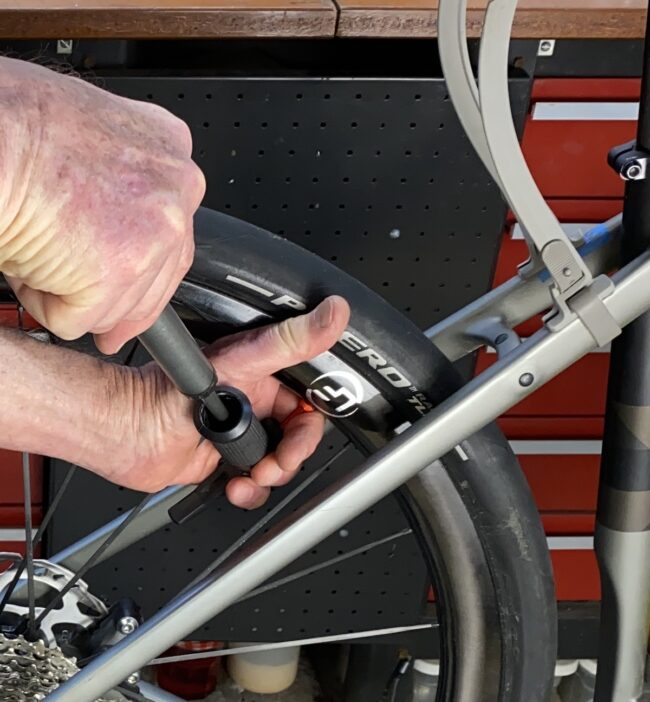
That’s the wrong way to use these pumps though because it can put excessive force on the Presta valve. Instead you always want to brace the end of the pump so that all your pumping force is going into your hand, never pushing on the valve. How you do this depends on the shape of the rim and tire, but the basic idea is to hold onto the rim and tire and maybe even a spoke to brace your hand and ensure that the valve doesn’t take any of the pumping force.
I provided a couple of photos here. The first one shows how not to hold the pump. The second shows how to hold the pump and the wheel to protect and save the valve.
If my assumption is correct and it’s the pump that’s the problem, you could also try a different type of pump. For example, there are pumps from companies such as Topeak that have flexible hoses that attach to the valve. With these, there’s no pressure on the valve at all unless you were to yank on the hose.
You might also like one of the new electric mini-pumps since no manual pumping at all is required. I’m especially fond of my Cycplus (just know that these are more expensive than manual pumps and must be kept charged).
Jim Langley is RBR’s Technical Editor. A pro mechanic & cycling writer for more than 40 years, he’s the author of Your Home Bicycle Workshop in the RBR eBookstore. Tune in to Jim’s popular YouTube channel for wheel building & bike repair how-to’s. Jim’s also known for his cycling streak that ended in February 2022 with a total of 10,269 consecutive daily rides (28 years, 1 month and 11 days of never missing a ride). Click to read Jim’s full bio.



Lezyne pumps have a flexible hose and thread onto the valve stem, so little force is exerted on the valve. However, many inner tubes ship with the valve core not fully tightened into the body, and it is not uncommon to unthread the valve core when unscrewing the pump head. I try to remember to tighten the valve core with any new inner tube that gets near my bike.
Lezyne actually recommends adding a dab of loctite to the valve core threads before you use the tube for this reason.
10+ Year Lezyne Road Drive pump user here. Their inline pressure relief valve on the hose helps but tightening valve core is also good.
Suggest that a second threaded valve nut be added and tightened as a jam nut against original new one so all core tightening torque is resolved through the valve stem…no force to the tube base!
Whether in the “shop” or on the road, do not insert the valve too deeply! I’ve found best success is, after “bleeding” it, insert the valve into the pump just past the valve cap threads. If air leaks when pumping, remove the pump and tighten the head gasket.
The advice here is right on–but if you’re pumping up an empty tube/tire outside the home shop, there’s a related way that’s almost foolproof. I have carpal tunnel syndrome, and holding the valve vs. pump as described quickly for the duration of a full pump-up triggers the syndrome. Instead:
Assuming you’re fixing a flat so the wheel is off the bike, once everything is installed, lay the wheel down horizontally, end of the axel into the ground/pavement.
On the road, ideally there’s a curb nearby– something with a bit of elevation about the height of the width of your hand at the knuckles.
Rest the rim at the point of the stem on the curb and install the pump, with the head of the pump resting on the curb = now you can pump like you’re driving a nail, with any/all force going directly into the curb, and the air safely into the valve.
Off road, no curb? Find a rock or large stick. Or, your shoe– the toe or rim of the sole works too (does require some flexibility!)
A tree can also work quite well for this technique.
Been using the Topeka Road Morph pump for many years. This pump features a hose which clips onto the valve stem, a pressure gauge, and a fold down foot pad which enables the user to use the “morph” as one would use a floor pump.
I now use a Lezyne pump with a hose, and brace my hand against the seat stay when pumping a rear tire, though I have sometimes used the “brace against an object” approach as well. Back when I used a pump that went right on the valve, I would pump the tire with the wheel out of the frame, with the wheel essentially “suspended in air” with the valve at the top and (nearly) all of my pumping force going into my hand rather than into the valve stem.
I carry one of the small electric pumps. No mess, no fuss, no banged knuckles, no stem problems, just push the button. The one I have will shut off when the correct pressure is reached.
Piston hand pumps are so yesterday. So are shop floor pumps except to seat tubeless tires. I installed Clik valves on my bikes. When connecting and disconnecting my e-pumps to the Clik valves, I get no air loss. I carry a CycPlus Pro pump in my jersey pocket with a Clik valve adapter (if needed). Its weight is about the same as the Topeak Road Morph I removed from the bike. For my shop pump, I use a Fanttik S200 Apex ($40 in-store at Costco) e-pump with a Clik valve adapter on the end of the flex hose. I can top off the pressure on my front and rear tires using the Fanttik pump in less than a minute. It is easily carried in a vehicle for road trips and can also be used to top off car tires. I still use a Topeak Joe Blow Booster pump to seat my tubeless tires. I store my bikes with the valves stems near the six o’clock position. The Clik valves have stayed clog-free of sealant since I began using them seven months ago. I won’t go back to Presta valve cores. I use the CycPlus Pro e-pump with or without the Clik valve adapter. Silca’s tests valves when connecting directly to Clik valves without the adapter found that an additional 6-7 psi is needed to overcome the spring tension inside the valve. If you have the cash, make a dash to make the change to e-pumps and Clik valves. You won’t look back.
I once had a frame pump with a removable hose to attach to the pump and the valve. For the pump’s last use (!) I was unable to inflate the tube as the hose fell out somewhere on the road…!
Wouldn’t all the valve issues be solved by a pump made to ‘swallow’ any length valve all the way to the rim, and a locking device that would brace the pump head between the two nearest spokes?? Time for the inventors among you to put my idea to work. I’ll be your first beta tester!
As many mentioned before me, a pump with a flexible hose is the answer (I use the Lezyne pumps)…
I just played catch up on a couple of these valve issues. I think a little hack I use might help. While on a trip with my 10 year old on our tandem, we flatted multiple times. It took some work to find a Presta valve tube to carry as a spare. We were lucky to find that bike shop! When we got to our destination a week later I bought some rubber grommets. I drilled out the valve holes so they could take Schrader valves, then popped in the grommets and POOF! I had my preferred Presta valves, with a soft interface, and a rim that would take schrader valves in emergencies. After we got home, I did the same thing to my touring bike rims. They make metal inserts that do the same thing, but those don’t stay in place when you take the tube out. I was lucky to find it the first time I had to change tubes on that wheel. I quickly got the pop in, stay put grommets! I can’t name a brand, but bike shops have them, and I have found some online.
Larry