Bicycle Car Rack Tips part 3

Jim’s Tech Talk
By Jim Langley
The plan wasn’t to write a third part to this series on car racks for bicycles but the great comments keep arriving and one from Phil Chavez asked an excellent question that deserves an answer. So I’ll weigh in here and then, please add your advice to Phil, especially if you disagree with what I tell him.
If you missed part 1 and part 2, here’s where you can catch up: Rick’s Car Bike Questions and Bicycle Car Rack Tips part 2.
Here’s What Phil Asked
“How about roof bike racks for road bikes? These are roof racks where you typically remove the front wheels and attach the front forks to the rack. I’ve seen where a nylon or plastic cover / bra is used to protect the bike from oncoming wind hitting the front of the bike straight on. Any experience with these? Also, are there full bike bags out there for transporting bikes on roof racks? I’m planning to use a roof bike rack to transport my road bike from the San Francisco Bay Area to northeastern Oregon in September. Wondering if this scenario is not recommended especially over longer distances. Thank you.”
My Advice
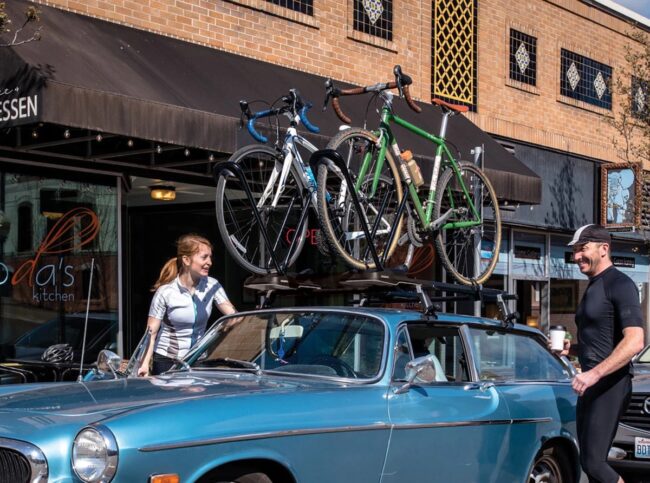
Appreciate the questions Phil. I visited the Yakima website to see their latest and you can see in their photo from their pages that they’re still offering cutting-edge roof bike racks. They’ve been making racks for toting sports gear since 1979 and I’ve used their roof racks on a couple of our vehicles.
There are different types of roof racks. But the way you usually choose one is that you find the crossbar kit that is attached to your car roof and then you choose the bike mounts that fit onto the crossbars. An example of a different type is a roof rack that attaches via suction cups made by SeaSucker.
If you already have a factory rack then you would either purchase the factory bike mounts if available or you would look for bike mounts made to fit your specific crossbars from a bike rack company. Thule is another major bike rack company with highly regarded roof racks.
Sources for the Roof Rack Accessories You Asked About
I’ve seen protective bike covers on the road so I did a little searching and found that the company Scicon makes some I once had a customer bring in his bike and tell me he needed his headset overhauled and filled with fresh grease. He said he’d been on a long drive with his bike on the roof rack and the wind had blown out all the lube. I don’t know if that’s what did it, but his headset definitely needed greasing.
A cover would protect the bike from bugs and flying debris too. Rocks coming off trucks break windshields all the time (one cracked our RV’s). I bet that in a worse case scenario a rock could damage a bicycle frame or fork too. A cover like this should help. I couldn’t tell if they are made for roof rack use or not, but you might check out the full covers by Veloock.
Would I Recommend Driving from San Francisco to Oregon with Bikes on a Roof Rack?
I’ve done that drive and it’s not that long, so I’d say that there’s an excellent chance that your bikes will travel safely on a quality roof rack, especially if they’re covered with one of these products. And so long as the rack is mounted properly and the bikes are attached correctly too.
However, I worry about everyone who uses roof racks for their bikes because it’s just too easy to forget that they’re up there.
Let me share a couple of stories to illustrate. We bought a new and beautiful emerald green Toyota Camry wagon and I immediately installed a just-as-beautiful-to-me Yakima roof rack. I was well aware that I had to be careful because my boss at the bike shop had already smashed the bikes off the roof of his car at a drive-through bank while I was riding shotgun.
I was sure that I would remember this lesson and never make this mistake with my new vehicle and rack. Just a few weeks later though, I had to bring a couple of bikes from my house to the shop. I used to do some extra work at home.
Since our car was under the carport in our condo complex I had to back out to put the two bikes on the roof. I did that, jumped back in the car, shut the door and was about to drive away when my wife hollered that the kids were late and I needed to drive them to school.
“No problem,” I hollered back. I left the car running, hopped out to go help with the kids’ backpacks and was then rudely interrupted by my neighbor in the next carport who was beeping his horn gesturing for me to get out of his way. And without giving it a second thought, I got back in my car, drove back under our carport smashing the bikes and brand new rack off the roof of our Camry.
The bikes weren’t badly damaged but the roof of the Camry was. I can’t remember, but I think it was covered by insurance. I do remember that the body shop said the roof is one of the most expensive parts of a car to repair.
After that incident I never put a roof rack on our vehicles again. But I did have one more roof rack scare. My teammate Dennis uses a roof rack on his Porsche Boxster. When he offered to drive us to a race, I was worried about putting my Cervelo up there but he assured me he’d never do anything stupid. Yet on the way to the race, even though we had checked and double checked, my bike came loose and started leaning precariously. Luckily we saw it and stopped to fix it. I forget what type of rack he had but there was an issue where it felt tight when it wasn’t really.
Warning Devices
There have been a couple of devices designed to warn you that you have bikes on top. One I’ve seen is a red flag with the words “BIKES!” that hangs down to alert you when you open your garage door (you could easily make something like this). Another one I thought might work (I think one of the major rack companies made it) is a gizmo that mounts to the hood of your car. As you slow down and the wind lessens, the lid on this device pops up and it displays a message about your bikes too, like the flag.
I’ve also heard of other ways people try to remind themselves that the bikes are on the roof. One came in from a reader of Bicycling Magazine when I was an editor there. I thought it was pretty clever. The tip was to always put your garage door remote control inside one of your bike gloves as a reminder. That wouldn’t have helped me with the carport or my boss with the bank drive-through.
Due to how easy it is to forget about the bikes, I have a hard time recommending roof racks and would instead say to look into having a hitch installed on your vehicle so that you can carry bikes on a hitch rack.
Your Turn Readers
Sorry for such a negative take on roof racks Phil. I’ve asked readers to share their opinions of roof racks. There may be some ideas on how to remember the bikes. And maybe some recommended roof racks and products for protecting them during the trip too.
Jim Langley is RBR’s Technical Editor. A pro mechanic & cycling writer for more than 40 years, he’s the author of Your Home Bicycle Workshop in the RBR eBookstore. Tune in to Jim’s popular YouTube channel for wheel building & bike repair how-to’s. Jim’s also known for his cycling streak that ended in February 2022 with a total of 10,269 consecutive daily rides (28 years, 1 month and 11 days of never missing a ride). Click to read Jim’s full bio.


I too have Yakima roof racks that I have not used in about 25 years as I prefer to keep the bikes inside my vehicle. I never had a problem with the racks….maybe because I didn’t park in the garage.
I did like to put the bikes on backwards because I felt that the strap for the rear tire was less likely to come loose than the QR for the fork.
IMO roof racks are a tried and true method to transport lightweight bikes. I would not want to lift my full suss MTB onto the roof with my 60+ year old back.
I have given away a number of roof racks, thanks to Subaru. In about 2009-2010, they changed the roof rails on the Outback into something that is pretty much useless!
I used a Yakima roof rack on my Jeep Cherokee for many years with one close call with my garage. I traveled cross country carrying a tandem and two road bikes a few times without any incident but I certainly understand the worry about accidentally driving under something. It also limits where you can park sometimes. Even though a tandem is heavy to get up onto the roof, it was the best way to carry it until I found a Draftmaster hitch rack. Now I use a tailgate pad for my truck and a Thule platform rack for my car and love them both.
IMHO, roof racks are the most secure and convenient in that they take the bikes out of the way for vehicle access. Cons: expensive, overhead obstacles, difficult to load. My wife and I have been loading a tandem on a 4Runner roof rack for over 10 years. We have a system, and when well meaning gentlemen friends offer help, I politely decline “she’s got it”. Bike Bra’s are great for long drives and do keep the bugs off. I would not use a full bike bag or sock as the drag would be incredible. Drag and noise are noticeable with any roof mounted bike. Before the roof rack we had a mini van. That is the best bicycle transport solution. I bolted three fork mounts on a small piece of plywood, and I could back a tandem and two full size bikes into the van. Secure, safe, clean, and cheap.
Roof racks are awesome when you are young. Although relatively young? I happily drove my Prius into the garage with my custom painted to match the Prius Cervelo on top. Screwed up my handle bars and thoroughly trashed my car roof. Pretty much stopped using it after that. Back to age hefting the bike up onto the roof can be troublesome as your shoulders get stiff. I have two Dirt bags made I think by a Canadian company, purchased 20 years again. I no longer use them but if you would like one, or both and will pay shipping I would be happy to give them to this reader. Feel free to give my email. I live in Santa Clarita.
Most years I participate in a ride called the Tour of the North Shore that starts in Evanston, IL. Every year, at least one vehicle with roof racks tries to park in the underground parking lot. Does not end well!
I have used roof racks and hitch racks. I prefer Hitch racks if I can not fit bikes inside car, as I think they are more aero and bikes are protected unless you encounter rain.
I bent an old spoke into a shape of a bike and put in on a leather shoe lace. I put it on my mirror whenever I had bikes uptop so I would not pull into garage when I got home. Just for added security I put something in my garage to block the spot (garbage can) as one time I remembered just before bike would have hit garage even with the bike hanging from my mirror.
I also used the block entry to the garage with the garbage totes when I used roof racks. This always worked for me. I have since switched to a hitch mount (1UP USA) for easier lifting and better aerodynamics. My wife and I once took a road trip where our routes diverged before the end so we had two essentially identical cars (both Ford Escapes with the same engine/transmission), one with two bikes on the roof and one without. The car with bikes on the roof used 10 – 20% more fuel travelling the same route at the same speed.
I have Thule and Yakima roof racks bought before I had kids and was driving smaller cars. I use fork mount trays and separate wheel carrier. Once drove through a parking deck and hit my bike on a bar that hung from ropes at the entrance to warn people of the low ceilings, bent the tray, no damage to the bike or car and the rest of the parking deck height was fine. Once, during RAAM, my crew told me they had pulled the vehicle into the shade of a tree in Arizona and the branches hit the bike, again no damage. Driving from VA to CA they were inside the car, but the bike I wasn’t riding at the time was on the roof on the way back. Never had a problem with a bike coming loose, but almost lost a wheel once, so I always throw a strap around them. Since kids and minivans, the bikes ride inside, it’s just too much of a PITA to put the roof rack on and easier to roll them inside without taking wheels off.
We put the bikes on the roof rack, attached at handle bars so tires were up on my friend’s Saab. Great set-up. Then, after our ride, he took me to my apartment going through the tunnel under the tracks and of course, the inevitable happened. I felt the car slowly “depress” and thought “how odd”. No noise, no bumps, no problems.
I opened the window and looked up and saw the wheels turning as they were in contact with the roof of the tunnel. Smoothly, we pulled out on the other side still with all in perfect shape. Got a good laugh.
I know riders whose bikes have required orthopedic surgery after a roof rack event. I never used one. My now-gone Honda Element was very convenient for carrying bikes standing upright inside the car.
Watched a friend drive under/into a portico at a rental house with his bike on top of the car. Not a good way to start a weekend cycling getaway! Thankfully, the LBS was able to get him on the road fairly quickly.
Also had the same experience as Jim with a friend’s roof rack: Got home from a ride to find my bike leaning at a precipitous angle. Just incredibly lucky it didn’t come off on the highway.
That’s not to say hitch racks are fool- (or idiot-) proof, either. Traveling to my very first organized ride many years ago, I witnessed a bike come off a hitch rack on the Interstate. It did not survive!
I have a hitch rack used only if I’m riding with my wife or someone else and need to carry multiple bikes. Otherwise, my bike rides inside!
I would need a stepladder to get my bike on top of my vehicle, so I use the “stash it in the back” method. But I used roof racks in the past and I would put the garage door remote in the glove box when there were bikes on the roof so I wouldn’t go on autopilot and drive into the garage. We also had a house with a carport, so I would roll the trash can into the center of the carport so I couldn’t drive into it. That worked well, except I had a well-meaning, elderly neighbor who would roll it back into place, thinking he was being helpful.
Yep, too many variables too deal with, back seat of my truck or rear rack on my car….makes it much harder to do something stupid
I just learned something interesting and important about SRAM AXS electronic shifters: They can be motion-activated, meaning they turn on if the bike is bumped or vibrates. This means that if you carry an AXS-equipped bike on any kind of car carrier, the vibration of the transport may be constantly turning the derailleurs on, using up battery power. In fact, the AXS instruction manual states: “Remove the SRAM derailleur batteries and install the derailleur battery blocks when the bicycle is being transported or not in use for long periods of time. Failure to remove the battery could result in unintentional actuation and/or battery depletion.”
I don’t know if this is true for other brands of electronic groupsets, but SRAM users should take note.
I learned that too when I took my MTB out of my truck after driving 8 hours and immediately got a low battery warning on my bike computer. Later on the same trip I road away from my truck with no battery in my RD. Luckily that ride started out flat and not with a big descent.
I sent a suggested to SRAM that they develop a Transport Mode as follows: use the AXS app to put the system to sleep and wake-up by pressing the button on the derailleur.
I’m sure roof racks are great but I would NEVER use one because I know what would happen. Once after a ride I leaned my bike in front of my Ford F350 and even said to myself “don’t do it” but assured myself only an idiot would run over their bike. After checking emails and text messages I took of my cleats and jumped in my truck and drove off….crushing my carbon fiber Trek 5500 that was in mint condition
It all depends on what you need/want re: transporting your bike. Inside is best, but not always practical depending on what else you have to transport and how. Roof racks decrease gas mileage but allow you to tow (if that what you need to do) other item behind you and still get into the back of your vehicle without unloading your bike(s). Bikes can get thoroughly bugged on top unless you put on a “bike bra” (I’ve bought several different brands, best so far is Xport – but they all get beat up). Back racks also have their own issues but are certainly easier to load, but bikes get trashed from road muck, and not great when you have to get stuff out from the back of the vehicle.
ALWAYS you need to be aware … JUST SAYING
Regarding the bike cover, I used a product in the past called a B String. It attaches to the seat and covers just the front profile of the bike. It gets filthy but keeps all those bugs and crud off the bike. I could not tell any difference in the wind resistance or handling of the car when used.