The Long Story of Lowering the Gearing on My Old Road Racing Bike

Jim’s Tech Talk
By Jim Langley
Woo-hoo! The 2025 Tour de France is underway! If you’re watching, I hope you’re enjoying it as much as I am. The race hasn’t gotten to the high mountains yet, but during last year’s edition, I noticed that some of the guys were riding cassettes with 36-tooth largest cogs for the climbing stages.
I immediately thought of the gearing on my road race bike, which has a 28-tooth largest cog (with a 39-tooth small chainring) for a lowest gear of 37.6 inches (39/28 x 27 = 37.6). That lowest gear served me well when I was racing regularly as an age-grouper (2005 to 2018).
That was over seven years ago. I’m not as strong or as fit as I was then. And at 72-years of age with bad knees, I likely won’t ever get back there. So, when I saw those giant cogs on pro bikes, I decided it was time to get one for my bike too.
The Bike I’m Upgrading
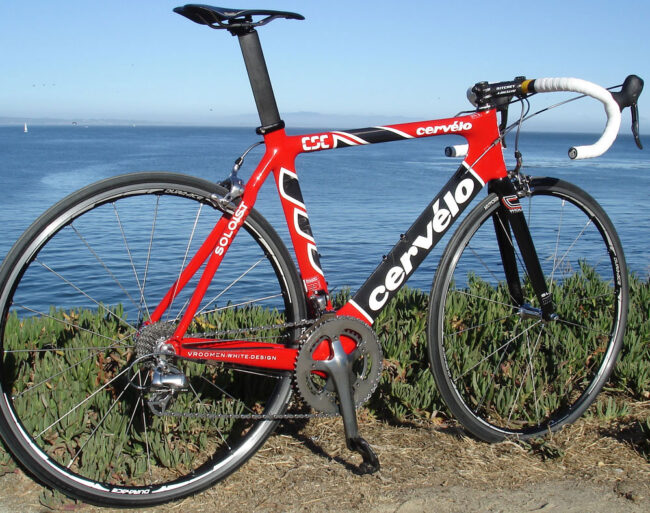
My race bike is a 2007 Cervelo Soloist Carbon, the same bike Fabian Cancellara rode. Cancellara (nicknamed “Spartacus”) won Paris-Roubaix in 2006, 2010 and 2013. He was famous for riding away from his competition and the Soloist Carbon is an aero road bike, which is perfect for this. I enjoy breaking away too and found that the bike let me do it a few times successfully too.
Why not just buy a new road bike with modern low gearing?
You might wonder why I wouldn’t just buy a modern road bike, since it would be equipped with modern lower gearing too. The answer is complicated so please bear with me. One of the main reasons is that I really like the ride. It was a highly regarded aero carbon frame in its day because it was a great combination of stiffness for laying down the power, compliance for comfort and control, with optimum aerodynamics for free speed.
It’s also equipped with tubular wheels and tires (also known as “sew-ups” since the tires are sewn together around the tubes inside).
The wider clincher tires available today – and what would be on a new road bike, can be run at lower pressures for a wonderfully smooth ride. While the Vittoria tubular tires on my Cervelo are only 25mm wide though, they too provide a super nice ride because of their round profiles and full casings. They can also be run at lower pressures since they’re not susceptible to pinch flats.
Other Reasons Not to Go with a New Bike
Also, and another reason this bike is a keeper, is because the Bontrager Aeolus carbon aero tubular wheels on it are significantly lighter than anything available on modern bikes. This helps keep the overall weight of the bike lighter than most modern race bikes too. [NOTE: you can just see these wheels in the photos of the makeover below.]
I do hope to compete again one day and one of the things you learn quickly lining up against the top age-groupers out there is that the fastest guys are on the fastest bikes. And when it comes to climbing – the thing that decides many road races – a lighter bike is a faster bike.
Sky High Prices
The other two reasons I’m not buying a new bike are the inflated prices and very few choices for rim brake bikes. When I bought the Cervelo it was around $3,000. Keep in mind that that $3K bought me almost the same bike Cancellara was riding.
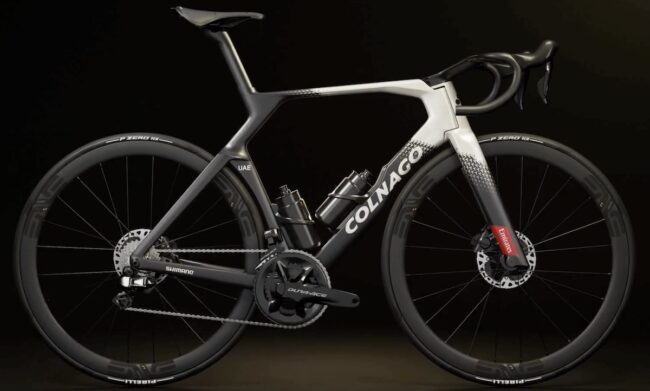
Looking at two bikes that would make my list to replace my Cervelo, Specialized’s S-Works Tarmac SL8 would run $12,999.99. And a bike like Tadej Pogačar rides, the Colnago Y1RS, sells for $14,664 (photo courtesy of Colnago).
Sure, I could buy one of these bikes, but I already own a bike straight out of pro cycling; it’s just an older model. So I don’t think I can justify the expense just for a new version.
Too Much Brake
Lastly, the reason I’m fine with the rim brakes on the Cervelo is because they do everything brakes are supposed to, they require barely any maintenance and they save weight compared to disc brakes.
Beyond that and maybe more importantly, I think you can make the argument that disc brakes are too powerful for road racing. Just today for example, in Stage 7 of the Tour, there was a weird crash at the back of the pack, maybe you saw it? NBC was kind enough to put up a clip of it here if you want to watch: https://www.youtube.com/watch?v=10_zgt1UNOA
What happened was a few riders collided and went down. But then a trailing rider who looked like he could avoid crashing, since he wasn’t next to other riders, hit his disc brakes hard. Instead of this slowing him down, it locked up his wheels and he skidded sideways and got launched off his bike. He landed in a heap on the road. And, this was a professional cyclist who surely handles a bike better than I’ll ever be able to.
Massive braking power like that makes sense for mountain and gravel riding, but I’m not convinced it does for road racing. The problem is that the contact patch on road tires, which is getting a little larger, is still small making it too easy to lock up the wheels when you have too much brake.
The Gearing Upgrade
Now that you know how the decision was made, it turned out to be only slightly complicated to upgrade my old Cervelo to gearing built around a cassette with a 36-tooth largest cog for a low gear of 29.25 gear inches (39/36 x 27 = 29.25).
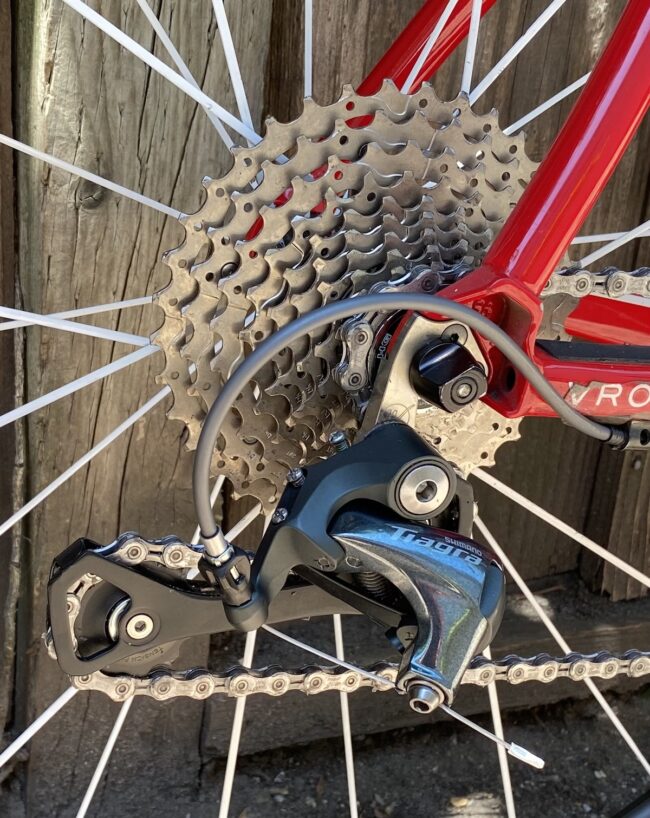
For parts, I needed an 11-36 10-speed Shimano cassette. Since my bike had older Shimano Dura-Ace components, I also needed a new rear derailleur that could handle the 36-tooth cog plus an STI shift lever that could shift the new rear derailleur. Plus, I had to buy a new Shimano 10-speed chain since it needed to be longer than the chain on my bike.
The issue trying to pair older Shimano shifters with new Shimano derailleurs is that the pull ratio doesn’t match. If you try it, what happens is you operate the lever and the chain does not sync with the cassette cogs.
Shimano Tiagra is Nice Enough for Me
I decided to go with the least expensive option, which was a Tiagra rear derailleur and STI lever. That’s a downgrade from Dura-Ace, but to me, the Tiagra components look fine and they perform nicely too.
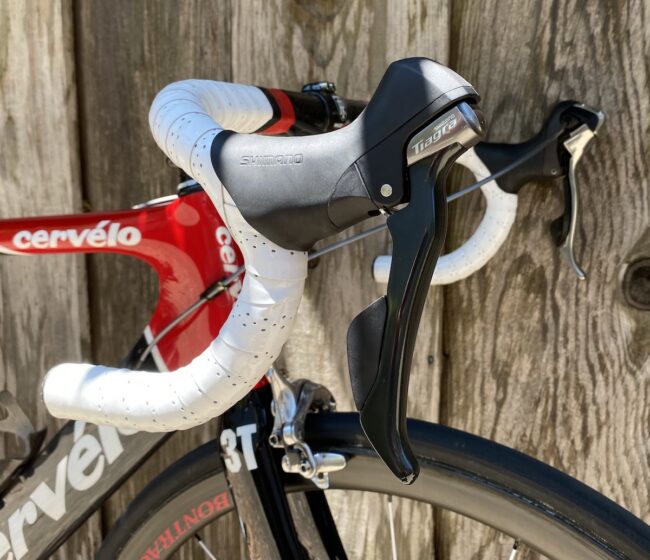
In the photos you should be able to see that with the Tiagra STI lever in place on the handlebars, the bike now has a left Dura-Ace lever and the new right Tiagra lever. The OG Dura-Ace lever has the cable housing exposed. With the Tagra, the housing is hidden beneath the bar tape.
Also, the old and new lever and rubber hood shapes are slightly different. This concerned me. It definitely doesn’t look as clean as matching levers. I think I’ll be able to get used to how it looks. Luckily I don’t notice the difference in the levers much when I’m riding.
I do notice that the shifting is still crisp, accurate and quiet. And the new lower gear makes me smile every time the road goes up. My 2007 race bike is back on the road and all it took was about $200 worth of parts.
Your Turn
Please weigh in with your comments about the Tour, my gearing choices or my takes on the pros and cons of modern road bikes. If you’ve lowered your gearing that would be fun to learn about too.
Jim Langley is RBR’s Technical Editor. A pro mechanic & cycling writer for more than 40 years, he’s the author of Your Home Bicycle Workshop in the RBR eBookstore. Tune in to Jim’s popular YouTube channel for wheel building & bike repair how-to’s. Jim’s also known for his cycling streak that ended in February 2022 with a total of 10,269 consecutive daily rides (28 years, 1 month and 11 days of never missing a ride). Click to read Jim’s full bio.


I also just upgraded my road bike with a 10 speed 11-36 tooth cassette. I have Shimano a 10-speed 105 group set and the rear derailleur is the long cage version. However, Shimano do not seem to make (at least in Europe) a 36 tooth road cassette. After much searching on-line, and without really being sure it would be compatible, I bought a Shimano Deore cassette to try. It turns out that it works just fine as a replacement to my existing cassette.
Thanks for sharing your conversion Adam, appreciate it.
Jim
Good advice. My older Torelli (2007 steel) was revamped with an 11×30 11 speed cassette and a 48×31 GTX crank. It needed a GTX front derailleur as well. It still has Shimano 600 brakes. Disc brakes are probably better in a downpour, but not worth a whole new bike.
Nice article. I am just a couple of yrs older than you (75,) and have been riding since 1976 when I had a 52/42 chainring and a 14/17/21/24/28 freewheel. Had to switch back and forth on the chainring to catch the right gear ratio. Also the 42/28 only gave me a 1.5 low ratio. Now, 49 years later, I am lucky enough to have a real nice bike in FL and another in WI. SRAM red groupo. I seldom use lower gearing in FL than 46/24. Almost never use my 33 small chainring. In WI, I had 46/33 chainrings, with 10-28 12 cog cassette. Last year I changed the cassette to 10-33. We have a fair number of hills at 10-14% incline. I could muscle up with the 33/28, but on longer hills was burning a match. With the 33/33 combo, I am still pushing hard, but can keep a cadence of 70+ going. I suppose in another couple of years I’ll be looking to change the granny gear to 36. I don’t see an e-bike in my immediate future.
Thanks a lot for sharing your gearing choices Bradley. I’ve ridden a good bit in Florida and Wisconsin and your choices sound perfect from what I recall. Thanks again,
Jim
Further to my previous comment, I too looked into buying a new bike. However, most of the new bikes I looked at come with exactly the same gearing as on my old bike. So instead of spending thousands on a new bike I opted for a new 30 Euro cassette instead 🙂
Good choice Adam😊
Thanks!
Jim
I was/am in the same predicament with my 2002 Seven which I never raced on but I know “low” gears from my racing days (42×24 not so low but it did the job in the Midwest).. just be glad you aren’t a campagnolo person as your options would be even more limited. I am downgrading my chorus derailleur to veloce to get a 29 for my lowest gear to tour in New Hampshire next month.. I hope it is good enough. The lowest gear I have ever had is a 39×25. Btw it was not cheap but a heck of a lot more affordable than a new bike. Why would I ever replace a bike with 150000 flawless miles on it???
I am a great proponent of low gears. When I got my first bike, a Peugeot px-10, the man who sold it to me put it in its lowest gear and told me not to shift until I could spin at least 80 RPM. 54 years later, I realize that it was good advice.
However, I am curious as to why you didn’t opt for some smaller chainrings, which would lower your gearing and save weight. Was it due to limitations of the front derailleur? Shimano used to make a nice Ultegra triple chainring, and that has worked great on my old LeMond Victoire for the last 20 years.
did you need new back derailleur?
why not get compact crank first or also
?
Jim, did you consider upgrading to a 11/12 cassette when getting a lower bottom gear? I’m in a similar position with a 34 front, 28 rear as my lowest gear.
Jim, you didn’t say whether you considered other Shimano derailleurs from the line.. It’s more complicated than it used to be, because they’ve dropped out most good mechanical shifters. 10 years ago when I bought my road bike I could choose Ultegra, for great shifting at a reasonable price. Still riding it today with no failures after 20000 plus miles.
It’s currently set up with a DA crankset, and am Ultegra RD. I have no preference to what I might upgrade/downgrade to. Tiagra/105 RD would be fine. I have an old set of 10 speed DI2 TT shifters which would be cool to switch to, but that might overly complicate things as well. It’s an Argon 18 E-117, with a 10-speed rear mech. derailleur.
I am a 78 year old rider with bad knees and declining cardiovascular capacity. I ride a Bianchi Infinito carbon bike with Shimano Ultegra groupset. The front is a 50/34 and rear is an 11 speed 11/34. Good for climbing but I wanted an even lower gear. My LBS is putting on an 11 speed 11/36 SRAM cassette. Everything I could determine and my mechanic agrees, this should work without having to change the rear derailleur. I’m looking forward to how it performs on the hills.
I agree with your appraisal of rim brakes on road bikes. They are far from obsolete. The industry has worked overtime trying to herd us toward discs, but the only real advantage is the ability to use wider tires. If you can fit 28c on your rim brake bike (which fortunately I can), you’re all set. Plenty comfortable, plenty of stopping power, and lighter to boot!
I was at a somewhat similar crossroads. Invest money in my old bike or buy new.
After looking at a new bike with disc brakes and electronic shifting, I saw that the overall weight would increase approximately 3 pounds!
For somebody who’s always been weight conscious, at least for my bike and it’s parts, the idea of getting a new bike that is almost 3 pounds heavier, made an easy decision for me to stick with what I have and just update some of the parts.
On a sidenote, I ended up upgrading my old ram red crank set to a Ultegra with shorter crank arms, 165.
It amazes me how you are down-to-earth and intelligently address issues like ordinary everyday rider, not like elite or full-of-cash biker that is not representing the mass. Thanks for your work all these years. Good luck on your next races !
I like it! I’m looking at making my tri-bike into a 1X set-up with a 36 tooth rear, and I was wondering how the standard TT shifters would respond to that (re: the pull ratios). I like that you’re still riding your “old” frame. Beautiful bike!
I recently did this to my Bridgestone RB-1. It is working fine so far and is a big help to my recently replaced right knee. My largest back cog increased from 28t to 36t, and I got a longer Shimano 105 derailleur to replace the Shimano 600. I love the ride and this mod should last!
I changed my Y-Foil from 53-39/11-30 to 53-39-26/11-34. Bring on the hills!
PS I have 44 years of experience as a 29-year-old.
On my gravel/cross bike that’s set up with 10-speed 11-36 cassettte and road STI shifters, I’m using 105 ST-5700 shifters and an XT RD-M772. That’s technically a “9-speed” rear derailleur, but that simply means that it has the traditional cable pull that’s compatible with almost every MTB group through 9-speed and road groups through 10-speed (except Tiagra 4700). There are plenty of other “9-speed” MTB rear derailleurs that would work – the M772 just happens to be one of the newer Shadow models so makes the bike look more “modern.”
With a 10 speed cassette you can use 10 speed Ultegra road shifters (shifter AND brake cables routed along the handlebar) with a 9-speed (!) Deore mountain rear derailleur. The 9-speed mountain Deore provides the range for a 11-36 cassette with the matching cable pull for a 10-speed road shifter The 10-speed Deore RD has the wrong cable pull for a road shifter, and do not use Deore LX because whereas the Deore has a cable adjuster on the derailleur, the LX does not, and they perform the same.
And be extra kind to yourself and switch to a 34-50 crankset! That combination will get you to age 80, at which time you can get a 32-48 or possibly a 30-46. Wouldn’t that be useful – to age 100! And beyond!
For my tandem I use 3 X 10-speed Ultegra shifters on a tandem with a 11-36 SRAM cassette, 9-speed Deore RD, and, get this, a 24-39-53 crankset (originally a 30-39-53). The 24-36 low gear ratio is 0.75, about as low as is feasible as one spins out at about 5 mph uphill. At 77 we need the low gear. When on the 3rd cog it upshifts to the middle ‘ring OK.
Ive swum against the tide a little bit. Ive recently gone from a campy 12 spd mechanical (50-34, 10-28) to a wireless SRAM groupset (46-33, 10-36). It was a combination of a great deal on a new groupset versus replacement of multiple worn out campy parts together with a gearing range more suited to climbing and managing power loss as the years go by! PS love an old bike upgrade too.
When I was 20, I came up with a formula for what the low gear on your bike should be:
70 minus your age
Now that I’m 72, like Jim, I know this formula has its drawbacks. But I’m thrilled to see the go-fast boys embrace lower gearing instead of grinding on the pedals.
••••••••
Another thought: I looked at the crash video a bunch of times. I don’t think you can simply blame the crash on those brakes. It looks like the rider had already turned sideways as he was braking, Also, if you haven’t practiced extreme braking on that particular bike with its brakes, so you have a feel for how to avoid crashes, you’re not a good bike handler.
For even lower gears, I have an Ultegra 10 triple (30 tooth small chainring) on one bike with a Deore 9 RD and don’t change the B screw or chain when switching from 11-28 to 11-36 cassettes. On a Di2 11 bike, I have a 34-50 crankset with 11-32 for local use. In the mountains, I use an 11-42 cassette with a Road Link and a 2-inch longer chain, for a gear marginally lower than I have with the triple on the other bike. I have to adjust the B screw when switching cassettes to avoid having too much slack in the chain when using the smaller chainring and small cogs.
I agree with everything you wrote Jim.
Thought the same thing when I saw the crash in the tour,( you notice the commentators didn’t mention disc brakes 🙂
I have a Moots Vamoots cr 2012. When Shimano stopped supporting high end mechanical I went back to Campagnolo.
My bike now has 12 speed Record 50-32 x 11-32 mechanical rim brakes, Campy bora wto rim brake wheelset.
I love it. I weighs 16.5 pounds and descends faster than all the friends carbon aero bikes I ride with.
Keep up the good work!
Save the mechanical group and rim brake bike ! ( or hoard them )
Apologies for the slow reply everyone. I was away camping and without reliable internet. Now that I’m home I want to thank you for the great comments. In my Tech Talk next week I’ll answer the questions you asked about my gearing choices and highlight some of the smart ways you have lowered your gearing and even lower than mine.
So please look for that next week and thanks again,
Jim Langley
I’m still using 53 39 and 13 29. I’ve built up musculature and improved cardiovascular fitness. I’m good up through 12 %, but 16% has me dancing on the pedals. I hardly ever see 16%. I’m much better at 75 than I was at 65 after hip surgeries.
That’s awesome that you’re fitter and riding stronger at 75 than at 65 Dana! Congratulations and thanks for sharing!!
I’m 73yo and a minimalist trainer. Have used a triple for some years now starting with a 46/36/26 with close ratio freewheels and now cassettes. Presently using a 44/32/22 with a 9-speed 11-28. I spin, not muscle up the mostly mountain roads in our city and never enjoyed cycling as much as when I started using low gears,
I have a touring bike that was initially set up with Force 22 50=34 chainrings and an 11-36 cassette. I had my mechanic swap the cranks for an FSA 46-30 and have been wishing it had been an option when I bought the bike. The Force 22 FD works just fine with the 46-30.