7 More Reasons To Give Time Trials A Go

Jim’s Tech Talk
By Jim Langley
In last week’s newsletter, there was a helpful article titled Why Should a Fitness Rider Do Training Time Trials? In the story we provided four excellent reasons cyclists working on fitness will benefit by riding training time trials.
I got into doing training time trials put on by the Putney Bicycle Club in Vermont shortly after moving there in 1978, and they definitely boosted my fitness. I enjoyed them so much that I continued to look for and compete in time trials after we moved to California. As I improved I started racing in the Northern California Masters and USA Masters Nationals time trials and did okay. I finished 10th in the 55+ USA Nationals on a tough course in Bend, Oregon and then won the 65+ NCNCA District Championship (Northern California Nevada Cycling Association).
From my experience racing against the clock, I’d like to share some of the other reasons – besides fitness – for doing training time trials. Here in Northern California the time trials start in about a month so there’s time to prepare if you’re interested.
1. They’re fun.
While time trial courses can vary in distance and terrain, a typical format is an out-and-back 10-miler on a flat or slightly rolling road with a turnaround 5 miles out. For safety, most organizers choose roads with little traffic. In official races the courses are often closed to traffic entirely. This means that apart from the other riders (who you’ll only see if you pass them or they pass you), that you have the road almost all to yourself. It’s a blast hammering along, head down, arms tucked in, monitoring your watts and heart rate trying to get every bit of speed out of your bike and body going for a new personal best.
2. They’re relatively safe.
As you know, it’s possible to crash on any bike and at any speed so you still want to be careful. But since time trials are mostly done on your own, you don’t have to worry about the risks of being elbow-to-elbow in a group of riders. If you can avoid road obstacles and make the turnaround without crashing, you should get home safely.
3. They’re motivating.
Once you’ve posted a time on a certain course, you have a mark that you can improve on as you get fitter and faster. And you can compare your results to the other competitors to see how close you are. Plus, when you’re racing, there’s the excitement and motivation of trying to catch the riders that left the starting gate before you and to stay ahead of those trying to chase you down!
4. They’re less expensive.
Most training and club time trials are put on by a club rather than a large organization. That helps keep the costs down since you don’t have to purchase a racing license and pay hefty registration fees. And because it’s a low key event not one that takes a lot of infrastructure and support to run that has to recoup their costs. For example, here we have the Beat The Clock Time Trial series, which is a fundraiser to fight cancer. To enter costs about $40, which is less than entering road races here and a LOT less than what it cost to race in the Sea Otter Classic back in April.
5. They’re a totally different vibe than at group races.
If you’ve raced the road or even joined large group rides, you know how competitive and aggressive it can be in the pack of riders. Time trials aren’t like that. Usually there are far fewer riders and most are there competing against themselves, not you. Also, some events can have categories for men, women, tandem teams, paracyclists and handcyclists, which keeps it interesting. Each category has its own start time so you can usually watch the other events before or after yours which is great if friends are racing too.
6. They’re challenging and fascinating.
One of the best things about time trialing is that there are many ways to improve. Getting fitter will help. But, analyzing the courses and understanding how to get the most out of your fitness, can help almost as much. Talking with other racers before and after time trials you can learn what strategies they used or learned that day, and that intel will help you the next time.
7. They’re about the tech.
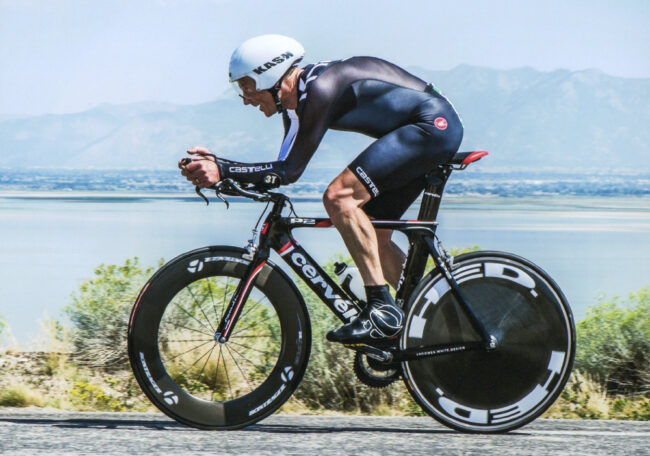
Some time trials have what the Beat The Clock series calls a Merckx style category, which is for traditional road bikes – no aero equipment allowed. But whether you choose to race a regular road rig or a slippery aero sled, it’s hugely satisfying tweaking and fine-tuning your bike and kit to try to get the most out of it on race day. For example, in Vermont, back before aero bikes, we would replace the grease in our hubs with oil, run the lightest wheels and tires we had and slam our stems to get as low as possible. And, if you get into today’s time trial bikes and equipment, there’s no end to what you can try (and spend a small fortune on!). You can see what I mean in the photo that shows my total aero setup 10 years ago at the Nationals in Antelope Island, Utah.
To find time trials in your area, try a local cycling club or ask at your favorite bike shop. USA Cycling has a club finder on their website here: https://clubs.usacycling.org/clubs_search.
It would be interesting to hear from others who enjoy time trialing and learn about more time trials around the country. If you have time trial information and tips to share, please post them in a comment. Thanks!
Jim Langley is RBR’s Technical Editor. A pro mechanic & cycling writer for more than 40 years, he’s the author of Your Home Bicycle Workshop in the RBR eBookstore. Tune in to Jim’s popular YouTube channel for wheel building & bike repair how-to’s. Jim’s also known for his cycling streak that ended in February 2022 with a total of 10,269 consecutive daily rides (28 years, 1 month and 11 days of never missing a ride). Click to read Jim’s full bio.
I’ve never understood the point of uber$$$ aero time trial bikes in professional or amateur racing. Isn’t the entire point a test of the participant’s fitness, not how much money you have to spend, or just how compactly genetics allow you to fold your body into an uncomfortable aero shape? Add to that the greater safety risk of a more unstable machine with compromised visibility.? Ask Egan Bernal or Chris Froome about that. Let’s not even get into the waste of resources to build such a special purpose bicycle that has no other function for cycling enjoyment. If you are a supremely gifted world class athlete, and you want to experiment with technology for an hour record – fine. But the imposition on competitive cycling as a whole (never mind triathletes) of this bastardization of a bicycle is just so pointless. Who cares if you win a time trial at 28 mph on a road bike, or 31 mph on some five figure barely stable menace. Is this supposed to be a test of technology, or athletic ability?Stupid, stupid, stupid…
Thanks for sharing your point of view Michael. The way I look at it is simple. There are rules for racing. For some time now the rules allow aero bikes. This means that anyone who lines up to race and wants to be competitive needs to be on an aero bike – unless they want to lose.
It’s super interesting and enjoyable to build an aero bike too. I took the budget approach and bought a Cervelo P2, which was about $1,500. I then upgraded parts to make it more and more aero. It took many revisions and some customization to get the aero handlebars just right. It took lots of experimentation on coast-down tests to determine which aero wheels, tire & tube combinations and helmet would provide the most aero advantage. And I tried multiple crank lengths and chainring shapes to try to optimize my cadence and spin – you can see the oval chainring in the photo. When you get it right and add some free speed to the bike, it’s so satisfying. At the top level races are won by hundredths of a second so it all counts.
And to answer your question “Who cares if you win a time trial at 28mph on a barely stable menace?” I do!
I haven’t competed on my aero bike in years, but I definitely cared about winning when I was. I couldn’t hit 28mph for 40K, but I did top a 27mph average speed for a silver medal in the 55+ CA District Championship and I’ll never forget that ride or standing on the podium next to World Champion 55+ Masters Rob Anderson.
Thanks again,
Jim
Figuring out your body positioning and getting as aero as possible is also a fun challenge.
Personally , I’ve never done a TT race, don’t plan to, and I’m bad at it. But I do them for training, which I think they’re great for. Not only that but I think they’re highly motivating. I have no reason to do them anymore, now that I don’t race (I don’t do intervals other than hill repeats). But setting up a TT segment on Strava (can be public or private or find one already there), and racing against yourself is a great challenge—as Jim suggests—you against the clock. The other part I like about TT-ing is trying to to figure out the right heart rate (or watts); it’s a challenge of focus and willpower to keep it there—not go too hard, not go too soft.
Sure, it’s a niche activity for amateurs that have the bikes (I don’t), but to each his own! Have fun, Jim!
I’ve ridden over 700 time trials since 1997. While I ride a Trek Speed Concept I can say that in the past I rode just as well on some pretty inexpensive set ups. About 80% of the aero equation is getting good position. After that, invest in a skinsuit, aero helmet and shoe covers. A good set of wheels would also be a great investment but they don’t have to be $3000+. You can find a good read disc wheel and deep rim front on the used the market if needed. The high end frame probably gives the least return in added speed for the money invested.
I was likley never going to win a lot of crits and road races but I’ve won over 120 state TT titles (some USAC and many NSGA) and four NSGA national titles. At 63, I still love training and competing in TT’s.
Thanks for the great comment and sharing your tips for building a time trial bike Peter! Also, huge congrats on all those state and national wins, super impressive – bravo!!!
That’s actually another great point about time trials: that there are time trial specialists – people who just know how to do it and keep winning. At the USA Masters Championships, these athletes show up and I always found it so motivating to see them ride because it’s beautiful to watch and interesting to analyze their positions and equipment hoping to learn something maybe even I can use at some level. The same holds true watching the pros on TV.
Thanks Peter and keep on winning!
Jim
You also! I enjoy all the articles!
Jim, I note that I also rode the National TTs in Bend Oregon and Utah (Antelope Island). As you said, it’s a very different vibe than the road, crit and circuit races, especially at the start. More inward focused than outward, which I appreciate. It’s definitely a venue worth exploring for those who enjoy challenging themselves and a great way to evaluate yourself over time.
That’s awesome that you were there at those Nationals too, Robert. Those were great events I thought, run really well with cool courses. Thanks for sharing your points about the value of riding time trials, I agree completely.
Thanks,
Jim
Mr. Langley promotes TRYING time trials for fitness gains. Same with Tabata Intervals, which I find on the road or in the pool to be good workouts. You don’t need an expensive race bike to do TTs on your own. A loop in an industrial park on Sunday mornings say where the local Thursday Night Crit is run can be used as a traffic free course. The race thing, with the associated expenses and endless tweaking, it’s good for those who choose to spend their time and money challenging the clock and the heart rate monitor. The important thing is to challenge yourself and improve. One’s self image gets wrapped up in the local and state competitions, and it begins to take over. My advice: live like Kevin KolodIejski and work hard to improve ON YOUR OWN TERMS AND ON YOUR OWN BIKE, Skip the international fame and RIDE BIKE, as Jobst Brandt used to admonish. RIP, Jobst.