
Cycling Inconveniences, Rightly Considered

By Stan Purdum
The term “adventure” is often applied to cycling, but what do we mean when we use that term? The writer G.K. Chesterton said, “An adventure is only an inconvenience rightly considered. An inconvenience is only an adventure wrongly considered.”
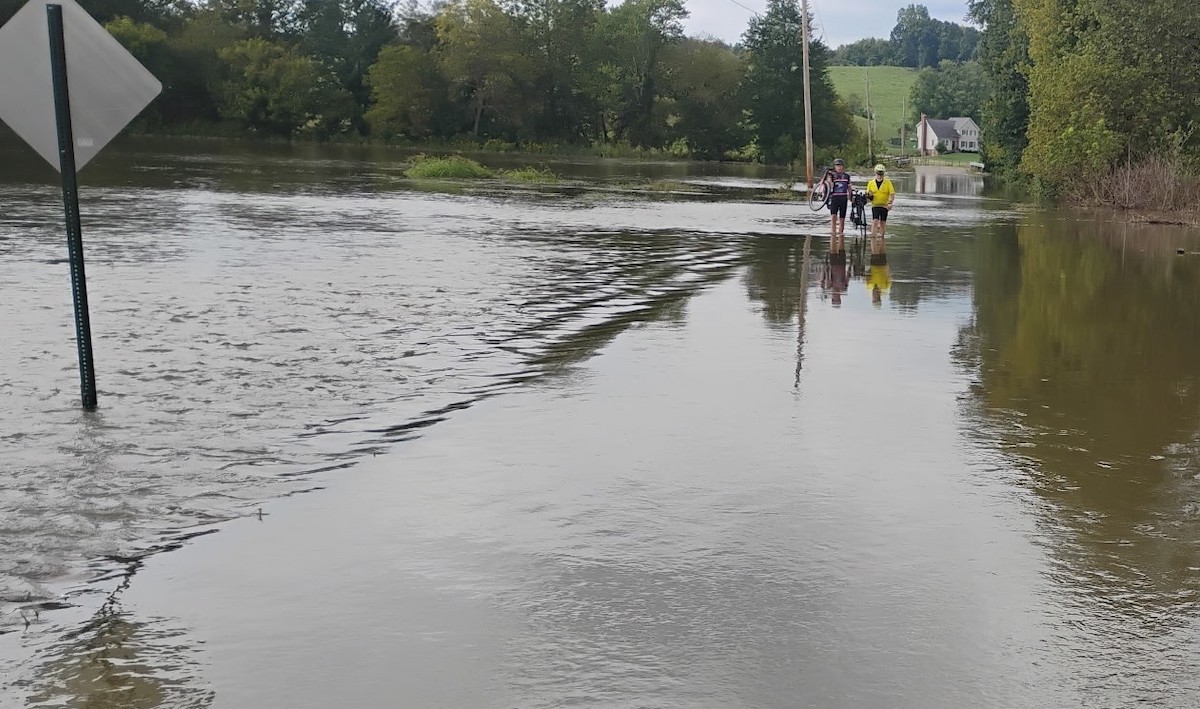
As a case in point, look at this photo below. Do you think these riders had planned to deal with such watery inconvenience when they set out to ride that day? They did not. And I know that because one of the cyclists is me.
Here’s the story: Most Thursdays, I ride with two friends — Rich and Jeff — to a bakery in the hinterlands of rural Jackson County, in southeast Ohio. Rich is linchpin for these rides, and he typically texts Jeff and me on Wednesday, stating a start time for the next morning. But on Wednesday, September 9 of this year, his message said, “Thursday weather not looking good. May need to do bakery ride on Friday.”
As it turned out, Rich’s calm declaration about Thursday’s weather was an understatement.
Indeed, during the wee hours of Thursday morning, eight-to-ten inches of rain fell in a short period of time. It was not a massive, multi-state regional disaster, but rather a highly concentrated, severe localized flash flood event that caused rapid and dramatic rises in small streams and creeks, flooding scattered low ground over a four-county area. But it was a hit-or-miss mess, having little to no effect on higher elevations, but significant overflows in the lower ones, damaging homes and businesses, stranding motorists and making some areas temporarily inaccessible. One road in our town had some significant destruction from a washout. The whole affair, though short-lived, was dubbed “historic” by newscasters who’d consulted the weather records for the area, and long-time residents agreed with that characterization.
None of the flooding touched the areas where Rich, Jeff and I live. And by Friday morning most of the floods had retreated to the streams and creeks, and thus, we three optimists saw no reason not to do our weekly two-wheeled jaunt for a juggernaut. That’s my name for the really big donuts the bakery sells, but on that Friday’s ride, we encountered a juggernaut of a different sort.
We knew that the roads we normally ride to the donut shop have some low spots, but since floods had withdrawn from our home area (Gallia County), we figured the same would be true of adjacent Jackson County.
We were wrong. There’s a choice of three low-traffic roads through a segment of that county we needed to traverse to reach the bakery. A portion of the first one was under a flood that embraced several acres. So we backtracked and tried the second road, only to find it widely flooded as well, as was the third road. Having exhausted the bike-friendly options, we reluctantly reached our destination by pedaling on the state highway, but we didn’t like that experience, where traffic, including large trucks, whizzed by us.
But we had our donuts. And we reasoned that since the flooding in our home area retreated so quickly, it was possible that one of the three preferred roads would now be passable (did I mention we three are optimists?), so on the way home, we tried one. The water was still there. Rich suggested we walk our bikes through, but an employee at a nearby business pointed out that several feet out, the water at that location was waist deep. A motorist stopped us before we got to the second road and warned us of how badly that road was still flooded.
So we headed for the third option, where we also found water across the road for several hundred yards, But at this location, the water did not appear to be very deep. We could see the road surface through the water and decided we could walk through with our bikes. So we did that, suffering no consequences other than wet shoes and well-washed bike tires.
But what we hadn’t seen from where we entered the water was that the dry road on the other side of this pool was merely an “island” that led us around a corner to where a faster flowing, deeper and wider deluge awaited us. So now our choice was to retrace our steps back through the water we’d already crossed or, like the Israelites on the shore of the Red Sea, push on through the watery expanse ahead of us.
Though we had no Moses to part the waters, we chose to do the latter.
Rich and Jeff ride regular lightweight road bikes, so they hefted them onto their shoulders and stepped into the water. My road bike, however, is an ebike version, and with the added weight of the motor and the primary and range-extender batteries, it was not feasible for me to shoulder it. But here, the water was deep enough that the mid-drive motor, positioned near the bottom bracket, would have been submerged, which didn’t sound like a good idea for an electric device. So I picked up the bike’s front end, and rolled it along on its back wheel. But this was an awkward maneuver, made even more precarious by the strength of the current rushing across the road. But then Rich, seeing my dilemma, used his free hand to hoist the back of my bike and help me carry it as we plodded through the flood.
When Jeff, who was in the lead, reached the dry road on the other side of this pool, he looked back, saw Rich and I with both bikes, and snapped the picture.
After all three of us were finally riding on dry pavement again, Jeff commented, “Well, we’ve had an adventure.”
Chesterton’s comment about an inconvenience rightly considered shot through my mind, leading me to reply, “So it seems, now that it’s over.”
Stan Purdum has ridden several long-distance bike trips, including an across-America ride recounted in his book Roll Around Heaven All Day, and a trek on U.S. 62, from Niagara Falls, New York, to El Paso, Texas, the subject of his book Playing in Traffic. Stan, a freelance writer and editor, lives in Ohio. See more at www.StanPurdum.com.