
Continental Joins the Trend, Adds TPU Bicycle Tubes

by Lars Hundley
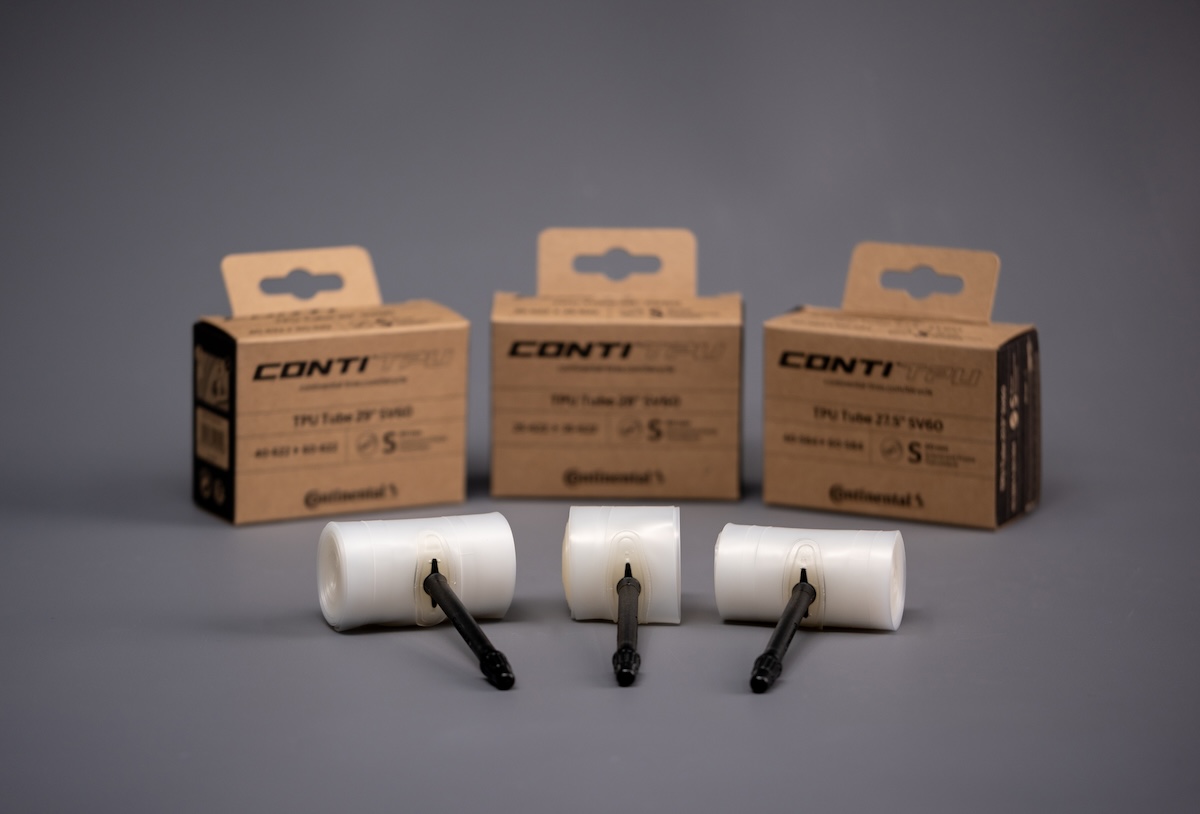
Continental has launched ContiTPU, a made in Germany TPU inner tube designed for road, gravel, and mountain bike riders. The ContiTPU inner tube is the latest addition to Continental’s product range, offering cyclists a new lightweight and durable tube option for their rides.
The ContiTPU inner tube is constructed using seven sealed layers of high-grade, micrometer-thick thermoplastic polyurethane (TPU). This multi-layer design ensures maximum airtightness and durability, making it suitable for both on and off-road cycling. The tubes are left uncolored to maintain the highest material quality and prevent air retention issues that may arise from dye-related surface imperfections.
One of the key features of the ContiTPU inner tube is its lightweight construction. The 700c x 25-35mm size weighs just 35 grams, while the 700c x 40-60mm and 650B/27.5″ x 40-60mm sizes weigh 45 grams and 43 grams, respectively. This lightweight design, combined with the tube’s low rolling resistance, makes it an attractive option for performance-focused cyclists looking to reduce weight and improve their ride efficiency.
The ContiTPU inner tube also boasts a small pack size, making it easy for cyclists to carry a spare tube on long rides without compromising storage space. Each pack includes a repair patch for quick fixes on the go.
Continental has designed the valve base to be slightly conical in shape, improving the fit to the wheel rim and reducing unwanted movement. The valve is internally threaded, allowing for the use of valve extensions or replacement valve cores when needed.
It is important to note that TPU tubes should never be used with rim brakes, as excessive heat exposure can lead to sudden air pressure loss. Cyclists should also use suitable rim tape to protect the TPU tube from damage and ensure the valve hole in the rim is the correct diameter to prevent the valve from twisting or shearing off. When mounting the tube, it should not be inflated over 4 psi until it’s completely inside the tire and on the rim, as over-inflation during this process can stretch the tube excessively, rendering it unusable. Lastly, TPU tubes should not be re-used with smaller tires; if mounting a smaller tire, a new tube must be used.
TPU Tubes, What’s the Difference? An Overview of Tube Types
- TPU tubes: Made from thermoplastic polyurethane, TPU tubes are the lightest option among the three types. They are more compact than butyl tubes and offer excellent puncture resistance. TPU tubes can be repaired easily and have lower rolling resistance, which can improve ride efficiency. However, they are generally more expensive than butyl tubes.
- Butyl tubes: These are the most common type of bicycle tubes, made from synthetic rubber. They are relatively inexpensive, durable, and have good air retention properties. However, they are heavier than TPU and latex tubes.
- Latex tubes: Latex tubes are lighter than butyl tubes but slightly heavier than TPU tubes. They offer low rolling resistance and are often favored by professional and competitive cyclists. However, latex tubes have a shorter lifespan, require more frequent inflation, and are more susceptible to punctures compared to butyl and TPU tubes.
Continental’s entry into the TPU tube market signifies the growing popularity and demand for TPU tubes among cyclists. Brands like Pirelli and Tubolito have already introduced their own TPU tube offerings, which are known for their lightweight, durable, and compact design. One notable aspect of Continental’s ContiTPU tubes is that they are manufactured entirely in Germany, including the sourcing of raw materials. This commitment to local production sets Continental apart from some of its competitors and may appeal to cyclists who value products made in Europe.
The ContiTPU inner tubes are available in a wide range of sizes, including options for 700c (ISO 622) and 650B/27.5″ (ISO 584) wheels, which are commonly used on road, gravel, and mountain bikes. With its combination of lightweight construction, durability, and small pack size, the ContiTPU inner tube is an excellent choice for cyclists of all disciplines looking to optimize their ride experience.


Both Pirelli and Rene Herse have TPU tubes that are OK to use with rim brakes.
Indications are that Tubolito TPU tubes are acceptable for rim brakes.
As do Tubolito, Schwalbe, RideNow, etc., etc. Not sure where the statement that “TPU tubes should never be used with rim brakes” came from.
After further research, I see that the statement “TPU tubes must never be used in conjunction with rim brakes” comes directly from Continental’s website. So I guess I will have to stick with the brands that have tested and approved their TPU tubes for rime brakes. That’s a shame, since I have always had excellent experience with Continental’s tires and tubes.
Yes, it was recommended directly by Continental.
I suspect the issue is that TPU tubes can melt and go flat if the rims get too hot and Continental is just being more careful about it than the other brands.
According to Jan Heine TPU tubes have a higher melting point than butyl tubes.
https://www.renehersecycles.com/tpu-tubes-are-here/
However, some TPU tubes from other companies are clearly marked not for use with rim brakes so there must be something to the heat build up.
Ik heb op een mountainbike met velgremmen meegemaakt dat zelfs een butyl binnenband klapte na een lange afdaling in Zwitserland. Gelukkig kwam ik op dat moment nét het dal binnenrijden. Toen ik direct een nieuwe binnenband wilde monteren, liet ik het achterwiel héél snel los. Niet omdat die warm was, nee die was bloedheet. Velgtemperatuur kan bij velgremmen onder bijzondere omstandigheden hoog oplopen. ‘
Niet onderschatten. Je leven kan ervan afhangen!
It’d be nice to have a more full analysis of price and environmental impact, things that are important to many of us.
Overall, a very informative article, including the 650B sizes also available.
However, the claimed unsuitability of usage with rim brakes begs some harsh questioning.
I say claimed, vs stated, as I think Conti’ is claiming it purely out of liability reasons.
I did some quick searching and found this:
https://www.magene.com/blog/exar-tpu-ultralight-inner-tube.html
It’s got some pretty good test data including temperature tests for bikes stowed inside very hot cars, as well as rim brake testing to extreme temperatures.
The results are very counter to Conti’s caution, while also fitting in with the other manufacture’s data and positions.
So I have no concern about putting TPU inners on my rim braked wheel set.
Having said that, if I lived in an area with thousands of feet of steep descents that I’d want to torch down and use extreme brake loadings for turns, I’d be putting a 160 mm front disc set up on my bike – more so for the added braking power and fade resistance than anything else.