
“Bike Boxes” Boost Cyclist Safety at Urban Intersections

by Lars Hundley
As the number of cyclists killed in collisions with motor vehicles continues to rise, researchers from Oregon State University College of Engineering have found that “bike boxes” can significantly improve safety for cyclists at urban, signalized intersections. The study, published in Accident Analysis & Prevention, highlights the importance of such safety measures, given that nearly half of all bicycle-car crashes occur at intersections.
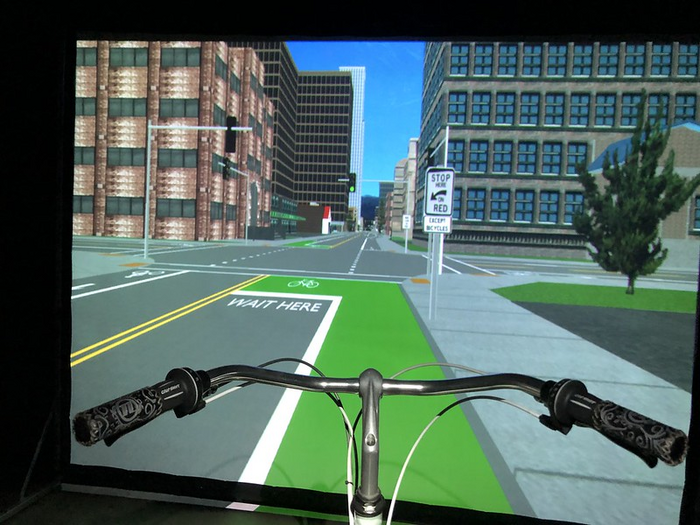
Depiction of a bike box. Image provided by David Hurwitz.
In 2020, 932 bicyclists in the United States were killed in collisions with motor vehicles, marking an 8.9% increase from the 856 fatalities in 2019, according to the National Highway Traffic Safety Administration. Furthermore, the National Safety Council reported a 44% increase in deaths from bicycle transportation incidents over the past decade.
Led by David Hurwitz, a transportation engineering professor at Oregon State, and Logan Scott-Deeter, a civil engineering graduate research assistant, the study examined the safety enhancement abilities of three types of intersection treatments – mixing zones, bicycle signals, and bike boxes.
Bike boxes are painted-off areas at the front of an intersection that hold cars back, allowing cyclists in the bike lane to have a head start through the intersection and become more visible to motorists. After testing the three treatments on 40 research subjects using a bicycling simulator, the researchers concluded that the bike box was the most versatile option.
Hurwitz explained, “Time-space measurements showed that the mixing zone treatment correlated with the most unpredictable riding behaviors. With a bicycle signal, analysis of the participants’ eye movements revealed a lower rate of detecting a potential conflict vehicle. The bike box proved the most effective treatment for encouraging safe riding habits while also providing enhanced safety for bicyclists at signalized intersections.”
The study was supported by the Oregon Department of Transportation and based on research for ODOT’s Impacts of Intersection Treatments and Traffic Characteristics on Bicyclist Safety report.