
Heading off embedded foreign objects in your bike tires

By Stan Purdum
While pedaling through a small town one day, my rear tire went flat. I was particularly annoyed by this because the same tire had flatted the previous day while riding out in the county. There, I had to replace the tube while kneeling at the side of the road — not an ideal setting for careful inspection of the tire, but I took the time to look it over, inside and out, and even ran my bare fingers inside the casing, but found nothing that would account for the sudden loss of air. Even trying to match the location of the hole in the tube with one in the tire yielded nothing. Finally, assuming the flat must have been caused by an in-and-out puncture, I inserted a new tube, remounted the wheel on the bike and continued on my way.
But now, here I was, the very next day, with the same tire flat again, and I now suspected that there was something embedded in the tire that I had missed. As luck would have it, however, I was only about a block from a bicycle shop, so I dismounted and walked the bike to the shop. Although the offending tire wasn’t that old, I was disgusted enough with it that I purchased a new one. When I did, the shop mechanic offered to mount it at no cost, so I agreed. When he was done, I told him to discard the old tire, but as he was walking with it toward the trash barrel, he ran his fingers inside it and then stopped, turned the tire inside out and showed me where a tiny stone was poking through the casing.
That was the moment when I should have decided to henceforth do some careful inspection of my tires between rides. Instead, I decided that the embedded stone was just a fluke, and I dismissed the resolve to do frequent tire inspections.
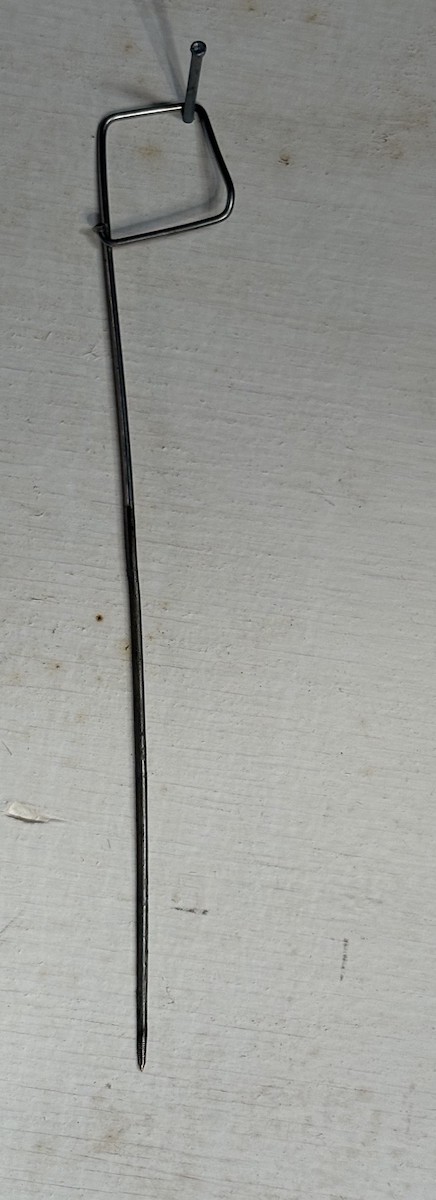
I am older and wiser now, and while I’ve not had a lot of flats, there’ve been enough that I eventually developed a routine for checking my tires often. I even created a tool to help me. Here’s my procedure:
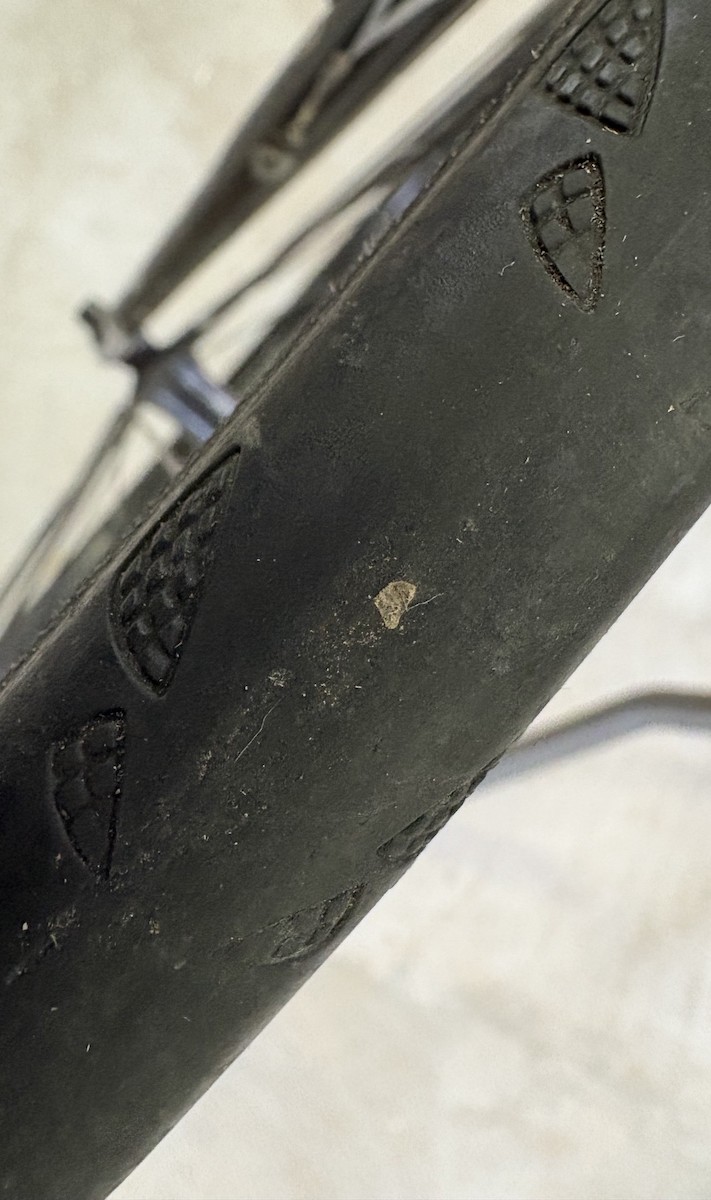
I lift my steed onto my bike repair stand and wipe both tires with a wet cloth to remove any loose bits of junk and dirt that would make embedded material difficult to spot. I’m convinced that even that wipe down removes small objects that could eventually burrow deeper if not removed.
Next, I use a flashlight to examine the rolling surface of each tire as I slowly spin it. Much of the time, I find nothing, but occasionally, I spy a tiny speck or two, usually visible because it’s some color other than the black of the tire’s rubber. Sometimes I can dislodge these with my fingernail. But if that doesn’t work, I turn to a tool I call a tire pick, which I made from an old spoke.
Using my workbench vice, I bent the hook end of the spoke into a square to be a handle, and used a grinder to sharpen the other end to fine point.
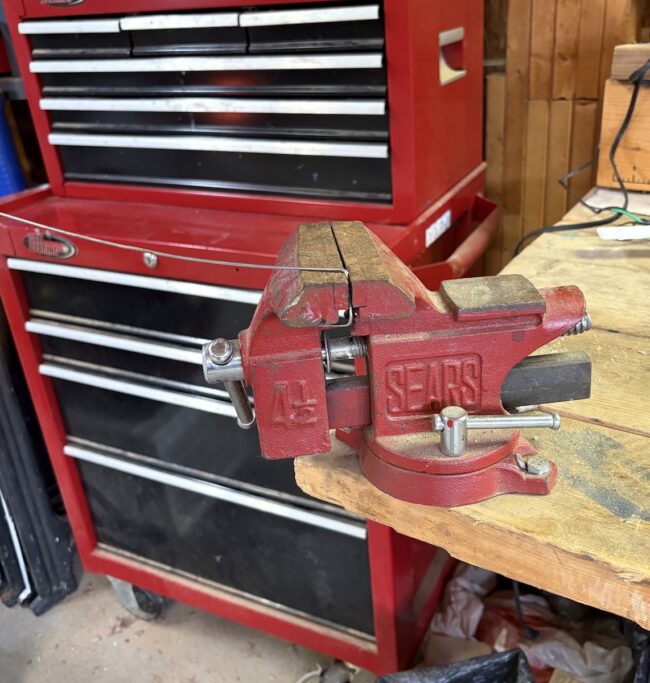
When I find a foreign object embedded in a tire, I use the pointed end of the tool to pick under the edge of the object and flick it out without spearing deep into the tire.
The whole inspection routine takes no more than about 15 minutes.
I made the pick expressly for this purpose, but now that I have it, I also find it useful for other bike work — such as clearing greasy build up between chain links or scraping dirt out of moving parts of a derailleur.
By the way, if you decide to make a tire pick for yourself, you might want to make two of them. I borrowed mine so often from my bike tool box to use in repair projects around the house that I finally made a second one to keep in my household tool box full time.
Stan Purdum has ridden several long-distance bike trips, including an across-America ride recounted in his book Roll Around Heaven All Day, and a trek on U.S. 62, from Niagara Falls, New York, to El Paso, Texas, the subject of his book Playing in Traffic. Stan, a freelance writer and editor, lives in Ohio. See more at www.StanPurdum.com.