A Mountain Bike Invention Finds a Place on My Road Bike

By Stan Purdum
Although dropper seat posts were created for the mountain bike world, where riders want the seat fully up for uphill pedaling, and down out of the way for rapid descending over rugged terrain (as explained in this YouTube video), I recently added a dropper to my road bike for a completely different reason: to make it easier to mount and dismount.
I’m 81, but I feel great riding, and it seems that my balance on the bike is as good as it ever was. But I’ve found that mounting and especially dismounting require me to pay more attention.
The difficulty is probably related to aging or to the fact that I had a total replacement of my right knee three years ago, or perhaps to a combination of the two. The surgery was successful and I can walk, pedal, stoop, climb stairs and ladders and do most other everyday maneuvers just fine (though to extend the life of my knees, I choose not to run or jump anymore). But I have noticed that when stepping into my shorts and trousers, I don’t lift my right leg quite as high as I do my left leg, which still has the knee I was born with. The difference is only marginal, but it may be a contributing factor.
Whatever the reason, climbing off my bike is harder than it used to be, especially when on an uneven surface. I fell once while dismounting, and though I was unharmed, I took that as fair warning. In some scenarios, I’ve had to lay my bike completely on the ground on its left side and then step out of the frame, which, when fully on its side, is a trip hazard.
So I’ve had a dropper post installed on my road bike, and it makes both mounting and dismounting easier.
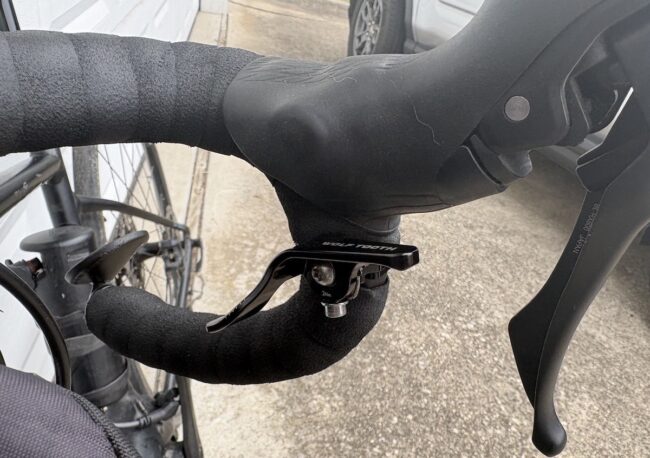
I operate the post by means of a handlebar lever. Because of the mountain bike market for droppers, the levers commonly available are for flat handlebars, but my local bike shop, which did the dropper installation for me, found a lever made expressly for drop bars, and it is fitted in the crook of the bar. I have mine in the left bend, but it can be located in either one.
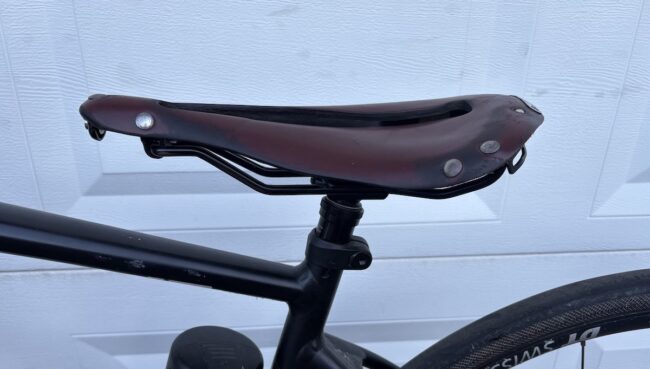
As I am coming to a stop where I intend to dismount, I simply use the lever to lower the seat, which moves down smoothly under the weight of my body rather than dropping suddenly — and it does not drop without weight on it. Like most modern dropper posts, mine is “infinitely adjustable,” which means you can hold down the lever and sit lightly on the saddle until it reaches your preferred height, and then release the lever to lock it in place. In my case, however, I want it all the way down to dismount.
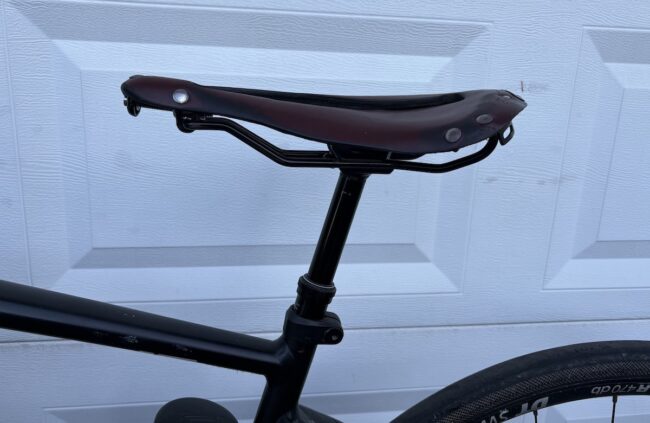
When in the up position, my seat is elevated 4¾ inches above the collar of my seat tube. The dropper post has its own collar, which occupies slightly over an inch of that space, but I am still able to lower my seat 3⅜ inches, which is enough to get it out of the way for when I swing my right leg over the frame when mounting and dismounting.
For now, at least, I don’t always bother lowering the seat to mount, as dismounting is more my problem.
If I am going to be off the bike for only a few minutes, I sometimes leave the seat in the down position until I remount, when another flick of the lever brings the seat back up to full height. If I am going to be off the bike longer, I put the post back in the up position, as it is not recommended to store the bike with the seat down. That’s because the down position puts more stress on the internal seals. When off the bike, it’s easy enough to simply click the lever and lean on the seat to push it back down to remount if I need to do so.
I’ve had to develop the habit of dropping the seat while preparing to stop to dismount. If you stop first, it’s still possible to drop the seat by leaning on it while operating the lever, but that’s awkward while you are still straddling the top tube.
Dropper posts provide other benefits some road riders may appreciate. If you drop the seat while descending, you have a lower center of gravity, making cornering at speed safer, and you are also more aero, all facts that at least one professional road racer took advantage of to win a race, as shown here. I’m not seeking more speed, but I like understanding the possible advantages of anything I add to my bike.
For the record, my road bike is an ebike, but the “e” part of the bike has nothing to do with my need for the dropper post. It did, however, have a bearing on why I chose to have the bike shop do the installation instead of attempting it myself. There’s an internal routing for the cable that connects the lever and the post, and since my ebike has a mid-drive motor, that had to be removed temporarily to complete the connection.
So here’s a shout-out to Jeff’s Bike Shop in Huntington, WV. I’m relatively short to begin with, and my inseam is only 29 inches, so Jeff had to do some searching to find a dropper that would work with my setup, and as already mentioned, he located the drop bar lever and did the installation on my requested schedule.
Here are the specs and costs:
Post: OneUp V3 Dropper Post, diameter: 27.2 mm, travel: 90 mm short (other sizes available). $270
(Dropper posts can only be used on bikes that accept round seat posts.)
Lever: Wolf Tooth Remote Drop Bar Dropper. $65
Shift cable and housing: supplied by the shop
Total cost, including bike shop installation: about $450
Weight gain: The dropper post for my size weighs 11.46 ounces, the lever weighs 1.3 ounces, and the cable and housing about 1.5 ounces, for a total of 14.26 ounces. But when I subtract the weight of my original carbon seat post (about 7 ounces), the weight gain is about 7 to 8 ounces.
More information about dropper posts can be found here on Reddit, in the entry headed “Dropper Posts – Everything you need to know!” It’s written for mountain bike riders, but there’s enough overlap to make its information useful for anyone considering a dropper post.
This video shows how to do a simple routine lube of the post:
This video shows how to do a more extensive lube for occasional servicing:
Stan Purdum has ridden several long-distance bike trips, including an across-America ride recounted in his book Roll Around Heaven All Day, and a trek on U.S. 62, from Niagara Falls, New York, to El Paso, Texas, the subject of his book Playing in Traffic. Stan, a freelance writer and editor, lives in Ohio. See more at www.StanPurdum.com.