
1X vs. 2X Drivetrain Comparison Follow-Up

Jim’s Tech Talk
By Jim Langley
Thanks everyone for sharing your thoughts and preferences in comments regarding “1X” and “2X” drivetrains (say “one by” and “two by”), which was the subject of last week’s column: Should You Consider a 1X Drivetrain on Your Next Road Bike?
Within the comments were a couple that are worth discussing a little more, which we’ll do here.
First, a reader named Gary M. Keene called us out for just saying that “a 1X bike might not be much lighter at all from a 2X bike.” We said that, because the companies and influencers pushing 1Xs typically claim significant weight savings when you go to 1X. Gary asked why we didn’t give actual weights of the components.
The answer is that, the only way to get those weights is to weigh the components ourselves and that’s not possible without already owning or buying them (which we don’t and can’t). So Gary, the best we can do is to compare the claimed weights given by SRAM. Here we go…
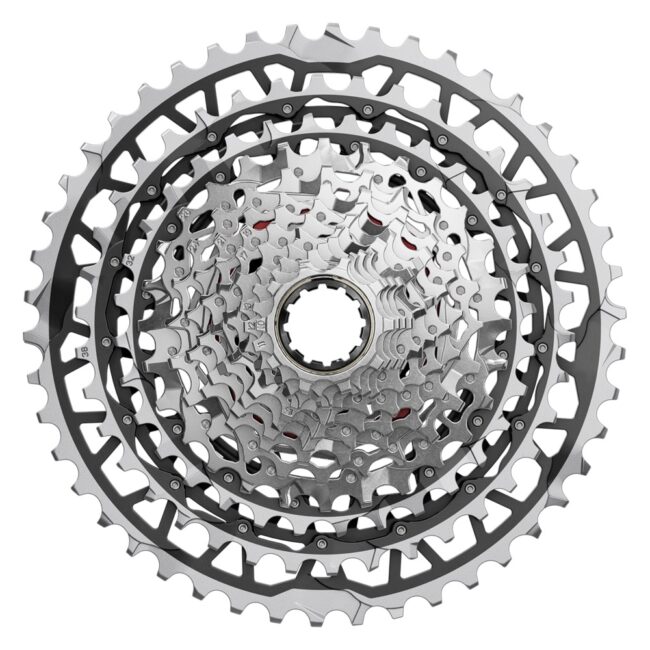
1X SRAM Force XPLR AXS
10-46 13-speed cassette with 1X crankset with 48 tooth chainring
Cassette: 346 grams
Crankset: 565 grams
Bottom bracket: same
Rear derailleur: 418 grams
Chain: 244 grams
Lever: same
TOTAL: 1,573 grams
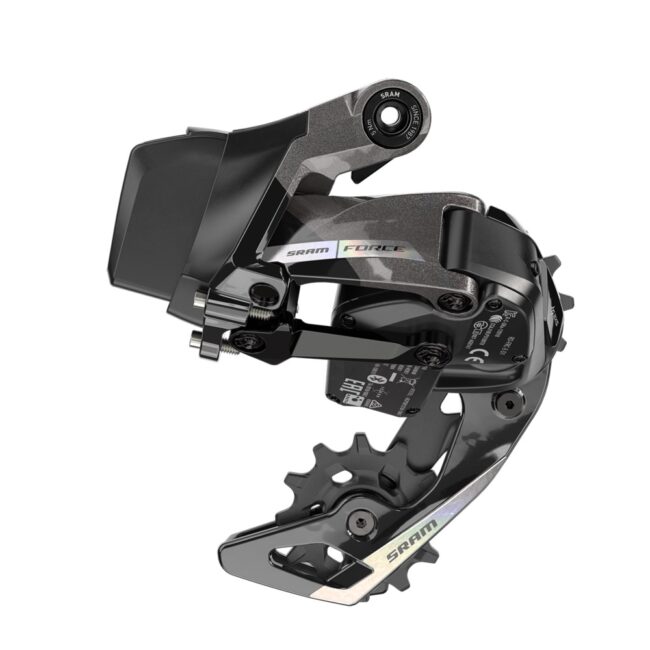
2X SRAM Force AXS
10-33 12-speed cassette with 2X crankset with 35/48 chainrings
Cassette: 266 grams
Crankset: 720 grams (no power meter)
Bottom bracket: same
Rear derailleur: 284 grams
Chain: 180 grams
Lever: same
Front derailleur: 209 grams (including battery)
TOTAL: 1,659 grams
Based on these SRAM numbers – as best we could track them down and trying our best to match components (chains vary a lot), the SRAM 1X drivetrain beats the 2X by 86 grams (or 3.034 ounces). The most remarkable comparison in our opinion is the weight of the 13-cog 10-46 cassette only weighing 80 grams more than the 10-33 12-cog, which is hard to believe looking at the giant 13-cog cassette.
Then, the other comment came from “Herbert” in Germany, who wished we had included a column in our gear chart in metric units. I had to look up how to convert them, and found this on Wikipedia: “To convert gear inches to metric units (known as metres of development or rollout distance), multiply the gear-inch value by pi (π ≈ 3.1416) and 0.0254 (the conversion factor from inches to meters).” I’ll let anyone interested in the metric units do the math themselves.
Or maybe you’ll be able to use the reference Herbert also provided in his comment: “I’d like to point out this excellent graph showing ‘gearing’ and allowing comparisons: https://ritzelrechner.de.”
Thanks for the comments Gary and Herbert and everyone else! And, as my late colleague at Bicycling Magazine, Frank Berto – a bicycle gearing specialist – used to sign off, “gears to you!”
Jim Langley is RBR’s Technical Editor. A pro mechanic & cycling writer for more than 40 years, he’s the author of Your Home Bicycle Workshop in the RBR eBookstore. Tune in to Jim’s popular YouTube channel for wheel building & bike repair how-to’s. Jim’s also known for his cycling streak that ended in February 2022 with a total of 10,269 consecutive daily rides (28 years, 1 month and 11 days of never missing a ride). Click to read Jim’s full bio.